CLINICAL & INDUSTRIAL EXPERT VALIDATION
Architecture Choice for an
Industrial Wastewater-Recovery System
THE DECISION
Which recovery-system architecture should be taken into a site feasibility study, and which operating conditions could make the apparent best option fail?
The Context
A hypothetical specialty-chemicals facility wants to reduce freshwater demand and wastewater discharge by recovering water from a variable process stream. The sponsor has identified several technically plausible architectures, but the site team is concerned that the wrong choice could create an energy, maintenance or concentrate-management problem that simply moves the burden elsewhere.
The engagement is designed to challenge the architecture before a detailed feasibility study. It treats recovery as an operating-system decision, not a single-equipment choice.
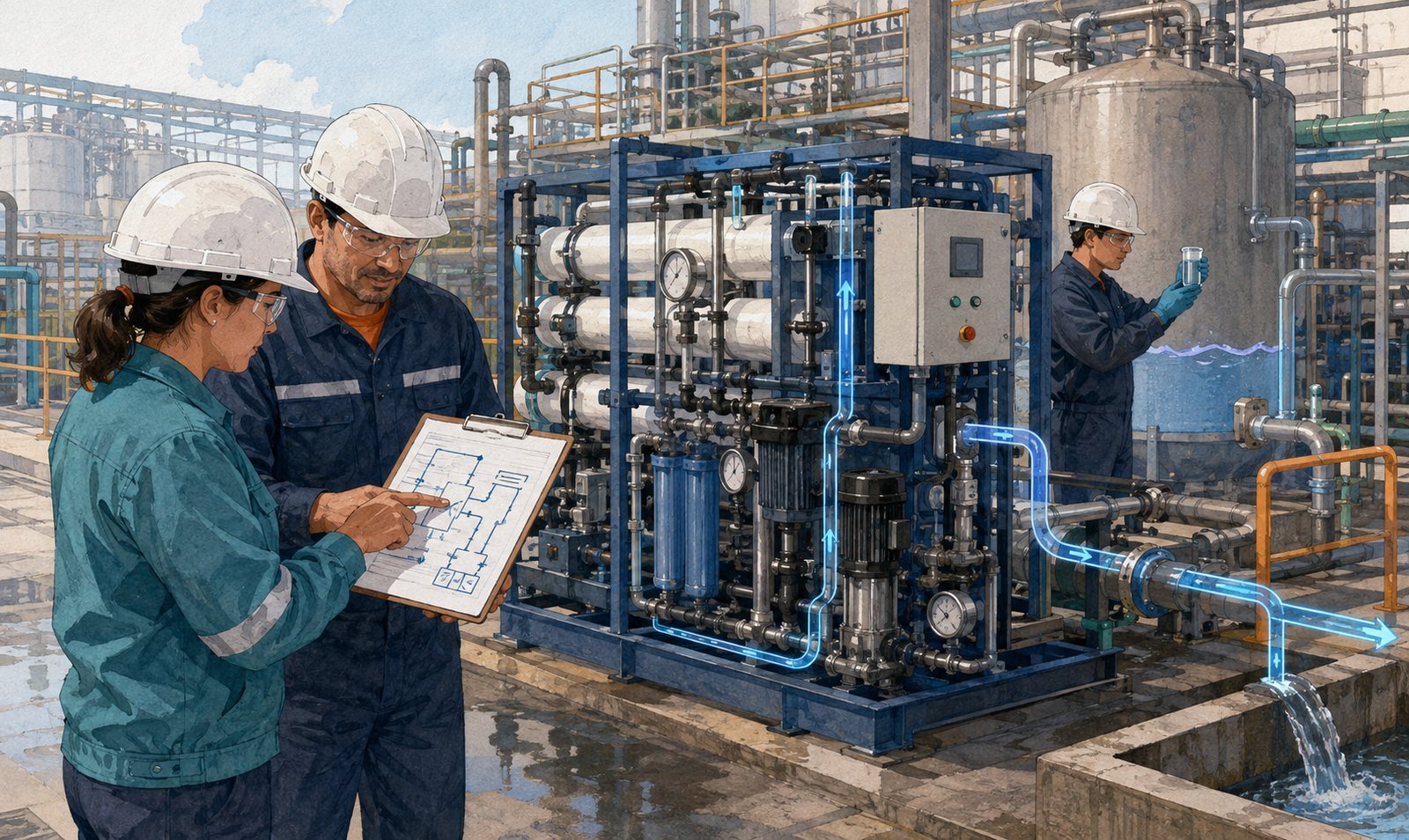
Architecture Choice Board
Three routes are tested against the site realities that usually decide whether a recovery system remains workable after installation.
Site question | Pre-treatment plus membrane | Membrane plus thermal polish | Segregation and reuse loop |
|---|---|---|---|
Influent variability | Moderate tolerance | Lower tolerance | High value if streams can be separated |
Energy exposure | Moderate | Potentially high | Lower if reuse fit is close to source |
Residuals management | Concentrate route required | Concentrate and thermal residuals | Depends on segregation discipline |
Expert Group Chosen for This Decision
The experts are selected around the actual waste stream, site utility constraints and the people who will operate the system. The group is not a generic water-technology panel.
Industrial water-treatment engineer
Tests treatment-train logic, fouling risk, cleaning strategy and performance boundaries.
Plant operations leader
Tests disruption, operator burden, maintenance access, alarms and the handoff between the recovery system and production.
Process integration specialist
Tests utility demand, heat opportunities, reuse location and the risk of solving one constraint by creating another.
Environmental and discharge specialist
Tests residuals, discharge obligations, monitoring questions and how the site should manage non-routine conditions.
Feasibility Gate Sequence
This illustration uses a gate sequence, because the architecture should not advance on a favourable recovery number alone.
GATE 1
Characterise the operating envelope
Capture representative variability, not only an average influent sample.
GATE 2
Define the preferred reuse destination
Confirm the quality requirement, reliability expectation and consequence of a shortfall.
GATE 3
Stress-test residuals and utilities
Quantify the unwanted streams, energy demand and operating dependencies created by each option.
GATE 4
Choose the site-feasibility route
Advance the architecture that best holds together across recovery, reliability and operational responsibility.
Illustrative Site Frame
The figures demonstrate the level of detail that turns a broad water-recovery ambition into a decision that experts can challenge.
45% recovery ambition
Illustrative target for the selected process stream. Experts would test whether it is realistic once variability, cleaning and residuals are included.
2 priority reuse points
Illustrative scope that forces a choice between the quality needs of two plant destinations.
12-month operating profile
Illustrative evidence window used to capture seasonal, maintenance and production-cycle variation before a capital decision.
3 architecture options
Illustrative comparison set. Experts would test whether the alternatives represent materially different operating strategies.
Note: The 45%, two-point, 12-month and three-option figures are illustrative assumptions, not site data or expected outcomes.
Illustrative Output
August Research would provide a Wastewater-Recovery Architecture Brief, setting out the critical operating questions, the architecture trade-offs, the feasibility gates and the evidence needed before a detailed site study.
Note: Findings are illustrative and conditional. They are not presented as real client outcomes.
Let’s Discuss Your Project
If a water-recovery proposition needs to work within real production, utility and discharge constraints, August Research can design an Expert Validation engagement around the architecture decision that matters.