R&D & INNOVATION / SECONDARY RESEARCH
Scientific Literature Review
A decision-specific review of what the scientific and technical evidence actually demonstrates, where it is comparable and where the evidence remains insufficient.
DECISION USE
Test technical assumptions and identify evidence gaps.
EVIDENCE FOCUS
Methods, conditions, outcomes, limitations and transferability.
DELIVERY STYLE
Traceable evidence base and decision-focused synthesis.
When a literature search is not enough
A search can return thousands of papers without answering a product, process or technology question. Studies may use different materials, models, operating conditions, metrics and control methods. A high citation count may reflect scientific interest, not relevance to the application in front of an R&D team.
Scientific Literature Review converts a defined decision into a transparent evidence protocol. It identifies the relevant studies, records how they were selected, extracts comparable technical parameters, examines study limitations and synthesises what the evidence supports, what it does not support and what should be validated next.
Questions this service is designed to answer
TECHNICAL EFFECT
What effect has been observed and by which methods?
CONDITIONS
Under what material, model, process or environmental conditions?
COMPARABILITY
Which studies can be compared directly and which cannot?
CONTRADICTION
Where do findings diverge, and why might that be?
TRANSFERABILITY
How relevant is published evidence to the intended application?
NEXT STEP
What evidence gap needs targeted testing, primary research or monitoring?
How the research is executed
The research starts with a review protocol, not an open-ended collection of sources. The protocol can be adapted to a technical mechanism, material, process, safety endpoint, clinical question or regulatory evidence need, while retaining an auditable route from source to conclusion.
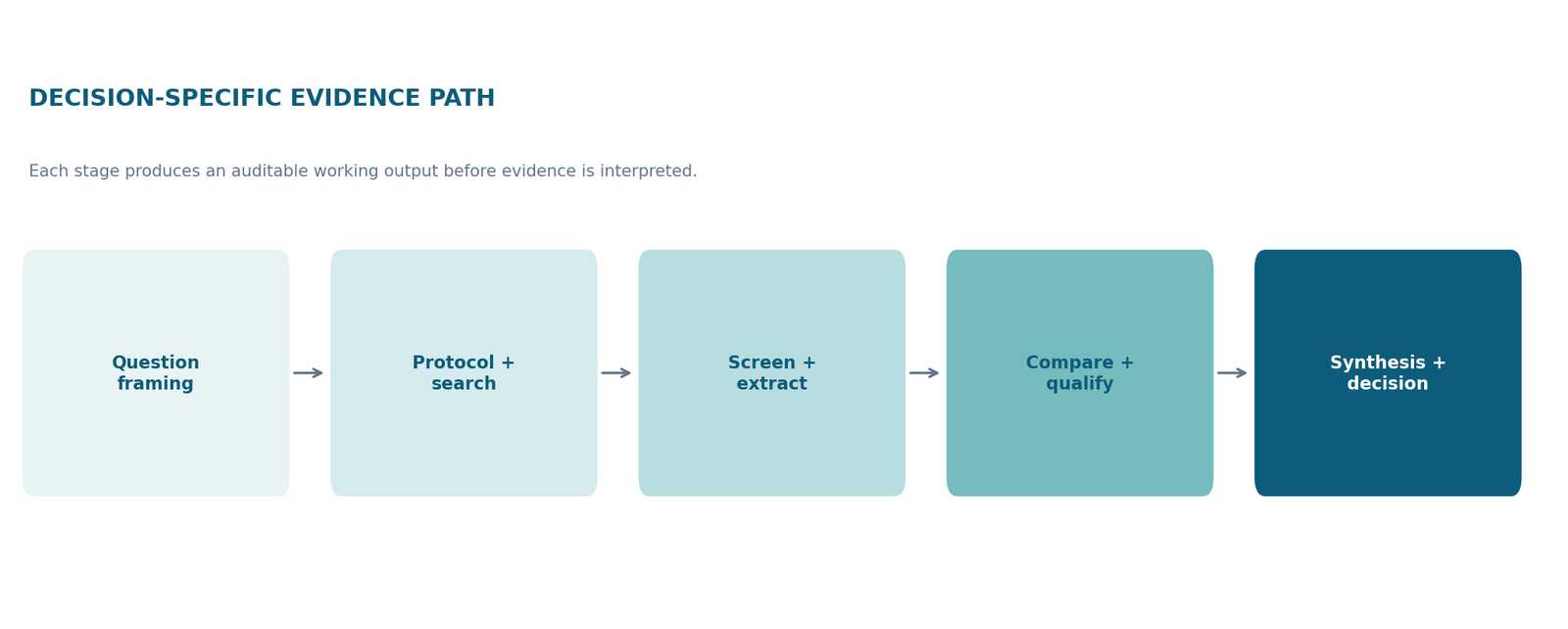
Define the decision, review question, technical boundary, inclusion and exclusion criteria, source types, date range, language coverage and evidence fields.
Build search strings and synonyms, retrieve from relevant scientific and technical sources, and record the search logic and retrieval date.
Remove duplicates, screen titles and abstracts, then assess full texts against the protocol. Record reasons for exclusion at the appropriate stage.
Capture methods, materials, models, operating conditions, endpoints, results, limitations, sponsor or affiliation context and application relevance.
Compare like with like, retain contradictory evidence, assess confidence and translate the evidence into technical implications and focused next questions.
Research access and source architecture
August Research draws on numerous technical, scientific, regulatory, IP and industry sources. The source architecture is selected for the decision, industry, geography and evidence requirement. Access is continuously updated and does not replace source-quality review.
RESEARCH-ACCESS AREA | CONSERVATIVE COVERAGE RANGE |
|---|---|
Technical and scientific databases | 50+ sources |
Patent and IP databases | 20+ sources |
Regulatory and standards sources | 30+ sources |
Industry, company and market-information sources | 40+ sources |
Language coverage through research capability | 15+ languages |
Curated taxonomies and internal evidence libraries | Continuously developed |
IMPORTANT CONTEXT
The table communicates access coverage, not ownership of databases or a promise that every source will be used. The final protocol identifies the sources most appropriate for the scope and documents the evidence limitations.
What clients receive
- A documented review protocol, including the decision question, technical taxonomy, eligibility criteria, source logic and extraction fields.
- A traceable evidence database with retained records, exclusion reasons, source links, technical parameters, study context and confidence notes.
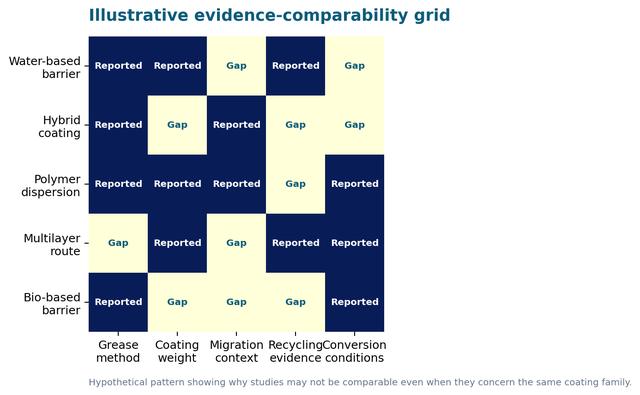
- An evidence-comparison matrix showing where methods, conditions, endpoints and results are directly comparable or materially different.
- A decision synthesis setting out supported findings, contradictions, evidence gaps, transferability limits and recommended next research actions.
Why August Research
Competitor offerings often position literature work as faster search, automated extraction or a general scientific summary. August Research treats the review as a technical decision system. We make the selection criteria, comparison logic and limits of inference visible, so the conclusion can be challenged, reused and updated by the people responsible for R&D decisions.
COMPARABLE, NOT JUST COLLECTED
Evidence is coded against the conditions needed for meaningful comparison.
CONDITIONAL, NOT OVERSTATED
Conflicts, limitations and gaps remain visible rather than being averaged into a generic conclusion.
BUILT FOR THE NEXT DECISION
The output states the specific validation, expert input or further research needed to resolve the important uncertainty.
Scope boundaries
Scientific Literature Review is secondary research. It does not establish a product claim, reproduce laboratory performance, provide a formal systematic review for clinical or regulatory submission, offer legal or regulatory advice, or replace experimental validation. Where relevant, the work can identify the evidence needed for those subsequent activities.
Frequently combined with
- R&D Trend Analysis
- Technology Landscape Analysis
- Patent Landscape Research
- Regulatory & Standards Intelligence
- Technical Documentation Review
Website presentation suggestion
Use a layered evidence path. Selecting each stage opens the protocol, records reviewed and working output from that step. At the end, show a concise “evidence strength and decision implication” panel. On mobile, convert the path into expandable stacked sections, retaining the distinction between study finding, interpretation and next action.
Typical review lenses
MECHANISM + PERFORMANCE
How a material, technology or intervention is reported to work and which performance outcome is observed.
METHOD + CONTEXT
Model, population, substrate, process, dose, operating conditions, endpoint and control strategy.
LIMITATION + TRANSFER
Study limitations, conflicting results, applicability to the target setting and the next evidence need.
Example engagements
These entries can appear as floating clickable placards on the service page. Each opens a detailed Phase 2 example.
INDUSTRY | EXAMPLE ENGAGEMENT | DECISION PREVIEW |
|---|---|---|
Biotech + Pharma | Extrahepatic RNA delivery under repeat-dose constraints | Which lipid, polymer or conjugate studies report comparable tissue targeting, cargo, dosing, biodistribution and safety evidence? |
Medical Devices | Direct-from-blood molecular diagnostics for bloodstream infection | Which platforms demonstrate clinically relevant sample preparation, turnaround, pathogen or resistance detection and intended-use evidence? |
Chemicals + FMCG | PFAS-free barrier coatings for food-contact paper | Which studies report comparable grease resistance, coating weight, migration, recyclability and conversion conditions for the target substrate? |
Mining + Materials | Tailings dewatering additives under variable mineralogy | Which findings remain comparable across ore mineralogy, water chemistry, solids concentration, shear history, dose and filtration response? |
Commercial Vehicles | Immersion-cooled heavy-duty battery packs | Which thermal, fire-propagation, fast-charge, vibration and pack-serviceability studies are relevant to commercial-vehicle duty cycles? |
Note: These are hypothetical engagement concepts for website illustration. They are not client projects or findings. Scope, records, sources, timelines and outputs would depend on the final research question and available evidence.
Frequently asked questions
How is this different from R&D Trend Analysis?
Trend Analysis interprets directional change across multiple event types over time. Scientific Literature Review examines the depth, comparability and limitations of scientific and technical evidence around a defined question.
Can the review include non-English literature?
Yes. The language approach is agreed in the protocol. Search and screening methods are tailored to the importance of the relevant geographies and language sources.
How long can a review take?
A focused review may take approximately three to five weeks. A broad, multi-endpoint or multi-language review may take six to ten weeks. Timing is illustrative and depends on scope and source accessibility.
Let's discuss your technical question
August Research can design a literature review around the evidence your team needs to assess, challenge or apply before making its next technical decision.