AUGUST RESEARCH
Customer Journey Mapping
See how customers progress across channels, teams and handoffs, and which breakdowns change the outcome.
August Research reconstructs a defined customer journey from the customer goal to the final outcome. The research connects customer evidence with operational records and frontline knowledge to show how real pathways differ from the process a company intended to deliver.
THE PATHWAY VIEW
GOAL
What the customer is trying to complete
PATH
The stages, channels and people involved
BREAKPOINT
Where progress slows, splits or stops
RECOVERY
How the customer or company responds
OUTCOME
Completion, delay, abandonment or loyalty
When this service is useful
- The journey crosses several teams. Sales, digital, operations, delivery, service or partners each control only part of the experience.
- Customers complete the same goal differently. Channel, account type, geography or support access produces several valid pathways.
- A visible complaint begins earlier. The stage where dissatisfaction appears may not be the stage where the breakdown originated.
- Improvement priorities are contested. Teams need evidence showing which handoffs materially change effort, completion, retention or recovery.
The deliverable is not a decorative lifecycle map.
It is an evidence based pathway showing how customers progress, where the experience fragments and which intervention is most likely to improve the outcome.
JOURNEY DEFINITION
Map a customer outcome, not an abstract lifecycle
Every engagement begins with a specific goal, a start event and a finish condition that can be recognised in evidence.
START EVENT
The trigger that begins the journey
CUSTOMER
Person, household, account or stakeholder
SCOPE
Market, channel, product and time window
FINISH
The completed or failed outcome
DECISION
What the client must change or prioritise
B2B and B2C journey structures
JOURNEY ELEMENT | B2B | B2C |
|---|---|---|
Customer unit | Account plus connected buyer, user, procurement and implementation pathways | Individual or household journey across purchase, use and service |
Typical structure | Longer cycle, approvals, partners and several decision owners | Shorter or repeated episodes across digital, retail, delivery and support |
Failure pattern | Ownership gaps, approval delay, missing evidence and weak handoffs | Channel changes, repeated information, unclear status and abandonment |
Useful outcome | Onboarding, implementation, renewal, expansion or issue resolution | Purchase, activation, repair, return, recovery or continuation |
Questions the research can answer
- Which paths do successful, delayed, abandoned and dissatisfied customers follow?
- Where do customers repeat information, wait, change channel, improvise or seek outside help?
- Which earlier event causes a later complaint, escalation, cancellation or loss of confidence?
- Which handoff is controlled by the client, a partner, a platform or the customer?
- Which journey improvement should be fixed, redesigned, monitored or validated first?
RESEARCH EXECUTION
Build the journey from several evidence lanes
Customer accounts are essential, but they are combined with operational traces and handoff validation so the map is not based on memory alone.
CUSTOMER EVIDENCE
Journey reconstruction interviews, event diaries, screenshots, messages, receipts, documents and customer supplied artefacts
OPERATIONAL EVIDENCE
CRM stages, service tickets, transaction records, application or web analytics, delivery events and approved call records
HANDOFF EVIDENCE
Frontline interviews, partner or distributor input, process documents, responsibility boundaries and exception handling
How customers are reached
CLIENT ACCESS
Known customers are invited by the client. August Research manages consent, fieldwork and independent moderation.
INDEPENDENT RECRUITMENT
Relevant customers are found through targeted outreach, panels, communities, professional routes or market partners.
HYBRID ACCESS
Client customers are combined with former customers, switchers, non completers or independently recruited comparison groups.
Participant selection follows the pathway
- Outcome contrast. Completed, delayed, abandoned, escalated, recovered, renewed or lapsed journeys are deliberately compared.
- Recent direct involvement. Participants must have experienced the defined journey within the agreed recall period.
- Role and authority. B2B participants are screened for their position in the account journey and the stages they actually influenced.
- Journey conditions. Selection can vary by geography, proximity, channel, account type, product, service access, partner involvement and journey complexity.
- Privacy and sensitivity. Identity, consent, customer relationship, evidence permissions and reporting treatment are agreed before fieldwork.
Field method is selected after scope
Journey reconstruction interview
Rebuild one recent pathway stage by stage using customer evidence and time anchors.
Event diary or journey pulse
Capture a journey that is still unfolding close to each milestone, failure or handoff.
Digital or physical observation
Observe navigation, channel movement, document use, waiting and workaround behaviour.
Operational record linkage
Connect permitted customer accounts with service, transaction, delivery or usage evidence.
Frontline handoff validation
Test where internal or partner responsibility begins, ends and becomes unclear.
Customer workshop validation
Confirm the pathway, test contradictions and examine possible recovery designs with selected customers.
Sample, evidence volume, markets and timing are agreed after access, journey frequency, data permissions, burden and privacy feasibility are confirmed. No fixed count is implied before feasibility.
OUTCOME PATHWAY MAPPING
Reconstruct progress, divergence and recovery
The method follows one customer goal through the real sequence of events and shows where customer action and company delivery stop matching.
01 Set the outcome boundary
Define the start event, customer goal, finish condition, market, pathway variants and business decision.
02 Build outcome groups
Select customers with contrasting completed, delayed, abandoned, escalated or recovered journeys.
03 Capture pathway evidence
Collect stage, channel, action, expectation, evidence, handoff, elapsed time and customer response.
04 Stitch customer and company records
Align customer episodes with permitted operational events while keeping disagreements visible.
05 Locate breakpoint chains
Trace how one missed expectation, ownership gap or channel failure produces later effort and outcome change.
06 Design the intervention sequence
Prioritise fixes, redesigns, measurement points, owners and further validation around the journey outcome.
One evidence record for every stage
STAGE
Where in the journey
ACTION
What the customer did
EXPECTATION
What should happen next
TOUCHPOINT
Channel, person or system
HANDOFF
Who took responsibility
RESPONSE
Wait, repeat, switch or recover
OUTCOME
Effect on progress and confidence
JOURNEY ANALYSIS
Connect the visible problem with the event that created it
A useful journey map explains consequences across stages instead of presenting isolated pain points.
Breakpoint chain
TRIGGER
A journey condition changes
MISSED HANDOFF
Information or ownership fails to transfer
CUSTOMER RESPONSE
The customer waits, repeats or works around
LATER EFFECT
Effort, delay or uncertainty appears elsewhere
OUTCOME
Completion, recovery, abandonment or loss of trust
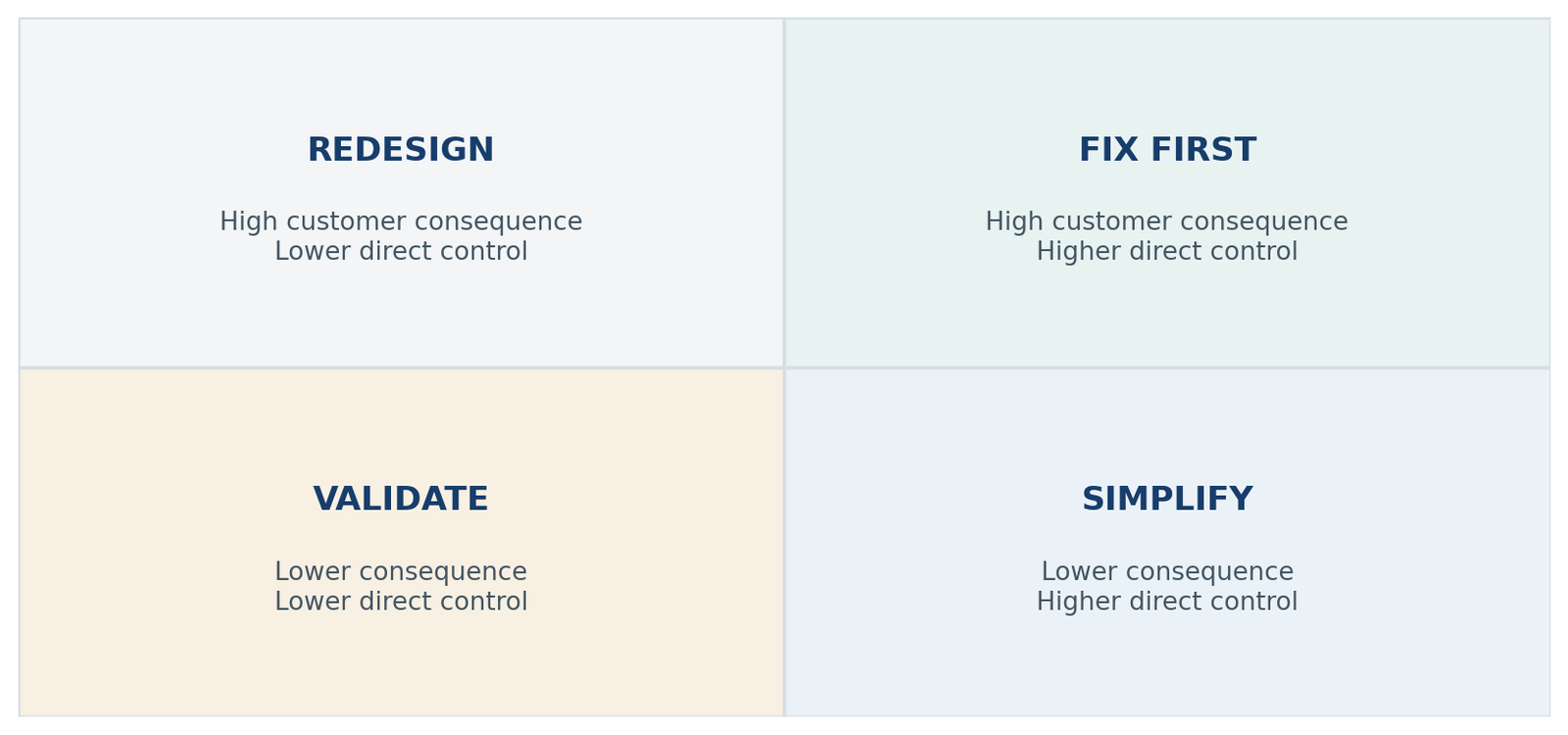
Prioritise what the organisation can change
What clients receive
- Current Journey Pathway. Customer stages, variants, channels, evidence and outcomes.
- Breakpoint and Consequence Register. Initiating event, later effect, customer group, owner and evidence strength.
- Handoff Responsibility Map. Where teams, systems, partners and customers exchange information or control.
- Journey Variation View. Differences by outcome, account type, geography, segment or channel.
- Improvement Portfolio. Fix, redesign, monitoring and validation actions with owners and dependencies.
- Decision Briefing. A management ready PowerPoint readout, evidence database and implementation workshop.
INDEPENDENT PERSPECTIVE
See the experience that no single department owns
External research separates the customer pathway from the organisation chart and tests internal assumptions against customers with different outcomes.
Why use an independent research company
INTERNAL VIEW
Teams often describe the stage they manage, use their own system record and interpret failure through their departmental target.
INDEPENDENT JOURNEY VIEW
Customer evidence is followed across departments, channels and partners so contradictions, missing ownership and downstream consequences remain visible.
- Reduce internal ownership bias. The study does not begin with one team’s process map or preferred explanation.
- Protect customer candour. Customers can discuss delay, confusion, workarounds and switching without turning the conversation into a service escalation.
- Bridge data silos. Customer accounts, operational evidence and frontline knowledge are compared under one journey boundary.
- Challenge the ideal process. The map retains valid pathway variants and exception journeys rather than forcing customers into an assumed funnel.
Why August Research
100+ INFORMATION CHANNELS
Company, market, customer and industry evidence available across the wider research ecosystem
8 INDUSTRY GROUPS
Sector context used to define roles, terminology, journeys and operational boundaries
B2B + B2C
Account, stakeholder, individual and household journey structures designed separately
MULTIPLE ACCESS ROUTES
Client contacts, targeted outreach, panels, communities and market partners
Engagement formats
CURRENT STATE DIAGNOSIS
Reconstruct one journey and identify the breakpoint chains changing its outcome.
FUTURE JOURNEY BLUEPRINT
Use customer and operational evidence to design a more workable pathway and ownership model.
MARKET OR SEGMENT COMPARISON
Compare the same outcome across geographies, account types, channels or customer groups.
JOURNEY MEASUREMENT DESIGN
Define listening points, evidence fields and metrics for the journey after the initial study.
Scope, customer count, operational evidence, markets and timing are agreed after the journey boundary, access routes, data permissions and fieldwork feasibility are confirmed.
ILLUSTRATIVE EXAMPLES
Different journeys require different evidence routes
Each illustration will use its own participant design, outreach, methodology, pathway parameters and visual output according to the customer outcome in scope.
PATH
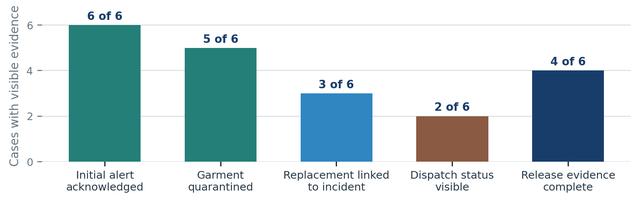
Cleanroom Garment Incident Recovery
How does a pharmaceutical production customer move from a contamination alert to verified garment replacement and restored operating confidence?
Evidence route: case triggered customer interviews, garment and quality records, service handoff validation Decision view: incident recovery pathway and responsibility boundary
PATH
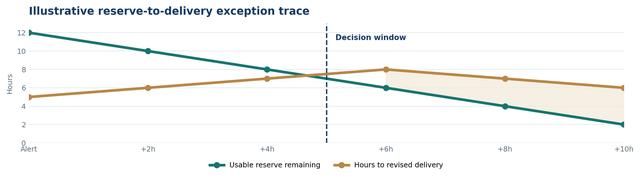
Remote Construction Site Fuel Delivery Exception
Where does a delayed delivery become a site shutdown risk, and which dispatch, driver and site handoffs determine recovery?
Evidence route: dispatch trace, site event diary, message reconstruction and route evidence Decision view: exception escalation and recovery design
PATH
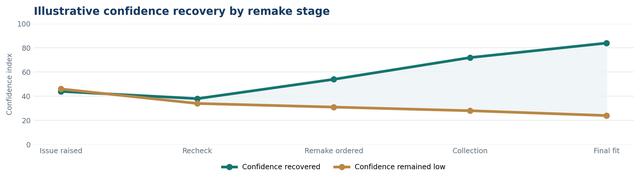
Prescription Eyewear Remake to Final Fit
Why do some customers recover confidence after an incorrect first fit while others abandon the retailer during the remake journey?
Evidence route: customer artefact diary, store visit reconstruction and permitted laboratory or service records Decision view: remake pathway and reassurance moments
PATH
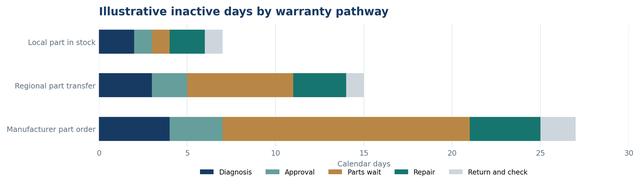
E-bike Warranty Return to Ride
How do fault diagnosis, proof requirements, parts availability and repair updates shape the journey back to safe use?
Evidence route: fault triggered diary, support interaction trace and repair partner handoff review Decision view: trust, status and recovery pathway
PATH
Laboratory Software Migration to First Compliant Report
Which implementation stages and stakeholder handoffs determine whether a laboratory reaches its first accepted report without shadow systems?
Evidence route: multi role journey interviews, implementation records, onboarding observation and document trace Decision view: implementation readiness and adoption blueprint
Each example is illustrative. Final scope, participant groups, evidence access, study scale, outputs and timing would be designed after feasibility and privacy requirements are understood.
FAQ
Customer Journey Mapping questions
The engagement is designed around a customer outcome and the evidence needed to improve it.
QUESTION | ANSWER |
|---|---|
Is this the same as an internal process map? | No. A process map describes how the organisation intends work to move. Customer Journey Mapping reconstructs how customers actually progress across stages, channels, teams and partners. |
Does every project map the full customer lifecycle? | No. A focused outcome such as onboarding, activation, issue resolution, renewal or recovery is usually more useful than an overly broad awareness to advocacy map. |
Can B2B journeys include several stakeholders? | Yes. The account journey can be connected with separate buyer, user, procurement, implementation, service and partner pathways where each role experiences different stages. |
Do customers need to provide documents or screenshots? | Only when relevant, permitted and consented. Interviews can be combined with diaries, artefacts, operational records or observation according to sensitivity and burden. |
Are journey findings statistically representative? | Not automatically. Qualitative pathway evidence is directional. Quantitative validation can be designed separately when the client needs incidence or population estimates. |
Can August Research work with an existing journey map? | Yes. The existing map can be treated as a hypothesis, tested against customer and operational evidence and revised where pathways, handoffs or outcomes differ. |
Contact Us
Discuss your customer journey question
Tell us the customer outcome, audience, journey boundary, markets, channels, available evidence and business decision. August Research will design the customer outreach, operational evidence plan, Outcome Pathway Mapping method and decision outputs around the journey that matters.