
MARKET & BUSINESS INTELLIGENCE | PRIMARY RESEARCH
B2B Buyer Research
Understand the organisation behind the buyer.
THE SERVICE PROMISE August Research shows how organisations recognise a need, involve functions, define evidence, manage disagreement and reach commitment. The result helps commercial teams engage the buying system rather than relying on one visible contact.
One opportunity can contain several different decisions
A user may be deciding whether the offer solves a workflow problem. IT may be deciding whether it can be supported. Procurement may be deciding whether the supplier can be contracted. An executive sponsor may be deciding whether the change is important enough to fund. B2B Buyer Research examines how these decisions connect inside the buying organisation.
ORGANISATIONAL CONTEXT
The trigger, budget route, operating conditions and risk surrounding the purchase.
BUYING-GROUP DYNAMICS
The roles, mandates, disagreements, evidence needs and veto rights involved.
SUPPLIER ACCESS
Where buyers seek information, admit suppliers and require human or digital support.
Why independent buyer research matters
Sales teams commonly hear the sponsor's version of the opportunity. Independent interviews can also reach users, technical reviewers, procurement, finance, rejectors and organisations that chose no supplier. Participants can discuss internal conflict, vendor weaknesses and informal workarounds without protecting an active sales relationship.
02 | COMMERCIAL DECISIONS
Start with what the client needs to change
The research question determines which buying organisations, roles and evidence should be included.
Decisions this service can support
MARKET ENTRY Identify how unfamiliar buyers define the category, which roles become involved and what a new supplier must prove.
GO-TO-MARKET DESIGN Choose the right combination of digital information, specialist selling, partners, trials and procurement support.
ACCOUNT DEVELOPMENT Understand which additional roles and conditions shape expansion, standardisation or multi-site adoption.
OFFER AND EVIDENCE Align the proposition, demonstration, business case and implementation proof with the people who must carry the decision.
SALES AND MARKETING ALIGNMENT Show where demand creation, seller engagement and buying-group enablement must connect.
NO-DECISION REDUCTION Find which internal condition prevents commitment even when buyers recognise the problem and like the offer.
Questions B2B Buyer Research can answer
NEED
What makes the organisation act now rather than tolerate the existing condition?
PEOPLE
Which roles enter, when do they enter and what are they responsible for defending?
EVIDENCE
What information is trusted, forwarded, challenged or judged insufficient?
CONSENSUS
Where do functions disagree, who can stop progress and what creates internal confidence?
ACCESS
Which digital, human, partner and procurement routes are available to suppliers?
COMMITMENT
What must be true before budget, contract and implementation approval become possible?
03 | PARTICIPANT ARCHITECTURE
Build the sample around the buying system
Job title alone does not establish influence. Selection follows the participant's actual mandate in the buying situation.
The buying-group constellation
NEED INITIATOR
Recognises the problem or opportunity
ECONOMIC SPONSOR
Connects the purchase to organisational priority
USER OR OPERATOR
Lives with the workflow and implementation
TECHNICAL OR QUALITY GATE
Tests fit, control, evidence and supportability
BUYING SITUATION
The organisation, category, trigger and commitment at the centre of the sample
PROCUREMENT
Shapes route, competition, terms and supplier approval
FINANCE
Tests funding, value logic and exposure
IMPLEMENTATION OWNER
Carries change, integration and adoption risk
ADVISER OR CHANNEL
Influences requirements or supplier access
How participants are selected
ORGANISATION FIT Industry, size, ownership, operating model, technology environment, procurement structure and buying situation.
DECISION INVOLVEMENT Direct contribution to need definition, requirements, evaluation, approval, implementation or supplier management.
PURCHASE CONTEXT New category, replacement, expansion, standardisation, mandated procurement, renewal or no-decision.
RECENCY AND STAGE A recent completed decision or an active stage that can be described with sufficient detail.
EVIDENCE ACCESS Ability to explain the information reviewed, alternatives considered and internal conditions affecting progress.
04 | OUTREACH AND FIELDWORK
Reach beyond the contact already known to sales
Outreach is assembled around the scarcity of the role, the sensitivity of the relationship and the evidence the study requires.
How outreach is carried out
1 DEFINE ACCOUNT CELLS Specify the organisation types and buying situations required. A list of senior job titles is not a sample plan.
2 COMBINE ACCESS ROUTES Use client-approved accounts, independent B2B recruitment, verified professional panels or communities, association and channel routes, targeted identification and market-specific partners.
3 ISSUE NEUTRAL INVITATIONS Describe the category and research purpose without revealing a preferred answer or turning participation into a seller introduction.
4 SCREEN FOR REAL INVOLVEMENT Confirm organisation fit, decision stage, role, recency, alternatives and the participant's direct contribution before scheduling.
5 EXPAND WITH PERMISSION Where account-level research is required, ask participants to identify other decision roles. Independent verification prevents one sponsor from defining the entire committee.
6 CONTROL AND DOCUMENT Track cell coverage, role balance, failed outreach, replacements, conflicts, evidence permissions and reasons for exclusion throughout fieldwork.
Outreach adapts to the buying population
BUYER POPULATION | PRIMARY ACCESS | FIELDWORK RESPONSE |
|---|---|---|
Known customers or opportunities | Permissioned account lists and relationship-safe invitations | Separate interviews by role; sales teams do not sit in the discussion |
Independent market buyers | Professional panels, specialist recruiters, associations, communities and targeted identification | Verify employer, function, buying involvement and category recency |
Rare or sensitive roles | Longer identification windows, referrals and market-specific recruitment partners | Use flexible scheduling, stronger screening and smaller defensible samples |
05 | SERVICE IN USE
How B2B Buyer Research is used
A visible research path connects the commercial question to the buying-system evidence and the actions the client can take.
From commercial question to commercial action
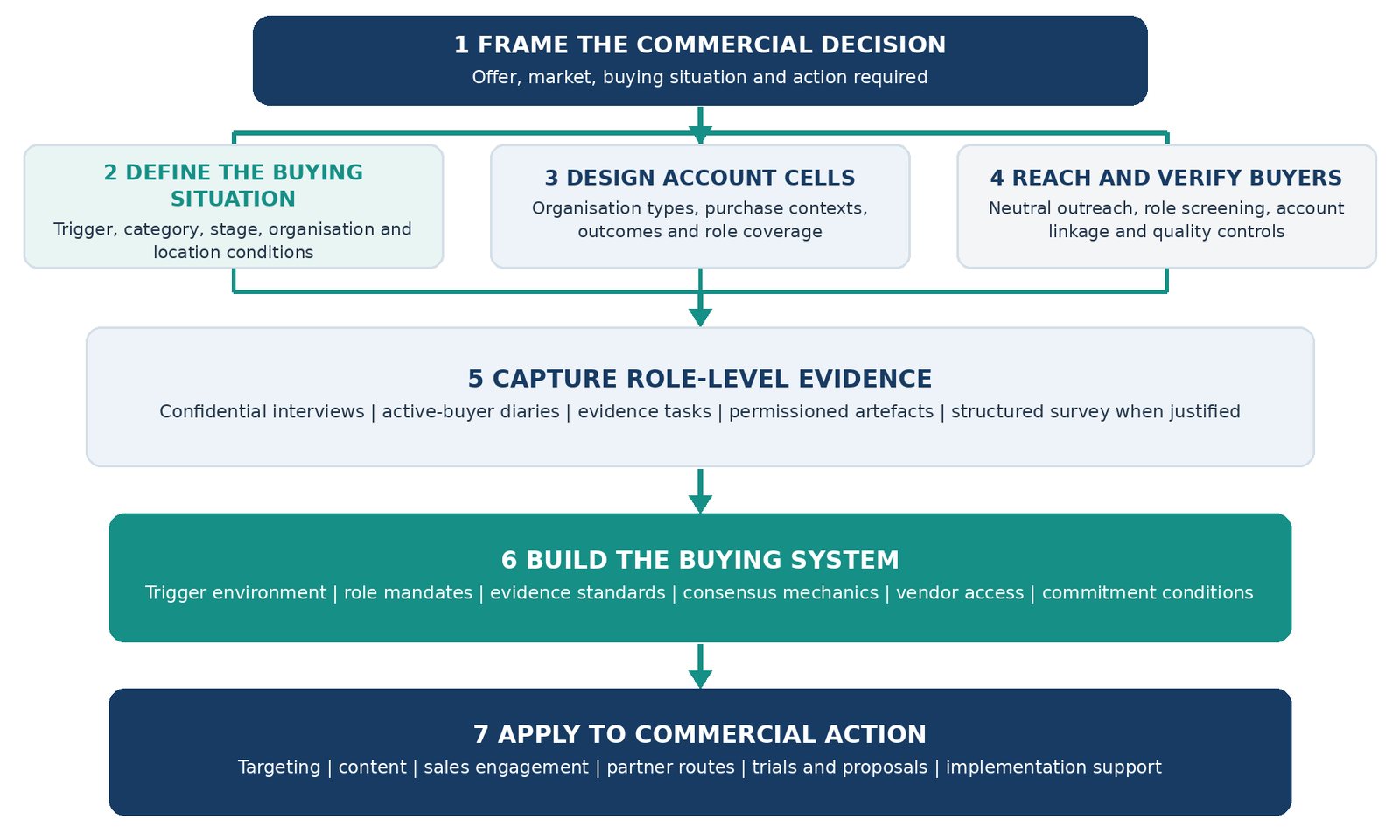
CLIENT INPUT
The offer, commercial decision, known evidence, access permissions and internal teams that will act on the findings.
AUGUST RESEARCH RESPONSIBILITY
Sample design, independent outreach, screening, fieldwork, evidence integration, limitations and decision translation.
The path can iterate when a new role, evidence requirement or account condition becomes visible. Any change to the sample remains documented and tied to the original client decision.
06 | B2B BUYING SYSTEM ARCHITECTURE
Analyse the conditions that organise the buying group
The methodology produces a system view from role-level evidence without forcing every purchase into a single linear journey.
Six connected evidence lenses
TRIGGER ENVIRONMENT
Operational change, risk, mandate, budget event or external pressure that activates the purchase.
ROLE MANDATES
The outcome each participant must create, defend or protect inside the organisation.
EVIDENCE STANDARDS
The proof each role seeks, trusts, challenges and passes forward.
CONSENSUS MECHANICS
Alignment, conflict, veto rights, informal influence and unresolved conditions.
VENDOR ACCESS
Digital research, sellers, partners, advisers, trials and procurement routes available to suppliers.
COMMITMENT CONDITIONS
What must be cleared before shortlist, funding, contract and implementation confidence become possible.
The evidence mix follows the decision
METHOD | USE IT WHEN | EVIDENCE CREATED |
|---|---|---|
Confidential role interviews | Internal mandates, disagreement and informal influence require explanation | Role narratives, evidence needs, veto conditions and language |
Active-buyer diaries | The buying group is still forming or information needs change over time | Live searches, meetings, forwarded material and unresolved questions |
Evidence tasks | The client needs to test what buyers can understand, trust and carry internally | Responses to proposals, proof modules, trials, calculators or implementation plans |
Permissioned artefact review | Requirements, RFPs, scorecards, proposals or approval material are available | A trace between stated criteria, actual evidence and internal approval |
Structured B2B survey | A reachable population and adequate sample support defined comparisons | Measured patterns by role, organisation, segment or buying situation |
METHOD DISCIPLINE Qualitative and quantitative methods are not paired automatically. A survey is added only when the target population, incidence, reachable sample and decisions requiring measurement justify it.
07 | ANALYSIS AND DELIVERY
Convert buyer evidence into commercial decisions
The final synthesis shows how to gain access, help the buying group build confidence and remove avoidable friction.
The Buyer Access and Consensus Blueprint
ACTIVATION
When the organisation becomes ready to examine change
ENTRY
Where a supplier can become visible or credible
MOBILISATION
Which roles must join and what each needs
CONSENSUS
What aligns the group and what creates conflict
COMMITMENT
Which evidence and conditions clear final approval
What the client receives
Buying-System Map Triggers, account conditions, roles, evidence flows, conflict and commitment requirements.
Role Mandate Profiles What each participant is trying to achieve, protect, avoid and prove.
Evidence Demand Map Information required by role and stage, including gaps that block internal forwarding.
Vendor Access Plan Human, digital, partner and procurement entry points by buying situation.
Consensus and No-Decision Register Recurring disagreements, missing ownership, open conditions and recovery actions.
Commercial Action Blueprint Implications for targeting, content, sales engagement, trials, proposals and implementation support.
August Research capability
8 INDUSTRY GROUPS
Sector context used to define buyer roles, terminology and organisation cells.
100+ INFORMATION CHANNELS
Company, market, customer, professional and industry routes across the wider research ecosystem.
MULTI-ROUTE B2B ACCESS
Client contacts, specialist recruitment, professional panels, communities, associations, channels and market-specific partners.
08 | ENGAGEMENT FORMATS
Scale the study to the buying population
Participant numbers follow role scarcity, account access, comparison needs and the reliability required from the conclusion.
Indicative engagement formats
FORMAT | INDICATIVE SCALE | BEST USED FOR | TYPICAL TIMING |
|---|---|---|---|
Focused buying-group study | 15 to 25 interviews across 6 to 10 organisations | One offer, segment or high-value buying situation | 6 to 8 weeks |
Multi-segment architecture | 30 to 50 interviews across 12 to 20 organisations | Role and organisation differences across selected segments | 8 to 10 weeks |
Measured buyer programme | Qualitative foundation plus 150 to 400 verified respondents when feasible | Defined comparisons that require measurement | 10 to 14 weeks |
These ranges are planning guides, not fixed packages. Rare executive or specialist populations may require smaller samples and longer outreach. Survey ranges apply only when the eligible population can be reached and verified.
How the format is chosen
ROLE SCARCITY Senior, specialist and sensitive roles may require longer outreach and fewer, deeper interviews.
ACCOUNT LINKAGE Multi-role account studies require permission, careful sequencing and enough time to reconcile different accounts.
COMPARISON NEED Segment, organisation, role and geography cells are included only when the client must act on the difference.
MEASUREMENT NEED Structured surveys are reserved for decisions that require defensible measurement from a reachable buyer population.
09 | ILLUSTRATIONS
Where B2B Buyer Research can be applied
Each illustration focuses on a different buying system, commercial decision and location condition.
BUYING SITUATION | BUYING-GROUP FOCUS | CLIENT DECISION | LOCATION LOGIC |
|---|---|---|---|
Automated invoice-exception platform for building-material distributors | Finance, accounts payable, IT, branch operations and procurement | How to enter the group and prove workflow fit | Geography neutral |
Low-carbon kiln service for ceramic-tile manufacturers | Plant operations, engineering, finance, energy and sustainability | How to support investment mobilisation | Castellon, Spain is material |
Workforce rostering platform for regional ferry operators | Marine operations, crewing, HR, IT, finance and workforce representatives | How to build operational and workforce confidence | Norway is material |
Sterile-barrier seal inspection system for medical-device manufacturers | Quality, packaging, operations, engineering, IT and procurement | How evidence should move through approval | Geography neutral |
Digital phytosanitary documentation service for berry exporters | Export operations, quality, compliance, logistics, finance and commercial teams | How to gain access before export-season commitment | Central Chile is material |
What changes between illustrations
The participant constellation, access route, evidence task, geography and analytical emphasis are redesigned for the buying situation. The illustrations do not reuse one standard methodology with different industry labels.
10 | FAQ
Questions about B2B Buyer Research
Scope, access and method are agreed around the commercial decision rather than imposed as a standard study package.
How is this different from Purchase Decision Analysis?
B2B Buyer Research identifies repeatable organisational buying conditions, roles, evidence needs and access points across selected buyers. Purchase Decision Analysis reconstructs the influences and thresholds inside a defined choice, renewal, rejection or switch.
Do we need to provide customer or prospect lists?
No. Client-approved contacts can be useful, but they can be combined with independent B2B recruitment, professional panels, associations, communities, channel routes, targeted identification and market-specific partners.
Can you include lost opportunities and organisations that chose no supplier?
Yes. They are often essential when the client needs to distinguish supplier rejection from internal delay, unresolved ownership or a decision that never became sufficiently important.
Is a survey always included?
No. Interviews, diaries, evidence tasks or artefact review may be more reliable for rare or complex buying groups. A survey is used only when measurement is necessary and the sample can support the intended comparisons.
Can several roles from the same organisation be interviewed?
Yes, when account-linked evidence is required and access is permissioned. Roles are interviewed separately so one sponsor does not define the entire committee's account.
Can individual consumers be included?
Yes, when an organisational buyer is purchasing on behalf of consumers and consumer evidence materially affects the B2B decision, such as retail, hospitality, healthcare or channel choices. Consumer coverage is not included by default.
When should geography be included?
Only when regulation, procurement practice, language, infrastructure, channel structure, service coverage or another location condition changes the buying system. Otherwise the design remains geography-neutral.
Does the research forecast sales or prove demand?
Not by itself. The service explains the buying system within the selected organisations and participants. Market incidence, demand forecasts and causal sales claims require additional designs and evidence.
Contact Us
UNDERSTAND HOW YOUR MARKET BUYS
Tell us which offer, buying situation and organisational audience matter. We will design the buying-group sample, outreach and evidence architecture around that decision.