MARKET & BUSINESS INTELLIGENCE | SECONDARY RESEARCH
Industry Analysis
Understand how an industry works, where value and power sit, what is changing and which consequences matter for the decision.
CENTRAL QUESTION How does this industry create, distribute and capture value, and how could its operating structure change?
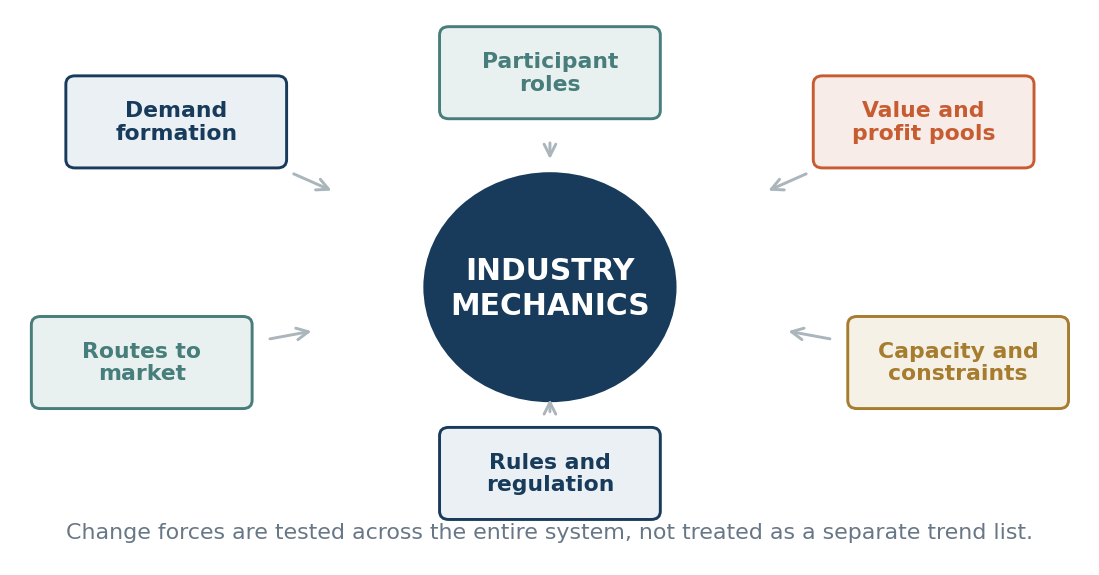
August Research treats an industry as a connected commercial system. The study moves beyond a catalogue of market facts to explain the relationships, economic mechanisms and change forces that shape industry outcomes.
THE DECISION CONTEXT
Turn industry information into business direction
Within Market & Business Intelligence, Industry Analysis connects external evidence with corporate action. It explains how the industry's structure affects profitability and competitive position, where value may migrate, and which changes should alter the client's priorities.
What the analysis can influence
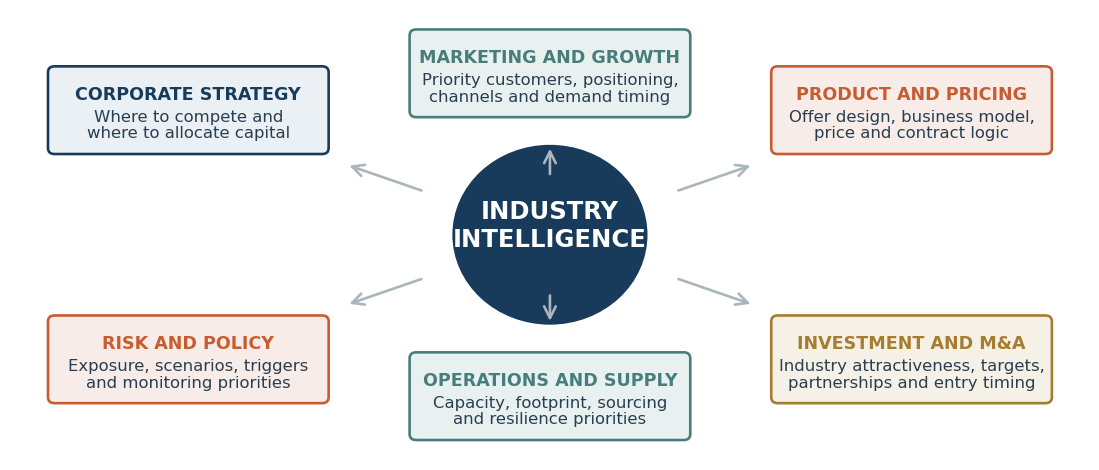
INFLUENCE RULE The analysis informs these decisions by explaining the external conditions behind them. It does not replace the client's financial, operational or leadership judgement.
Five questions the analysis must resolve
Boundary: What belongs inside the industry definition?
Architecture: Who performs each role and where do control points exist?
Economics: Where are revenue, cost, margin and profit pools concentrated?
Change: Which forces can alter demand, capacity, power or value capture?
Consequence: What should change in the client's priorities, timing or exposure?
WHY INDEPENDENT RESEARCH An external team can challenge inherited industry definitions, reconcile evidence across functions and test whether a familiar narrative is supported by the complete system rather than a preferred internal view.
CORE METHODOLOGY
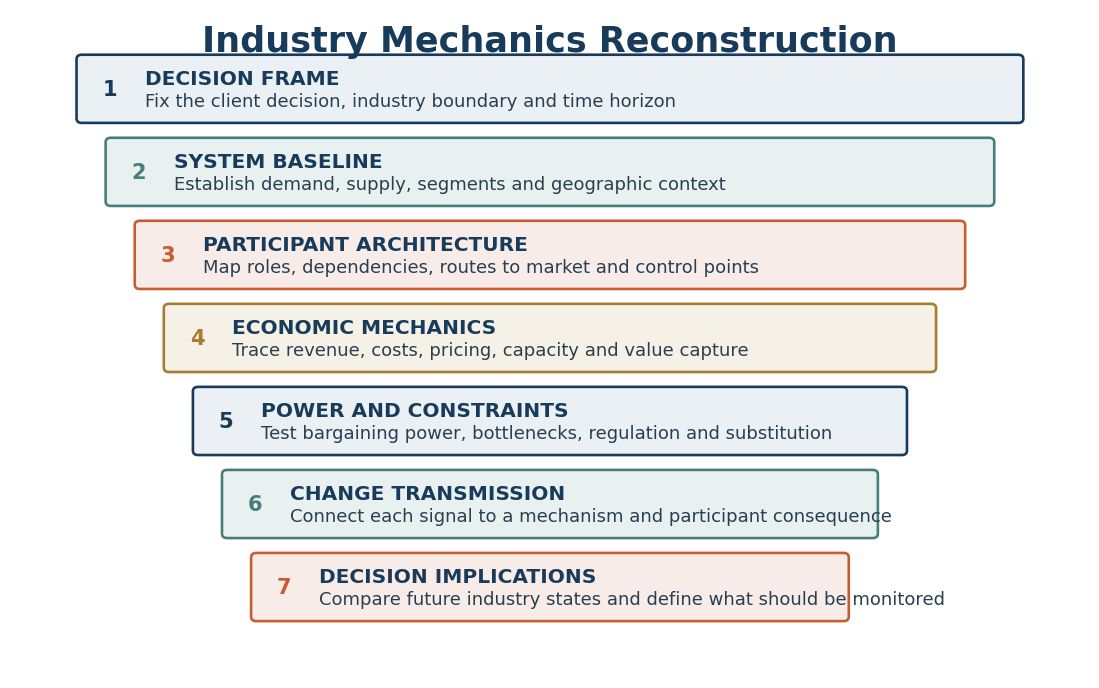
Industry Mechanics Reconstruction
The methodology reconstructs the industry from its decision boundary outward. Each stage answers a different question, and every conclusion must remain connected to the evidence and mechanism that produced it.
Method controls
- The industry boundary, value-chain level, geography and time horizon are fixed before evidence is assembled.
- Current structure and future change are analysed separately before they are connected.
- Reported facts, derived estimates and analyst interpretations remain visibly distinct.
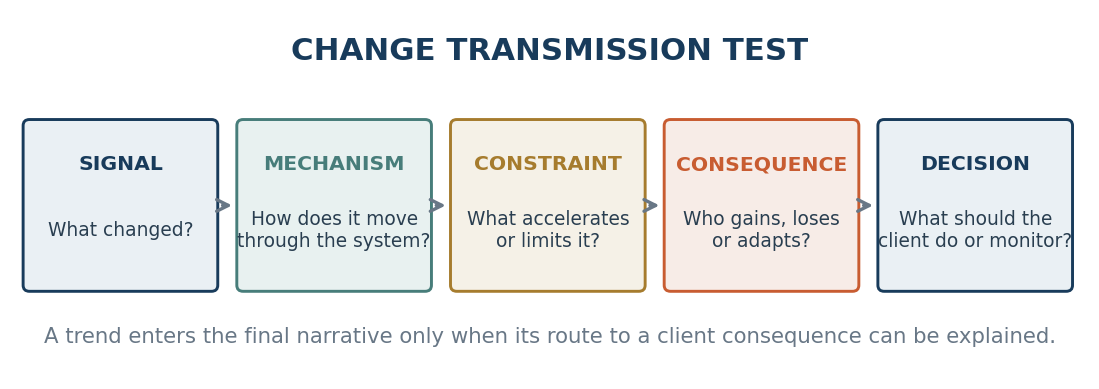
- A trend is not promoted to a strategic conclusion without a plausible transmission mechanism.
- Evidence gaps, competing interpretations and unresolved uncertainty remain visible.
DECISION PRINCIPLE The output does not attempt to describe everything about an industry. It explains the mechanics that can alter the specific decision under consideration.
EVIDENCE ARCHITECTURE
Select evidence around the system, not a fixed database bundle
The source plan follows the industry roles, economic flows and change forces defined in the methodology. Licensed information can be combined with public evidence where it improves coverage or allows an independent cross-check.
EVIDENCE FAMILY | POTENTIAL COVERAGE | ANALYTICAL USE |
|---|---|---|
Demand and activity | Production, shipments, installations, consumption, procurement, utilization and customer activity | Demand formation and market rhythm |
Companies and participants | Filings, registries, ownership, facilities, portfolios, channels and operating disclosures | Roles, scale, integration and control |
Economics and capital | Financial data, prices, costs, funding, transactions, investment and capacity commitments | Profit pools, capital intensity and value migration |
Trade and supply | Customs, trade flows, logistics, supplier records, inventories and capacity evidence | Dependencies, bottlenecks and regional exposure |
Rules and institutions | Legislation, regulation, standards, incentives, tenders, permits and association records | Rules that enable, constrain or redistribute value |
Change signals | Hiring, partnerships, M&A, new facilities, launches, patents, conferences and dated announcements | Direction, maturity and speed of change |
The evidence ledger
Each material item records its definition, date, geographic and participant coverage, original context, transformation and evidence strength. Linked sources are marked so that several publications repeating the same underlying figure are not mistaken for independent confirmation.
SOURCE DISCIPLINE Paid databases improve reach and efficiency, but they do not replace boundary control, reconciliation or analysis. The strongest evidence mix is the one that can explain the industry mechanics relevant to the decision.
ANALYSIS LOGIC
Explain how change moves through the industry
Industry analysis becomes useful when a visible signal can be connected to a commercial mechanism, a limiting condition and a consequence for specific participants. This prevents fashionable themes from dominating the study without decision relevance.
Analysis modules
Industry architecture: Participant roles, dependencies, integration, routes to market and control points.
Economic engine: Revenue flows, cost pressures, pricing logic, capacity utilization, investment and value capture.
Power and exposure: Buyer and supplier leverage, concentration, switching, substitution, regulation and bottlenecks.
Change forces: Demand shifts, technology, capital, policy, M&A, new capacity and business-model movement.
Future industry states: Alternative structures built from defined uncertainties, mechanisms and timing conditions.
The outputs remain decision readable
Depending on the question, the final materials may include an industry architecture map, value flow model, profit pool view, participant power matrix, capacity and constraint map, regulatory timeline, change dashboard, scenario comparison and decision implications.
DELIVERY
A study that can be challenged and refreshed
The deliverable combines the industry narrative with the structured evidence behind it. The client can inspect why a conclusion was reached, where uncertainty remains and which indicators would change the interpretation.
What clients receive
- Industry analysis built around the executive decision
- Industry boundary, terminology and participant-role definitions
- Industry architecture and value-flow maps
- Economics, profit pool, power and constraint analysis
- Change register with maturity and consequence assessment
- Alternative industry states and decision implications where useful
- Evidence ledger, assumptions and indicators for future monitoring
Engagement formats
Industry structure diagnostic: A focused reconstruction for one strategic question or emerging issue.
Strategic industry review: A deeper examination of structure, economics, power, change and future states.
Industry change monitor: A repeatable update of the signals and mechanisms most likely to alter the decision.
Why August Research
August Research connects company, market, transaction, trade, regulatory, capacity and commercial evidence within one decision framework. The approach is designed for industries where the answer cannot be obtained from a single report or dataset and where explaining the system matters as much as describing it.
WORKING STANDARD A strong conclusion must be traceable to the industry boundary, supported by more than one evidence route where possible and explicit about the mechanism connecting evidence to the client decision.
ILLUSTRATIONS
Industry questions this service can address
INDUSTRY CONTEXT | ILLUSTRATIVE INDUSTRY QUESTION |
|---|---|
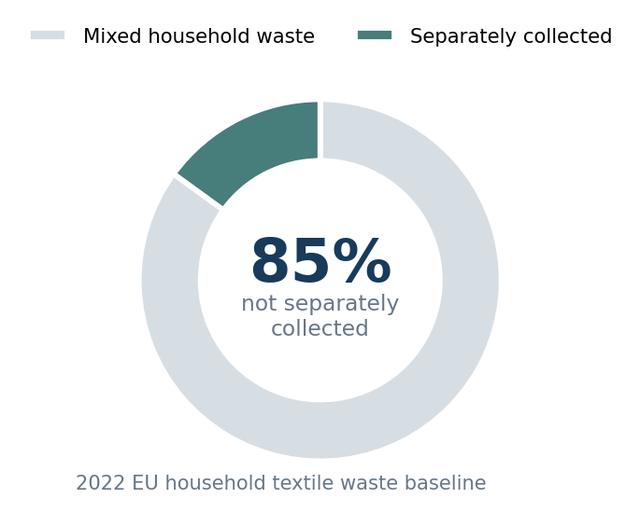
Textile recycling | Europe | How could producer responsibility, collection quality, sorting capacity and brand offtake change value capture across recycled textile feedstocks? |
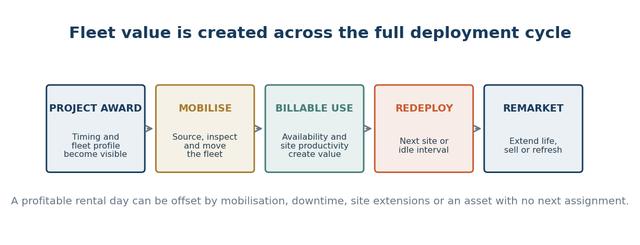
Construction equipment rental | GCC | How are megaproject procurement, fleet utilization, dealer participation and specialist rental models reshaping the industry? |
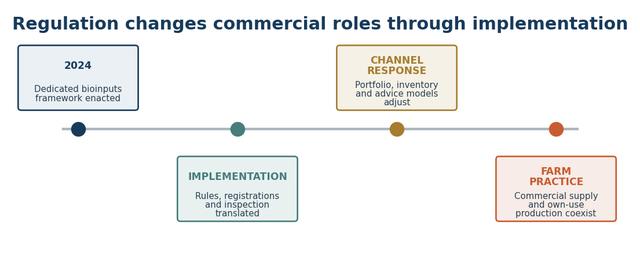
Agricultural biologicals | Brazil | How are regulation, local manufacturing, distributors and cooperatives changing commercialization and bargaining power? |
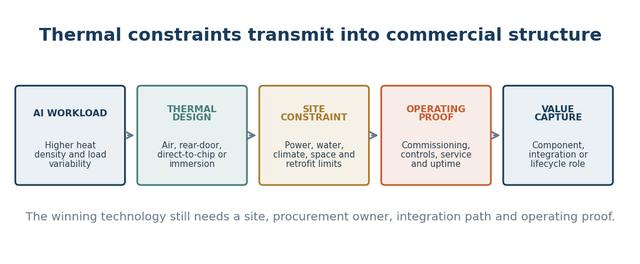
Data centre cooling | Southeast Asia | How could higher rack density, power and water constraints, and operator procurement alter the cooling ecosystem? |
Offshore wind operations | North Sea | How might turbine scale, service contracts, vessel availability and auction economics redistribute value in operations and maintenance? |
FAQ
How is this different from Market Sizing & Forecasting?: Market Sizing quantifies the market and its growth. Industry Analysis explains the system, economics, power, constraints and change behind those numbers.
How is this different from Competitive Business Benchmarking?: Benchmarking compares corporate peers through controlled metrics and signals. Industry Analysis examines relationships and value movement across the complete industry system.
Can the study include market size or forecasts?: Yes, when they help establish context or test a future industry state. They are not automatically the centre of the engagement.
Can it support an M&A decision?: Yes. It can test industry attractiveness, structural change and value chain exposure alongside separate diligence on the target.
Can a fragmented or private industry be analysed?: Yes. The method uses participant mapping, proxy measures and evidence reconciliation while keeping material gaps visible.
Contact Us
Discuss the industry decision, geography and time horizon you need to understand. August Research can define the system boundary, build the evidence architecture and develop an analysis designed around that decision.
August Research | Market & Business Intelligence