MARKET & BUSINESS INTELLIGENCE
Supply Chain Intelligence
Reconstruct the dependencies behind supply continuity, cost exposure and recovery options.
Product
WHAT MUST KEEP FLOWING
Dependency
WHAT CAN STOP IT
Alternative
WHAT CAN REPLACE IT
Response
WHAT SHOULD CHANGE
CENTRAL QUESTION Which suppliers, facilities, materials, routes or rules can change the client's ability to deliver, and what practical alternative exists if one of them fails?
Supply chains are often visible at the direct-supplier level but unclear beneath it. Company names, plant locations, intermediate materials, shipment routes and capacity claims sit in different records. August Research connects these fragments into a decision-specific view of dependency, replaceability and time to impact.
Questions the service can resolve
- Where are single-site, single-country or single-route dependencies concentrated?
- Which sub-tier suppliers and facilities sit behind a critical product or material?
- How much qualified supply is genuinely available rather than nominally announced?
- Which disruptions could reach production before inventory or contracts can absorb them?
- Which alternative suppliers, materials or routes are credible, and what would qualification require?
SERVICE PRINCIPLE | The research begins with a defined product, decision or continuity question. It does not attempt to map every relationship in the client's global supply chain.
DECISION VALUE
Move from supplier visibility to operational consequence
A supplier list identifies who is present. Supply Chain Intelligence explains how an interruption would move through the network, when it would affect the client and which response can change the outcome.
DECISION | WHAT THE INTELLIGENCE CAN INFLUENCE |
|---|---|
Sourcing strategy | Concentration, country exposure, supplier leverage and second-source priorities |
Continuity planning | Time to impact, inventory cover, bottlenecks and recovery sequence |
Network redesign | Facility, route and regional alternatives with transition constraints |
Market entry | Local supplier depth, import dependence, logistics access and regulatory friction |
Investment and M&A | Supply dependencies that can affect operating resilience, integration or growth |
Regulatory response | Origin, traceability, sanctions, forced-labour, tariff or product-rule exposure |
Why independent research matters
Look beyond the approved supplier list: Internal records usually describe contractual relationships. External evidence can reveal ownership, sub-tier production, shipment and facility links that are not recorded in procurement systems.
Challenge self-reported resilience: Supplier declarations may describe group-level capacity while the qualifying product is made at one plant or depends on one precursor.
Compare evidence across jurisdictions: Company registries, customs classifications, port records, permits and local-language disclosures must be reconciled before they can support one conclusion.
Prioritise without internal ownership bias: An independent assessment can rank exposure by operational consequence rather than by supplier spend, relationship strength or business-unit influence.
OUTSIDE-IN ADVANTAGE August Research can test the client's known network against observable external evidence while keeping confirmed links, supported inferences and unresolved gaps visibly separate.
CORE METHODOLOGY
Supply Chain Dependency Reconstruction
The method builds a relationship graph around the operating output that matters to the client. A connection is included only when it can explain supply, interruption, substitution or recovery. This avoids producing a decorative value-chain map with no decision consequence.
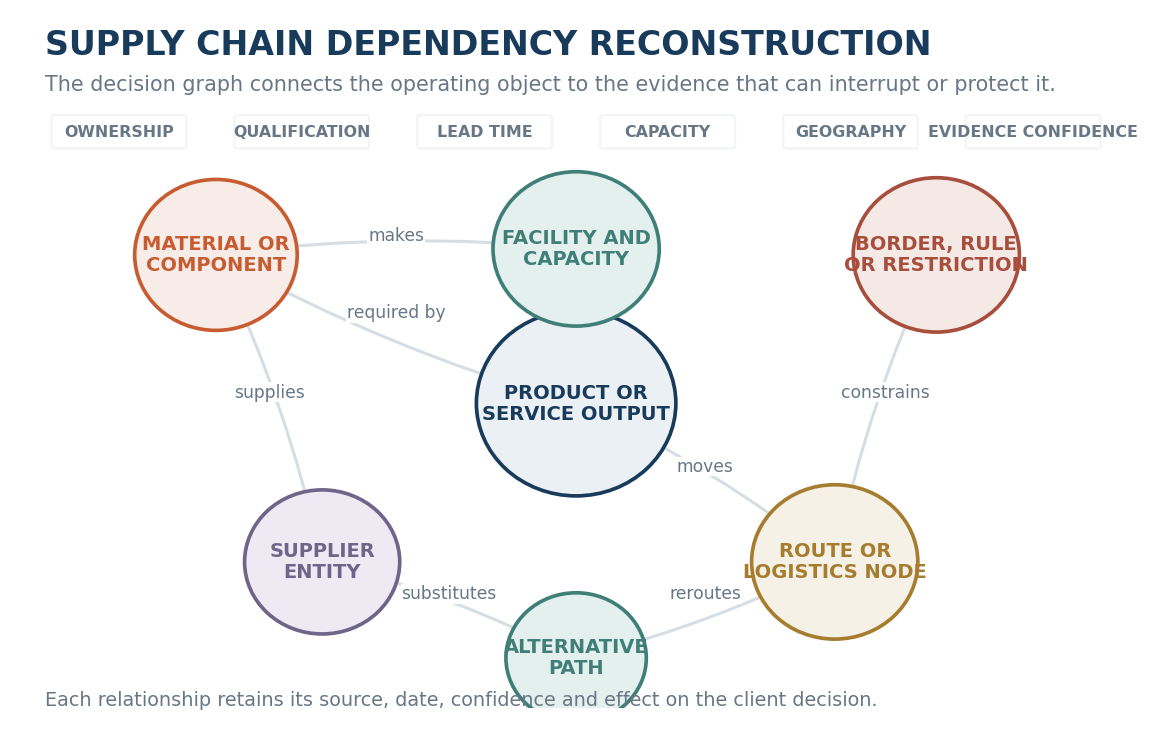
Six questions define every dependency
QUESTION | RESEARCH TEST |
|---|---|
Identity | Which legal entity, operating facility and product relationship is involved? |
Criticality | What output depends on the relationship, and how quickly could it be affected? |
Concentration | How much qualified supply, volume or route capacity sits in the same exposure? |
Replaceability | Which substitute is technically, commercially and operationally available? |
Recovery | What inventory, lead time, qualification or contract condition controls restoration? |
Confidence | Is the relationship confirmed, strongly supported, inferred or unresolved? |
METHOD CONTROL | Unknown sub-tier relationships remain unknown. They are not filled with assumed links simply to make the network appear complete.
RESEARCH EXECUTION
Reconcile identity, flow and disruption evidence
The research does not depend on one supplier-risk database. Three evidence threads are built separately, then reconciled into the dependency model. A relationship advances only when the underlying company, product, facility and route definitions agree.
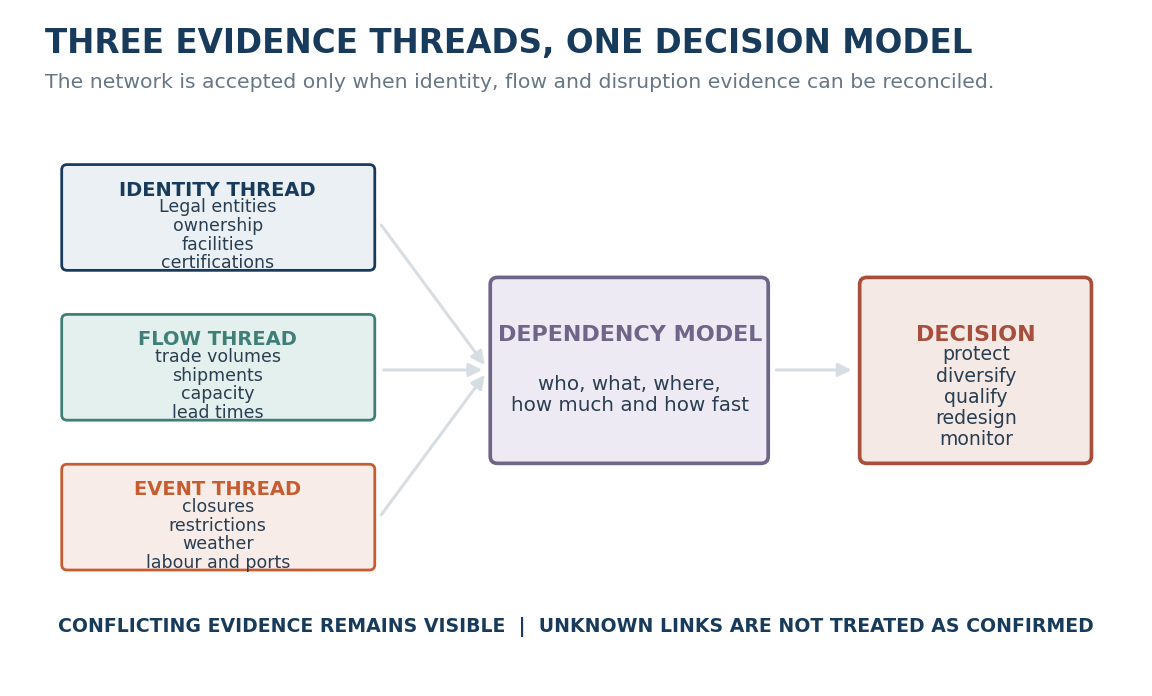
How the research is carried out
RESEARCH OPERATION | EXECUTION |
|---|---|
Fix the operating boundary | Define the product, bill-of-material level, geography, supply window and decision that the network must support. |
Resolve entities and facilities | Match parent groups, legal entities, trading names, plant addresses, certifications and product claims. |
Reconstruct material and shipment flows | Connect trade classifications, shipment records, production evidence, routes, ports and receiving markets. |
Estimate dependency | Calculate supported ranges for concentration, qualified capacity, lead time, inventory cover and exposure duration. |
Build alternative paths | Test supplier, facility, material, route and geographic options against qualification and transition constraints. |
Apply disruption cases | Model plausible shocks and define triggers for protect, qualify, diversify, redesign, monitor or accept decisions. |
EVIDENCE ARCHITECTURE
Use each database for the claim it can support
Trade data can show dependence between countries but may not identify the producing plant. Corporate data can identify ownership but not prove capacity. Shipment data can reveal trading relationships but may omit domestic flows. The source plan therefore changes with the product, jurisdiction and level of supply-chain visibility required.
EVIDENCE OBJECT | SOURCES THAT CAN BE INTEGRATED | WHAT THE EVIDENCE CAN ESTABLISH |
|---|---|---|
Trade and customs | UN Comtrade, Eurostat Comext, national customs data, tariff schedules, Panjiva or ImportGenius where relevant | Country and product flows, origins, destinations and concentration |
Companies and ownership | National registries, statutory accounts, annual reports, Orbis, D&B Hoovers and S&P Capital IQ where available | Entity resolution, ownership, financial condition and group relationships |
Facilities and capacity | Permits, certification records, environmental filings, plant disclosures, tenders, planning records and industry databases | Operating location, qualified product, capability and supported capacity range |
Shipping and logistics | Port and rail statistics, schedules, bills of lading, vessel and freight data, route announcements and infrastructure records | Routes, nodes, transit time, congestion and transport alternatives |
Restrictions and events | Regulators, sanctions lists, customs notices, recalls, weather and hazard records, labour notices and port updates | Disruption likelihood, affected objects, timing and potential duration |
Client evidence | Approved supplier lists, bills of material, purchasing records, inventory policies, qualification status and contract terms | Known network, materiality, buffer and operating constraints |
Evidence controls
- Every material link retains its source, date, geographic scope and confidence classification.
- Trade codes are tested for product fit before flows are attributed to the client's material.
- Nameplate, announced, operating and qualified capacity remain separate measures.
- Several publications repeating the same underlying record are treated as one evidence route.
- Missing evidence is shown as a gap and linked to the decision it prevents.
ACCESS NOTE | Licensed databases are selected according to the engagement and availability. They extend coverage but do not replace entity resolution, reconciliation or analytical judgement.
ANALYTICAL DESIGN
Measure dependence together with the ability to respond
A high-risk country label does not explain what the client should do. The analysis connects dependency severity with substitute readiness, timing and evidence confidence so each exposure receives a practical response.
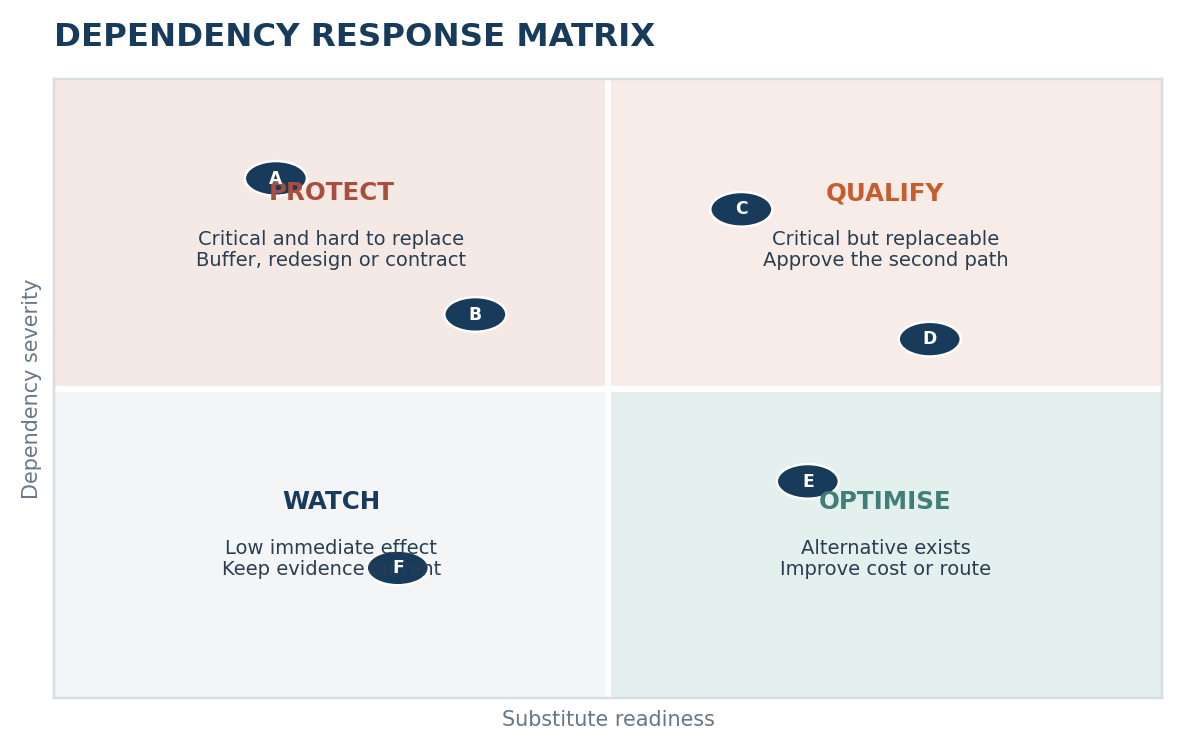
Decision measures
MEASURE | DECISION MEANING |
|---|---|
Qualified concentration | Share of usable supply controlled by the largest supplier, plant, country or route |
Time to impact | Time from disruption to production, service or customer effect after available buffers |
Effective alternative capacity | Alternative capacity discounted for access, qualification, quality, lead time and competing demand |
Substitution friction | Commercial, technical, regulatory and operational work needed to activate another path |
Recovery range | Supported minimum, central and extended restoration time under the defined disruption |
Evidence confidence | Strength of the relationships and assumptions carrying the conclusion |
What the client can receive
Decision-specific supply network | Supplier and facility identity register | Trade and route analysis | Dependency heat map | Capacity and concentration ranges | Disruption propagation cases | Alternative-path register | Monitoring triggers | Executive decision brief
ENGAGEMENT DESIGN
Match the depth of research to the decision
FORMAT | BEST SUITED FOR | INDICATIVE TIMING |
|---|---|---|
Critical dependency diagnostic | One product, material or route | Typically 4 to 5 weeks |
Multi-tier network reconstruction | A defined product family or operating network | Typically 6 to 8 weeks |
Disruption response study | One active or plausible disruption | Scope and urgency dependent |
Supply-chain intelligence monitor | Selected dependencies and trigger indicators | Monthly or quarterly refresh |
Timing depends on the number of products, sub-tier depth, geographies, data availability and the level of capacity or shipment reconstruction required.
Illustrations
INDUSTRY CONTEXT | SUPPLY-CHAIN QUESTION |
|---|---|
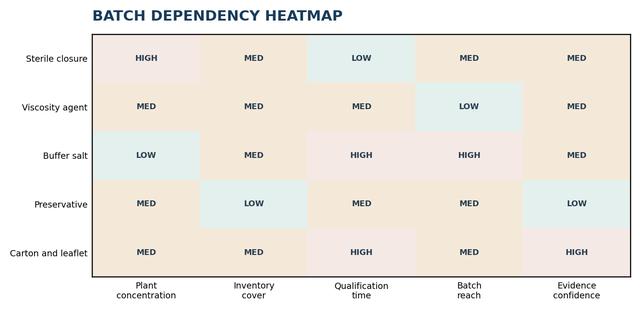
Pharmaceuticals | India | Which excipient and sterile-packaging dependencies could interrupt ophthalmic drug production? |
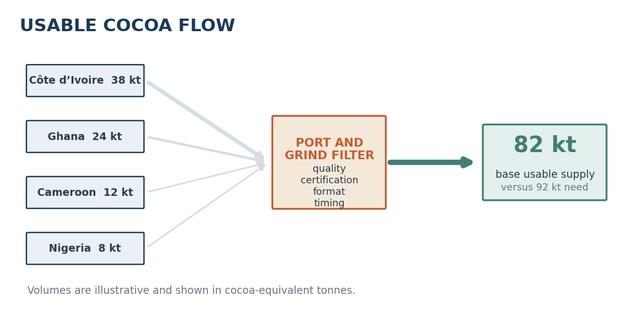
Food and beverages | West Africa to Europe | How exposed is a chocolate portfolio to cocoa-grinding capacity, port concentration and alternate origin constraints? |
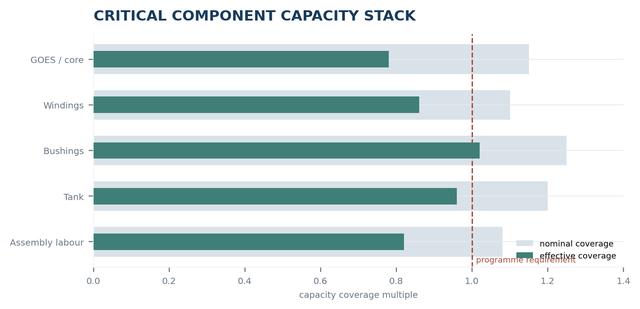
Electric utilities | United States | Which component and facility bottlenecks are extending distribution-transformer availability? |
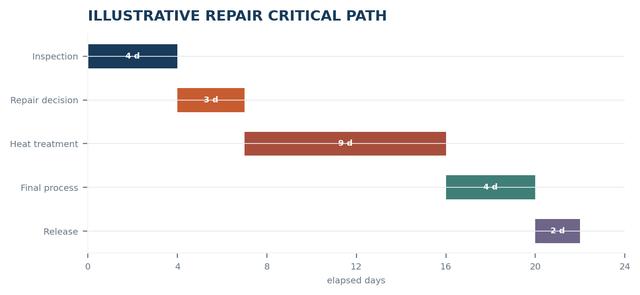
Aerospace services | Europe | Where could casting and heat-treatment dependencies delay aircraft-engine maintenance activity? |
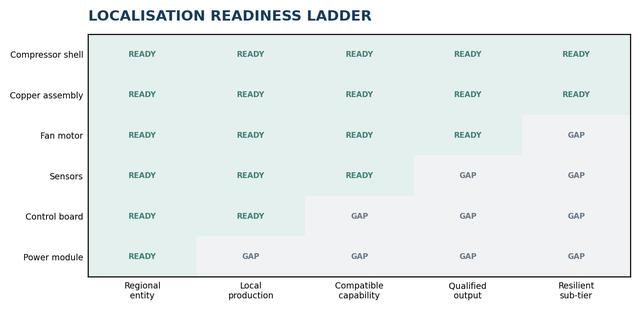
Home appliances | Mexico | Can a new manufacturing plant localise compressor and control-board supply without creating hidden sub-tier concentration? |
SERVICE QUESTIONS
Why August Research
August Research builds supply-chain intelligence around the object that matters to the decision, whether that is a product, component, material, facility or route. The method resolves entities before scoring exposure, distinguishes nominal capacity from accessible qualified supply, and connects every risk to a response path and evidence threshold. Clients receive the reasoning and evidence behind the conclusion, not a black-box risk score.
FAQ
Does this replace supplier audits?: No. It prioritises the suppliers, facilities, claims and gaps that require direct verification or formal diligence.
Can the work use internal procurement data?: Yes. Client records can be connected with external evidence when access, confidentiality and definitions are agreed.
Is this a live software platform?: The service can define monitoring indicators and refresh cycles, but it is designed as research-led decision intelligence rather than an automated alert product.
Can the study begin without a complete supplier list?: Yes. The work can begin outside-in with a defined product, material or geography, then use available evidence to build and test the relevant supplier and facility universe.
Starting an engagement
The initial scope normally defines:
- The product, material, facility, route or business decision that must be protected.
- The geographic boundary and the sub-tier depth that could change the decision.
- Known supplier, bill-of-material, inventory or qualification evidence available from the client.
- The disruption, continuity, localisation, sourcing or investment scenarios to be tested.
Contact Us
RECONSTRUCT THE DEPENDENCY BEFORE IT BECOMES A DISRUPTION Tell us the product, material, geography or supply decision you need to understand. August Research will define the network boundary, evidence model and response questions required for the study.