PRIMARY RESEARCH | USER EXPERIENCE RESEARCH
User Experience Research
See what users can complete, where interaction fails and what must change before a product, interface or workflow is released, redesigned or scaled.
THE SERVICE ROLE
August Research evaluates a defined user task through direct observation. The evidence shows what the interface communicated, how the user interpreted it, what action followed and whether the user could recover without assistance.
Research starts with a task, not a broad user category
The study is organised around an important interaction: configure, find, decide, submit, approve, operate, respond or recover. User role, proficiency, device, environment, accessibility and consequence determine the research design. B2B or B2C is included only when it materially changes those conditions.
What this service helps clients decide
- Which interaction problems must be fixed before launch or wider deployment?
- Why do users abandon, repeat, bypass or complete a task incorrectly?
- Which design option best supports accurate and confident completion?
- Where does the interface create avoidable support demand or operational risk?
- Did a revised prototype resolve the original problem without creating another one?
BEST USED WHEN
A client has a product, prototype, interface or workflow that users can interact with and a design, release, content or support decision that depends on observed performance.
SCOPE
Products and interfaces that can be studied
UX Research can examine customer-facing, employee-facing, public-facing and specialist-user systems across digital, physical and connected settings.
Digital interactions
Websites, mobile applications, portals, enterprise software, dashboards, e-commerce, self-service tools, digital forms, chat interfaces and workflow systems.
Physical and connected interactions
Kiosks, equipment controls, device displays, smart-product applications, handheld terminals, in-vehicle interfaces and physical processes supported by digital instructions.
Research across the product stage
STAGE | CLIENT QUESTION | SUITABLE EVIDENCE |
|---|---|---|
CONCEPT | Does the proposed interaction match the user's mental model? | Scenario walkthrough, information structure and early prototype tasks |
PROTOTYPE | Can intended users complete the critical task? | Moderated testing, comparison tasks and recovery probes |
LIVE PRODUCT | What causes real errors, delay, abandonment or support? | Live task observation, contextual inquiry and permitted product evidence |
STUDY ARCHITECTURE
Recruit the user and the conditions of use
A participant is relevant because of the task they perform and the conditions under which the interaction matters.
Participant selection
- Direct responsibility for, or recent experience of, the task being tested
- Appropriate proficiency: first-time, occasional, experienced or administrator-level use
- Relevant device, channel, language and operating environment
- Exposure to the selected success, delay, error or recovery condition
- Accessibility needs or assistive-technology use when these affect the intended audience
- Permission to participate without breaching employment, customer or security boundaries
Test-context parameters
DEVICE AND ACCESS
Desktop, mobile, tablet, kiosk, control panel, assistive technology or shared device
ENVIRONMENT
Home, office, field, vehicle, public space, controlled simulation or remote setting
TASK PRESSURE
Routine, time-limited, interrupted, high-consequence or exception condition
KNOWLEDGE
Novice, trained user, specialist, occasional user or system administrator
GEOGRAPHY AND LANGUAGE
Market, language, local convention and connectivity where relevant
PRODUCT STATE
Concept, prototype, staged environment, live product or revised release
Access routes
Participants may come from client-approved users, targeted independent recruitment, consumer panels, professional communities, specialist networks, market partners or a hybrid design. The route is selected for user incidence, relationship sensitivity, geography and the confidentiality of the product being tested.
METHODOLOGY
Interaction Consequence Testing
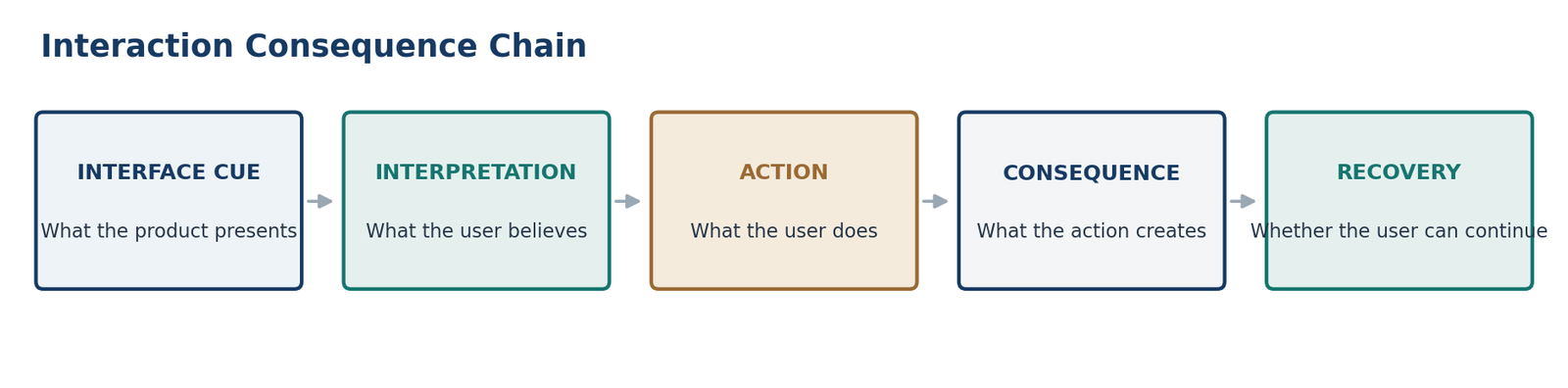
The method connects an observed interface problem to the action, consequence and recovery path it creates.
How the research is carried out
1. Define the critical task
Agree the user goal, starting state, successful outcome, evidence available and decision the client must make.
2. Build a realistic scenario
Give participants sufficient background to act without telling them where to click, what to notice or which answer is preferred.
3. Observe an uninterrupted attempt
Record navigation, actions, pauses, errors, reversals, help-seeking and completion before the moderator probes reasoning.
4. Apply the assistance ladder
Distinguish independent completion, self-recovery, completion after a neutral cue, moderator-supported completion and non-completion.
5. Reconstruct the consequence chain
Link the interface cue to interpretation, action, downstream consequence and recovery difficulty.
6. Prioritise and retest
Translate evidence into design actions and, where required, test whether the revision resolves the original failure.
A METHOD SELECTED FOR THE SCOPE
Moderated, unmoderated, field-based, remote, comparative and accessibility-inclusive techniques are used only when they answer the defined task question. No fixed method bundle is applied to every project.
FIELDWORK
What an interaction session looks like
The participant receives a credible situation, attempts the task and explains key decisions after observable behaviour has been captured.
Before the session
August Research verifies the participant, device and task conditions; confirms consent and recording boundaries; checks the test environment; and ensures the scenario contains necessary context without revealing the intended path.
During the task
What the participant knows, sees and has available before acting
The initial interpretation and route selected without assistance
Steps completed, repeated, reversed, skipped or abandoned
What caused the error and whether the interface supported correction
Documentation, colleague, support channel or moderator assistance required
Whether the participant believes the final state is correct and complete
Evidence that may be captured
Task outcome, time on task, interaction path, error type, repeated actions, assistance level, confidence, participant explanation, screen or device recording, observation notes and relevant system evidence supplied or permitted for the project.
WHY FIELDWORK MATTERS
Usage analytics can show where activity stopped. Direct observation shows what the user believed, why the next action appeared reasonable and whether the interface helped them recover.
ANALYSIS AND DECISIONS
Prioritise what changes the outcome
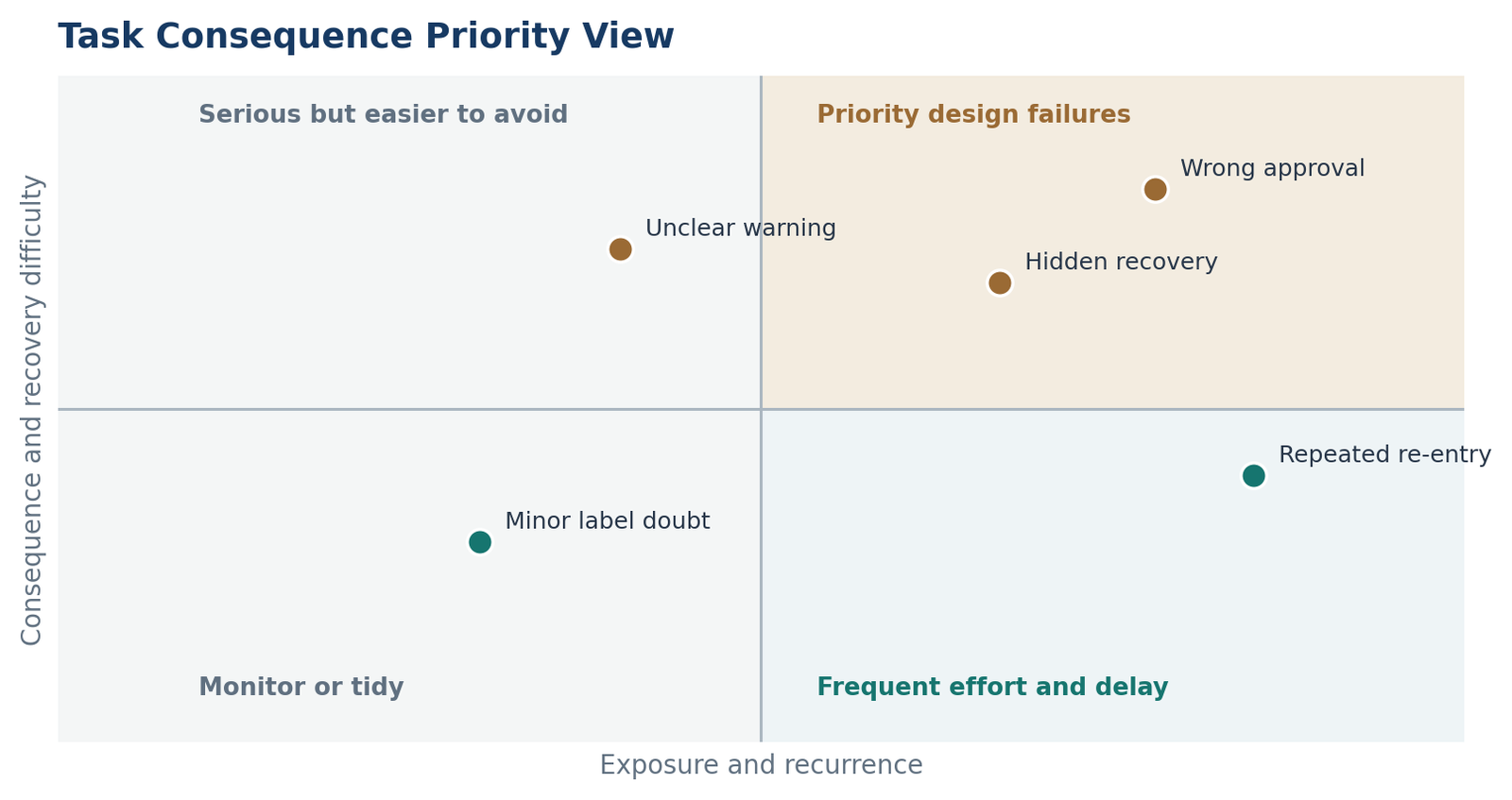
Findings are not ranked by opinion volume or visual preference alone.
Priority factors
CONSEQUENCE
Effect of the action or error
RECURRENCE
How consistently the issue appears
RECOVERY
Effort and support needed to continue
EXPOSURE
Users and situations affected
Why use an independent research company
A neutral moderator does not explain, defend or demonstrate the interface. Participants can struggle, disagree or reject a design without managing the relationship with the product team. Independent recruitment can also reach infrequent users, unsuccessful users and accessibility profiles beyond the easiest internal contacts.
AUGUST RESEARCH
Research access shaped around the task
The service combines participant access, sector context and independent moderation without tying the study to one testing platform.
What the client receives
TASK PERFORMANCE EVIDENCE
Completion, error, recovery, assistance and confidence by user condition
INTERACTION CONSEQUENCE MAP
Cue, interpretation, action, consequence and recovery for priority issues
ANNOTATED INTERFACE REVIEW
Screen or control-level evidence connected to the observed task
DESIGN PRIORITY REGISTER
Recommended action, rationale, owner and validation requirement
RETEST COMPARISON
Evidence showing whether the revised experience resolved the original issue
DECISION BRIEFING
Focused readout for product, design, technology, operations and leadership teams
Why August Research
100+ INFORMATION CHANNELS
Company, market, customer and industry evidence available across the wider research ecosystem
8 INDUSTRY GROUPS
Sector context used to define users, tasks, terminology and consequence
MULTIPLE ACCESS ROUTES
Client contacts, targeted recruitment, panels, professional communities, specialist routes and market partners
MULTI-MARKET DESIGN
Comparable task evidence across selected geographies, languages, devices or operating conditions
Engagement formats
FORMAT | SUITED TO | INDICATIVE DELIVERY |
|---|---|---|
FOCUSED TASK DIAGNOSTIC | One critical task, user condition and design decision | Often 3 to 4 weeks |
MULTI-ROLE WORKFLOW STUDY | Related tasks across user roles or operating conditions | Often 5 to 7 weeks |
COMPARATIVE OR MULTI-MARKET STUDY | Design options, languages, markets or user contexts | Often 6 to 10 weeks |
Timelines are indicative and depend on recruitment incidence, product access, prototype readiness, markets, languages, security review and participant response.
ILLUSTRATIVE EXAMPLES
Where UX Research can be applied
Each example would use a different participant design, testing environment, methodology and visual analysis according to the task in scope.
Illustrative engagement directions
ILLUSTRATION | RESEARCH FOCUS |
|---|---|
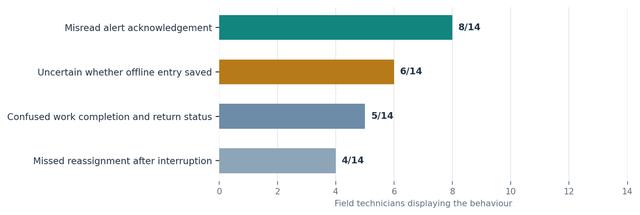
Elevator service response mobile workflow | Test alert interpretation, action recording and return-to-service confirmation under time pressure. |
Bulk chemical delivery confirmation terminal | Test compartment verification and recovery after a product or destination mismatch. |
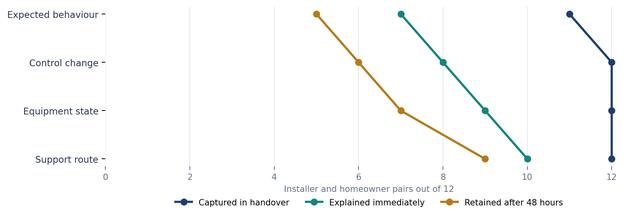
Heat-pump commissioning and handover application | Compare installer completion with homeowner understanding and control after handover. |
Commercial-kitchen allergen change approval tool | Evaluate how different managers review a substitution and prevent incomplete approval. |
Accessible rented-mobility-equipment return locker | Test return and receipt confirmation across different physical and digital access conditions. |
FAQ
How is UX Research different from the other customer research services?
UX Research observes how users interact with a defined product or system to complete a task. Customer Journey Mapping follows a wider outcome across channels and departments, while Customer Interviews, Voice of Customer Research and Consumer Behaviour Analysis answer different questions about choices, opinions and broader actions.
Can you test an early prototype?
Yes. The task, fidelity and evidence expectations are adjusted to what the prototype can realistically support.
How are participant numbers decided?
Counts depend on task complexity, user diversity, issue-discovery needs and whether directional or statistical comparison is required.
Can accessibility be included?
Yes. Relevant users and assistive technologies can be included. The research complements, but does not replace, formal conformance, regulatory, clinical, software-validation or engineering assessment.
Contact Us
Discuss your UX research question
Tell us the user, critical task, product or interface, development stage, operating conditions, priority markets and decision you need to make. August Research will design the recruitment, test environment, Interaction Consequence Testing method and decision outputs around the interaction that matters.