MARKET & BUSINESS INTELLIGENCE | SECONDARY RESEARCH
Market Opportunity
Assessment
Find unmet demand, qualify new growth spaces and determine which opportunities deserve investment.
CENTRAL QUESTION Where does a meaningful need remain underserved, and can the client credibly convert it into commercial value?
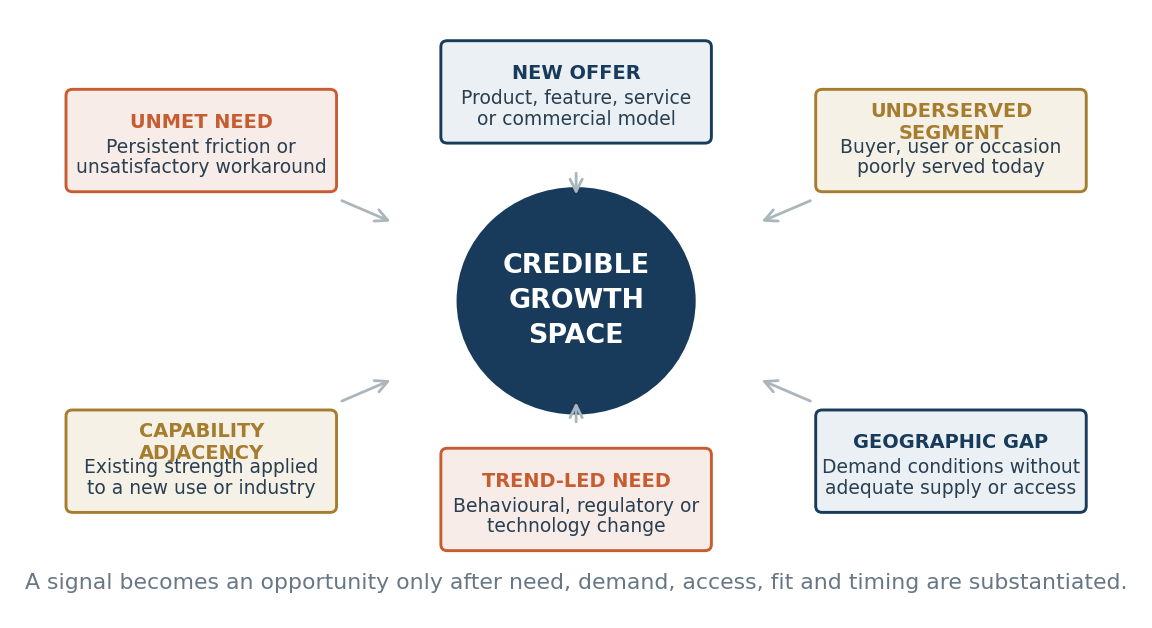
August Research treats market opportunity assessment as both discovery and qualification. The work identifies possible growth spaces, then tests whether the need, demand, supply gap, access, client fit and timing are strong enough to support action.
OPPORTUNITY DISCOVERY
Growth can begin from more than one kind of gap
A study can begin with a known market question or with a broader search for non-obvious growth. The opportunity universe is structured before candidates are compared, preventing the loudest trend or largest market from dominating the decision.
OPPORTUNITY ORIGIN | WHAT THE RESEARCH LOOKS FOR | POTENTIAL DIRECTION |
|---|---|---|
Unmet customer need | A recurring job, frustration, risk or workaround remains unresolved | New product, service or requirement |
Offer gap | Available products miss a feature, format, performance, price or delivery condition | Product extension or redesigned proposition |
Underserved segment | A buyer group, user type or usage occasion is poorly served | Segment-specific proposition |
Geographic gap | Demand conditions exist but supply, access or local adaptation is inadequate | Priority geography or regional offer |
Trend-led need | Behavioural, demographic, regulatory or technology change creates a new problem | Early growth platform or response |
Capability adjacency | The client's assets or know-how may solve a problem in another market | Adjacent use case, industry or business model |
Decisions this service can influence
- Which product concepts or requirements deserve deeper development
- Which customer segments, occasions or use cases should receive priority
- Which geographic markets merit further entry assessment
- Whether a consumer or industry trend represents monetisable demand
- Which adjacent markets align with the client's capabilities
- Which opportunities should be pursued, shaped, monitored or rejected
OPPORTUNITY RULE A growing market is not automatically an attractive opportunity. The client must have a credible path to reach the customer, meet the need and capture value.
CORE METHODOLOGY
The Opportunity Qualification Field
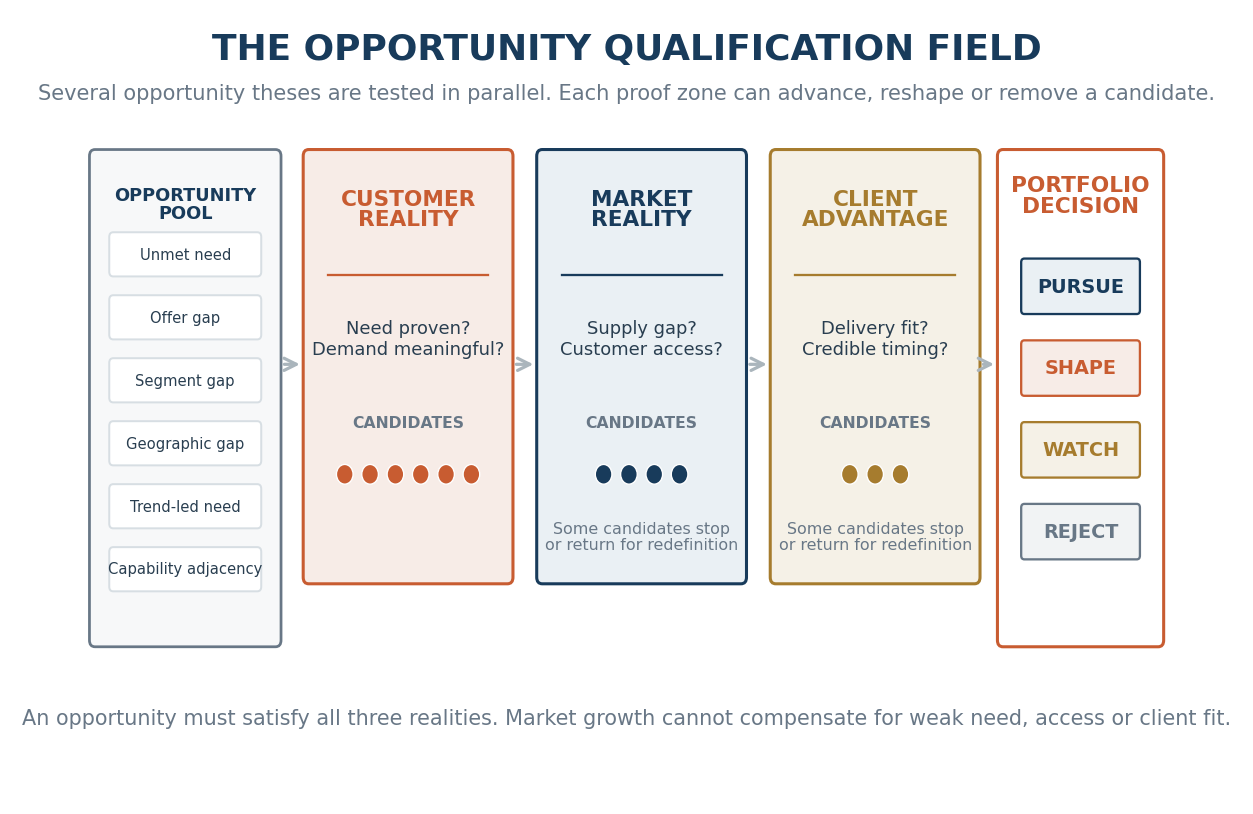
The methodology does not force every opportunity through one linear sequence. Multiple opportunity theses enter a shared field and are tested independently through customer reality, market reality and client advantage. Evidence can advance a candidate, reshape its definition or remove it from the portfolio.
How the field is controlled
- Every candidate is framed by product or service, customer, geography, channel and time horizon before comparison.
- Customer reality tests whether a persistent need and commercially meaningful demand can be substantiated.
- Market reality tests whether a genuine supply gap and practical route to the customer exist.
- Client advantage tests capability, credibility, economics and timing independently from market attractiveness.
- Weak evidence can return a candidate for narrower definition, place it on watch or remove it entirely.
PORTFOLIO PRINCIPLE A large or fast-growing market cannot compensate for an unproven need, poor customer access or weak client fit. A recommended opportunity must satisfy all three realities.
HOW THE RESEARCH IS CARRIED OUT
Build evidence around each opportunity thesis
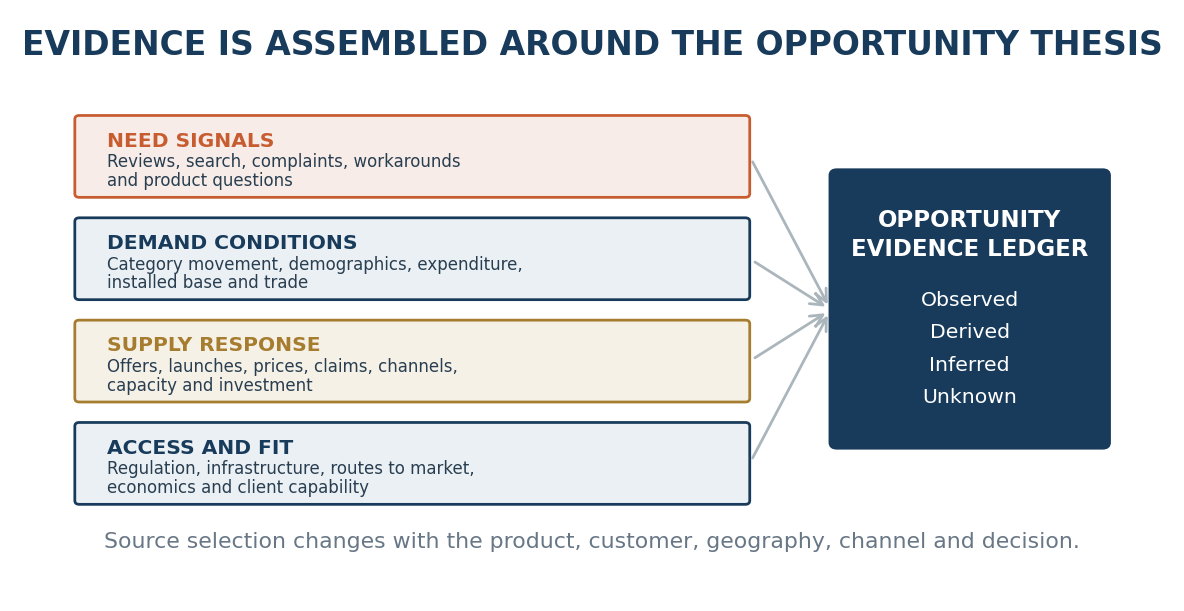
The research plan changes with the industry question. Consumer signals may matter most for a new format, while trade flows, installed base, regulation and channel structure may matter more for an industrial or geographic opportunity.
EVIDENCE LAYER | POTENTIAL EVIDENCE | WHAT IT ESTABLISHES |
|---|---|---|
Need and behaviour | Reviews, product questions, search behaviour, complaints, forums, workarounds and usage evidence | Need frequency, dissatisfaction and language used by customers |
Market and demand | Category data, demographics, expenditure, installed base, trade, tenders and forecast evidence | Addressable demand, momentum, location and scenarios |
Products and supply | Launches, assortment, pricing, specifications, claims, capacity, distribution and investment | Current alternatives, white spots and likely response |
Geographic readiness | Economic indicators, infrastructure, regulation, incentives, channel density and local conditions | Demand access, barriers and regional sequencing |
Client right to win | Existing portfolio, manufacturing, commercial reach, partnerships, credibility and constraints | Capability fit, gaps, economics and path to participation |
DATABASE SELECTION Open statistical, trade, regulatory, company and digital sources are combined with relevant licensed market, consumer, financial, product or traffic databases when they improve the decision. The source mix is selected for the assignment, not copied from a fixed checklist.
OPPORTUNITY QUALIFICATION
Separate commercial promise from evidence confidence
A high-potential idea can still be premature when important assumptions remain unproven. Each shortlisted opportunity therefore receives a proof card showing both its commercial logic and the strength of the supporting evidence.
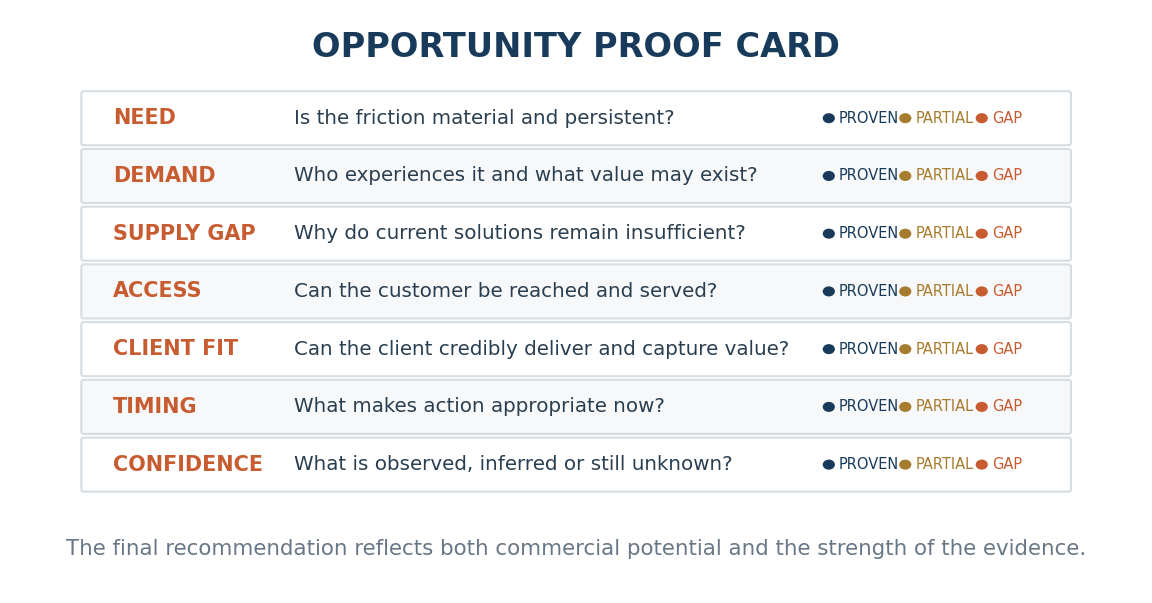
Four decision outcomes
Pursue: Evidence supports active commercial or development planning.
Shape: The opportunity is credible, but the proposition, segment, geography or delivery model requires refinement.
Watch: Signals are meaningful, but timing, scale or evidence strength does not yet support commitment.
Reject: The need, demand, supply gap, access or client fit does not withstand the evidence test.
What the client receives
- Opportunity universe and screening logic
- Unmet-need and current-workaround reconstruction
- Demand, supply-gap and geographic-readiness analysis
- Opportunity profiles with market estimates and scenarios where evidence permits
- Client right-to-win and capability-gap assessment
- Evidence ledger separating observed, derived, inferred and unknown elements
- Pursue, shape, watch or reject portfolio with decision conditions
- Focused validation questions for any remaining uncertainty
QUANTIFICATION RULE Market values, growth rates and forecasts are included where the available evidence can support them. Precision is not manufactured when the market is emerging, fragmented or poorly defined.
WHY AUGUST RESEARCH
Opportunity research built to challenge the growth thesis
August Research combines tech-led research pipelines with expert analysis to search broadly, investigate the strongest candidates and connect external evidence with a practical business decision. Each engagement is customised around the client's market, capabilities and level of uncertainty.
Decision-led design: The search boundary and success conditions are defined before opportunities are collected.
Cross-industry discovery: Signals and comparable business models can be examined across pharmaceuticals and life sciences, chemicals, materials and energy, mobility, industrial technology, telecommunications, food and home care, engineering, packaging and medical devices.
Structured signal mining: Large evidence sets can be searched and organised using technology-assisted workflows, followed by analyst review and interpretation.
Visible reasoning: Every recommendation retains its need logic, evidence trail, assumptions, uncertainties and rejection conditions.
Right-sized delivery: The depth of research, number of opportunities and geographic coverage are matched to the decision rather than forced into a standard report.
Why an independent assessment matters
Internal teams may be influenced by existing products, preferred technologies or markets already familiar to the organisation. An independent assessment applies the same evidence thresholds to familiar and unfamiliar growth spaces, challenges optimistic assumptions and shows when a promising narrative lacks demand, access or client fit.
ENGAGEMENT FORMAT | BEST USED WHEN | OUTPUT EMPHASIS |
|---|---|---|
Focused opportunity test | One product, customer need or geography is already under consideration | Qualification field, demand logic and decision recommendation |
Opportunity universe | The client wants to identify and compare several growth spaces | Candidate map, screening, proof cards and portfolio |
Ongoing opportunity watch | Signals and assumptions may change before investment | Trigger ledger, targeted updates and decision refresh |
AUGUST RESEARCH VALUE The client receives fewer unsupported possibilities and a clearer explanation of where unmet demand exists, why it matters and what must be true before committing resources.
APPLICATIONS
Illustrations
Each illustration begins with a real industry question and uses a different opportunity origin, evidence architecture, geography and qualification logic.
INDUSTRY | INDUSTRY QUESTION | OPPORTUNITY LOGIC |
|---|---|---|
Specialty chemicals | Is there an unmet need for low-odour, rapid-return floor repair systems for occupied hospitals in the Gulf states? | Product requirement and operating-constraint opportunity |
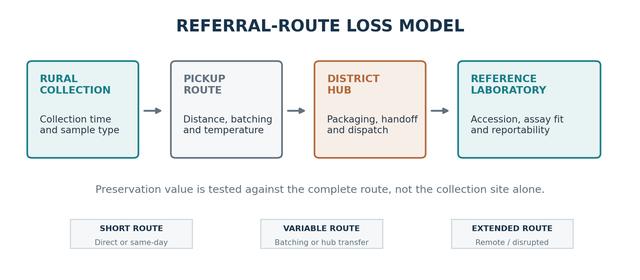
Healthcare diagnostics | Could ambient-stable sample preservation kits improve access for rural diagnostic networks in East Africa? | Access-gap and infrastructure opportunity |
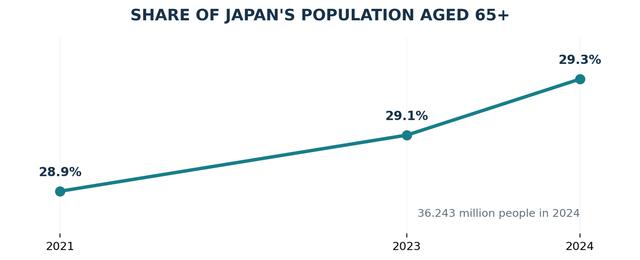
Food and nutrition | Is there a viable opportunity for protein-rich savoury snacks designed around the needs of older adults in Japan? | Demographic and usage-occasion opportunity |
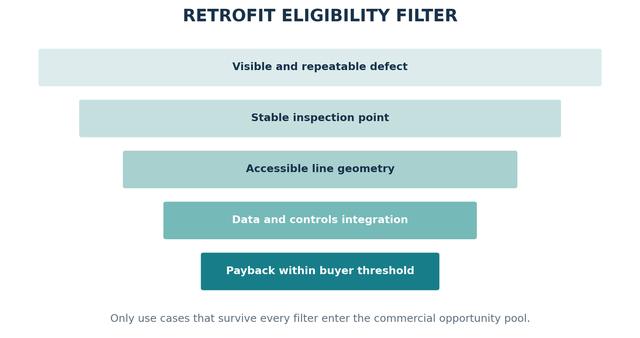
Industrial automation | Could modular machine-vision retrofit packages serve mid-sized food processors in Central Europe that cannot justify full-line replacement? | Underserved segment and capability-adjacency opportunity |
Commercial mobility | Is there an opportunity for independent battery-health certification for used electric commercial vans in the UK and Benelux? | Trust-gap and service-model opportunity |
What each illustration will demonstrate
- The business background and reason the opportunity needs assessment
- How the opportunity was framed by product, customer, geography, channel and time horizon
- A research approach and evidence mix designed for that specific question
- Relevant visuals such as unmet-need maps, demand curves, geographic heat maps, supply-gap views and opportunity portfolios
- Commercial estimates, growth assumptions or forecasts only where the evidence supports them
- A conclusion explaining what should be pursued, shaped, watched or rejected and why
PRACTICAL QUESTIONS
FAQ
How is this different from Market Sizing and Forecasting?
Market Sizing and Forecasting estimates the scale and development of a defined market. Market Opportunity Assessment determines which unmet needs, segments, offers, adjacencies or geographies are worth considering and whether the client can credibly pursue them.
How is this different from Market Entry Assessment?
Market Opportunity Assessment helps decide whether a growth space or geography deserves pursuit. Market Entry Assessment begins after a market has been selected and determines how the company should enter, compete and operate there.
Can the assessment begin without a product idea?
Yes. The study can begin with a capability, customer group, broad growth objective or emerging trend and construct an opportunity universe before individual candidates are tested.
Does every opportunity need a market-size estimate?
No. Quantification is used when the market can be defined and supported with sufficient evidence. Early or fragmented opportunities may be better represented through ranges, scenarios, demand proxies and explicit uncertainty.
Can client information be included?
Yes. Internal portfolio, customer, operational and commercial information can be incorporated to strengthen the right-to-win assessment, while remaining separate from externally observed evidence.
What happens when secondary evidence is insufficient?
The gap remains visible. The final output can specify the exact assumptions that require later validation through customer, industry or expert research rather than presenting them as established facts.
Contact Us
START WITH THE GROWTH DECISION Tell us what kind of growth you are considering, the capabilities already available and the assumptions creating uncertainty. August Research will define the opportunity universe, evidence architecture and qualification method around that decision.