MARKET & BUSINESS INTELLIGENCE | SECONDARY RESEARCH
Company
Profiling
Build a complete, decision-ready understanding of a startup, private company, public corporation, subsidiary, family-owned business or conglomerate.
Know the company behind the name
Company information is usually scattered across registrations, websites, filings, investor records, product material, facilities, hiring activity, transactions and announcements. August Research reconstructs these fragments into one coherent profile that explains what the company is, how it operates, what it can do, where it is moving and why it matters to the client.
CORPORATE REALITY
Identity, ownership, structure and operating boundary
BUSINESS REALITY
Model, capabilities, customers, footprint and relationships
STRATEGIC REALITY
Direction, momentum, constraints and decision relevance
Questions the service can resolve
- Who controls the company, and which entities actually own the relevant assets or operations?
- How does the company make money, serve customers and organise its value chain?
- What capabilities are operating today, and which remain announced, planned or inferred?
- Where are investment, hiring, partnerships, acquisitions or facilities changing its direction?
- What does the company represent as a competitor, partner, customer, target or market participant?
SERVICE FOCUS The aim is comprehensive coverage of the company, organised around the business decision so important evidence is not buried inside a long corporate description.
ENTITY ARCHITECTURE
Different companies leave different evidence trails
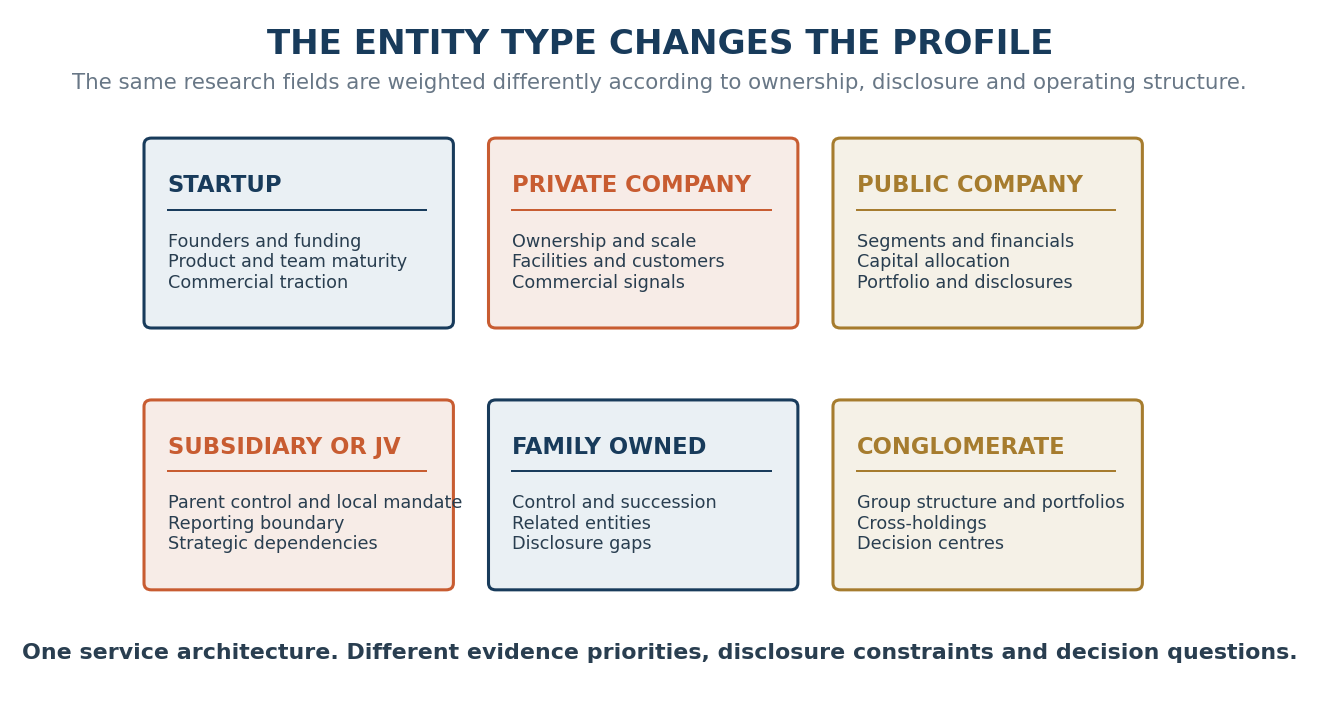
A startup cannot be profiled through the same disclosure expectations as a listed corporation. A subsidiary cannot be understood without its parent, and a conglomerate cannot be reduced to one business description. The study design changes before research begins.
The boundary is defined before facts are collected
Entity boundary: Legal company, trading name, parent, subsidiary, joint venture and related entities included in the study.
Business boundary: Products, services, business units, value-chain roles and revenue activities being profiled.
Geographic boundary: Operating locations, registered entities, commercial reach and jurisdiction-specific records.
Time boundary: Current profile, historical development and the observation window used for strategic signals.
WHY THE BOUNDARY MATTERS Without entity resolution, a parent announcement may be attributed to the wrong subsidiary, group revenue may be confused with a business unit, or a planned capability may be treated as operational.
CORE METHODOLOGY
The Company Decision Dossier
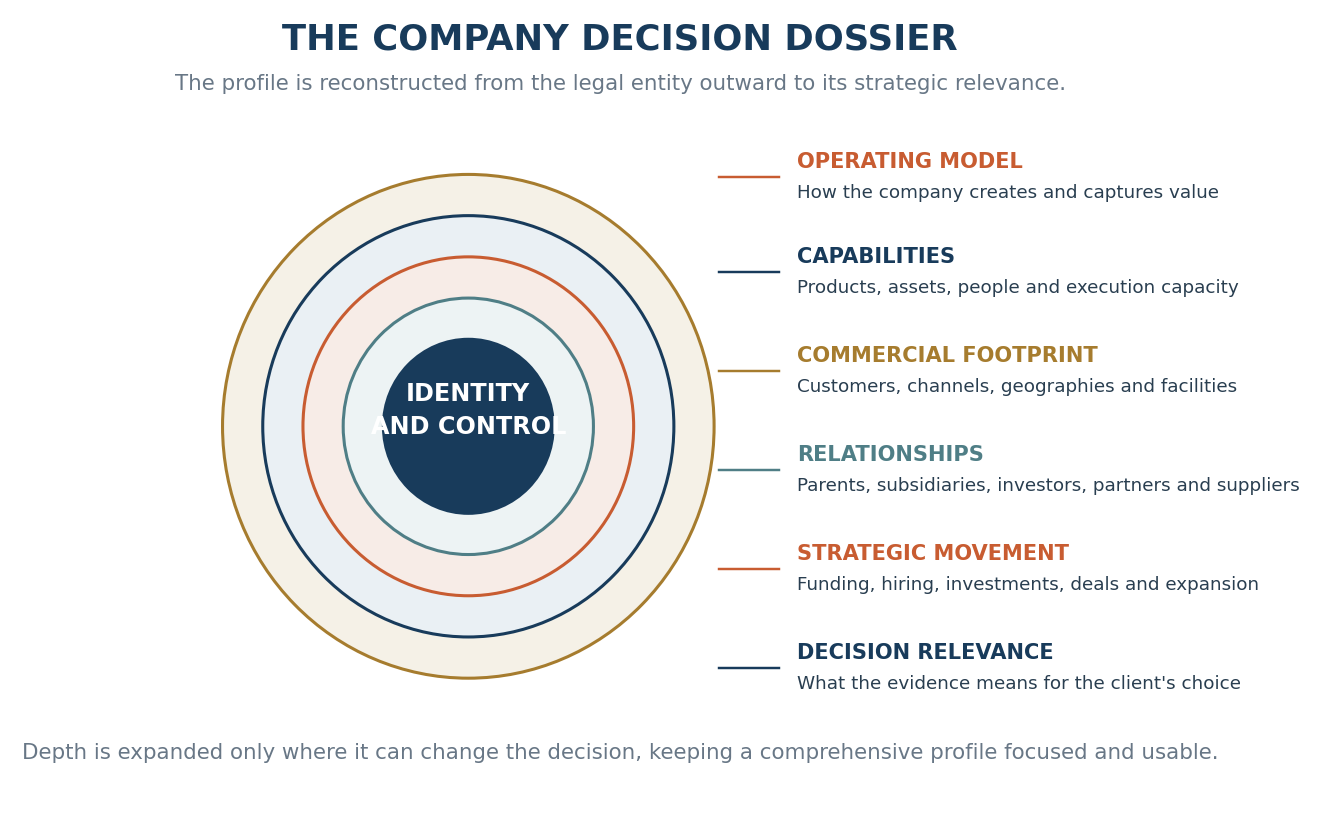
The dossier is assembled from the company outward. Each layer must be supported before it is used to interpret strategic direction or relevance to the client.
DOSSIER LAYER | RESEARCH PURPOSE |
|---|---|
Identity and control | Resolve the legal entity, ownership, governance, parent relationships and corporate history. |
Operating model | Explain how value is created, delivered and monetised across products, services and business units. |
Capabilities | Identify operating assets, technology, people, facilities, channels and execution dependencies. |
Commercial footprint | Map customers, sectors, routes to market, locations and visible scale indicators. |
Relationships | Connect investors, subsidiaries, partners, suppliers, distributors, acquisitions and joint ventures. |
Strategic movement | Read dated signals across funding, hiring, investment, deals, launches and expansion. |
Decision relevance | Translate the reconstructed company into implications, questions and action priorities. |
METHOD PRINCIPLE No single data source defines the company. The profile is built by reconciling legal identity, corporate reporting and observable operating signals.
RESEARCH EXECUTION
How the company is reconstructed
The research programme is designed around a named company and decision. It does not begin by filling a fixed corporate template.
RESEARCH MOVE | HOW IT IS CARRIED OUT | OUTPUT CREATED |
|---|---|---|
Frame the decision | Define why the company is being profiled, who will use the work and which unknowns could change the decision. | Decision brief and priority questions |
Resolve the entity | Match names, registrations, parents, subsidiaries, historical entities, brands and operating locations. | Verified entity and ownership map |
Reconstruct the business | Connect business model, portfolio, capabilities, customers, channels, facilities and geographic activity. | Operating and commercial profile |
Read corporate movement | Sequence funding, hiring, investments, transactions, partnerships, launches and footprint changes over time. | Strategic signal chronology |
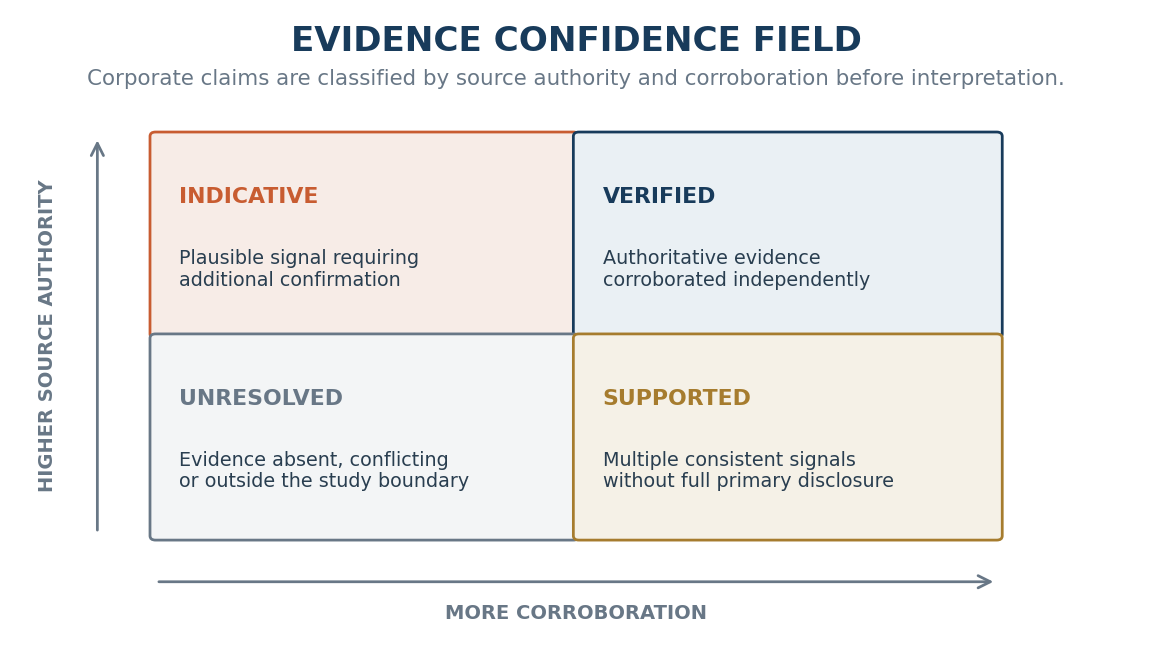
Test consistency | Compare claims against independent evidence and classify conflicting, missing or weakly supported information. | Evidence confidence field |
Translate for action | Explain what the company means for the client's partnership, competition, acquisition, investment or account decision. | Decision dossier and next-step questions |
Profile depth follows materiality
A commercial partnership profile may emphasise ownership, capability, customers and delivery footprint. An acquisition screening profile may require deeper corporate structure, financial performance, portfolio, management and transaction history. A competitor profile may focus on operating model, strategic activity and market presence.
SCOPE DISCIPLINE Comprehensive does not mean indiscriminate. A field is expanded when it can explain the company or change the decision; irrelevant data is not added merely to increase page count.
EVIDENCE ARCHITECTURE
Use the source that can answer the company question
Source selection changes with the entity type, jurisdiction, disclosure level and decision. Public records and licensed databases are combined only where they improve identity resolution, completeness or confidence.
EVIDENCE GROUP | POTENTIAL SOURCE COVERAGE |
|---|---|
Legal identity and ownership | National company registries, official filings, ownership records, OpenCorporates and D&B Hoovers where relevant |
Financial and corporate | Annual reports, securities filings, investor material and licensed financial databases selected for the market |
Startup and transactions | Funding, investor and deal databases such as PitchBook, Crunchbase, Tracxn or CB Insights where relevant and available |
Operations and footprint | Facility records, planning documents, tenders, trade evidence, product catalogues and location disclosures |
People and capability | Leadership histories, workforce profiles, career pages, job postings and organisational disclosures |
Strategy and market signals | Partnerships, acquisitions, launches, conferences, media coverage, executive statements and dated company announcements |
CONFIDENCE RULE Missing information is recorded as an unresolved evidence gap. It is not converted into a negative conclusion about the company.
OUTPUTS
A profile designed to be used, not merely read
The final package combines a concise corporate view with supporting maps, timelines and evidence structures. Output depth depends on whether the work concerns one company, a corporate group or a short target universe.
UNDERSTAND
See the company, its structure and operating reality in one place
INTERROGATE
Separate verified facts, supported signals and unresolved questions
DECIDE
Connect corporate evidence with the client's next action
What the client can receive
- Executive company profile and decision summary
- Legal entity, ownership, subsidiary and corporate relationship map
- Business model, portfolio, customer and route-to-market reconstruction
- Capability, asset, facility and geographic footprint map
- Leadership, workforce and hiring signal profile
- Funding, investment, partnership, acquisition and expansion timeline
- Financial and operating indicator sheet where evidence supports it
- Evidence confidence register and unresolved-question list
- Strategic implications for the client's specific decision
Delivery formats
FORMAT | BEST SUITED FOR |
|---|---|
Single-company dossier | A deep profile of one company, corporate group or subsidiary |
Company portfolio | Consistent profiles for a selected target, partner, customer or competitor universe |
Refreshable profile | A structured profile with selected corporate signals updated over an agreed period |
DELIVERY PACKAGE Outputs can be supplied as an editable company dossier, relationship map, evidence workbook, visual summary and executive presentation.
WHY AUGUST RESEARCH
A company profile that explains the organisation
A database record can identify a company. A decision dossier must resolve the entity, reconstruct how it operates and test what its actions mean. August Research builds the profile around that wider responsibility.
Entity-specific design: The research fields change for startups, private companies, listed corporations, subsidiaries, family-owned businesses and conglomerates.
Cross-source reconstruction: Legal, financial, commercial, workforce, transaction, facility and market evidence is connected into one company narrative.
Independent interpretation: Corporate claims are tested against observable signals, reducing reliance on internal assumptions or promotional descriptions.
Geographic research: Local registries, jurisdiction-specific records and local-language evidence can be incorporated when the company operates across markets.
Visible uncertainty: Contradictions and information gaps remain visible, preventing weak evidence from being presented as certainty.
Decision translation: The final profile explains why the company matters and which questions, risks or actions should follow.
Why commission the work externally?
Internal teams often know the company through one relationship, market or business function. Independent research can examine the organisation across jurisdictions and evidence types, challenge familiar narratives and separate what the company says from what its observable actions support.
Frequently combined with
- Competitive Business Benchmarking
- Market Opportunity Assessment
- Investment & Opportunity Research
- Partner / Vendor Evaluation
- Market Entry Assessment
AUGUST RESEARCH VALUE The client receives a structured view of the company, the evidence behind that view and a clear explanation of what the organisation means for the decision at hand.
APPLICATIONS
Illustrations
The examples below show how profiling depth, evidence fields and visual outputs change with the company type and business decision.
INDUSTRY | COMPANY QUESTION | PROFILE EMPHASIS |
|---|---|---|
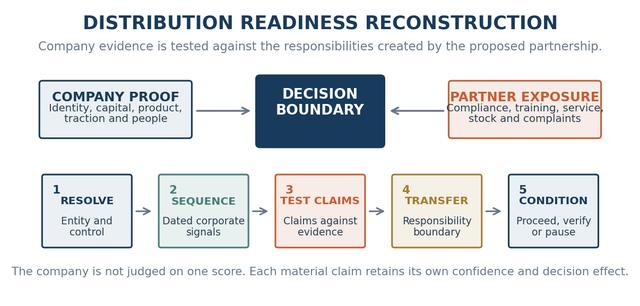
Medical technology | Is a Nordic remote-monitoring startup sufficiently established for a German distribution partnership? | Founder and ownership map, funding and product chronology, regulatory position, team build, customer signals and partner readiness |
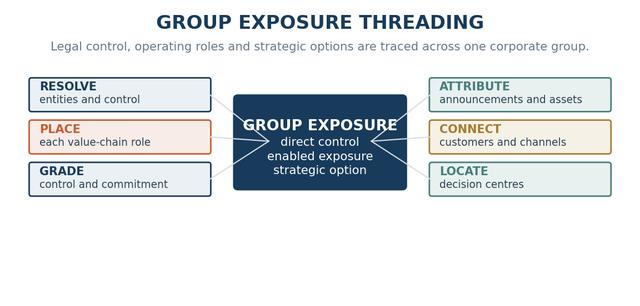
Commercial mobility | How exposed is a Southeast Asian conglomerate to the electric two-wheeler value chain across its subsidiaries and joint ventures? | Group structure, portfolio exposure, capital commitments, manufacturing footprint, partnerships and decision centres |
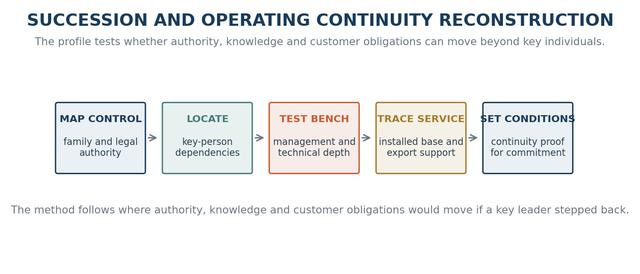
Industrial machinery | Does a family-owned packaging-equipment manufacturer in Northern Italy have the export, service and leadership depth required for acquisition screening? | Ownership and succession, installed-base reach, service network, facilities, management depth and transaction questions |
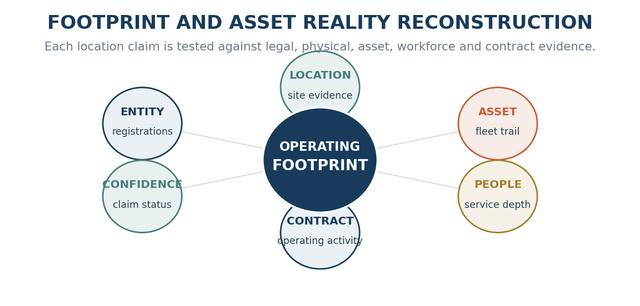
Cold-chain logistics | Can an East African private cold-chain operator support regional pharmaceutical distribution at scale? | Entity history, fleet and depot footprint, healthcare contracts, financing, operating partners and expansion evidence |
Specialty chemicals | How is a listed South Korean materials company repositioning its portfolio toward semiconductor applications? | Business segments, capital allocation, product portfolio, facility investment, technical hiring, partnerships and strategic movement |
Profiles shaped by the organisation
A startup profile can centre on founders, funding and commercial traction. A conglomerate profile can centre on ownership, portfolio exposure, operating entities and decision centres. Each engagement therefore produces a different corporate evidence story, even though every profile is governed by the same confidence standards.
EVIDENCE DISCIPLINE Numbers, relationships and corporate signals are used only when the available evidence can support them. Missing information remains visible as an unresolved question.
PRACTICAL QUESTIONS
FAQ
Can you profile a startup with limited public information?
Yes. The research will use ownership, founder history, funding, hiring, product, regulatory, partnership and commercial signals where relevant. Any remaining gaps will be stated clearly rather than filled with unsupported assumptions.
Can the service cover a complete conglomerate?
Yes. The profile can map the parent, major subsidiaries, business portfolios, ownership relationships, geographic operations and decision centres. The depth of each business unit is set by the client's decision.
Can several companies be profiled together?
Yes. A consistent company portfolio can be created for a target, partner, customer or competitor universe. This remains profiling unless the purpose is to compare and score the companies against common measures.
How is this different from Competitive Business Benchmarking?
Company Profiling reconstructs each organisation in depth. Competitive Business Benchmarking compares several companies through common definitions, metrics and normalized corporate signals.
Does the profile include financial information?
Where relevant and supportable, it can include revenue, growth, profitability, funding, valuation signals, capital allocation or other financial indicators. Private-company estimates remain clearly distinguished from reported figures.
Does this replace legal, financial or investment due diligence?
No. The service provides structured business intelligence from available evidence. It does not provide legal verification, an audit, a credit rating, a valuation opinion or investment advice.
Can a company profile be updated?
Yes. Ownership, leadership, funding, transactions, hiring, facilities, launches and other selected signals can be structured for periodic or event-led refresh.
Contact Us
START WITH THE COMPANY Tell us which company, startup, subsidiary or corporate group you need to understand and which decision the profile must support. August Research will define the entity boundary, evidence architecture, profile depth and delivery format around that requirement.