R&D & INNOVATION / SECONDARY RESEARCH
Technology Landscape Analysis
A transparent evidence system for deciding where a technology space is heading, what is credible today, and where attention is justified next.
DECISION USE
Prioritise, monitor, investigate, validate or defer technology pathways.
EVIDENCE BASE
Structured databases, curated sources and a client-specific technology taxonomy.
DELIVERY STYLE
Decision-ready map, evidence trail and practical next actions.
When the technology question is bigger than a single source
Technology decisions rarely fail because information is unavailable. They fail because patents, scientific papers, company claims, regulatory developments and commercial signals are viewed separately, or treated as equally reliable. A technology landscape brings those fragments into one bounded, decision-specific view.
August Research develops a tailored evidence architecture around the client’s question. The work does not aim to produce an exhaustive catalogue. It is designed to show the pathways, participants, maturity signals, gaps, contradictions and conditions that matter to a defined R&D, investment, partnership or product-development decision.
Questions this service is designed to answer
- Which technology pathways are established, emerging, adjacent or still speculative?
- Where is activity concentrating, and where is evidence of real application still limited?
- Which companies, research groups, suppliers, investors or institutions shape the ecosystem?
- What technical, commercial, regulatory or supply-chain conditions may constrain adoption?
- Where is the evidence coherent, where is it conflicted, and what requires primary validation?
- What should the client prioritise, monitor, investigate further, validate externally or set aside?
The August Research technology landscape methodology
Each engagement follows a systematic but adaptable research sequence. The sequence begins with the client’s objective, moves through structured discovery and application-level assessment, and ends with a traceable evidence database and a decision-focused presentation. The steps below are tailored to the technology, industry and decision rather than applied as a generic market-research checklist.
Clarify the objective, intended decision, technology boundary, use cases, geographies, time horizon, stakeholder priorities and explicit exclusions.
Develop the landscape taxonomy and search framework. Break the topic into mechanisms, materials, components, processes, performance attributes, applications and adjacent alternatives.
Find existing and emerging technology routes together with commercial solutions, products, pilots and relevant developers. Capture technical principle, process, composition, claimed performance and development status.
Map the landscape by end use, application, value-chain position, performance need and adoption level. Identify established, developing and high-potential segments.
Compare where and why one route may replace, complement or fail to displace another. Assess switching triggers and barriers such as cost, speed, compliance, infrastructure, substrate, scale, integration and qualification burden.
Identify relevant participants across the value chain, including raw-material suppliers, technology developers, equipment providers, formulators, OEMs, integrators, converters, research groups and investors.
Deep-dive selected organisations against technology strength, evidence quality, commercial presence, development stage, application fit, partnerships and the client’s strategic requirements.
Cross-check findings across source types, record contradictions and evidence gaps, and prioritise technologies, applications or organisations using client-specific criteria and confidence labels.
Prepare a structured evidence database and a decision narrative covering the methodology, landscape, benchmarks, application map, ecosystem, implications and recommended next actions.
How the research is executed
The working method can be presented on the website as a six-stage evidence flow. Each stage shows both the research activity and the working output produced before the evidence moves to the next stage.
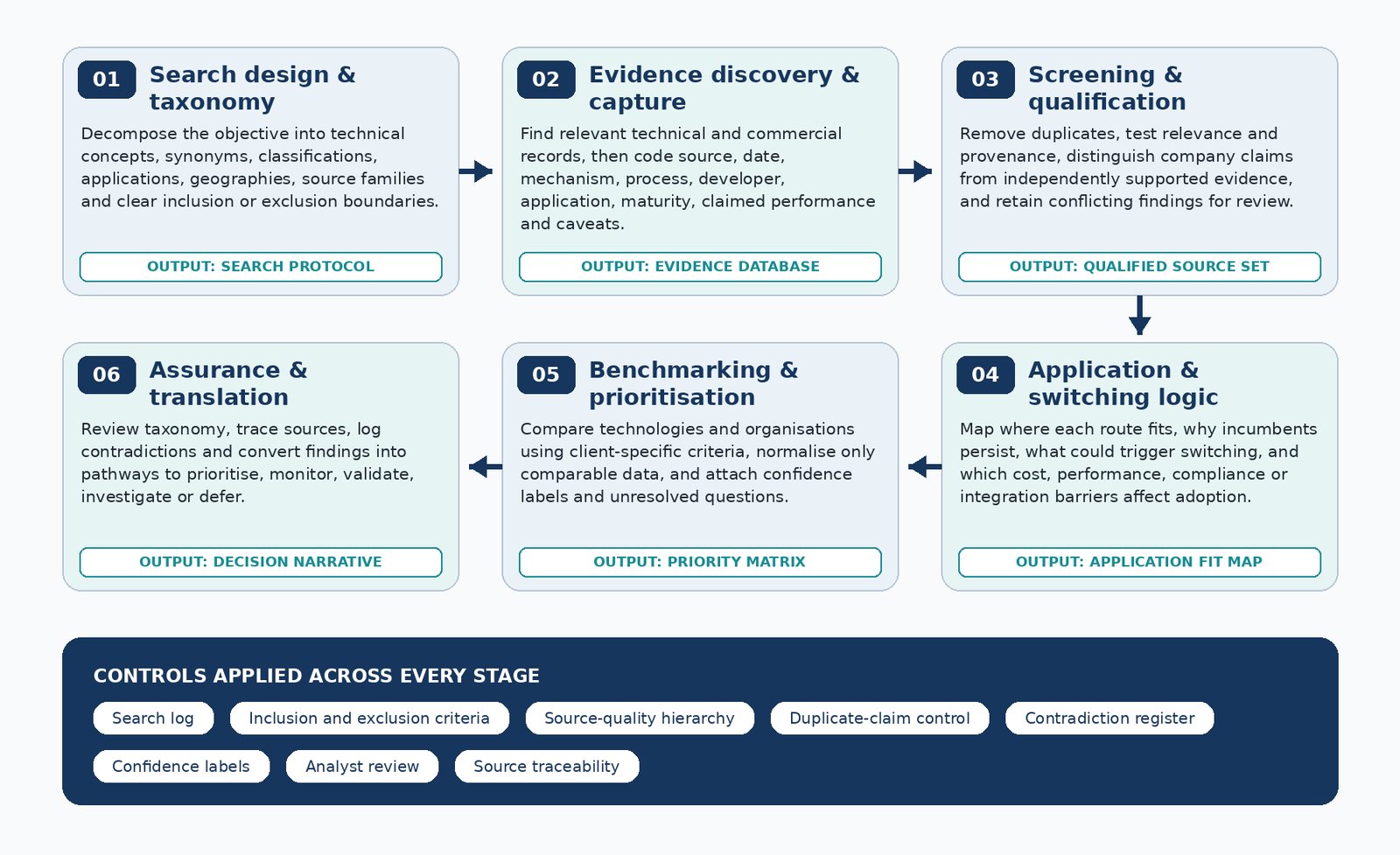
WEBSITE PRESENTATION SUGGESTION
Desktop: present the six boxes as a connected serpentine flow. Hovering over a stage reveals the fuller methodology, example research fields and its working output. Keep the methodological-controls band visible beneath the flow. Mobile: convert the same content into a vertical sequence of expandable cards, retaining the order and control labels.
Source architecture and evidence controls
The source mix is chosen for the question, not applied as a standard checklist. A materials landscape, for example, may require publications, patents, standards, supplier data and pilot evidence. A digital-health landscape may place greater weight on clinical evidence, regulatory records, product documentation and reimbursement signals.
DISCOVER
Patents, literature, standards, regulatory records, company materials, technical documents, partnerships, investment and credible trade sources.
CROSS-CHECK
Use source triangulation, date checks, taxonomy review and conflict logging to avoid treating repeated claims as independent evidence.
INTERPRET
Apply clear labels for established evidence, developing signals, unsupported claims and questions requiring primary research or validation.
What the output can look like
The final format is selected around the decision. The working evidence base and executive narrative are normally separated so that technical teams can interrogate the records while decision-makers can focus on implications.
- Technology pathway map showing mechanisms, components, applications and enabling conditions.
- Maturity and evidence-strength view distinguishing demonstrated activity from early claims or speculative routes.
- Ecosystem map of relevant developers, research institutions, suppliers, partners and investors.
- Signal timeline covering publications, patent activity, product releases, partnerships, standards or regulatory milestones.
- Opportunity and risk view identifying dependencies, adoption friction, evidence gaps and areas requiring validation.
- Executive decision brief setting out the implications, priority questions and recommended next actions.
TYPICAL DELIVERY PACKAGE
Evidence database
An Excel-based research database containing the project taxonomy, screened records, source links, technical fields, application mapping, organisation profiles, benchmark variables, evidence notes and prioritisation fields.
Decision presentation
A PowerPoint presentation explaining the scope, methodology, technology landscape, commercial solutions, application segments, switching logic, ecosystem, priority findings, evidence gaps and recommended actions.
Why August Research
August Research does not present a landscape as a static collection of documents or an automated chart. We begin with the decision that needs to be made, construct the taxonomy around that decision, and make the route from source evidence to interpretation visible. This helps teams challenge the analysis, reuse it internally and update it as the technology changes.
DECISION-LED TAXONOMIES
The structure is built around the client’s strategic question, not a pre-set market category.
TRACEABLE INTERPRETATION
Each conclusion can be linked back to source families, assumptions, evidence gaps and areas of disagreement.
RESEARCH THAT CONNECTS
Technical, IP, regulatory, company and ecosystem signals are considered together when the scope calls for it.
Scope boundaries
Technology Landscape Analysis is secondary research. It can inform technology, R&D, partnership and investment choices, but it does not by itself establish technical performance, legal freedom to operate, regulatory approval, commercial success or a universal market conclusion. Where the evidence is insufficient, the output identifies the specific questions that may require expert interviews, laboratory work, field validation, legal analysis or other primary research.
Frequently combined with
- Scientific Literature Review
- Patent Landscape Research
- Competitive Technology Benchmarking
- Emerging Technology Assessment
- Regulatory & Standards Intelligence
- Technology Scouting
Illustrative engagements
The following five hypothetical topics will appear as floating clickable placards on the service page. Each placard will open a separate Phase 2 illustrative page containing the full challenge, methodology, evidence structure, findings and visual output.
INDUSTRY | ILLUSTRATIVE ENGAGEMENT | DECISION PREVIEW |
|---|---|---|
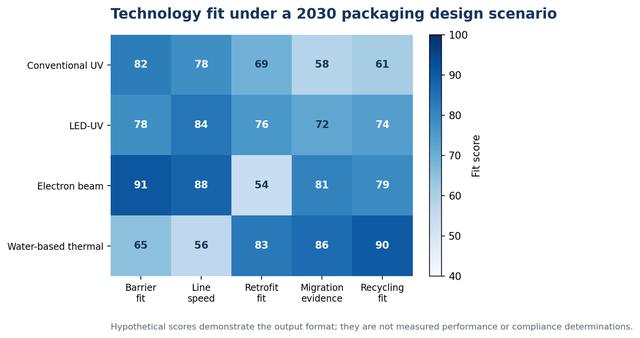
FMCG + Chemicals | Energy-curable coatings for packaging and electronics | Which UV, LED-UV or electron-beam routes best fit priority applications, equipment constraints and changing compliance needs? |
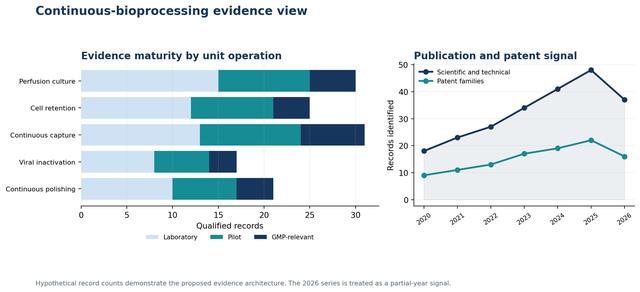
Biotech + Pharma | Continuous bioprocessing technologies for biologics | Which upstream and downstream routes show the strongest maturity evidence and the most relevant equipment and service ecosystem? |
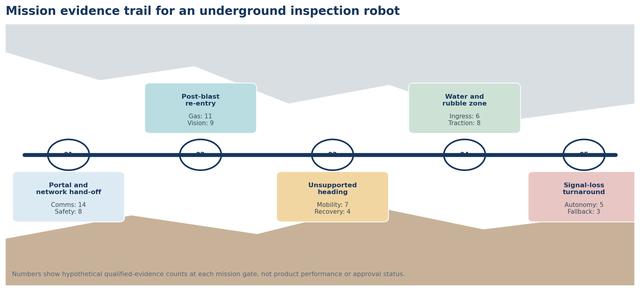
Robotics + Mining | Autonomous inspection and maintenance systems for underground mines | Which combinations of locomotion, sensing, communications and autonomy are suited to harsh underground operating conditions? |
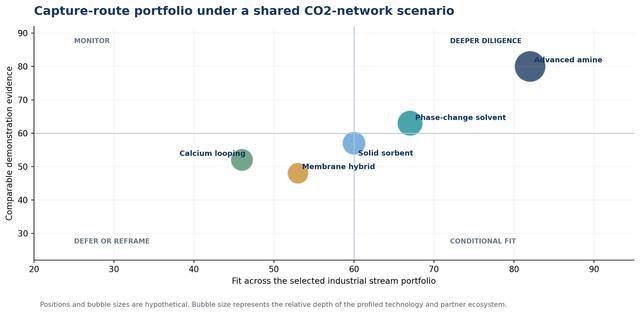
CCUS + Oil & Gas + Raw Materials | Carbon-capture pathways for low-concentration industrial exhaust | Which solvent, sorbent, membrane, mineralisation or hybrid routes align with specific exhaust conditions and integration constraints? |
Automotive + Transportation | Thermal-management technologies for high-duty commercial electric vehicles | Which cooling architectures and enabling materials are most relevant to high-load duty cycles and vehicle-integration requirements? |
Note: These are hypothetical engagement concepts for website illustration. They are not client projects or actual research findings. Any eventual methods, numerical values, timelines, contributors and outputs will remain illustrative and will depend on the final scope and availability of relevant evidence.
WEBSITE PRESENTATION SUGGESTION
Present these five entries as floating clickable placards on the service page. Each placard should show the industry tag, illustrative title and one-line decision preview. Selecting a placard opens the complete Phase 2 illustrative page. Desktop can use a staggered grid with subtle hover elevation; mobile can use a swipeable carousel or stacked cards.
Frequently asked questions
How is this different from a patent landscape?
A patent landscape focuses on IP activity and claims. A Technology Landscape Analysis can include patents, but also connects them with scientific, regulatory, company, ecosystem and application signals relevant to the decision.
Can the work focus on a narrow component or process?
Yes. The scope can be tightly defined around a material, component, manufacturing process, formulation, use case, technology mechanism or adjacent substitute.
Will the service use a fixed database?
No. August Research maintains and develops its research databases and monitoring structures over time, but the source architecture is tailored to the project scope and decision question.
Can the landscape be updated?
Yes. The original taxonomy, source logic and evidence trail can support focused refreshes, watchlists or follow-on assessment as the field evolves.
Can commercial solutions and potential partners be included?
Yes. The landscape can identify commercial products, suppliers, developers, equipment providers, integrators and other potential partners. Profiles and prioritisation criteria are adjusted to the client’s technical and strategic requirements.
What information is useful at the start?
Useful inputs include the decision to be supported, priority applications, incumbent technologies, known alternatives, performance requirements, relevant geographies and any internal hypotheses that the research should test.
How long can a study take?
A focused landscape may take approximately three to five weeks, while a broad multi-technology or multi-region study may require six to ten weeks. Actual timing depends on scope, source accessibility, taxonomy complexity and the depth of organisation profiling required.
Let’s discuss your technology question
If your team needs to decide whether to pursue, partner, monitor, validate or deprioritise a technology pathway, August Research can design a landscape around the evidence required for that decision.