SERVICE OVERVIEW SECONDARY RESEARCH
Strategic Business Intelligence
Connect market competitor company regulatory operational and financial evidence around a defined executive decision
Decision supported What is changing around the decision, how material is the change to the business, which response is supported, and what should management monitor before committing further resources?
Strategic decisions often depend on information held across different markets, functions and source systems. Market growth may appear favourable while regulation, customer behaviour, competitor investment or operating constraints point in another direction. A conventional market report or dashboard may describe each signal without explaining how they change the decision.
August Research conducts independent secondary research around a specific executive question. The work connects external developments with the organisation's choices, assumptions and exposure, then determines which evidence is strong enough to influence action.
The service can support a one-time decision, a recurring management question or an intelligence requirement that must be monitored as conditions change. Its purpose is not to collect the greatest volume of information. Its purpose is to identify the evidence that changes what management should do.
FRAME CONNECT CHALLENGE INTERPRET CONTROL
The result is a decision record with a supported response and explicit conditions for revision.
When Strategic Business Intelligence is needed
Decision situation | Management question | Intelligence emphasis |
|---|---|---|
Conflicting market signals | Which evidence should management trust? | Source authority, definition, timing, independence, consistency and decision consequence |
Cross functional decision | How do commercial operational regulatory and financial conditions interact? | A common decision frame that connects evidence produced by different teams and external sources |
Emerging disruption | Is the development material now or only a possibility? | Signal maturity, transmission path, exposure, timing, response options and early warning indicators |
Time sensitive choice | What can be decided now and what must remain conditional? | Minimum evidence thresholds, unresolved assumptions, pressure cases and reversible next actions |
Continuing uncertainty | Which developments should trigger a review of the strategy? | Defined indicators, trigger levels, ownership, monitoring frequency and escalation rules |
What makes the service different
Strategic Business Intelligence is organised around the client's decision rather than a standard market, industry or competitor report. Several intelligence lenses may be used, but only when they help resolve the same question and time horizon.
The service is also different from a business intelligence implementation. August Research does not begin by building data infrastructure or reporting historical performance. It reconstructs the external and internal evidence required for a strategic choice, tests the implications and specifies how the conclusion should be controlled over time.
The work can inform corporate strategy, capital allocation, commercial priorities, product and innovation decisions, supply and operating plans, partnerships, regulatory preparation and risk management. It supports management judgement rather than replacing it.
Our methodology
Decision Evidence Lattice
The methodology begins with one decision core and connects only the evidence streams that can change it. Each stream is examined independently before the relationships between them are tested. This prevents a strong signal in one area from concealing a failure condition elsewhere.
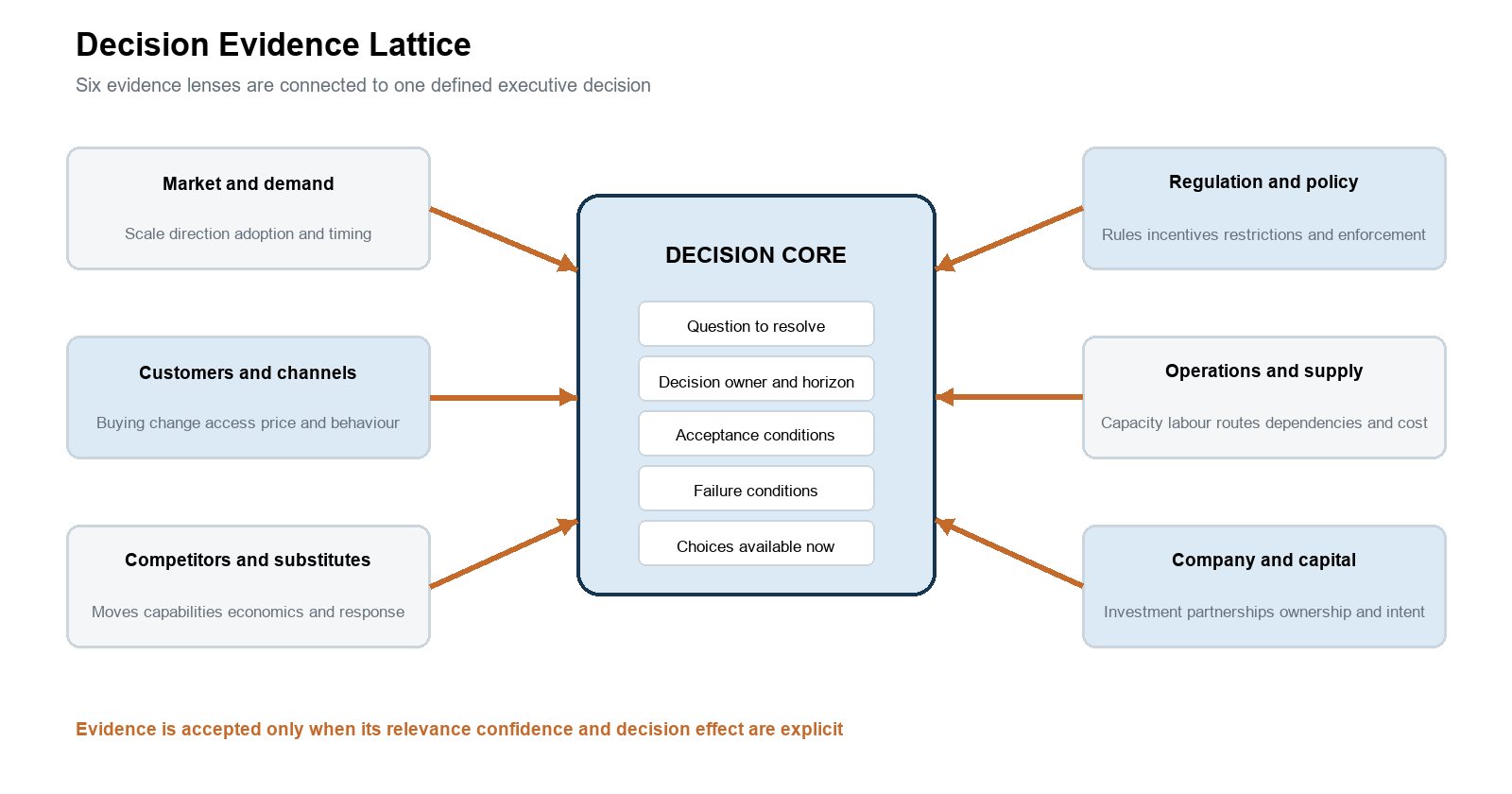
The lattice changes with the question. A pricing decision may emphasise customer purchasing, competitor economics and channel power. A capacity decision may place more weight on demand timing, supply constraints, regulation and competitor investment. The method preserves a common decision logic without forcing every assignment into the same research sequence.
How the analysis is completed
Define the decision core
The engagement begins by stating the decision, owner, time horizon, available choices and level of commitment. The current management view is converted into assumptions that can be tested. Acceptance conditions describe what must be true for a choice to proceed, while failure conditions identify evidence that would make the choice unsuitable.
Information requirements are then defined around the decision. This prevents broad information collection and makes it possible to explain why each source, metric or signal is included.
Construct the evidence lattice
Relevant market, customer, competitor, company, regulatory, operational and financial evidence is collected from public, licensed and client-supplied sources. Each item is recorded with its definition, date, geography, source authority and relationship to the decision.
Evidence streams are first analysed separately, then connected through a cause-and-effect view. The analysis asks how a development could transmit into demand, price, cost, access, capacity, timing, risk or strategic freedom.
Challenge the interpretation
Conflicting sources are not averaged automatically. Differences are examined for scope, timing, methodology, incentives and independence. A contradiction record shows which interpretation was accepted, which remained unresolved and whether the disagreement changes the recommendation.
The leading interpretation is tested against alternative explanations, slower or faster timing, competitor response, regulatory change and operating constraints. The analysis identifies what must be true, where the decision becomes vulnerable and which next action remains reversible.
Control the decision
The final recommendation states the preferred response, alternatives considered, evidence confidence and conditions for implementation. A decision control plan assigns the developments that should be monitored, the trigger for reconsideration and the management owner responsible for review.
How evidence enters the recommendation
A source may be reliable without being important to the decision, while an uncertain signal may still require attention if its potential consequence is material. Strategic Business Intelligence therefore assesses evidence confidence and business consequence separately.
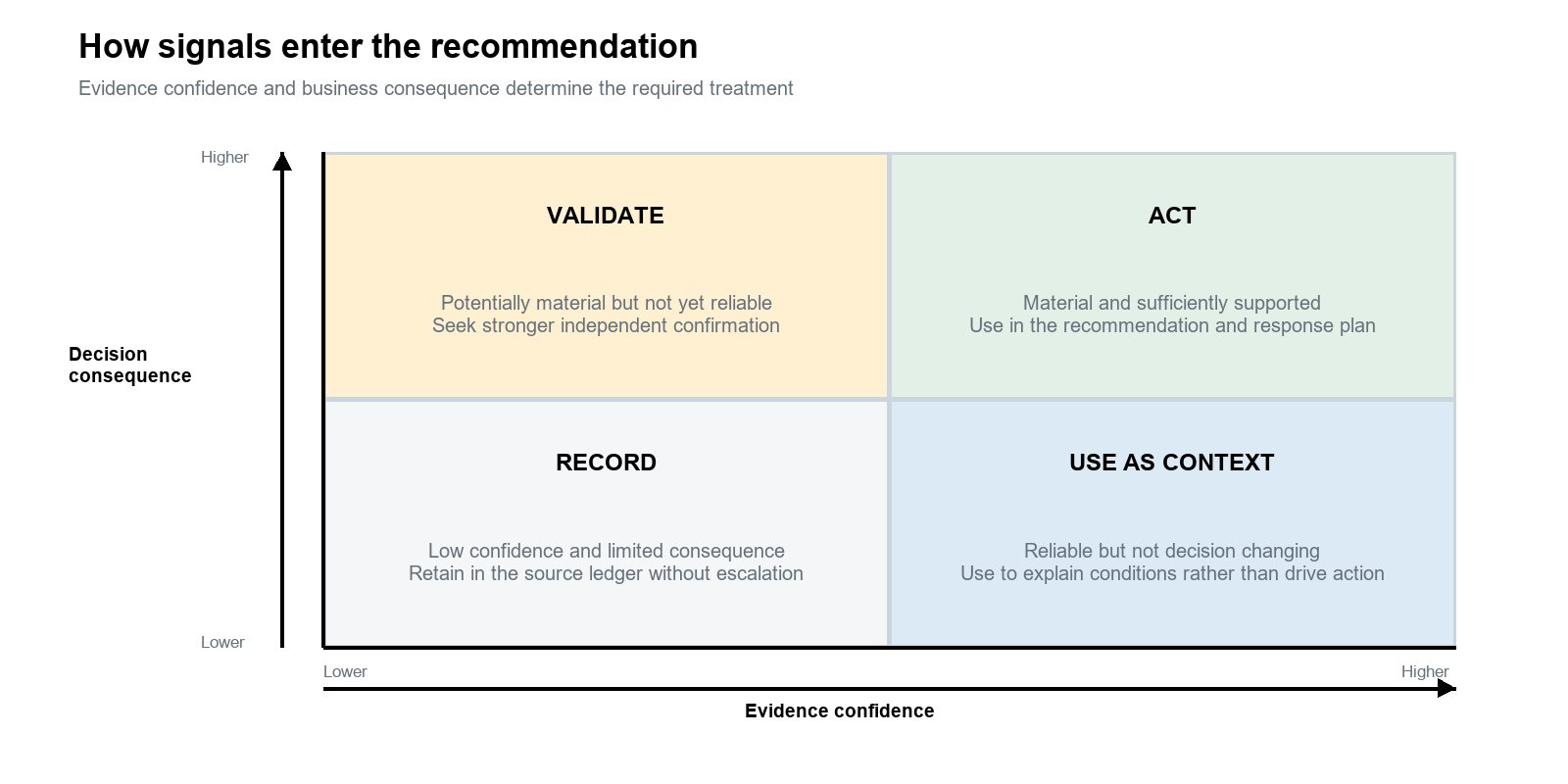
Confidence reflects source authority, recency, definition, independence, directness and corroboration. Consequence reflects the scale, timing and reversibility of the effect on the client's decision. The assessment does not convert these judgements into false precision. It shows the evidence and reasoning behind the classification.
Evidence labels
Material conclusions distinguish confirmed facts, supported interpretations, plausible signals and unresolved assumptions. Forecasts, estimates and scenarios retain their original basis and are not presented as observed facts.
Official and institutional information coverage
Source selection follows the decision, geography and sector. Official sources establish the governing conditions and provide the most defensible baseline for national, regulatory and transaction evidence.
Intelligence requirement | Representative websites and databases | What the evidence can establish |
|---|---|---|
Law regulation and policy | Official government gazettes, ministry and regulator websites, EUR-Lex, the US Federal Register, competition authorities, sanctions and export-control authorities | Current rules, proposed changes, licences, enforcement, incentives, restrictions, consultation status and effective dates |
Economic and market conditions | National statistical offices and central banks, World Bank DataBank, IMF Data, OECD Data Explorer, Eurostat and sector ministries | Output, prices, consumption, investment, employment, financing conditions, demographics and comparable national indicators |
Trade tariffs and supply flows | National customs authorities, UN Comtrade, WTO Tariff and Trade Data, ITC Trade Map, Eurostat Comext and UNCTAD Data Hub | Product flows, origin and destination, value and volume, concentration, tariff exposure, route dependence and changes over time |
Companies ownership and filings | National company registries, beneficial ownership registers, SEC EDGAR and other securities regulators, stock exchanges, annual reports and investor disclosures | Legal identity, ownership, financial position, subsidiaries, investments, capacity, partnerships, acquisitions and stated strategy |
Procurement and public investment | SAM.gov, TED Europa, national e-procurement portals, development-bank project databases, budget documents and public investment agencies | Purchasing specifications, award history, contract values, public programmes, project timing, suppliers and demand visibility |
Technology standards and intellectual property | WIPO PATENTSCOPE, WIPO Global Brand Database, EPO Espacenet, national patent offices, standards bodies and certification registers | Technology ownership, filing direction, standards, certification, claims, potential constraints and areas of capability development |
Summaries and news reports can identify a development, but the governing document or responsible institution is checked before the development is treated as a decision condition.
Commercial and dynamic information coverage
Official sources rarely explain the complete commercial picture. Company, transaction, product, channel and digital evidence can reveal how organisations are acting and where conditions are changing before they appear in aggregated statistics.
Intelligence requirement | Representative sources | What the evidence can establish |
|---|---|---|
Market and category intelligence | Industry associations, company disclosures, Euromonitor, Mintel, GlobalData or other sector databases where available, recognised industry publications | Market definitions, category direction, segment development, demand drivers, forecasts and differences between published estimates |
Competitor activity | Corporate websites, filings, product documentation, price lists, distributor listings, job postings, conference programmes, procurement awards and Factiva or Nexis where licensed | Offer changes, positioning, pricing, hiring, capability building, geographic movement, customer focus and possible strategic direction |
Investment and transactions | Regulatory filings, company announcements, development-finance records, PitchBook, S&P Capital IQ, Crunchbase, Preqin or Mergermarket where licensed | Funding, investors, deal activity, valuation signals, capital requirements, expansion commitments and ownership change |
Customer channel and pricing signals | Retailer, distributor and marketplace websites, public tenders, app stores, advertising libraries, customer reviews, Google Trends, Similarweb or Sensor Tower where available | Assortment, availability, observed price, promotion, distribution, search direction, digital traction and recurring customer complaints |
Workforce and capability signals | Labour ministries, national statistics, ILOSTAT, company career pages, professional networks and job portals | Skill availability, wage and hiring pressure, capability priorities, team location and the likely operating implications of recruitment activity |
Client supplied evidence | Existing strategy papers, sales and pipeline records, supplier records, risk registers, management reporting and previous studies supplied for the engagement | The assumptions already guiding the decision, internal exposure and where external evidence confirms or challenges the organisation's current view |
How sources are combined
Every material conclusion retains a traceable source path. Official records take priority for legal and national facts. Company and transaction evidence is used to reconstruct corporate behaviour. Commercial databases extend coverage where their definitions are suitable, while digital signals identify developments that require stronger confirmation. Public and licensed information is collected lawfully and confidential information is not sought through deceptive means.
Deliverables for the strategic decision
The final package is structured around the action management must consider. It shows the accepted interpretation, evidence confidence, alternatives, pressure conditions and the signals that should change the response.
Decision component | What the client receives |
|---|---|
Decision charter | A defined question, decision owner, time horizon, choices, current assumptions, acceptance conditions and failure conditions |
Evidence lattice | A connected view of the market, customer, competitor, regulatory, operational, company and financial evidence relevant to the decision |
Contradiction record | Material disagreements between sources, the reason for the selected interpretation and the uncertainty that remains |
Strategic implication brief | What the evidence means for the organisation, the preferred response and the reasons for rejecting or deferring alternatives |
Pressure test | Alternative explanations, adverse conditions, competitor responses and the points at which the recommendation weakens or fails |
Decision control plan | Indicators, trigger levels, monitoring frequency, review ownership and actions for proceeding, preparing, monitoring or reframing |
Engagement formats
A focused decision brief can resolve a tightly defined question over approximately two to three weeks. A strategic intelligence dossier usually examines several evidence lenses over four to six weeks. A continuing intelligence mandate begins with a baseline decision record and then monitors agreed indicators monthly or quarterly. Scope, information availability and the number of markets or companies determine the final timetable.
Who uses the work
The service can support executive leadership, corporate strategy, business-unit management, commercial and marketing teams, investment and corporate-development teams, product and innovation leaders, supply and procurement functions, and regulatory or enterprise-risk teams.
Frequently combines with
- Industry Analysis Explains the industry system, economics and structural forces surrounding the decision.
- Competitive Business Benchmarking Compares selected companies consistently when relative position or capability is central.
- Company Profiling Provides deeper evidence on a company that could affect the strategic decision.
- Market Entry Assessment Converts an accepted geographic or product opportunity into a practical entry route and commitment plan.
- Supply Chain Intelligence Reconstructs dependencies and operating exposure when supply continuity materially affects the decision.
- Partner or Vendor Evaluation Assesses specific organisations when implementation depends on a partner, supplier, distributor or service provider.
Illustrative applications
Industry | Illustrative executive question | Intelligence combination |
|---|---|---|
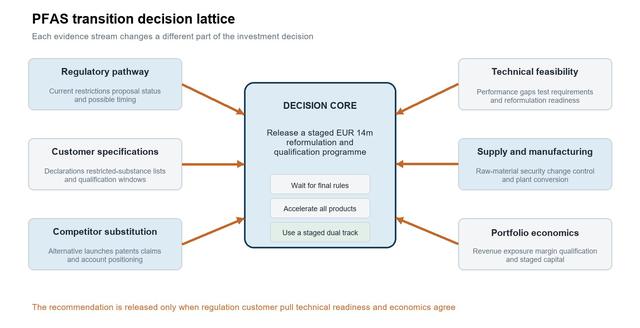
Specialty chemicals | Should a coatings producer redirect formulation and capacity investment as restrictions and customer specifications move away from a material class? | Regulation, customer specifications, patents, competitor launches, plant investment, pricing and substitution economics |
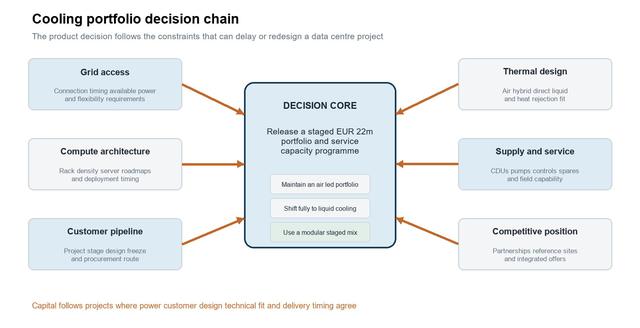
Data centre infrastructure | How should a cooling-equipment company adjust its portfolio as power constraints and new computing architectures change facility design? | Grid and planning data, project pipelines, technology direction, customer investment, competitor partnerships and component supply |
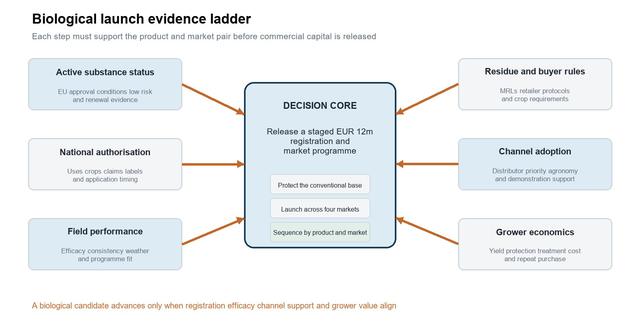
Agricultural inputs | Should a crop-input company accelerate biological products in selected markets or protect its conventional portfolio? | Registration pathways, residue policy, distributor behaviour, adoption evidence, funding, product launches and farmer economics |
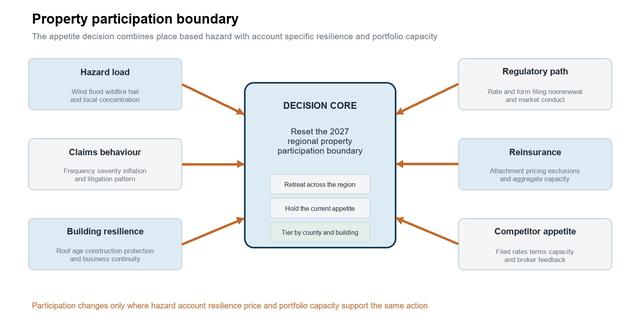
Commercial insurance | Which climate, regulatory and claims developments should change participation in a regional property segment? | Hazard and loss data, building activity, regulation, reinsurance conditions, competitor appetite, pricing and portfolio exposure |
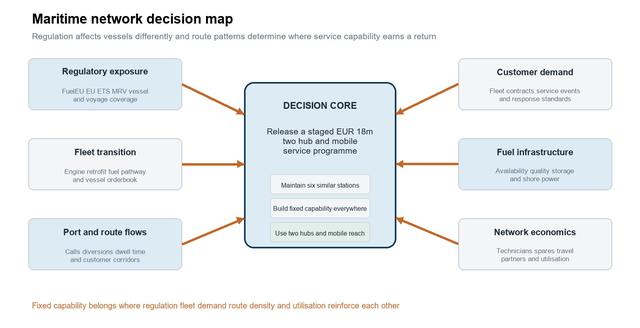
Maritime services | How should a service provider reposition its network as route volatility, fuel rules and fleet investment alter customer needs? | Port and vessel flows, regulation, fleet orders, customer routes, competitor capacity, fuel economics and infrastructure investment |
Each illustration would use a question-specific evidence lattice, pressure case and decision-control plan to show how the service changes a practical management decision.
Frequently asked questions
How is this different from a market intelligence report
A market intelligence report normally explains a defined market or trend. Strategic Business Intelligence may use that evidence, but it begins with an executive decision and connects several intelligence lenses to determine the response supported by the evidence.
Is this a dashboard or business intelligence implementation
No. The core deliverable is analysis and decision support rather than data engineering or historical performance reporting. A monitoring tracker can be specified when continuing intelligence is required.
Can internal information be included
Yes. Existing client information can be combined with public and licensed evidence when it is relevant to the decision. Internal definitions and dates are reconciled with external sources before conclusions are drawn.
Does the service include primary research
The service is based on existing information. If customer, expert or stakeholder evidence is essential and unavailable, the output defines the primary research question rather than presenting the evidence gap as resolved.
How are conflicting sources handled
Differences are tested for definition, period, geography, methodology, incentives and independence. The accepted interpretation and unresolved uncertainty remain visible in the contradiction record.
Can the intelligence be monitored continuously
Yes. After the baseline decision is established, August Research can monitor defined indicators and report only developments that cross an agreed trigger or materially change the interpretation.
What happens when the evidence remains uncertain
The recommendation can be conditional. It states what can be decided, what should remain reversible, which evidence is still required and what development would justify a different course of action.
Discuss a strategic intelligence question August Research can connect the evidence surrounding a complex decision and define the response, conditions and monitoring signals management needs.
FRAME THE DECISION | BUILD THE EVIDENCE LATTICE