R&D & INNOVATION / SECONDARY RESEARCH
Emerging Technology Assessment
Application-specific evidence for deciding whether to pursue, validate, partner, monitor or set aside an emerging technology.
EVIDENCE
APPLICATION FIT
READINESS
DEPENDENCIES
ACTION
When “promising” is not a decision
Emerging technologies are often introduced through breakthrough claims, funding announcements, prototypes, patents or early commercial demonstrations. These signals can show that a field is moving, but they do not tell an R&D or product-development leader whether the technology is suitable for a particular product, process or operating environment.
Emerging Technology Assessment examines a selected technology or small set of alternatives against the client’s intended application, performance requirements, integration constraints and decision horizon. The purpose is not to predict a universal winner. It is to establish what the available evidence supports, what remains uncertain and what the organisation should do next.
THE CENTRAL QUESTION Is this technology ready enough, relevant enough and accessible enough for us to act on, or should we continue monitoring it?
Questions this service is designed to answer
- What has the technology actually demonstrated, at what scale and under which operating conditions?
- How closely does the published evidence match the client’s intended application and performance boundary?
- Which system, manufacturing, infrastructure, supply, data or workforce dependencies could delay adoption?
- What regulatory, standards, safety or certification requirements may shape the development pathway?
- Are credible developers, partners, suppliers or research capabilities accessible to the client?
- Should the organisation pursue, validate, explore partnership, monitor with triggers or set the technology aside?
EMERGING TECHNOLOGY ASSESSMENT / HOW THE RESEARCH IS EXECUTED
From technical signal to decision gate
The research begins with the future product or R&D decision, not a pre-defined maturity score. The technology is assessed only after its intended use, comparison baseline and evidence threshold have been agreed. This prevents a generally mature technology from being treated as ready for an application where it has not been demonstrated.
1. FRAME
2. DEFINE EVIDENCE
3. ASSESS FIT
4. TEST DEPENDENCIES
5. SET ACTION
Stage | What is done | Why it matters |
|---|---|---|
1. Frame the decision | Define the intended application, baseline solution, required performance, operating environment, time horizon, geographies and the decision the assessment must support. | Creates a client-specific definition of relevance and readiness. |
2. Build the evidence protocol | Set the technology taxonomy, source types, date range, inclusion and exclusion rules, comparison fields and confidence conventions. | Makes the route from public evidence to interpretation traceable. |
3. Establish demonstrated capability | Review scientific, patent, technical, pilot, product and standards evidence. Record what was demonstrated, at what scale, by which method and under which conditions. | Separates a technical claim from evidence that can be transferred to the target application. |
4. Assess application fit and dependencies | Compare the evidence with product requirements, integration needs, scale-up route, economics, regulatory pathway, ecosystem access and adoption conditions. | Reveals why a technically promising option may still be difficult to use. |
5. Challenge the interpretation | Retain contradictory evidence, source dependence, unknowns and publication lag. Identify the assumption that could most change the conclusion. | Prevents confidence from being created by repeated but non-independent claims. |
6. Translate to an action gate | Place the technology in pursue, validate first, explore partnership, monitor with triggers or set-aside lanes. Define the evidence needed to move between lanes. | Connects the assessment to a practical R&D or product-development decision. |
READINESS PRINCIPLE Readiness is conditional. A technology can be highly mature in one application and still require substantial evidence, integration or regulatory work in another.
EMERGING TECHNOLOGY ASSESSMENT / DECISION-CONDITIONAL READINESS
Eight dimensions that shape the decision
Technology Readiness Levels provide a useful language for technical maturity. However, technical maturity alone does not resolve application transfer, adoption, scale, regulatory or access barriers. The assessment therefore keeps each dimension visible instead of combining everything into a single attractiveness score.
Assessment dimension | What the research examines |
|---|---|
Demonstrated technical capability | Observed function, test method, evidence scale, prototype or system boundary, operating conditions, repetition and limitations. |
Application fit | Relevance to the client’s use case, target performance, environment, duty cycle, user, substrate, material, process or clinical context. |
Integration burden | Required changes to product architecture, equipment, software, data, utilities, workflow, service, infrastructure or workforce. |
Scale and manufacturability | Process repeatability, throughput, yield, quality control, equipment access, material availability, capacity and scale-up dependencies. |
Economics and resources | Visible capital, operating, energy, material, labour and lifecycle requirements, with assumptions and uncertainty retained. |
Regulatory and standards pathway | Relevant regulation, guidance, test method, certification, safety, quality and standards-development context. |
Access and ecosystem readiness | Developers, suppliers, partners, laboratories, manufacturing capabilities, research institutions, licensing routes and geographic access. |
Timing and uncertainty | Decision horizon, evidence gaps, dependency timing, competing pathways and the events that should trigger reassessment. |
How evidence status is communicated
OBSERVED
CORROBORATED
CONDITIONAL
UNRESOLVED
Each important conclusion is linked to the evidence record and labelled according to what is directly observed, independently supported, conditional on an assumption or still unresolved. The action lane is therefore accompanied by the reason for the decision and the condition that could change it.
FRAMEWORK CONTEXT NASA uses Technology Readiness Levels to describe technical maturity. The US Department of Energy’s Adoption Readiness framework recognises that technical progress alone is not sufficient to resolve market and adoption risk. August Research uses these principles as context while building a decision-specific assessment around the client’s application.
EMERGING TECHNOLOGY ASSESSMENT / SOURCE ARCHITECTURE
Sources selected around the readiness question
The source architecture changes with the technology and the decision. Critical statements are anchored to the most direct available record, while specialist databases support discovery, structure and comparison. The study documents where public evidence is unavailable or cannot answer the client’s question.
Readiness question | Preferred evidence sources | Typical use in the assessment |
|---|---|---|
What has been demonstrated? | Peer-reviewed studies, conference proceedings, technical reports, test protocols, public project reports, product documentation and regulator-reviewed records where applicable. | Capture the method, scale, conditions, result, limitations and transferability of the demonstration. |
Is development progressing? | Patent-office records, public grants and awards, pilot and demonstration programmes, research-consortium records, facility or equipment announcements and technical recruitment signals. | Trace movement from concept to prototype, pilot, integration or scale-up without treating activity volume as readiness. |
Can it be manufactured or deployed? | Supplier and equipment documentation, permits, manufacturing announcements, capacity records, project-development filings, infrastructure requirements and deployment case material. | Identify process, capacity, material, equipment, infrastructure and service dependencies. |
Can it meet regulatory and standards requirements? | Regulatory registers, official guidance, public consultations, standards work programmes, certification requirements, safety records and recognised test methods. | Define the pathway, evidence expectation, unresolved standards questions and timing constraints. |
Is there an accessible ecosystem? | University and national-laboratory technology-transfer records, licensing notices, startup and investment databases, partnerships, procurement portals and developer documentation. | Assess whether the technology and required capabilities can realistically be accessed, partnered for or monitored. |
Do the economics and externalities support the use case? | Public techno-economic and lifecycle studies, energy and material databases, project filings, procurement data, policy incentives and topic-specific models such as GREET where relevant. | Test the assumptions behind cost, resource, environmental and adoption claims without presenting an unsupported forecast. |
EVIDENCE HIERARCHY A primary technical or regulatory record is preferred for a material conclusion. Company claims, media coverage and database summaries can identify signals, but they are not treated as independent confirmation unless the underlying evidence supports them.
EMERGING TECHNOLOGY ASSESSMENT / OUTPUTS AND VALUE
Two ways to structure the engagement
Engagement format | Best used when | Typical assessment depth |
|---|---|---|
Portfolio screen | A team has a broad set of approximately 8 to 20 technologies and needs to decide which ones deserve management attention or deeper analysis. | Consistent screening criteria, evidence-quality check, comparative readiness profile and action lane for each option. |
Focused assessment | A team has selected approximately 1 to 5 technologies and needs to understand application fit, dependencies, uncertainty and the next evidence requirement. | Deeper technical evidence review, application-transfer analysis, dependency map, decision gates and follow-on research brief. |
What clients receive
- A documented decision and evidence protocol covering the intended use, comparison baseline, scope, sources, cut-off date and assessment conventions.
- Technology evidence cards showing demonstrated capability, evidence strength, application relevance and important limitations.
- A decision-conditional readiness view that keeps technical, integration, scale, economic, regulatory and ecosystem dimensions separate.
- A dependency and evidence-gap map showing what must be resolved before the technology can move to the next decision gate.
- An action brief placing each technology in pursue, validate first, explore partnership, monitor with triggers or set-aside lanes.
- A focused next-step brief for primary validation, proof-of-concept work, expert input, partner screening or continued monitoring where needed.
Why August Research
Many emerging-technology services lead with signal dashboards, broad growth narratives, innovator rankings or a single readiness score. August Research begins with the client’s intended application and asks what evidence would justify a decision. We preserve the conditions of each demonstration, show where evidence does not transfer, and keep technical maturity separate from integration, scale, regulation, economics and ecosystem access. This creates a defensible route from “interesting technology” to a specific action, without overstating what secondary research can prove.
Scope boundaries
Emerging Technology Assessment is secondary research. It can help prioritise R&D, product-development, partnership and validation choices, but it does not prove performance, establish regulatory approval, confirm legal freedom to operate, provide investment or legal advice, guarantee commercial adoption or replace laboratory, pilot, clinical, field or engineering validation. Where a decision-critical uncertainty remains, the output defines the question that requires specialist or primary research.
EMERGING TECHNOLOGY ASSESSMENT / WEBSITE CONTENT
Frequently combined with
- Technology Landscape Analysis
- R&D Trend Analysis
- Scientific Literature Review
- Patent Landscape Research
- Regulatory & Standards Intelligence
- Technology Scouting
- Proof-of-Concept Evaluation
Website presentation suggestion
Present the service as an interactive Technology Decision Gateboard. A visitor selects a technology card and moves it through four gates: evidence of function, fit for the application, ability to integrate and scale, and reason to act now. Selecting a gate reveals the evidence considered, the condition that has not been met and the next question. The final card enters pursue, validate first, explore partnership, monitor or set-aside lanes. On mobile, use a vertical gate sequence with one expanded evidence card at a time.
VISUAL CUE Use an open gate motif rather than a conventional radar chart. Technologies should be shown progressing only when the evidence condition is met. A visible hold marker can explain why an otherwise promising technology remains in validation or monitoring.
Example engagements
These five example briefs can appear as floating clickable placards on the service page. Each placard opens a separate Phase 2 example page.
Industry | Example assessment | Decision preview |
|---|---|---|
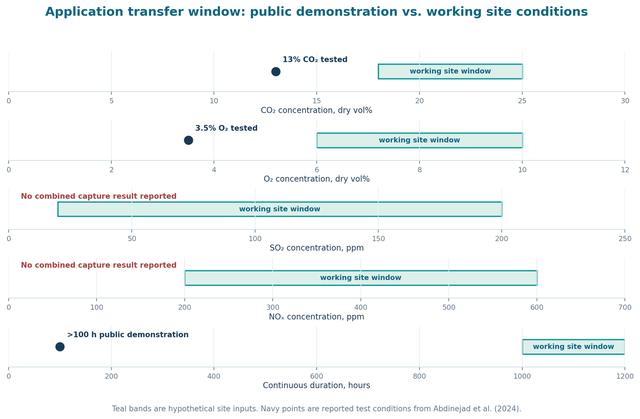
CCUS + Chemicals | Electrochemical CO2 capture for variable cement flue gas | Is the available evidence strong enough to justify a site-relevant pilot, or do oxygen, contaminants, duty cycle and energy requirements remain unresolved? |
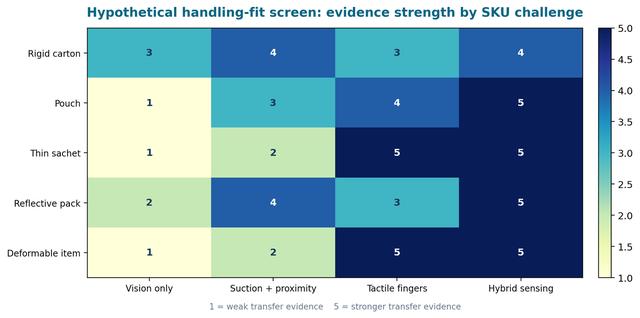
Robotics + Commercial Equipment | Tactile-sensing grippers for mixed-SKU robotic picking | Can the technology improve handling of deformable and irregular products without creating unacceptable cycle-time, calibration or maintenance burdens? |
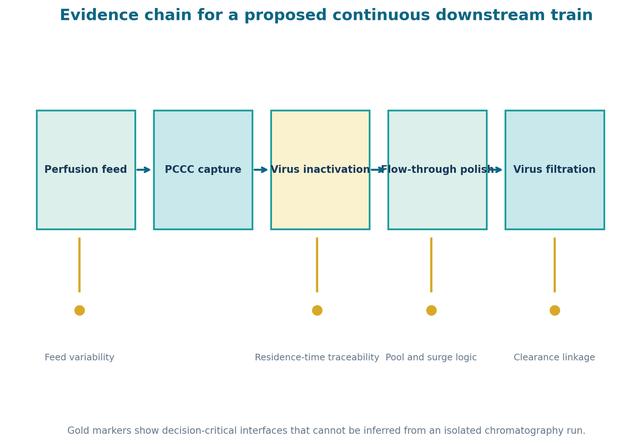
Biopharma + Manufacturing | Continuous chromatography for flexible biologics production | Does published and operational evidence support the target molecule, scale, control strategy and facility integration needed for a development programme? |
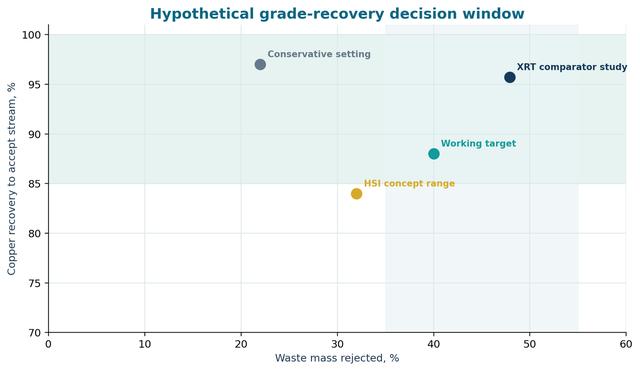
Mining + Raw Materials | Hyperspectral ore sorting for low-grade copper feed | Is sensor-based sorting transferable to the site’s mineralogy, particle-size distribution, throughput and downstream recovery objectives? |
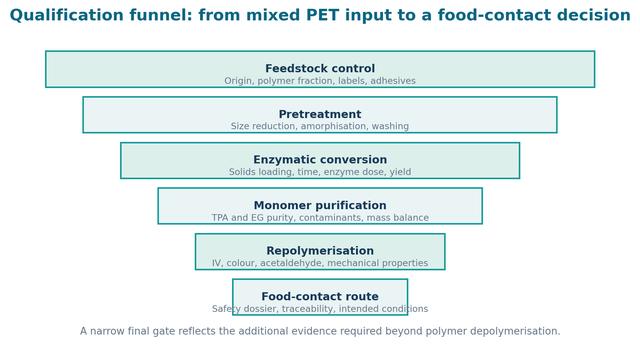
FMCG + Circular Materials | Enzymatic recycling for food-grade PET feedstock | Do process, feedstock, scale-up, food-contact and regulatory signals justify technical validation or a partnership watchlist? |
Note: These are hypothetical engagement concepts for website illustration, not client projects or research findings. The exact technology boundary, source mix, numerical values, timeline and outputs would depend on the final decision question and available evidence.
EMERGING TECHNOLOGY ASSESSMENT / FAQs
Frequently asked questions
How is this different from Technology Landscape Analysis?
Technology Landscape Analysis maps the breadth of a defined technology space, including pathways, applications and participants. Emerging Technology Assessment evaluates a selected technology or small set against the client’s application, dependencies and decision criteria.
How is this different from R&D Trend Analysis?
R&D Trend Analysis identifies directional change and the signals that should alter attention. Emerging Technology Assessment examines whether a selected technology is ready and relevant enough to justify a specific action.
Does the assessment use Technology Readiness Levels?
TRLs may be included when the evidence supports a meaningful maturity judgement. They are not used as the only decision measure because application fit, integration, scale, regulatory, economic and ecosystem conditions may lead to a different action.
Can the service compare several technologies?
Yes. A portfolio screen can compare a broader set using consistent evidence and decision criteria. A focused assessment is more appropriate when deeper application, dependency and evidence-gap analysis is required.
Can the work identify potential partners?
Yes. The assessment can map relevant developers, suppliers, research institutions and enabling capabilities. A dedicated Technology Scouting engagement may follow when active partner qualification and outreach are required.
How long can an assessment take?
A focused assessment may take approximately three to five weeks. A broad multi-technology, multi-region or highly regulated assessment may require six to ten weeks. Timing is illustrative and depends on the technology set, source accessibility and depth of interpretation.
Let’s discuss your technology decision
If your team needs to decide whether an emerging technology should move into validation, partnership, monitoring or active development, August Research can build the assessment around the application and evidence threshold that matter to that decision.
NOTE: The appropriate assessment design, sources and action gates are agreed for the decision at hand. Findings remain conditional on the available evidence and the defined application context.