R&D & INNOVATION / SECONDARY RESEARCH
Regulatory & Standards Intelligence
Forward visibility into regulatory change, standards development and the possible impact on products, technologies and R&D portfolios.
THE DECISION THIS SERVICE SUPPORTS What is changing, which parts of our portfolio may be affected, when could action become necessary and where does an unresolved standards pathway create additional uncertainty?
From regulatory information to portfolio decisions
Regulatory updates are easy to collect and difficult to use. A proposed rule may change scope several times. A final regulation may depend on delegated acts, guidance, test methods or harmonised standards that are still under development. The same change may require immediate action for one product family, monitoring for another and no action for a third.
Regulatory & Standards Intelligence helps R&D, product, engineering, regulatory, quality and portfolio teams understand those differences. The work tracks credible signals of change, establishes their legal and technical status, links the emerging requirements to the client’s portfolio and identifies the evidence, redesign, reformulation, testing, documentation, supplier or standards participation decisions that may follow.
When this service creates value
Portfolio exposure review
Identify products, components, substances, claims, software functions or markets that may be touched by a proposed requirement.
R&D requirement anticipation
Translate future safety, environmental, data, traceability or performance expectations into research and design questions.
Standards readiness
Track whether the test method, technical specification, certification route or harmonised standard needed for implementation is available.
Geographic change comparison
Understand where jurisdictions are converging, diverging or creating different transition dates and evidence expectations.
Portfolio prioritisation
Distinguish products that need action now from those that should be prepared, monitored, influenced or deprioritised.
Standards participation decision
Identify when a company may benefit from technical committee participation, public consultation input or industry coordination.
WHAT THE INTELLIGENCE COVERS
Regulation and standardisation are related, but not interchangeable
The service keeps the authority, status and practical role of each record visible. An early policy signal is not treated as an adopted obligation. A voluntary standard is not described as law. A harmonised standard may provide a recognised route for demonstrating conformity, but the legal requirements remain in the underlying legislation.
Intelligence layer | What is monitored | Why it matters |
|---|---|---|
Policy direction | Strategies, work programmes, calls for evidence, regulator priorities and enforcement themes. | Shows which issues may enter formal rulemaking and when early input may still be possible. |
Legislative development | Consultations, proposals, amendments, adopted texts, delegated or implementing acts and national transposition. | Establishes scope, status, timing and the parts of a requirement that may still change. |
Regulatory interpretation | Official guidance, authority questions and answers, committee opinions, decisions, notices and inspection or enforcement material. | Reveals how requirements may be interpreted and what evidence authorities are beginning to expect. |
Standards development | New work items, work programmes, committee drafts, enquiry drafts, ballots, revisions, withdrawals and publication. | Shows whether the technical route for testing, interoperability, safety or conformity is stable, changing or incomplete. |
Conformity infrastructure | Recognised test methods, certification schemes, accreditation scope, notified body information and market surveillance practice. | Tests whether a requirement can be demonstrated consistently in practice. |
Trade notification | WTO TBT and SPS notifications, comment periods, specific trade concerns and national enquiry point material. | Identifies proposed product requirements that may affect cross-border market access. |
The European Commission’s Have Your Say portal provides access to public consultations and feedback on upcoming EU policy initiatives.
ISO publishes defined standards development stages, from a new proposal through drafting, enquiry, approval and publication.
The WTO ePing SPS & TBT platform supports tracking of notified technical regulations, conformity assessment procedures and trade concerns.
Questions the research can answer
- Which changes are credible enough to enter the client’s planning horizon, and which remain weak or speculative signals?
- Which portfolio elements are directly exposed, indirectly dependent or presently outside scope?
- What technical requirement, test method, documentation field or supplier evidence may need to change?
- Could standards timing lag the regulatory deadline, creating a temporary interpretation or conformity gap?
- Which decisions are sensible early actions, and which should wait for a defined trigger?
HOW THE RESEARCH IS EXECUTED
Dual-Clock Portfolio Intelligence
August Research tracks the legal pathway and the technical standards pathway separately. The two are then connected to the client’s portfolio architecture. This prevents a final legal date from being read without the standards needed for implementation, and prevents a draft standard from being treated as a settled requirement.
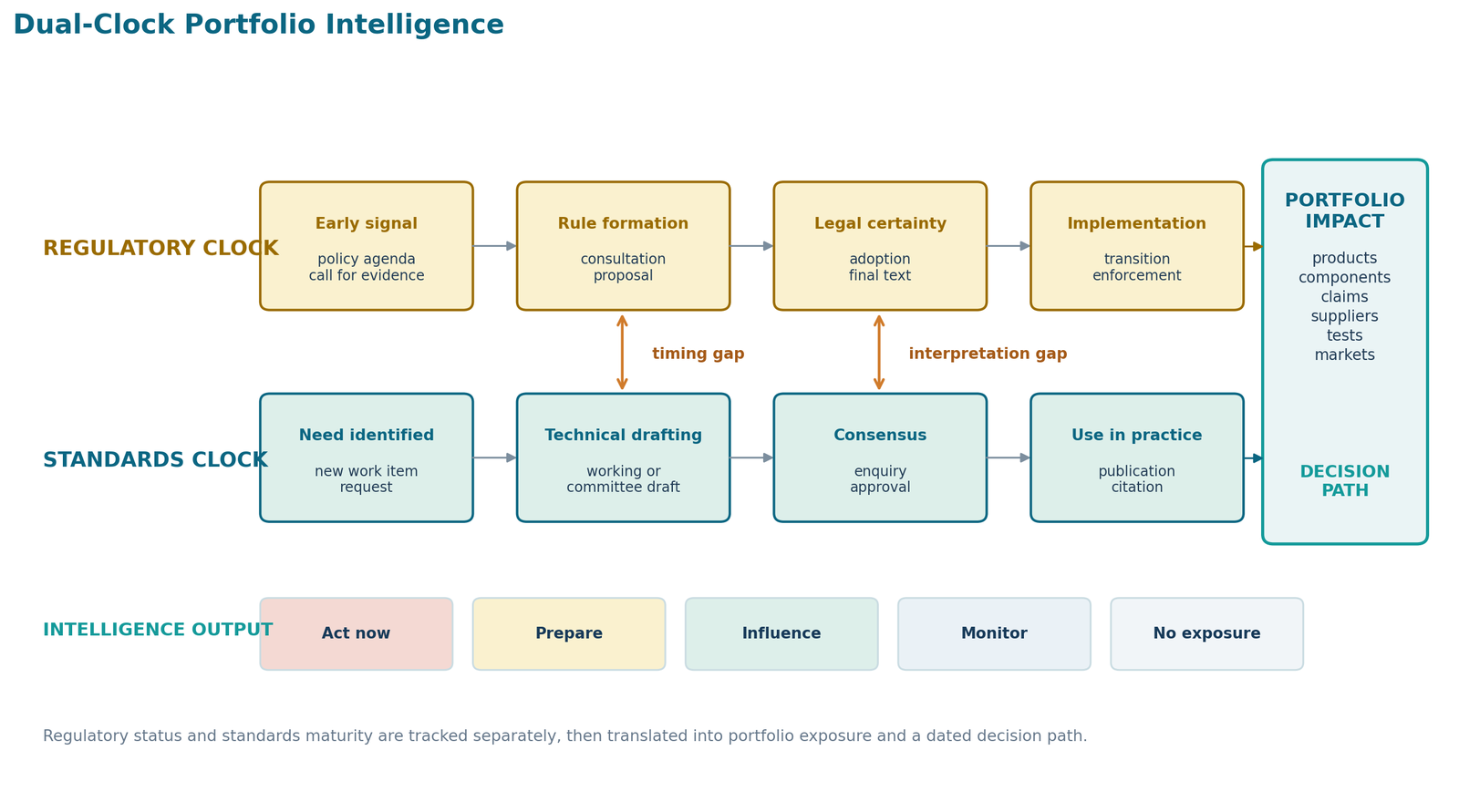
The central research logic
Regulatory clock
Where is the change between agenda setting, consultation, proposal, adoption, transition and enforcement?
Standards clock
Where is the technical route between new work item, drafting, committee consensus, enquiry, approval, publication and citation?
Portfolio linkage
Which substances, components, products, claims, data fields, suppliers, facilities and markets connect to the change?
Decision path
Should the client act, prepare, influence, monitor or document that no current exposure was found?
DUAL-CLOCK PRINCIPLE A regulation can become certain before its supporting standards are complete. A standard can also change ahead of a legal revision. The gap between these timelines is treated as a decision variable, not hidden inside a single readiness score.
RESEARCH MODULES
Nine connected modules from signal to action
The exact research sequence changes with the jurisdiction, industry and portfolio question. These modules define the information that must be resolved rather than imposing one generic compliance checklist.
Module | How it is executed | Working output |
|---|---|---|
1. Decision and portfolio boundary | Define jurisdictions, product families, technologies, market roles, decision horizon and the action the work must support. | Scope and portfolio hierarchy |
2. Authority and source map | Identify legislators, regulators, ministries, agencies, standards bodies, technical committees and conformity actors relevant to the scope. | Authority and source register |
3. Signal capture | Monitor policy agendas, consultations, proposals, dockets, notifications, committee work programmes, draft standards and enforcement signals. | Dated change register |
4. Status and confidence control | Record legal stage, standards stage, publication date, authority, comment period, expected milestone and uncertainty. | Controlled status horizon |
5. Requirement decomposition | Extract definitions, scope, thresholds, exemptions, transition periods, evidence, testing, labelling, reporting and data requirements. | Requirement architecture |
6. Portfolio applicability logic | Link requirements to ingredients, bills of material, product functions, claims, software, packaging, sites, suppliers and destination markets. | Portfolio exposure map |
7. Standards dependency assessment | Identify normative references, harmonised standards, recognised methods, revisions, committee ownership and unresolved technical gaps. | Standards dependency map |
8. Scenario and trigger analysis | Model plausible timing or interpretation cases and define events that would increase, reduce or remove exposure. | Trigger-based action lanes |
9. Decision translation | Prioritise reformulation, redesign, testing, documentation, supplier engagement, market sequencing, consultation input or monitoring. | Portfolio action brief |
Evidence status remains visible
Confirmed
Adopted or formally published material with a defined authority and status.
Developing
A formal proposal, consultation, new work item or draft exists, but content may still change.
Interpreted
The portfolio implication follows from stated assumptions or applicability logic and is labelled accordingly.
Unresolved
Scope, timing, standard, exemption, test route or enforcement position cannot yet be established.
PORTFOLIO IMPACT AND STANDARDISATION NEED
The change is mapped to the product, not left as a legal summary
A requirement becomes useful intelligence only after it is connected to the portfolio. The research creates an applicability chain from the regulated object or technical requirement to the product families, components, evidence systems and markets that may be affected.
Portfolio lens | Examples of exposure questions | Possible decision |
|---|---|---|
Materials and formulation | Is a substance restricted, reportable, conditionally permitted or dependent on a supplier declaration? | Substitute, reformulate, qualify supplier evidence or monitor an exemption. |
Product architecture | Does the requirement change safety functions, cybersecurity, repairability, interoperability, energy performance or component selection? | Redesign, create a platform requirement or separate regional variants. |
Testing and validation | Is a new or revised method needed, and is the standard sufficiently mature for test planning? | Reserve testing, run a gap study or wait for a defined draft milestone. |
Claims and labelling | Will environmental, performance, recycled content, safety or digital claims require new evidence or wording? | Change claim substantiation, label fields or technical documentation. |
Data and traceability | Are product passports, incident reports, supply chain records or machine-readable data becoming necessary? | Build data fields, governance, supplier collection and audit logic. |
Market and lifecycle | Do transition dates, duties for products already installed, spare parts, software support or importer obligations vary by market? | Sequence launch, revise service obligations or limit a variant to selected markets. |
How the need for standardisation is assessed
The service does not assume that every regulatory problem needs a new standard. It tests whether the requirement can already be implemented consistently, whether existing standards transfer to the product and whether unresolved technical definitions could create avoidable variation across laboratories, suppliers or markets.
Adequacy
Does an existing standard cover the product, operating condition and evidence requirement?
Maturity
Is the relevant document a proposal, draft, approved standard, published standard or formally cited route?
Alignment
Do regulatory definitions, international standards and regional adoption use compatible terminology and thresholds?
Participation value
Could consultation, national mirror committee or technical committee participation materially improve preparedness or influence?
The European Commission explains that a harmonised standard is developed by a recognised European standards organisation following a Commission request and may be used to demonstrate conformity with relevant EU legislation.
RESEARCH ACCESS AND CLIENT OUTPUTS
Source architecture built around authority and timing
The research prioritises the most direct available record. Alerts, media and database summaries may help discover a change, but material conclusions are checked against legislation, regulator records, official consultations, standards work programmes or published technical documents wherever possible.
Research need | Preferred source architecture |
|---|---|
What may change? | Legislative agendas, regulator work programmes, calls for evidence, consultations, dockets, policy strategies and WTO notifications. |
What is the current status? | Official journals, bill and proposal trackers, authority registers, adopted texts, delegated acts, implementing measures and national transposition records. |
How may it be interpreted? | Official guidance, questions and answers, committee documents, authority decisions, enforcement notices and market surveillance material. |
Which standard may be required? | ISO, IEC, CEN, CENELEC, ETSI, ASTM, SAE and sector-specific work programmes, stage codes, drafts, revisions and withdrawal notices as applicable. |
Can conformity be demonstrated? | Recognised test methods, certification schemes, accreditation scopes, notified body information and conformity assessment guidance. |
What does it mean for the portfolio? | Client product data, bills of material, supplier documentation, technical files, product claims, market lists and public technical documentation. |
SUPPORTING RESEARCH ACCESS Depending on scope, the work may draw on 30+ regulatory and standards sources, 50+ technical and scientific sources, 20+ patent sources, 40+ industry and company sources, and language expertise covering 15+ languages. These figures describe access, not ownership or mandatory use.
What the client receives
- A regulatory and standards horizon with authority, status, dates, milestones, confidence and source links.
- Requirement dossiers that separate confirmed text, likely implications, open interpretations and unresolved questions.
- A portfolio exposure map connecting changes to products, components, materials, claims, suppliers, evidence and markets.
- A standards dependency map showing available methods, documents under development, committee ownership and timing gaps.
- An action portfolio placing issues in act now, prepare, influence, monitor or no current exposure lanes.
- A monitoring protocol defining the sources, trigger events, refresh cycle and internal owner for each priority issue.
ENGAGEMENT FORMATS AND MONITORING DESIGN
Two engagement formats
Format | Best used when | Indicative timing |
|---|---|---|
Focused change and portfolio assessment | A team needs to understand one regulatory or standards development across selected products and markets. | Approximately 4 to 7 weeks |
Multi-market intelligence horizon | A team needs a broader view across a product portfolio, several jurisdictions or a rolling change programme. | Approximately 7 to 12 weeks, followed by an agreed refresh cycle if needed |
TIMELINE NOTE: Timelines are indicative and depend on portfolio breadth, jurisdictions, language coverage, access to official or draft material, standards availability and the depth of product-level mapping required.
How ongoing intelligence can be maintained
Where the issue is still moving, the initial assessment can be converted into a controlled monitoring programme. The cadence is selected according to the expected milestone and the cost of missing it, rather than applying the same alert frequency to every topic.
Event-driven alerts
Triggered by a defined event such as proposal publication, amendment, adoption, delegated act, draft standard, ballot outcome or formal citation.
Scheduled horizon review
A monthly, quarterly or other agreed review of priority changes, timing assumptions and portfolio exposure.
Standards milestone watch
Focused tracking of work-item status, draft availability, committee timetable, enquiry, approval, publication and withdrawal.
Portfolio re-baseline
A deeper refresh when product architecture, market plans, suppliers or the regulatory text change enough to alter applicability.
Delivery methods
- Executive decision brief for portfolio, R&D and product leadership.
- Excel-based horizon and exposure register with source links, dates, status controls, product tags and action owners.
- PowerPoint decision presentation explaining the highest-impact changes, standards gaps, scenarios and recommended actions.
- Optional recurring update note showing what changed since the previous review and whether the action lane has moved.
WHY AUGUST RESEARCH
We connect the legal clock, the standards clock and the product architecture
Many services stop at alerts, summaries or compliance checklists. August Research focuses on the decision that sits between an emerging requirement and a technical portfolio. We establish what is authoritative, show what may still change, identify whether the standards route is ready and trace the potential impact through the product, evidence and supply chain structure.
Status before urgency
Every signal is labelled by authority, legal stage, standards stage and confidence before an action is recommended.
Dual-clock analysis
Regulatory deadlines and standards milestones remain separate so timing and interpretation gaps stay visible.
Portfolio-specific applicability
The assessment uses product families, materials, functions, claims, suppliers, data and markets rather than generic sector exposure.
Technical requirement translation
Regulatory language is converted into R&D, design, testing, validation, documentation and supplier questions.
Trigger-based monitoring
The output defines the event that should change the decision, such as adoption, draft publication, threshold revision or formal citation.
Standards participation lens
The work identifies where observing, commenting or participating may be more valuable than waiting for publication.
How this differs from adjacent August Research services
Service | Primary question |
|---|---|
R&D Trend Analysis | Where is research and innovation activity moving? |
Emerging Technology Assessment | Is a selected technology credible and ready enough for a defined application? |
White Space Opportunity Analysis | Which underexplored research areas may warrant deeper investigation? |
Technical Documentation Review | Does the available documentation support the required technical decision or evidence need? |
Regulatory & Standards Intelligence | What is changing, how could it affect the portfolio and what action or monitoring trigger follows? |
Scope boundaries
The service provides secondary research intelligence for planning and decision support. It does not constitute legal or regulatory advice, determine formal product compliance, replace a notified body or conformity assessment body, guarantee future regulatory outcomes or represent August Research as a standards development organisation. Where legal interpretation, certification or authority interaction is required, the output identifies the question for appropriately qualified counsel or specialists.
WEBSITE CONTENT
Website presentation suggestion
Present the methodology as a split-screen Dual-Clock Portfolio Map. The upper track shows the regulatory pathway and the lower track shows standards development. Selecting any milestone reveals its authority, current status, expected date, open question and affected portfolio elements. The tracks converge into five decision lanes: Act Now, Prepare, Influence, Monitor and No Current Exposure. On mobile, use two stacked timelines followed by swipeable portfolio impact cards.
VISUAL CUE Use moving milestone markers rather than a conventional process ribbon. A visible gap between the regulatory deadline and the expected standards milestone should open a short explanation of the technical uncertainty it creates.
Frequently combined with
- Technology Landscape Analysis
- Scientific Literature Review
- Patent Landscape Research
- Competitive Technology Benchmarking
- Emerging Technology Assessment
- Technical Documentation Review
- Technology Scouting
Frequently asked questions
Does the service provide legal advice?
No. It structures official information, technical implications and decision uncertainty. Formal legal interpretation remains with qualified counsel or the relevant authority.
Can the work include continuous monitoring?
Yes. A one-time assessment can be followed by a defined refresh cycle, alert threshold and change log. The cadence should reflect how quickly the issue is moving and the client’s decision horizon.
Can standards be assessed before publication?
Yes, where official work programmes, stage information or accessible draft material allow it. The document status and access limitations remain explicit.
ILLUSTRATIVE ENGAGEMENTS
Five portfolio questions for Phase 2
These five topics can appear as floating placards on the service page. Each placard would open into a separate Phase 2 example with its own methodology, portfolio logic and visual output.
Industry and engagement scope | Decision question |
|---|---|
Industrial robotics + connected commercial equipment | Cyber Resilience Act, Machinery Regulation and evolving cybersecurity standards | Which controllers, engineering tools, service gateways, applications and remote functions require reporting readiness, product evidence, redesign or conformity planning at each implementation gate? |
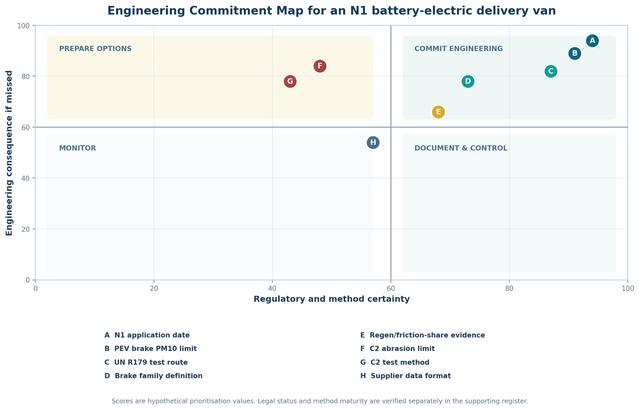
Commercial vehicles + braking and tyre systems | Euro 7 non-exhaust emissions and developing measurement procedures | How could brake-particle limits, tyre-abrasion requirements and supporting test methods affect component specifications, supplier evidence, validation plans and future vehicle platforms? |
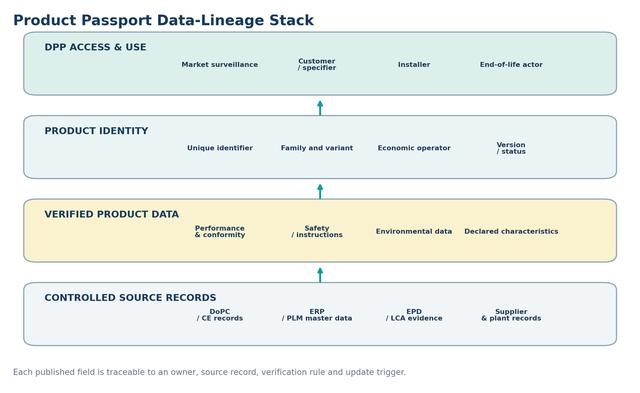
Construction chemicals + prefabricated building products | New Construction Products Regulation, digital product passports and technical specifications | Which product data, declarations, sustainability characteristics, test evidence and digital records may need to change as the new CPR and its standards pathway are implemented? |
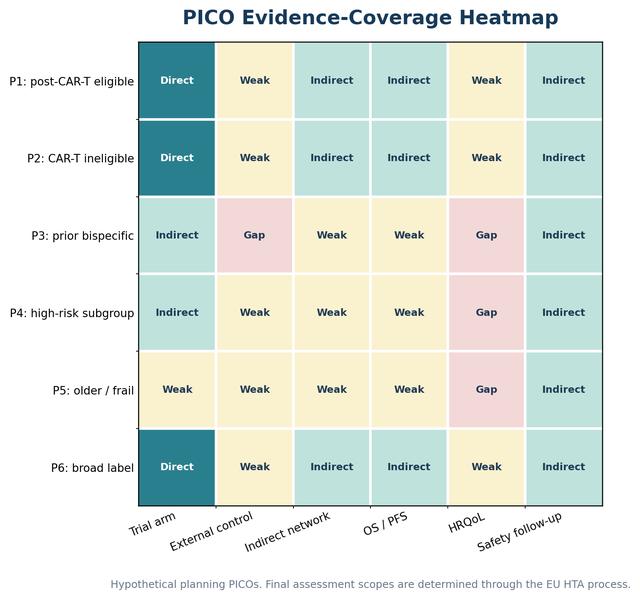
Biotechnology + pharmaceuticals | EU Health Technology Assessment joint clinical assessment for oncology medicines and advanced therapies | How should evidence teams anticipate population, comparator, outcome and submission expectations when the European joint assessment process and methodological guidance influence development planning? |
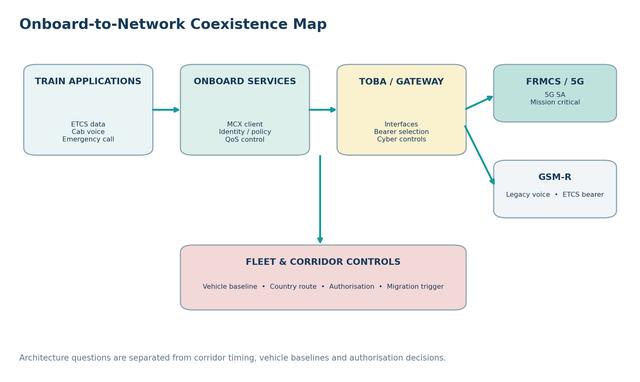
Rail transport + onboard communication systems | FRMCS migration, GSM-R coexistence and Control-Command and Signalling TSI development | Which onboard radios, interfaces, software baselines and verification activities should be prepared as technical specifications, interoperability requirements and national migration plans continue to develop? |
How the placards can work on the website
The visible placard should show the industry, the regulatory or standards trigger and one portfolio decision question. Opening it should reveal the technical background, current status, applicability logic, methodology, portfolio output and monitoring trigger. The Phase 2 pages should not reuse the dual-clock layout; each example will use a visual form suited to its specific evidence and decision.
LET'S DISCUSS YOUR PORTFOLIO If your team needs to understand how an upcoming regulation, standard or conformity route could affect product design, R&D priorities, supplier evidence or market timing, August Research can build the intelligence around your portfolio and decision horizon.
Note:
The engagement topics above demonstrate possible applications of the service and are not presented as client outcomes. Scope, jurisdictions, evidence thresholds, outputs and timelines would be defined for each live project.