INDUSTRY ADOPTION STUDIES
Understand how a technology, product, practice or business model moves from interest to trial, integration and repeatable use across an industry.
THE DECISION VIEW
● Where is adoption actually progressing?
● What causes a trial to stall?
● Which evidence unlocks the next stage?
● What must change before use can scale?
A STUDY OF MOVEMENT, NOT STATED ENTHUSIASM
Adoption becomes visible when decisions and operating conditions are reconstructed
August Research examines the real progression of adoption across organisations. The study compares current adopters with evaluators, stalled trials, rejecters, former users and organisations that have not yet entered the category. It shows what changed at each transition and which conditions must be present for adoption to continue.
01 AWARE
The need or option enters view
02 EVALUATE
The case and alternatives are tested
03 TRIAL
Use begins in a bounded setting
04 INTEGRATE
People, process and systems adapt
05 REPEAT + SCALE
Use becomes sustained and transferable
Use this service when
A promising market is not converting
Interest, demonstrations or enquiries are visible, but committed use remains limited.
Trials are not becoming standard practice
The organisation needs to understand the hand-off from pilot proof to operating ownership.
Adoption differs sharply across segments
The client must know which contextual differences matter before choosing priority segments.
A scale plan needs evidence
Commercial, support, partnership or policy investment depends on the conditions required for repeatable use.
01
DEFINE THE ADOPTION QUESTION
What counts as adoption must be defined before research begins
Awareness, stated intent, a funded pilot, an installed system and repeat use are not interchangeable. August Research agrees the adoption unit with the client so the study measures the behaviour that matters to the decision.
ADOPTION UNIT
The specific product, practice, workflow, standard or business model being adopted.
OBSERVABLE THRESHOLD
The event that demonstrates movement, such as an approved trial, operational integration or repeat deployment.
DECISION HORIZON
The period within which progression, abandonment or scale must be understood.
Questions the research can answer
ENTRY Which trigger causes an organisation to begin serious evaluation?
PROOF What evidence is accepted before a trial receives time, access or budget?
TRIAL Which operational conditions determine whether a pilot is judged fairly?
TRANSFER What has to change when ownership moves from sponsor to daily operations?
REPEAT Which outcomes, support conditions and risk protections sustain continued use?
SCALE What can be standardised, and what must remain segment or site specific?
The transition is the unit of analysis
The study does not assign organisations to a simple readiness label and stop there. It reconstructs the transition between two states: who initiated it, what evidence was available, which operating conditions were present, what resistance appeared and what finally allowed movement or caused it to stop.
FROM
TRIGGER
EVIDENCE
CONDITION
OUTCOME
Bounded trial
A sponsor seeks operating proof
Performance and exception data
User time, integration and support
Integrated use, redesigned trial or abandonment
02
BUILD THE EVIDENCE POPULATION
Recruit around adoption experience, not interest alone
A reliable study needs contrasting evidence. The participant plan is built around adoption state, direct experience and role in the transition. Current customers may be included, but the design reaches beyond the client's sales pipeline whenever the decision requires a wider view.
ADOPTION STATE | WHY INCLUDE IT | ELIGIBILITY EVIDENCE |
|---|---|---|
Not yet evaluated | Reveals entry triggers and category invisibility | The need exists, but no formal evaluation has begun |
Active evaluation | Shows the case, alternatives and proof now being tested | A real decision has an owner, scope or timeline |
Trialling | Exposes trial design, resource demands and early friction | A bounded use episode is underway or recently completed |
Integrated | Explains the transfer into normal operating practice | Use is embedded in a live workflow or site |
Paused or abandoned | Makes failed proof, internal resistance and hidden costs visible | A real evaluation or trial stopped after material effort |
Repeated or scaled | Identifies what made use sustainable and transferable | Use has been renewed, expanded or repeated elsewhere |
Who may need to be heard
SPONSORS + BUDGET OWNERS
Why the initiative received attention, budget or protection
EVALUATORS + RISK OWNERS
Which proof, alternatives and safeguards shaped approval
IMPLEMENTERS + USERS
How the innovation changed work, systems, training and accountability
PROCUREMENT + LEGAL
How terms, liabilities, supplier confidence and standards affected movement
PARTNERS + INTEGRATORS
Where external delivery capacity enabled or constrained progress
FORMER USERS + REJECTERS
Why the option lost support, failed to transfer or was replaced
Selection parameters may include adoption stage, recency, use case, organisation size, installed base, site type, decision role, procurement route, regulatory environment and geography or proximity where those conditions materially change adoption.
03
OUTREACH AND FIELDWORK
Outreach is built to find the evidence that a sales list misses
Fieldwork is important because adoption often fails in the gap between a positive concept and routine use. Direct outreach finds the people who experienced that gap, validates whether they held the claimed role and creates room for them to discuss failed trials, internal resistance and supplier limitations candidly.
Create a candidate universe from client-approved contacts, company and market information channels, industry directories, professional networks, specialist recruiters, panel partners and relevant associations.
Confirm the organisation, use case, adoption state, decision role, recency and direct involvement. Interest in the category is not sufficient eligibility.
Use a neutral invitation that explains the research purpose, expected time, confidentiality terms and why the person's adoption experience is relevant.
Monitor evidence cells during fieldwork. Recruit replacements or targeted contrasts when adopters, large organisations or easy-to-reach roles begin to dominate.
Challenge unclear claims during the session and, where permission allows, check supporting dates, process steps, deployment evidence or non-confidential operating records.
Questions begin with a real adoption episode
CONTEXT
Organisation, site, workflow, need and alternatives already in place
EPISODE
The actual evaluation, trial, implementation or abandonment event
TRANSITION
Evidence, people and conditions that moved or stopped the decision
CONSEQUENCE
What changed in use, economics, risk, responsibility or future intent
Interview guides, structured questionnaires, observation protocols and secondary evidence plans are tailored to the adoption unit. A survey is used only when the client needs defensible prevalence or segment comparison; it is not a default layer in every study.
04
ADOPTION TRANSITION RECONSTRUCTION
A six-part method converts adoption episodes into a scale decision
01 FRAME THE ADOPTION UNIT
Define the behaviour, threshold, decision horizon and client action the study must support.
02 BUILD CONTRAST CELLS
Specify the adoption states, roles, organisation contexts and exceptions that must be represented.
03 TRACE THE MARKET RECORD
Assemble public and market evidence on deployments, standards, policy, partnerships, alternatives and operating context.
04 RECONSTRUCT TRANSITIONS
Use interviews, site-based enquiry, structured outreach or observation to rebuild real progression and stoppage episodes.
05 TEST CONDITIONS
Compare triggers, proof thresholds, operating fit, authority, risk and ecosystem dependence across contrast cases.
06 RESOLVE THE SCALE PATH
Separate conditions the client can influence from structural limits, then define priority actions and monitoring signals.
Methods are selected by the uncertainty
EVIDENCE MODULE | USE IT WHEN | WHAT IT CONTRIBUTES |
|---|---|---|
Secondary adoption trace | The market record can establish formal context and visible deployments | A candidate universe, stage hypotheses and evidence gaps |
Transition interviews | The reasons behind movement or stoppage are not observable | Detailed decision episodes and responsibility changes |
Site or workflow observation | Integration depends on physical work, hand-offs or exceptions | Evidence of operating fit beyond stated opinion |
Structured survey | Prevalence or defined segment comparison is decision critical | Measured distribution within a defensible reached population |
05
ANALYSIS AND DELIVERY
The result shows what must be true for adoption to advance
Evidence is organised around transitions rather than a single composite score. This preserves important differences between a weak business case, a poorly designed trial, an integration problem and a scale constraint.
TRANSITION | VALUE PROOF | OPERATING FIT | AUTHORITY + RISK | ECOSYSTEM |
|---|---|---|---|---|
Enter evaluation | Recognised problem | Relevant use case | Named sponsor | Credible category |
Approve a trial | Expected outcome | Bounded test | Budget + safeguards | Supplier capacity |
Integrate use | Observed performance | Workflow change | Operating owner | Training + support |
Repeat or scale | Sustained value | Transferable model | Governance standard | Partners + infrastructure |
What the client receives
ADOPTION TRANSITION MAP
Evidence, conditions and decision ownership at each stage boundary
STALLED TRIAL REGISTER
Recurring failure points, consequences and redesign options
ADOPTION CONTEXT PROFILES
Where segment, site, use case or market conditions change progression
CONDITION-TO-ACTION MATRIX
Which adoption conditions the client can influence, enable or only monitor
SCALE PATH BRIEF
Priority commercial, support, partnership and evidence actions
MONITORING SIGNALS
Observable events that indicate movement, delay or reversal
Why independent research matters
LOOK BEYOND THE PIPELINE
Include rejecters, former users and organisations outside existing commercial relationships.
PROTECT CANDOUR
Separate participation from a supplier relationship so failed trials and objections can be discussed safely.
COMPARE CONSISTENTLY
Use one transition structure across organisations while preserving contextual differences.
CHALLENGE INTEREST
Separate positive opinion from funded trials, integrated use and repeated deployment.
06
AUGUST RESEARCH DELIVERY
Research reach, controlled fieldwork and decision-ready synthesis
August Research combines structured secondary research with targeted primary outreach. The evidence plan is shaped around the adoption decision, and each claim is reported within the limits of the reached population and available market record.
8 INDUSTRY GROUPS
Sector context used to define adoption units, roles, operating settings and evidence routes.
100+ INFORMATION CHANNELS
Company, market, professional and industry channels available across the wider research ecosystem.
TARGETED + PANEL ACCESS
Direct outreach, specialist recruiters, professional panels, client-approved contacts and partner routes.
Engagement formats
TRANSITION SPRINT
One critical stage boundary and a focused evidence population
FULL ADOPTION STUDY
Progression from entry trigger through integration and repeat use
MULTI-CONTEXT COMPARISON
Selected segments, sites or markets where conditions may differ
ADOPTION TRACKER
Defined signals and cohorts revisited as the market develops
Quality controls
DIRECT EXPERIENCE CHECK
Participants must demonstrate involvement in the relevant adoption episode and decision stage.
CONTRAST MONITORING
Fieldwork is reviewed so current adopters or easily reached organisation types do not dominate.
EVIDENCE BOUNDARIES
Observed behaviour, reported experience, secondary evidence and researcher interpretation remain distinguishable.
CLAIM CALIBRATION
Prevalence, representativeness and market-wide conclusions are used only when the design supports them.
Timelines depend on audience incidence, adoption recency, number of evidence cells, site access, method mix, markets, languages, confidentiality and client approvals.
07
ILLUSTRATIONS
Illustrative applications
Each illustration will use a scope-specific participant structure, outreach method, evidence design and visual logic. Geography will be included only where it materially changes adoption conditions.
ILLUSTRATION | ADOPTION QUESTION | DISTINCT RESEARCH DESIGN | PRIMARY VISUAL |
|---|---|---|---|
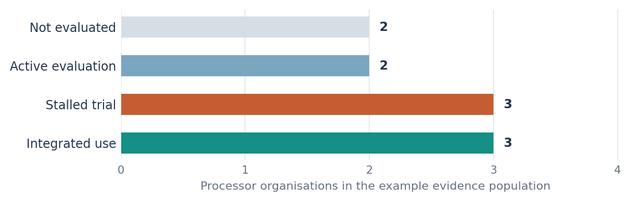
Inline spectral inspection for mid-sized nut processors | Why do promising demonstrations fail to become permanent line integration? | Contrast interviews with integrated users, stalled trials and evaluators, supported by workflow observation | Trial-to-line transition heatmap |
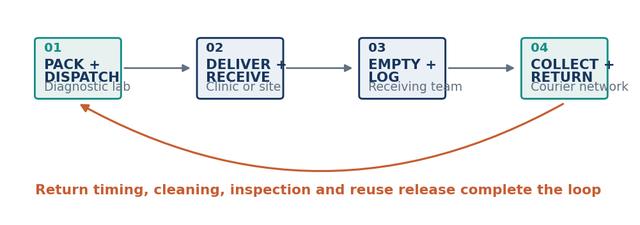
Reusable diagnostic shipping packs across Southern Ontario | Which route density, courier hand-offs and return conditions make network adoption viable? | Multi-party route reconstruction with laboratories, couriers, receiving sites and former trial participants | Closed-loop hand-off map |
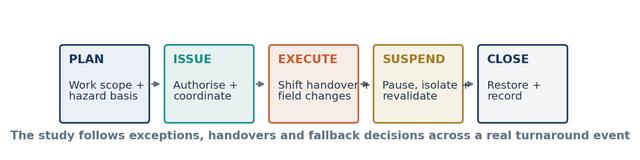
Digital permit-to-work during US Gulf Coast chemical turnarounds | What allows a digital workflow to survive contractor turnover and high-pressure maintenance events? | Event-based reconstruction across site owners, contractors, safety teams and system administrators | Turnaround integration gate map |
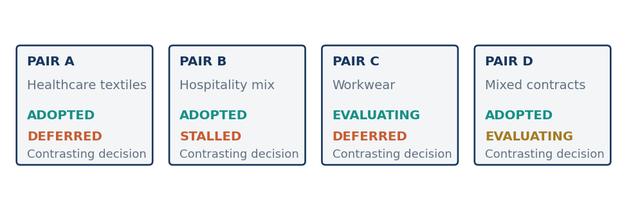
Closed-loop water recovery in Catalonia's commercial laundries | Which operating and local water conditions justify installation, repeat use and expansion? | Matched-site comparison combining operating records, site interviews and local context | Adoption condition comparison plot |
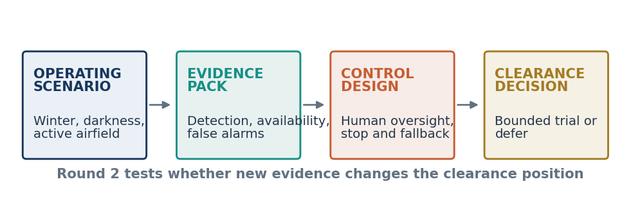
Autonomous airfield inspection at Nordic regional airports | Which safety proof, weather performance and authority conditions allow trials to progress? | Two-round structured assessment with airport operators, safety roles, regulators and technology partners | Evidence-to-clearance pathway |
FAQ
How is this different from an Industry Survey?
An Industry Survey measures needs, opinions or intentions across a defined population. An Industry Adoption Study reconstructs observed movement between adoption states and the conditions behind that movement. A survey may be one module when prevalence is needed.
Are interviews always required?
No. Secondary evidence may answer a narrow question, while observation, structured outreach or a survey may suit other uncertainties. Interviews are used when decision episodes and operating context must be reconstructed.
Can different markets be compared?
Yes, when geography changes regulation, infrastructure, supply, operating practice, access or economics. Shared transition definitions preserve comparison while local conditions remain visible.
CONTACT US
DISCUSS YOUR ADOPTION QUESTION
Tell us what is being adopted, the transition that matters, the organisations involved and the decision the evidence must support. August Research will shape the adoption unit, contrast cells, outreach and analysis around that requirement.