SERVICE OVERVIEW / SECONDARY RESEARCH
Partner / Vendor
Evaluation
Select an organisation that can perform, scale and support the intended relationship.
DECISION SUPPORTED Should the organisation be appointed, qualified, piloted, developed under defined conditions, dual-sourced or not progressed?
A potential vendor, CRO, CDMO, laboratory, startup, distributor or strategic partner may present convincing capabilities, certifications and commercial claims. These signals do not automatically establish whether the organisation can meet the client's specific requirements, deliver consistently or support a sustainable relationship.
August Research conducts independent secondary research that connects organisational evidence with the actual product, service, programme or commercial relationship being considered.
RECONSTRUCT / TEST / STRESS / DECIDE
The work goes beyond a generic supplier checklist. It reconstructs how the proposed relationship would operate, where it could fail and which conditions would be required for it to succeed.
Different relationships require different evidence
Relationship type | Principal decision | Primary evaluation focus |
|---|---|---|
Vendor | Can it reliably deliver a defined product or service? | Capability, quality, capacity, cost, delivery and compliance |
Strategic partner | Can both organisations create and govern value together? | Strategic fit, complementary capabilities, incentives, governance and scalability |
CRO, CDMO or laboratory | Can it execute controlled work and support continuing oversight? | Technical competence, quality systems, capacity, documentation and relationship control |
Startup or technology partner | Can an emerging capability support a dependable commercial relationship? | Technology maturity, financial runway, team depth, IP position and scale-up readiness |
Distributor or market-access partner | Can it provide credible access to intended customers and geographies? | Market coverage, channel strength, customer relationships, service capability and conflicts |
An organisation may be technically capable but commercially incompatible. It may also be strategically attractive while lacking the operational maturity required for immediate appointment.
Why the decision is difficult
Relevant information is usually fragmented across corporate disclosures, certifications, regulatory records, technical materials, facility information, financial filings, hiring activity, investment announcements and commercial claims.
Capability evidence The analysis separates demonstrated capability from stated capability, current capacity from planned capacity, and group-level credentials from site-level readiness.
Operating perimeter The organisation presented in a proposal may rely on different legal entities, facilities, teams or subcontractors to perform the work.
Assurance and execution Certifications are assessed alongside practical quality performance, while commercial ambition is tested against the organisation's financial and operational ability to execute.
Relationship interpretation The assessment distinguishes a capable provider from a governable long-term relationship and treats missing information differently from evidence of an actual weakness.
Our methodology: Relationship Suitability Reconstruction
August Research begins with the client's decision, reconstructs the complete operating relationship and tests whether the available evidence supports appointment.
- Define the relationship mandate
Establish the product, service or capability required; the intended relationship; technical, quality and geographic boundaries; capacity expectations; commercial conditions; data and IP requirements; acceptable risks; and exclusion criteria.
Working output: Relationship mandate and evaluation boundary.
- Resolve the organisation and operating perimeter
Identify the legal entity, ownership, business unit, facilities, operating sites, parent-company support, subcontractors, sub-tier providers, investors, strategic relationships and potential conflicts that sit inside the proposed relationship.
Working output: Entity, facility and relationship map.
- Build the capability-to-requirement proof
Connect each material client requirement to evidence covering relevant products, platforms, industry experience, facilities, technical expertise, quality systems, certifications, validation, regulatory readiness and delivery history.
Working output: Capability-to-requirement evidence matrix.
METHODOLOGY PRINCIPLE Capability is not treated as a single score. Technical strength can coexist with weaknesses in documentation, scale-up, geographic delivery or continuing support.
Reconstructing delivery, exposure and compatibility
- Reconstruct execution readiness
Examine whether the organisation can translate capability into delivery by assessing capacity, facilities, equipment, workforce, implementation structure, supply dependencies, business continuity, technology transfer, expansion investment and ability to support increased volumes.
Working output: Delivery and scale-readiness assessment.
- Identify dependency and failure exposure
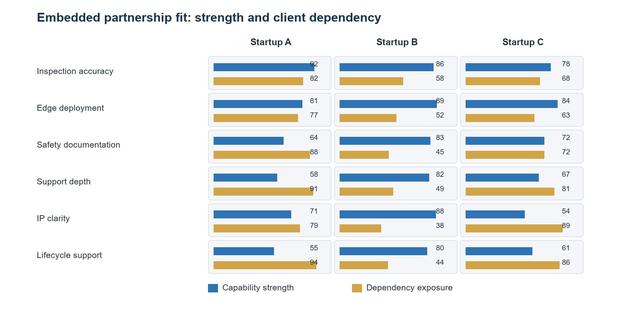
Map single-site and single-equipment dependencies, critical subcontractors, concentrated sources, financial exposure, key-person reliance, competing customer priorities, geographic risk, change controls, replacement options and potential data or IP lock-in.
Working output: Dependency map and failure-exposure register.
- Test relationship compatibility
Assess strategic alignment, capability complementarity, incentives, governance, decision rights, transparency, communication, escalation, information access, confidentiality, change control, exclusivity and the ability to improve jointly over time.
Working output: Relationship-compatibility and governance assessment.
What this reveals
Delivery reality Whether delivery depends on a different entity, site or team than the one presented.
Expansion credibility Whether capacity commitments are supported by investment, facility and workforce signals.
Dependency exposure Where subcontracting or sub-tier reliance changes the client's risk position.
Governability Whether the proposed relationship can be controlled effectively after the selection decision.
From fragmented evidence to a controlled decision
- Triangulate the evidence
Classify findings according to their credibility, recency, decision relevance and consistency across sources. Limited disclosure is separated from a confirmed weakness, especially for private companies, startups and specialist providers.
Working output: Evidence-confidence register and confirmation priorities.
Evidence status | Interpretation |
|---|---|
Verified | Directly supported by credible and current evidence |
Supported | Consistent across multiple credible sources |
Conditional | Dependent on an assumption, location, product, team or future action |
Unresolved | Available evidence is insufficient for a reliable conclusion |
Contradicted | Credible sources present materially different information |
Concern | Evidence indicates a significant risk or requirement mismatch |
- Stress-test the proposed appointment
Test the preferred candidate against capacity pressure, delayed expansion, loss of a subcontractor, certification failure, implementation-cost increases, key-person departure, financial pressure, technology-transfer delay, quality deterioration, acquisition or restricted data access.
Working output: Relationship stress test and decision breakpoints.
- Determine the appropriate decision
Translate the evidence, exposure and stress-test findings into a practical relationship decision with explicit conditions, controls, unresolved questions and next actions.
Working output: Decision brief and relationship-control plan.
The relationship decision framework
Decision | Meaning |
|---|---|
Appoint | Evidence supports selection within the proposed relationship model |
Qualify with conditions | Proceed after specified evidence, controls or agreements are completed |
Pilot | Test a defined capability before making a larger commitment |
Develop | Retain the candidate while agreed capability gaps are addressed |
Dual-source | Proceed while maintaining an alternative source for critical activities |
Monitor | The organisation is potentially relevant but not ready for progression |
Defer | Evidence is insufficient or the timing is unsuitable |
Do not progress | Material risks or mismatches outweigh the potential value |
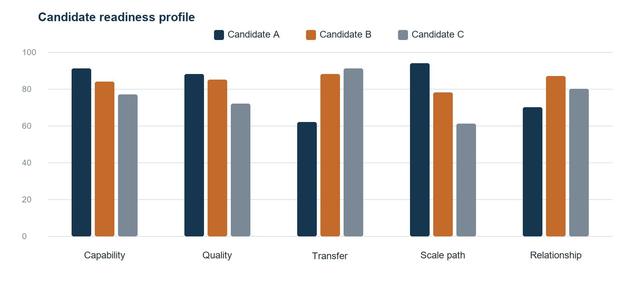
The highest technical score does not automatically produce the strongest recommendation. The decision reflects the interaction between capability, execution, resilience, compatibility, governability and future readiness.
Evaluation architecture
Capability. Can the organisation perform the defined work to the required technical, quality and commercial standard?
Execution. Does it have the capacity, people, facilities, systems and supply network required for reliable delivery?
Resilience. Can it continue operating when exposed to disruption, capacity pressure, financial stress or organisational change?
Compatibility. Do its strategy, incentives and commercial interests support the intended relationship?
Governability. Can responsibilities, information access, performance, change and escalation be controlled effectively?
Future readiness. Can it support scale-up, innovation, geographic expansion or a broader relationship over time?
Information and database coverage
The evidence architecture is adapted to the organisation, industry and relationship decision.
Corporate and financial evidence Corporate registries, ownership records, financial disclosures, investment databases, funding activity, partnerships and transaction records establish the organisation's identity, stability and strategic direction.
Technical and quality evidence Facility information, manufacturing or laboratory records, certifications, accreditation, regulatory databases, patents, publications, technical sources and standards are used to test claimed capability.
Operational and market signals Product portfolios, trade and supply-chain information, workforce activity, expansion announcements, customers, distributors, legal records and reputational signals help reconstruct execution readiness and exposure.
Relationship-specific evidence Client-supplied proposals, specifications, technical documents and commercial information connect external evidence to the precise work and relationship being considered.
EVIDENCE RULE Databases establish evidence; they do not replace analysis. The value comes from connecting fragmented information to the client's specific relationship decision.
Decision-ready deliverables
Deliverable group | Included outputs |
|---|---|
Decision case | Partner or vendor decision dossier, comparative shortlist and appointment recommendation |
Organisation profile | Ownership, facilities, operating perimeter and relationship structure |
Evidence assessment | Capability-to-requirement and evidence-confidence matrices |
Risk and resilience | Capacity, dependency, governance and stress-test assessments |
Control and action | Confirmation register, decision breakpoints and required relationship controls |
Engagement formats
Single-organisation assessment. An in-depth evaluation of one proposed vendor or partner.
Comparative evaluation. A consistent assessment of several candidates against the same decision requirements.
Longlist development and screening. Identification, classification and filtering before detailed evaluation.
Existing-relationship review. Reassessment before renewal, expansion, investment or increased dependency.
Continuous partner intelligence. Periodic monitoring for changes in capability, ownership, financial position, capacity or strategic direction.
Illustrative applications
BIOPHARMACEUTICAL MANUFACTURING Which CDMO can support clinical manufacturing, technology transfer and commercial scale-up without creating an unmanageable capacity dependency?
MEDICAL DIAGNOSTICS Which specialist laboratory can deliver a multi-country testing programme while maintaining required quality, turnaround and data controls?
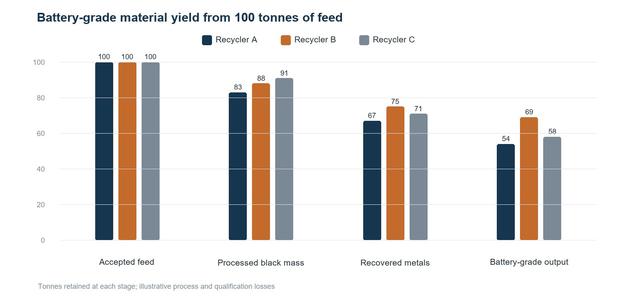
BATTERY MATERIALS Can an emerging recycling company become a reliable source of recovered materials, or should the relationship remain a limited pilot?
INDUSTRIAL AUTOMATION Which machine-vision startup offers the strongest combination of technical capability, integration readiness and long-term commercial stability?
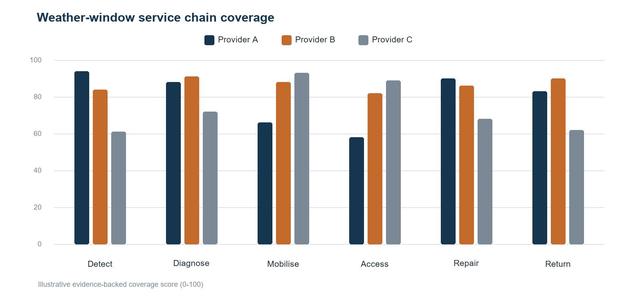
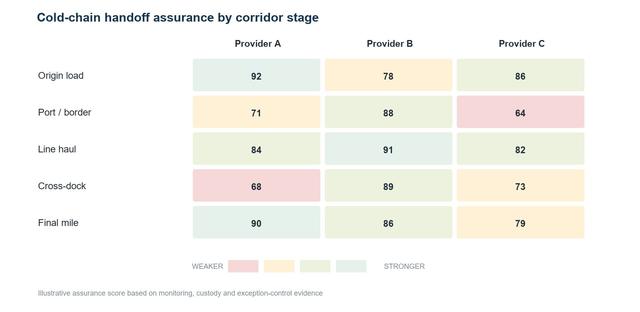
FOOD AND COLD-CHAIN DISTRIBUTION Which regional logistics provider can support temperature-controlled expansion while maintaining service continuity across priority markets?
Frequently asked questions
Is this a formal supplier audit?
No. The service provides independent secondary-research-based commercial, operational and strategic assessment. It may identify issues for formal audit, legal review, regulatory diligence or technical validation, but it does not replace those activities.
Can several organisations be compared?
Yes. Candidates can be evaluated through a consistent framework while retaining the criteria that matter to the specific relationship.
Does limited public information mean a company is unsuitable?
No. Limited disclosure is treated as an evidence gap, not automatically as a weakness. The assessment identifies what must be confirmed before a decision is made.
Can the service be used for an existing supplier?
Yes. It can support renewal, expansion, dependency reduction, performance review, dual-sourcing or contingency planning.
Can startups and established companies be compared?
Yes, but not through identical maturity expectations. Evidence is interpreted according to organisational maturity while the client's essential requirements remain consistent.
LET'S DISCUSS YOUR PARTNER OR VENDOR DECISION The right external organisation must do more than meet a list of requirements. It must be able to perform, withstand pressure and operate within a relationship that protects the client's objectives.
EVALUATE A POTENTIAL PARTNER | COMPARE PROSPECTIVE VENDORS