MARKET & BUSINESS INTELLIGENCE
Investment &
Opportunity Research
Turn a promising opportunity into a capital decision that can withstand challenge.
CORE DECISION Should capital be committed to this sector, company, project or business model, through which route, and under what conditions?
August Research builds the evidence behind the investment thesis, challenges the assumptions that carry the decision and shows where the case remains resilient, becomes conditional or should stop.
For corporate strategy, corporate venture capital, private capital, family offices and development or infrastructure investors
PURPOSE OF THE SERVICE
Research for the decision before detailed diligence begins
The service is used when an investor or corporate team has identified a theme, target, asset or project but does not yet have enough independent evidence to commit resources or begin full diligence. It can also build the opportunity universe when the investable candidates are not yet known.
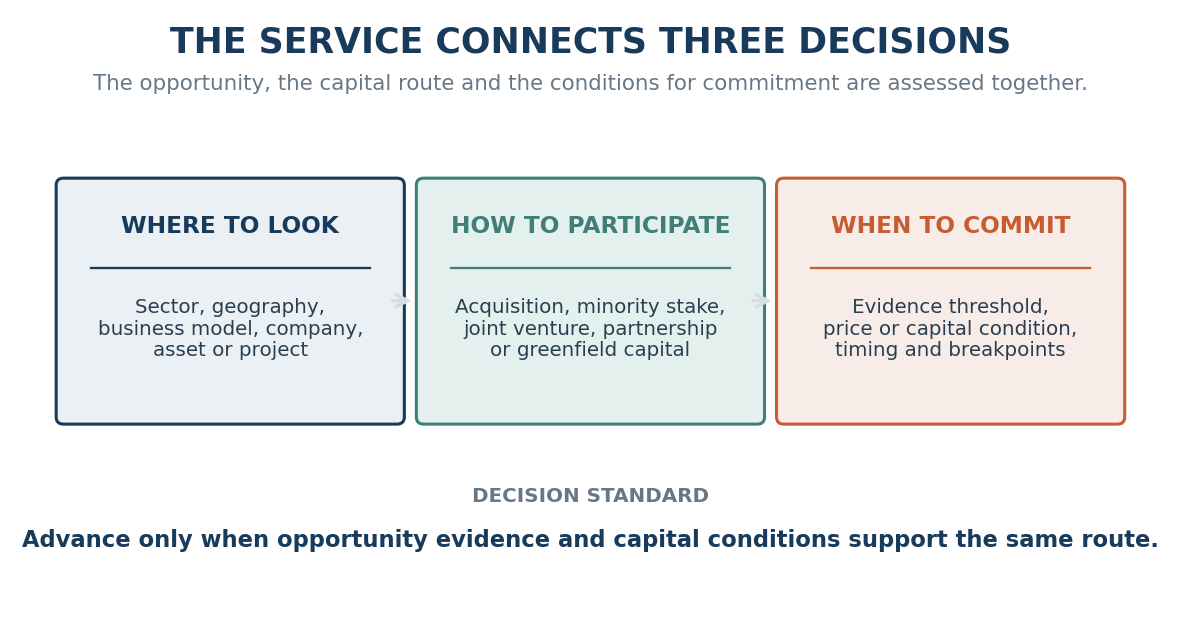
Questions the research can resolve
- Which opportunity spaces fit the investment mandate and which should be excluded immediately?
- What demand, business-model or capability mechanism could create value?
- Which companies, projects or assets provide a practical route into the opportunity?
- How do recent funding, valuation and transaction conditions affect timing and access?
- Which assumptions remain supported under pressure and where does the thesis break?
- What evidence must be obtained before the opportunity advances to detailed diligence?
CORE METHODOLOGY
The Investment Thesis Challenge System
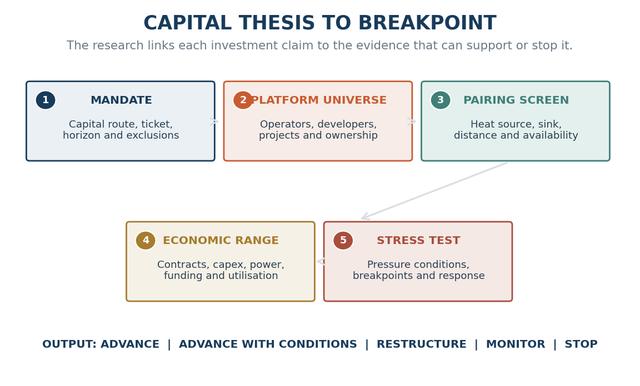
The methodology does not begin by scoring a long list of companies. It first defines what the investor is trying to achieve and reconstructs how the proposed opportunity is expected to create value. Every subsequent research question tests part of that thesis.
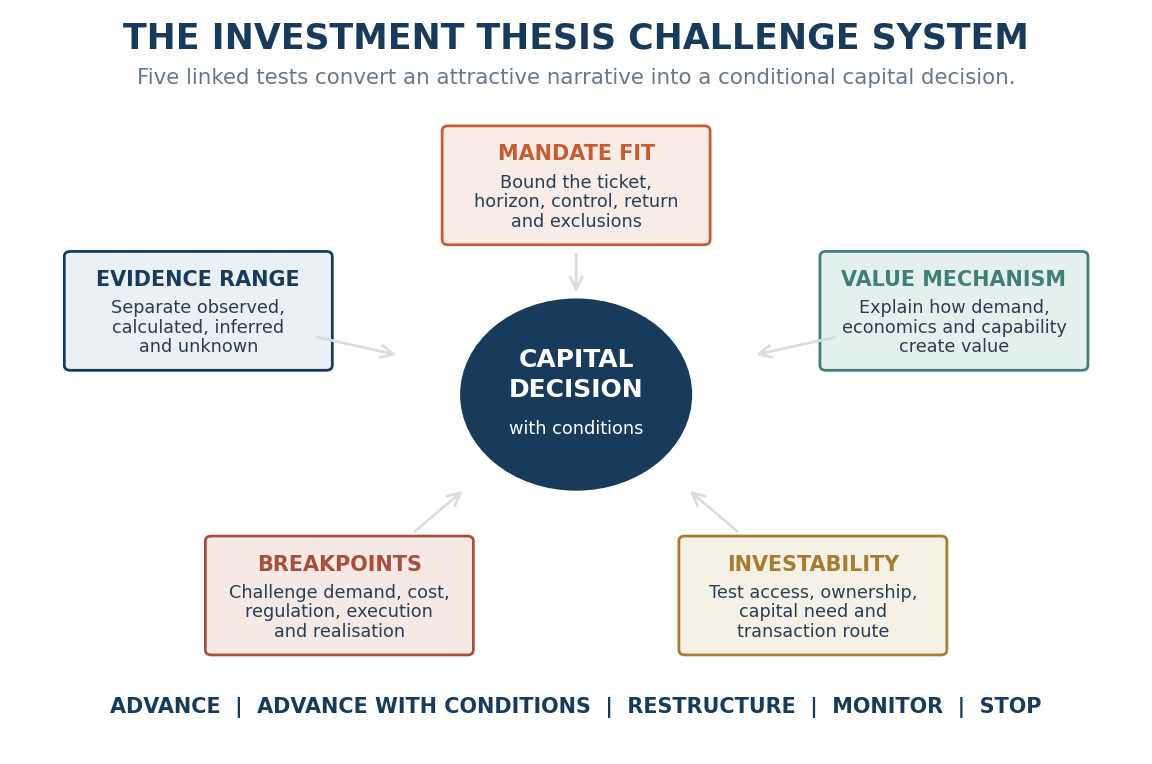
Five tests must agree
Mandate fit: The opportunity must match the permitted geography, ticket, maturity, ownership position, holding period and exclusions.
Value mechanism: Demand, economics, capability and competitive advantage must explain how value could be created.
Investability: Ownership, capital need, company maturity and transaction conditions must provide a feasible route for participation.
Breakpoints: The thesis must remain coherent under credible pressure, with explicit conditions that would invalidate it.
Evidence range: Observed facts, calculations, inferences and unknowns must remain distinguishable throughout the decision.
RESEARCH EXECUTION
A controlled research process, not a database search
The work progresses through six research objects. This keeps the mandate, assumptions, evidence, exclusions and recommendation connected. A mandatory condition can stop the study early, preventing unnecessary research on an opportunity that no longer qualifies.
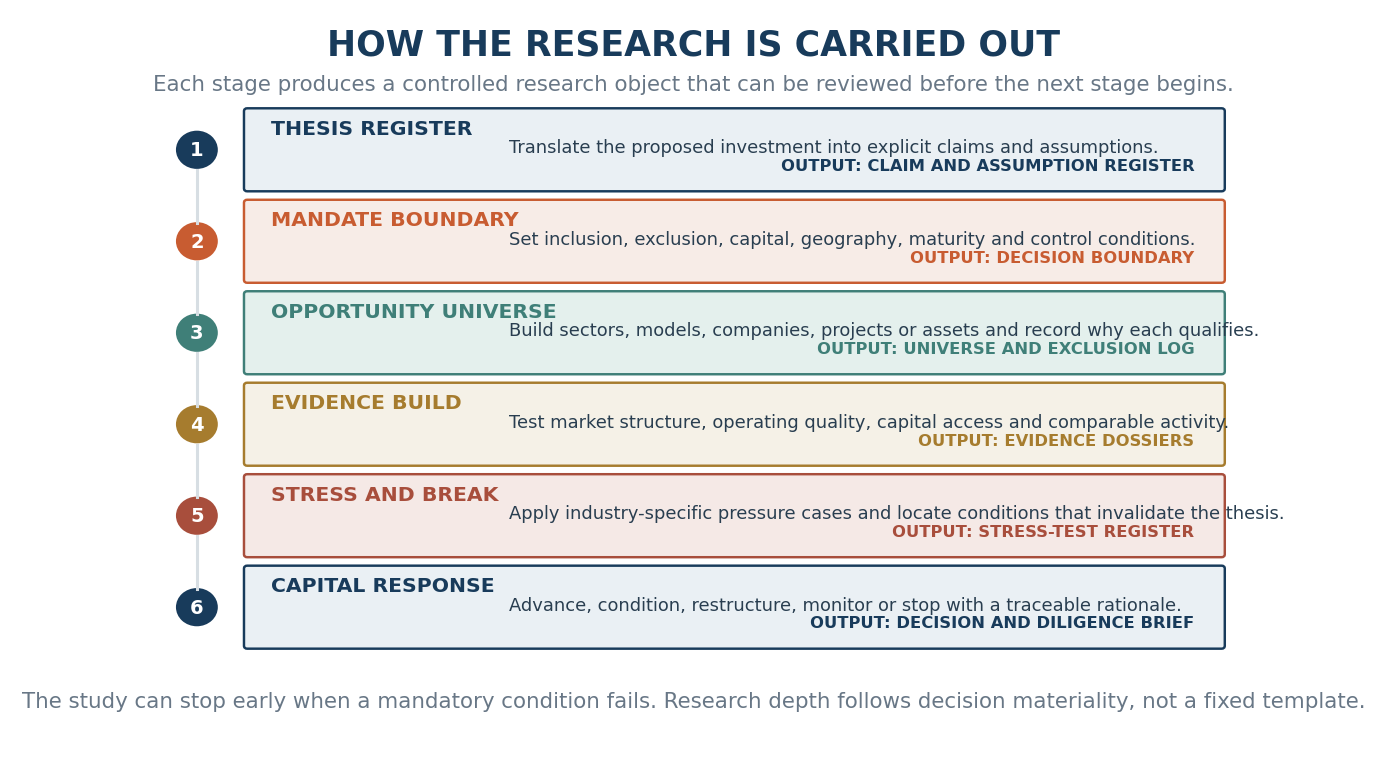
How candidate selection is controlled
Candidates are included because they satisfy defined opportunity and mandate criteria, not because they are highly visible or well funded. Each exclusion retains a reason, such as geographic mismatch, unsuitable investment stage, unavailable ownership route, insufficient operating evidence or capital need outside the mandate.
RESEARCH DEPTH Broad universe work identifies and filters opportunities. Detailed dossiers are reserved for candidates capable of changing the capital decision.
INVESTMENT THESIS STRESS TESTING
Find the point at which the investment logic changes
Stress testing is not the addition of a generic downside scenario at the end of the study. It begins when the thesis is defined. Material assumptions are assigned an evidence range, subjected to a credible industry-specific pressure condition and linked to a breakpoint and response.
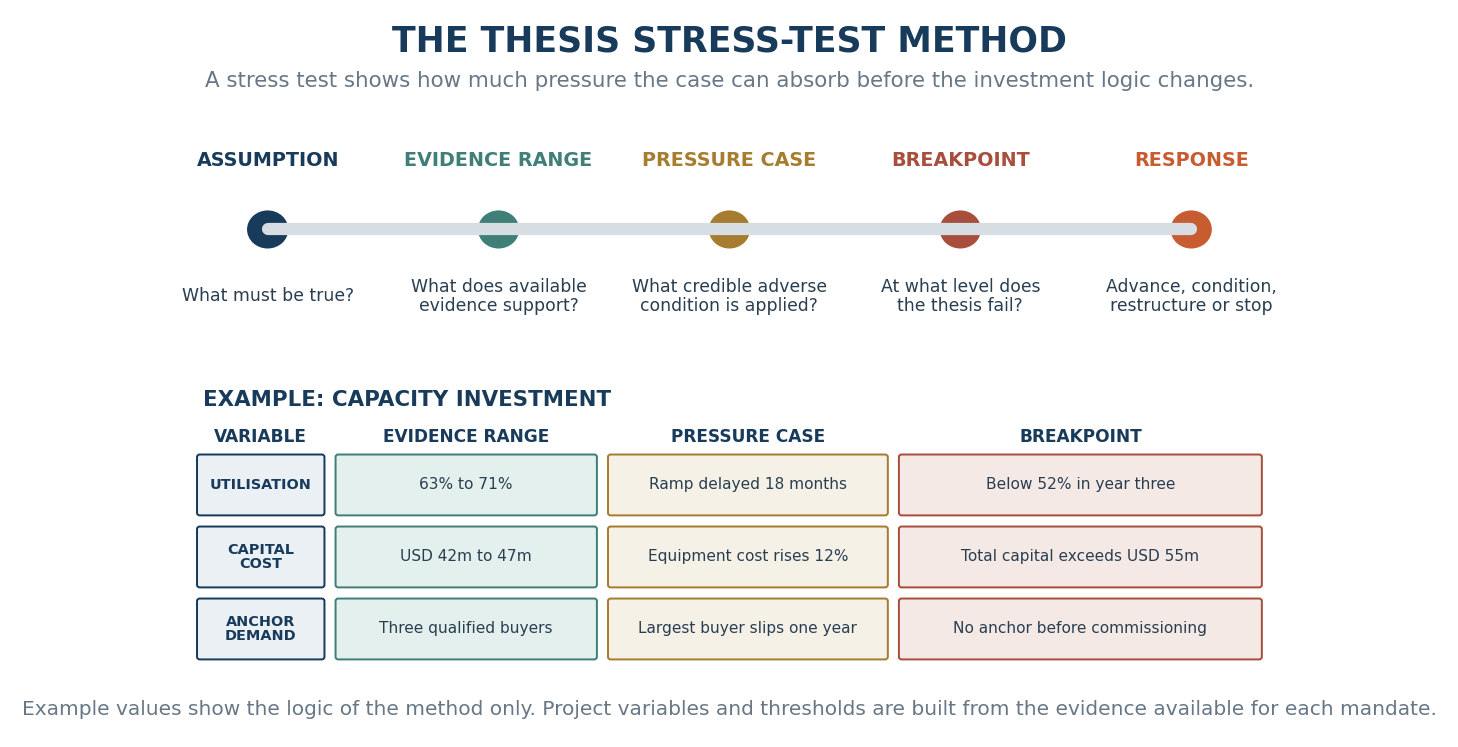
What can be stressed
- Demand adoption, penetration, customer conversion or utilisation ramp
- Price, margin, acquisition cost, working capital or capital expenditure
- Construction, certification, hiring, integration or commercialisation timing
- Regulatory approval, reimbursement, policy support or market-access conditions
- Funding availability, dilution, valuation, buyer interest or exit timing
DECISION VALUE The result identifies which assumptions are resilient, which require conditions and which can no longer support the proposed investment route.
ANALYTICAL DESIGN
Use the calculation that can change the thesis
The analytical model is built around the value mechanism and available evidence. CAGR, forecasts and transaction multiples are used only where they answer the investment question. They are not added simply because the study concerns investment.
ANALYSIS AREA | POSSIBLE MEASURES | DECISION USE |
|---|---|---|
Market development | Historic growth, CAGR, penetration, adoption rate, demand drivers and forecast range | Tests the scale and timing of demand |
Commercial economics | Revenue pool, price structure, customer concentration, margin signals and recurring demand | Tests the quality of the value mechanism |
Capital requirement | Capacity need, capital intensity, funding rounds, disclosed investment and financing conditions | Tests whether the opportunity fits the ticket |
Transaction context | Comparable funding, acquisitions, valuations, investor activity and ownership change | Tests access, timing and reference points |
Strategic value | Capability fit, channel access, integration requirements, growth levers and option value | Tests the route to value creation |
Downside exposure | Sensitivity ranges, scenario effects, concentration, regulation and execution dependencies | Locates the investment breakpoint |
Rules for quantitative claims
Defined denominator: Every percentage or share states what has been measured and over which period.
Evidence range: Sparse or conflicting data is expressed as a supported range rather than false precision.
Comparable control: Transactions and multiples are normalised for geography, year, stage, business model and deal type before comparison.
Scenario logic: Changes to demand, cost or timing flow through the decision model rather than appearing as disconnected charts.
EVIDENCE ARCHITECTURE
Connect market, company, capital and contextual evidence
Every source is selected for a defined claim. Evidence is dated, attributed to the correct company or project and classified before it affects the thesis. Conflicting sources remain visible rather than being averaged into a convenient answer.
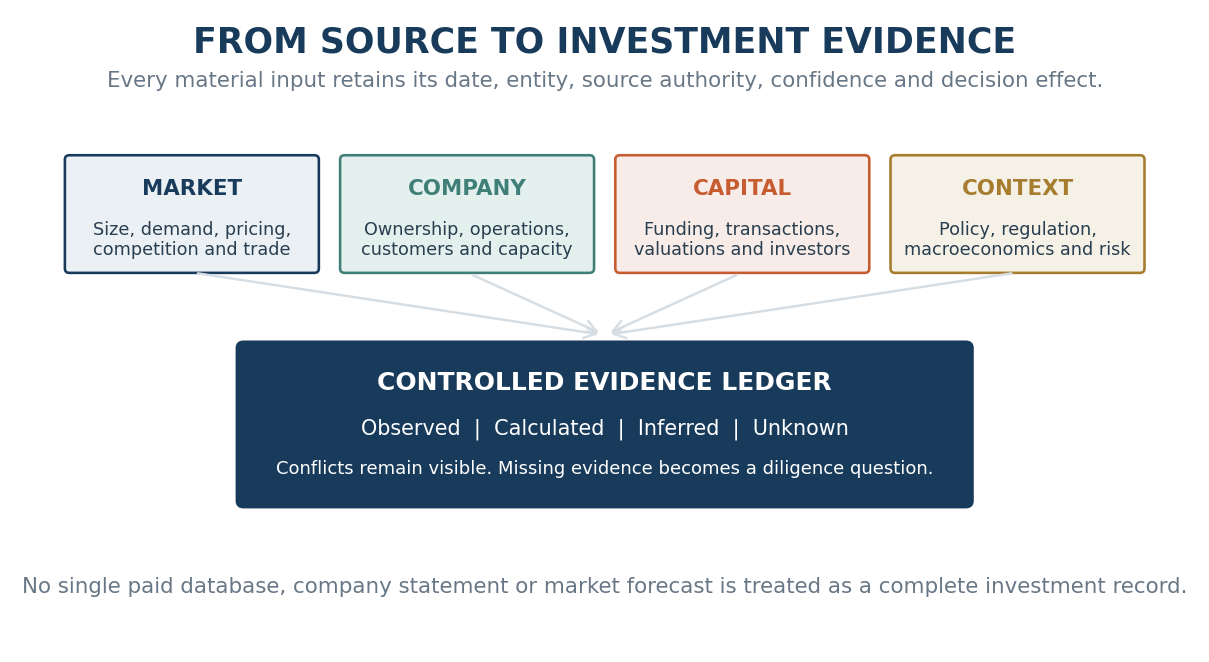
Sources selected according to the mandate
EVIDENCE REQUIREMENT | SOURCES THAT CAN BE INTEGRATED |
|---|---|
Private capital and transactions | PitchBook, Preqin, Crunchbase, Tracxn, CB Insights, S&P Capital IQ, Refinitiv, Mergermarket and Zephyr |
Corporate disclosure | Exchange filings, annual reports, investor presentations, company registries, statutory accounts and transaction announcements |
Market and operating evidence | Industry databases, trade and customs data, product and pricing records, facilities, hiring, customers and contracts |
Policy and macro context | Regulators, government programmes, investment agencies, World Bank, IMF, OECD, UNCTAD and national statistics |
Innovation evidence | Patent, scientific, clinical, technical and regulatory sources when technology is material to the investment thesis |
The final source mix depends on database coverage, subscription availability, company type, geography and the client's existing access.
DECISION DELIVERY
A decision pack that preserves the research trail
CLIENT OUTPUT | WHAT IT CONTAINS |
|---|---|
Investment thesis register | Claims, assumptions, evidence requirements and initial break conditions |
Opportunity universe | Candidates, categories, inclusion logic and exclusion register |
Investment dossiers | Market case, value mechanism, investability, evidence confidence and unresolved questions |
Stress-test register | Evidence ranges, pressure conditions, sensitivities, breakpoints and responses |
Capital decision brief | Advance, advance with conditions, restructure, monitor or stop |
Diligence handoff | Priority evidence requests and questions for commercial, financial, legal or technical review |
Why August Research
Thesis before targets: We establish how the opportunity is expected to create value before allowing company visibility or funding momentum to drive selection.
Breakpoints before recommendation: The conditions that would weaken or stop the investment are defined before the final conclusion is written.
Evidence without forced certainty: Sparse private-company data, weak comparables and conflicting forecasts remain visible and decision-specific.
Independent challenge: An external research team can test sponsor enthusiasm, internal assumptions and preferred targets against the same evidence standard.
Research that transfers: The evidence ledger, exclusions and diligence questions can move directly into the client's next review stage.
Engagement formats
Rapid thesis screen | Opportunity universe | Detailed investment case | Portfolio theme assessment
APPLICATIONS
Illustrations
INDUSTRY | INVESTMENT QUESTION | STRESS-TEST FOCUS |
|---|---|---|
Industrial energy services | Should a strategic investor back waste-heat-as-a-service providers in Germany? | Utilisation ramp, gas-price movement, contract conversion and project capital |
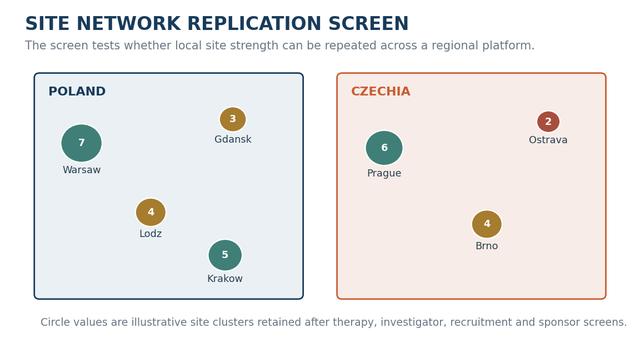
Life sciences services | Can clinical-trial site networks in Poland and Czechia support a buy-and-build thesis? | Patient recruitment, investigator capacity, sponsor concentration and integration pace |
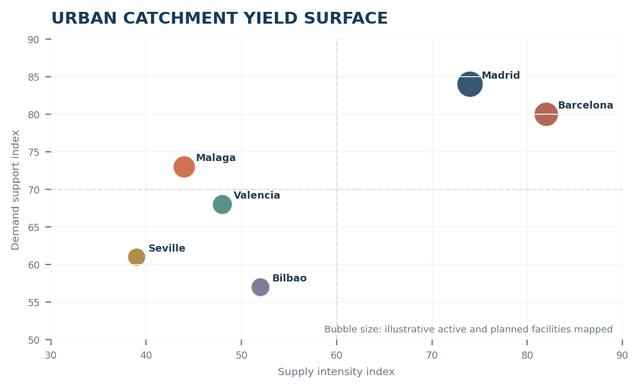
Consumer real estate | Are urban self-storage operators in Spain entering an investable consolidation phase? | Occupancy ramp, rent growth, property cost and acquisition pipeline |
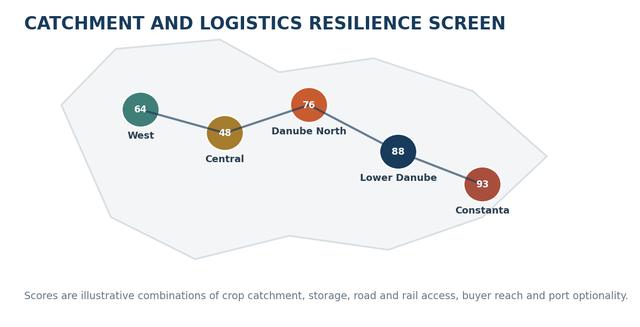
Agribusiness | Which Romanian grain-storage and handling operators merit minority growth investment? | Harvest volatility, throughput, energy cost and working capital |
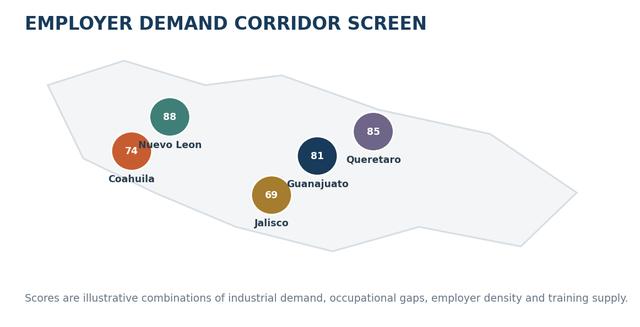
Workforce services | Should a growth investor enter industrial vocational-training networks in Mexico? | Enrolment, completion, employer placement and instructor capacity |
Frequently combined with
- Market Sizing & Forecasting
- Market Opportunity Assessment
- Company Profiling
- Competitive Benchmarking
- Market Entry Assessment
DECISION RANGE Applications can cover strategic investment, minority growth capital, acquisitions, buy-and-build platforms and project participation across different stages of opportunity maturity.
PRACTICAL QUESTIONS
FAQ
Does this service provide investment advice?
No. It provides independent market, company and opportunity research to support capital decisions. It does not replace regulated investment advice.
How is this different from Market Opportunity Assessment?
Market Opportunity Assessment determines where unmet commercial opportunity exists. Investment & Opportunity Research determines whether capital should be committed to an opportunity, through which route and under what conditions.
Is this commercial due diligence?
It is commonly used before or alongside formal diligence. It shapes the thesis, screens the universe, stress-tests the assumptions and defines what deeper diligence must verify.
Can private companies be included?
Yes. Available evidence is assessed with explicit confidence levels. Estimates, inferred signals and missing information are not presented as reported facts.
Can the work start from our target list?
Yes. August Research can test a client-provided list, build an independent universe or reconcile both against one mandate and inclusion standard.
How long does a study take?
Timing depends on the number of markets or candidates, the accessibility of private-company evidence, the analytical depth and the number of assumptions that must be stress-tested. The scope is set against the decision deadline.
Contact Us
TURN AN INVESTMENT IDEA INTO A TESTABLE DECISION Tell us the sector, geography, capital route and mandate you are considering. August Research will define the thesis, opportunity universe, evidence architecture and stress tests required for the next decision.