MARKET & BUSINESS INTELLIGENCE | PRIMARY RESEARCH
Stakeholder Mapping
See how influence moves before deciding where to engage.
THE SERVICE PROMISE August Research identifies the people, organisations and institutions that can enable, redirect, delay, constrain or legitimise a defined business initiative. The map shows how their influence reaches the decision, what activates it and where engagement or monitoring should begin.
A stakeholder list is not yet a decision map
Job titles and formal authority reveal only part of the system. A trade association may relay evidence to regulators. A delivery partner may control implementation without approving the investment. A local group may influence the institution that grants permission. Stakeholder Mapping reconstructs these pathways so attention is based on decision relevance rather than visibility alone.
WHO MATTERS
Stakeholders selected for their role in the defined decision, not because they appear on a standard list.
HOW INFLUENCE MOVES
Direct authority, operating dependencies, evidence routes, relationships and legitimacy pathways.
WHAT TO DO NEXT
Engagement priorities, unresolved assumptions, timing windows and signals that can change the map.
Why independent mapping matters
Internal teams naturally begin with familiar contacts and visible decision makers. Independent research can test whether those relationships represent the wider system, identify less visible intermediaries and invite candid views without attaching the discussion to an existing commercial or institutional relationship.
02 | DECISION SCOPE
Start with the decision that may be shaped
The decision boundary determines which stakeholders, relationships, geographies and evidence routes belong in the study.
When Stakeholder Mapping is useful
MARKET ENTRY
A new geography or sector contains unfamiliar authorities, intermediaries, partners and opinion-forming groups.
ECOSYSTEM BUILDING
The offer depends on partners, platforms, infrastructure owners or complementary service providers acting together.
POLICY OR STANDARDS
Regulation, procurement rules, technical standards or industry guidance could change adoption conditions.
SITE OR OPERATING CHANGE
Permission, community acceptance, local infrastructure and delivery responsibilities affect whether a plan can proceed.
CATEGORY CREATION
The organisation must establish credibility, terminology and evidence across several audiences before demand can develop.
M&A AND INTEGRATION
Transaction approval, relationship continuity, talent retention and integration depend on stakeholders inside and outside the organisations.
Questions the research can answer
DECISION ROLES Who can approve, specify, fund, implement, influence, challenge or legitimise the initiative?
INFLUENCE ROUTES Does influence reach the decision directly, through an intermediary or through a dependency elsewhere in the system?
POSITION What does each stakeholder currently support, question or require, and how confident is the evidence?
CONDITIONS Which proof, protection, incentive or change in circumstance could alter a stakeholder's position?
TIMING When can each stakeholder shape the outcome, and which pathway must be addressed first?
ENGAGEMENT Where is direct engagement appropriate, where is a trusted relay more credible and what should be monitored rather than contacted?
03 | STAKEHOLDER UNIVERSE
Map the system, not only the visible organisations
Stakeholders are included when they hold a decision role, control a dependency, carry trusted evidence, connect the network or experience a material effect.
Who may need to be mapped
AUTHORITIES
Regulators, ministries, local government, standards bodies and public procurers
ECONOMIC GATEKEEPERS
Investors, lenders, budget holders, insurers, procurement bodies and major buyers
DELIVERY SYSTEM
Operators, service providers, contractors, distributors, infrastructure owners and suppliers
EVIDENCE CARRIERS
Professional bodies, researchers, technical advisers, auditors and recognised specialists
THE CLIENT DECISION
The initiative, location, timing and action that define the stakeholder boundary
NETWORK RELAYS
Associations, alliances, conveners, channel leaders and organisations that connect groups
AFFECTED GROUPS
Customers, users, employees, unions, works councils, communities or organisations that experience the consequences
PUBLIC VOICES
Advocacy groups, media, commentators and opinion leaders when they can shape legitimacy
ALTERNATIVE INFLUENCES
Competing models, incumbent providers and organisations that benefit from the status quo
Selection parameters
Formal mandate, practical control, relationship to the initiative, ability to transmit evidence, network position, affected interest, geography, proximity, timing and the reversibility of the stakeholder's decision can all shape inclusion. Only parameters that materially affect the client decision become selection criteria.
GEOGRAPHY WHERE IT CHANGES THE SYSTEM Local institutions, language, regulation, infrastructure, community proximity and market conventions may create different stakeholder pathways. Geography is included only when those differences affect the decision; it is not added as decoration.
04 | INFLUENCE PATHWAYS
Show how each stakeholder reaches the decision
The analysis distinguishes authority from dependency, credibility, network transmission and legitimacy.
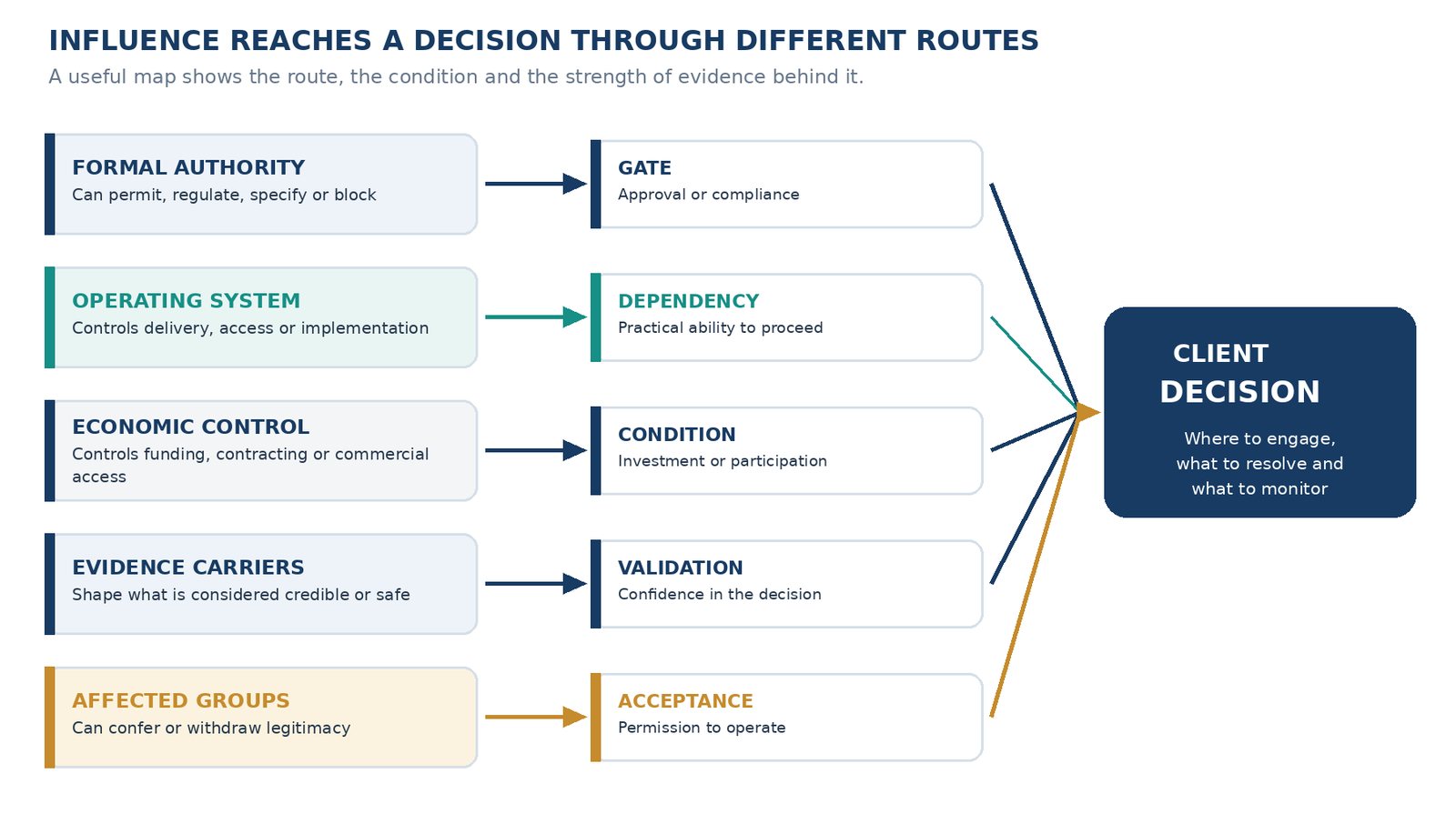
What the pathway map adds
ROUTE
Direct influence, relayed influence or dependence through another actor.
CONDITION
The evidence, incentive, protection or event that activates the pathway.
CONFIDENCE
Whether the relationship is confirmed, supported, inferred or still unresolved.
A stakeholder can appear in more than one pathway. The map therefore avoids a single universal score that hides why the stakeholder matters.
05 | RESEARCH DESIGN
Stakeholder Influence Pathway Mapping
An evidence-first method that uses targeted primary research where informal relationships, current positions or engagement conditions cannot be verified from published information.
How the research is carried out
01 FRAME THE DECISION Define the initiative, action required, time horizon, geographic boundary and what would make the map useful.
02 BUILD THE UNIVERSE Review official records, governance structures, policies, consultations, organisations, market activity and documented relationships.
03 FORM PATHWAY HYPOTHESES Identify likely roles, connections, dependencies and influence routes, while marking assumptions and evidence gaps.
04 DESIGN TARGETED VALIDATION Select interviews, short structured outreach or a survey only where the scope requires evidence that is not otherwise observable.
05 TEST POSITION AND CONDITIONS Establish what stakeholders support, question or require, how stable the position is and what could change it.
06 PRIORITISE ACTION Translate verified pathways into engagement order, relationship routes, evidence needs and monitoring triggers.
Method selection follows the uncertainty
EVIDENCE ROUTE | USED WHEN | WHAT IT ADDS |
|---|---|---|
Secondary evidence | Roles, authority, public positions and formal relationships are documented | A traceable starting universe and relationship hypotheses |
Targeted interviews | Informal influence, current position, trust or engagement conditions remain unclear | Explanation of how influence works and why a route matters |
Structured outreach | Several stakeholders need the same focused validation | Comparable responses without imposing a full survey design |
Stakeholder survey | A defined, reachable population and defensible quantitative comparison are needed | Distribution of views, conditions or priorities within the reached population |
06 | OUTREACH AND VALIDATION
Reach the person who understands the pathway
Outreach is not a blanket invitation to everyone on the map. It is a controlled response to a specific evidence gap.
What stakeholder outreach looks like
IDENTIFY
Locate candidates through client-approved contacts, independent professional networks, associations, public records, targeted identification and local partners.
VERIFY
Confirm the person's current role, relevant decision exposure, relationship to the initiative and ability to explain the pathway under study.
INVITE
Use a neutral invitation that explains the research purpose, confidentiality and topic without presenting a preferred position or lobbying message.
CAPTURE
Ask decision-specific questions about roles, dependencies, evidence, current conditions and relationship routes. Record uncertainty as well as agreement.
How participants are selected
PATHWAY KNOWLEDGE Direct knowledge of the decision route, dependency, institution or relationship being validated.
CURRENT RELEVANCE A role and experience recent enough to reflect the present stakeholder environment.
PERSPECTIVE BALANCE Coverage across stakeholders with different interests, responsibilities and exposure to the consequences.
MARKET FIT The relevant jurisdiction, location, operating context, language or institutional level when geography matters.
CONFLICT CONTROL Transparent screening for employer, client, advocacy or commercial interests that may shape interpretation.
Fieldwork discipline
The number of interviews or responses is agreed after the stakeholder universe, evidence gaps, accessibility and comparison needs are understood. The objective is sufficient pathway coverage and contradiction testing, not a large headline sample. One participant does not represent an institution unless the scope and evidence justify that conclusion.
07 | ANALYSIS AND DELIVERY
Turn the map into a practical engagement system
The final output combines network structure, stakeholder conditions, evidence confidence and action timing.
Six lenses used to interpret influence
FORMAL AUTHORITY
Mandate to approve, regulate, specify, fund or contract
OPERATING DEPENDENCE
Control of access, implementation, infrastructure or delivery
EVIDENCE CREDIBILITY
Ability to define what is accepted as valid, safe or legitimate
NETWORK REACH
Capacity to transmit a position through trusted relationships
AFFECTED INTEREST
Degree and direction of exposure to the initiative's consequences
ACTIVATION CONDITION
Event, proof, incentive or protection that could change behaviour
What the client receives
Stakeholder Universe A structured register with role, relationship, inclusion reason and evidence status.
Influence Pathway Map Direct, relayed and dependency routes connected to the defined decision.
Position and Conditions View Current stance, questions, evidence needs and circumstances that may change it.
Engagement Priority Plan Who to engage, through which route, for what purpose and at what point.
Evidence Gap Register Unresolved assumptions, contradictions and areas requiring further validation.
Monitoring Triggers Policy, organisational, market or relationship signals that could change the map.
Quality controls
Each conclusion retains its evidence route and confidence level. Formal authority is separated from informal influence. Reported relationships are distinguished from analyst inference. Contradictory views remain visible. Sensitive identities and comments are handled according to the agreed confidentiality approach.
08 | AUGUST RESEARCH
Evidence breadth with role-specific access
The service combines structured secondary research, independent outreach and decision-ready visual analysis within one engagement.
Why August Research
100+ INFORMATION SOURCES AND CHANNELS
A broad evidence base for identifying organisations, mandates, relationships, positions and change signals.
1,500+ ESTABLISHED EXPERT NETWORK
Access to experienced practitioners who can help validate how influence and dependencies operate in practice.
EIGHT INDUSTRY GROUPS
Sector context used to distinguish meaningful influence from generic stakeholder categories.
GLOBAL, ROLE-SPECIFIC RESEARCH
Participant identification and fieldwork designed around decision exposure, market conditions and local context.
Engagement formats
FOCUSED MAP One defined decision, market or initiative with a bounded stakeholder universe.
VALIDATED INFLUENCE MAP Secondary mapping plus targeted interviews or outreach to test informal pathways and current conditions.
MULTI-MARKET MAP Comparable core logic with market-specific institutions, relationships, language and engagement conditions.
LIVING STAKEHOLDER MONITOR An initial map followed by agreed updates when policies, roles, positions or relationships change.
Scope, participant counts and timing are agreed after the decision boundary, stakeholder accessibility, evidence gaps and conflict checks are understood.
09 | ILLUSTRATIVE EXAMPLES
Illustrative Examples
Five examples of how Stakeholder Mapping can support different business decisions and stakeholder systems.
ILLUSTRATION | CLIENT DECISION | MAPPING EMPHASIS |
|---|---|---|
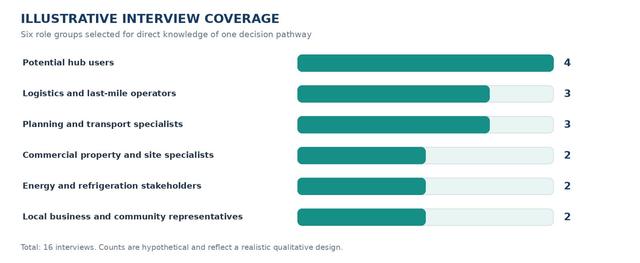
Urban cold-storage hub | Greater Manchester, UK | Which organisations and local groups must be understood before choosing a site and operating model? | Proximity, permission sequence and community legitimacy |
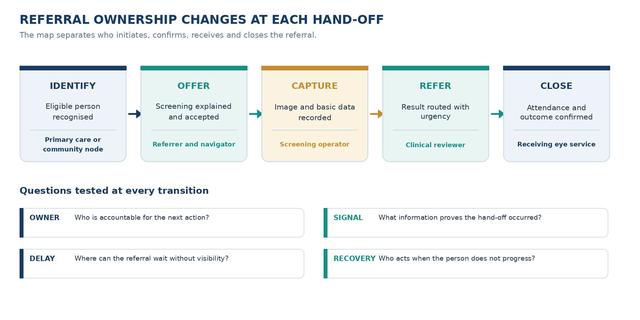
Digital eye-screening referral service | West Java, Indonesia | How should a service provider navigate referral authority, clinical credibility, payer access and patient trust? | Referral pathways, evidence carriers and adoption conditions |
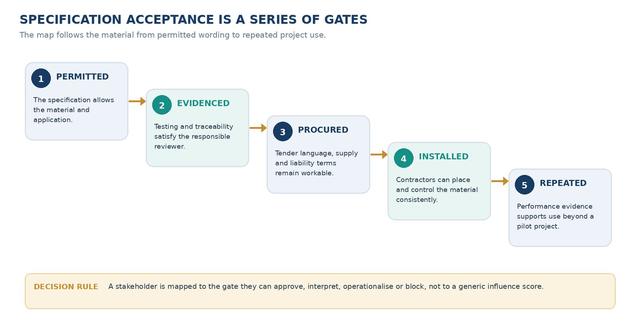
Recycled aggregate specification | Victoria, Australia | Who shapes whether recycled material can enter municipal road-maintenance specifications and procurement? | Formal approval chain, proof requirements and market readiness |
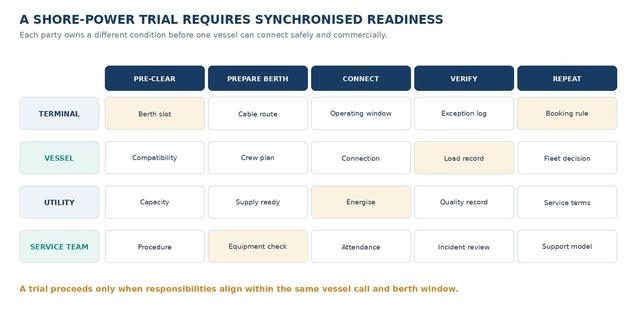
Shore-power service for harbour vessels | Santos, Brazil | Which port, utility, operator and financing relationships must align before a shared service can proceed? | Operating dependencies, investment gates and timing |
Specialty ingredients acquisition | Benelux and Germany | Which customers, employees, distributors, suppliers and authorities could affect approval, relationship continuity and integration? | Approval routes, key-person dependence, customer continuity and integration timing |
One service, different research designs
The stakeholder boundary is defined before evidence sources or outreach are selected. Interviews, structured outreach, surveys, geography, proximity and quantitative scoring are used only when justified by the decision. Each engagement receives a mapping and validation approach suited to its stakeholder system rather than one standard influence matrix.
10 | FAQ
FAQ
Practical questions about scope, evidence, interviews and map use.
Is Stakeholder Mapping just a power-interest matrix?
No. A matrix can be one simplified view, but the service focuses on why a stakeholder matters, how influence reaches the decision, what activates it and how well the pathway is supported.
Are interviews always required?
No. The study begins with available evidence. Interviews are added when informal influence, current position, trust, relationship strength or engagement conditions cannot be established reliably from secondary sources.
Can Stakeholder Mapping support M&A?
Yes. It can identify the stakeholders and relationship dependencies affecting transaction approval, customer and supplier continuity, talent retention, integration and market confidence. It complements rather than replaces financial, legal or commercial due diligence.
Can August Research contact stakeholders?
Yes. Outreach can use client-approved contacts and independent routes. Invitations remain neutral, participants are screened for relevant experience and confidentiality is agreed before fieldwork.
How is geography handled?
A common decision framework can be retained across markets, while local institutions, language, regulation, proximity and recruitment routes are adapted where they change the stakeholder system.
How often should a stakeholder map be updated?
The map should be revisited when decision timing, roles, policy, market structure, organisational positions or material relationships change. Monitoring triggers can be built into the first engagement.
Does a map predict stakeholder behaviour?
It supports evidence-based planning, but it does not guarantee behaviour or consensus. Positions can change, and the final output distinguishes confirmed evidence from inference and unresolved uncertainty.
Contact Us
UNDERSTAND WHO SHAPES THE DECISION
Tell us the initiative, decision boundary and markets involved. We will design the evidence review, stakeholder identification and validation approach around the influence system that matters.