SERVICE OVERVIEW SECONDARY RESEARCH
Market Entry Assessment
Determine whether a new geography or product line offers accessible demand, workable economics and a practical route to entry
Decision supported Should the company enter, which customer or product segment should it prioritise, what route should it use, and what conditions must be satisfied before it commits further resources?
A growing market does not automatically represent an attractive opportunity for every company. Demand may be concentrated in an inaccessible customer segment, regulation may delay launch, local competitors may control the principal channels, or the cost of serving the market may undermine the apparent opportunity.
August Research conducts independent secondary research to determine whether a company should enter a new geography or product category, how the opportunity could be approached and which conditions should govern the decision.
The assessment connects market evidence with the company's actual proposition, capabilities and intended entry model. It examines customer demand together with market access, competition, labour, supply chains, logistics, infrastructure, channel requirements and entry economics.
DEFINE RECONSTRUCT TEST SEQUENCE DECIDE
The result is an entry decision with a practical route rather than a general description of the market.
Different entry decisions require different evidence
Entry situation | Central decision | Evidence emphasis |
|---|---|---|
New geography | Can the existing proposition travel successfully? | Local demand, adaptation, regulation, distribution, logistics, labour, taxation and competitive response |
New product line | Can the company win in an adjacent category? | Customer overlap, willingness to buy, brand fit, channel access, cannibalisation, delivery capability and cost to serve |
New geography with a new product | Can two layers of uncertainty be managed together? | Separate evidence for product demand and geographic viability before a combined launch case is accepted |
A geographic expansion usually tests whether an established proposition can travel. A product-line expansion tests whether the company can earn customer acceptance in a different category and support the new offer without weakening the existing business. When both the product and geography are new, the two questions are examined separately because weak early performance would otherwise be difficult to diagnose.
Why attractive markets can produce poor entry decisions
Headline market totals may include customers, price points and routes to market that the company cannot reach economically. Legal permission to operate may also conceal practical requirements involving certification, local representation, data, staffing or ownership. These conditions change the time, cost and form of entry.
The operating system matters as much as demand. Local supply, inventory, logistics, service support and channel power may require changes to the product or commercial model. Competitors can then respond through pricing, channel incentives or product changes after the entrant signals its intentions.
The assessment therefore asks whether the company can access demand, deliver the proposition and earn an acceptable return under realistic conditions. A market can be attractive in aggregate while remaining unsuitable for the proposed entrant or entry route.
Our methodology
Entry Viability Reconstruction
The method reconstructs the complete route from an entry idea to a controlled commercial commitment. Each stage produces evidence required by the next, so market demand is considered together with the rules, operating capabilities and economics that determine whether the opportunity is executable.
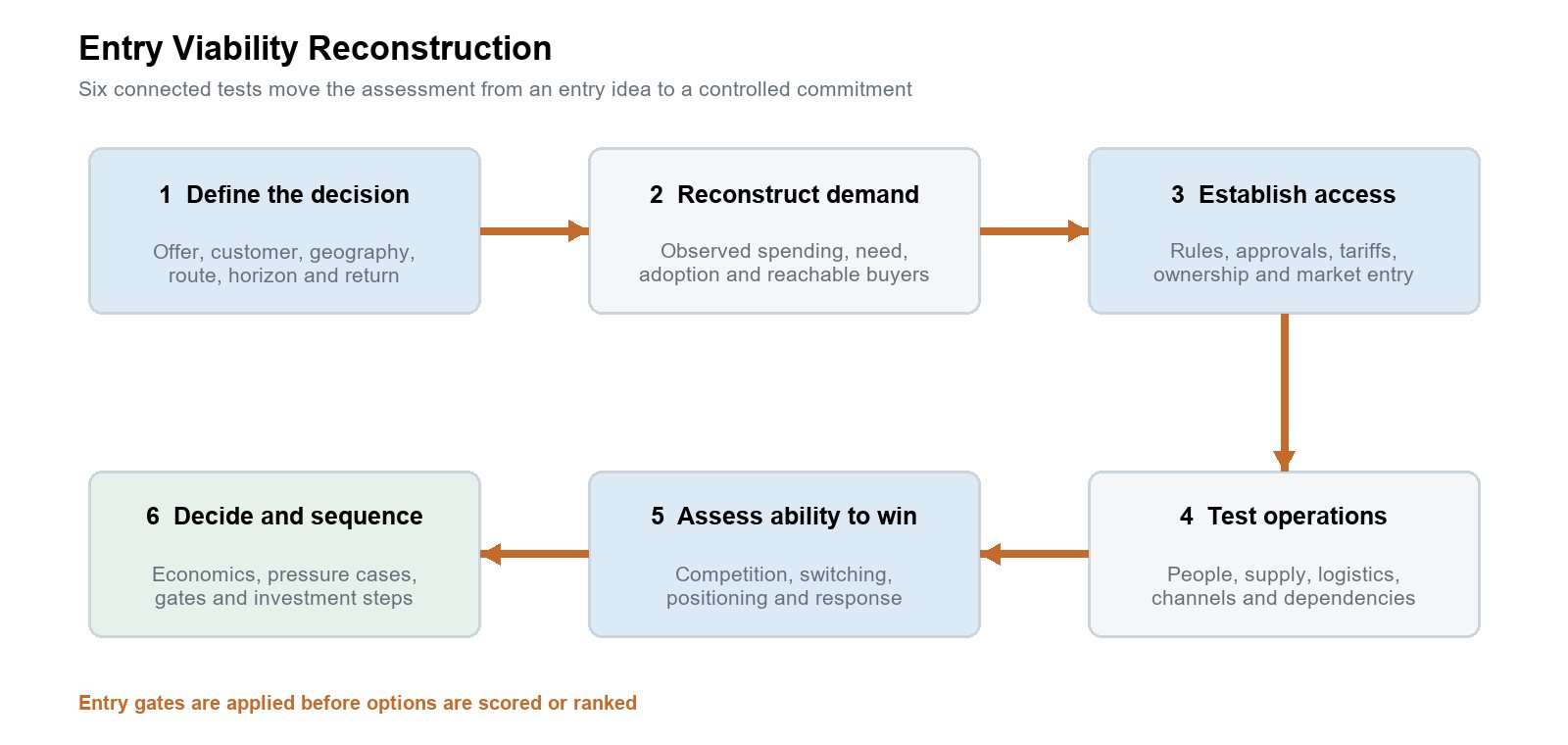
The sequence can be adapted to the decision. A country-prioritisation engagement may begin with a broad comparison before the leading markets receive deeper analysis. A product-line assessment may devote more attention to customer overlap, channel fit, cannibalisation and new capabilities.
How the assessment is completed
Establish the entry case
The work begins by defining the offer, intended customers, geography, route to market, investment horizon, target economics and conditions that would make entry unacceptable. A product-line decision also defines which existing customers, capabilities and channels the new offer is expected to use.
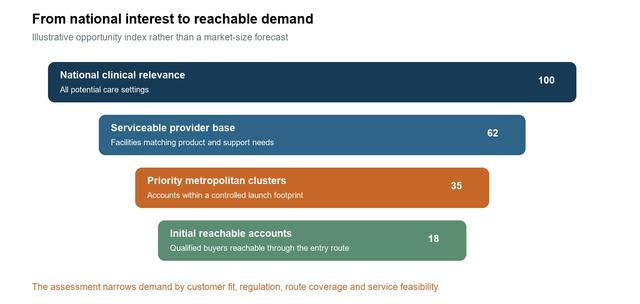
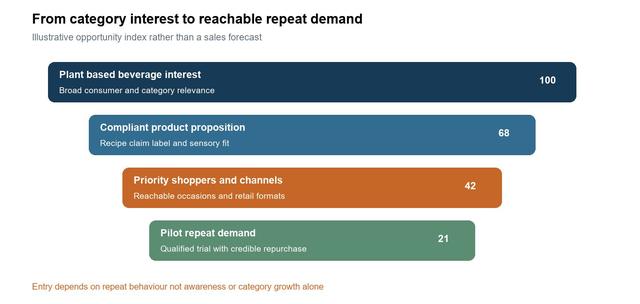
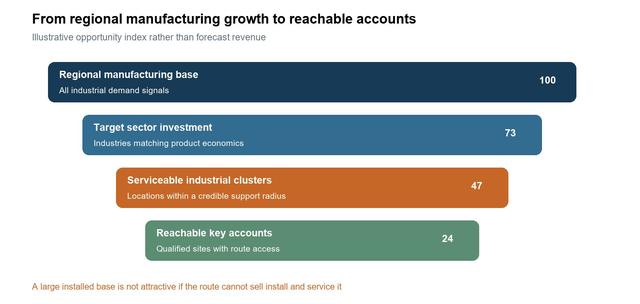
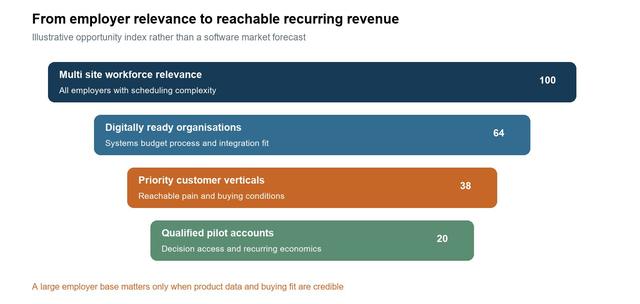
Demand is then reconstructed from observed expenditure, trade or sales activity, customer problems, purchasing capacity, adoption conditions and evidence of unmet need. General awareness and search interest are treated as signals. They are not treated as proof that customers will buy the proposed offer at the required price.
Test access and operation
Regulatory and market-access research identifies approvals, licences, standards, tariffs, taxes, foreign-ownership rules, investment screening, data requirements and local operating obligations. The analysis follows the proposed product and entry route because the applicable requirements may change with sector, legal entity and delivery model.
The operating model maps the labour, suppliers, production, utilities, inventory, logistics, distribution, customer support and partners required to deliver the proposition. It separates resources controlled by the company from dependencies that require contractual or operational protection.
Determine the route and commitment
Competitive analysis examines the actual alternatives available to the target customer, the power of channels and procurement routes, customer switching conditions and the likely response of incumbents. The entry case then translates the evidence into price, volume, landed cost, investment, working capital and time to break even.
The preferred route is tested under slower adoption, delayed approval, higher cost, supply disruption, currency movement and competitive pressure. The recommendation states whether to enter, pilot, partner, build capability, defer or reject the opportunity, together with the evidence that could change that decision.
How evidence changes the recommendation
The assessment does not begin with a single attractiveness score. Strong demand cannot compensate for a regulatory prohibition, an unavailable route to the customer or economics that fail below an unrealistic scale assumption.
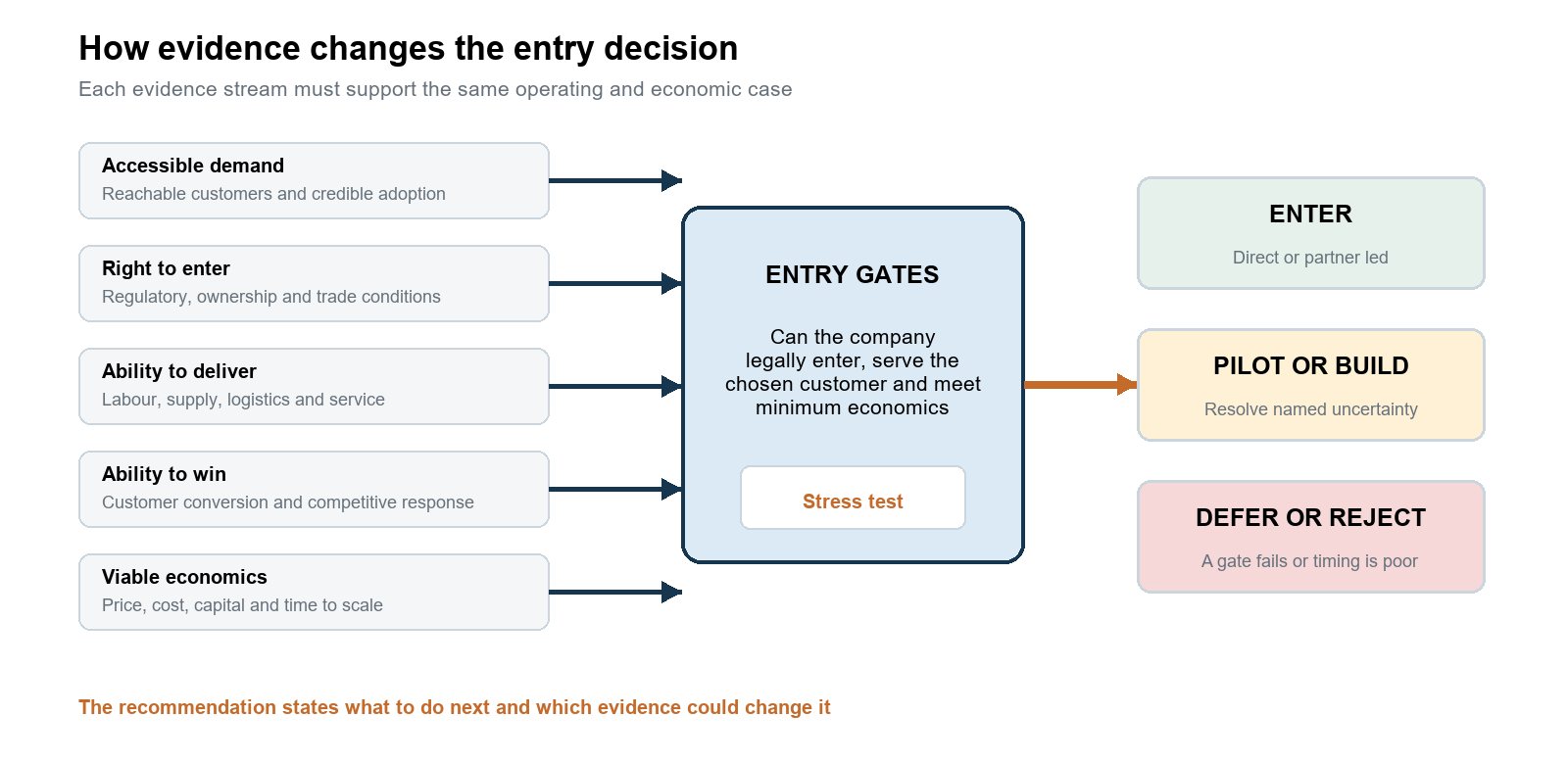
Non-negotiable conditions are applied first. Viable countries, segments and entry routes can then be compared on a consistent basis. The final pressure test identifies where the case breaks and how management could detect the change before committing additional capital.
Accessible demand evidence
Different sources describe different parts of demand. Their definitions, dates and geographic coverage must be reconciled before they are combined. The analysis builds from observable activity toward a company-specific estimate of reachable demand.
Evidence layer | What it establishes | Effect on the entry decision |
|---|---|---|
Category activity | Expenditure, sales, imports, installed base, tenders or service use | Shows whether customers already allocate money or operating resources to the need |
Customer conditions | Segment size, purchasing power, use case, buying process and price sensitivity | Identifies who can buy, why they may act and what could slow adoption |
Channel evidence | Retail presence, distributor coverage, procurement routes, platform activity and account access | Tests whether the customer can be reached at an acceptable acquisition and service cost |
Competitive evidence | Offer range, pricing, capacity, investment and route to market | Shows where demand is served and where the entrant may hold a credible advantage |
Forward indicators | Policy, investment, capacity, demographics, technology adoption and announced projects | Tests whether the opportunity may expand, contract or change before entry |
Decision outcomes
The evidence may support direct entry, entry through a partner, a controlled pilot, capability development before launch, a monitored deferral or a decision not to enter. Each outcome includes the next action, the conditions for further investment and the signals that should reopen the decision.
Evidence gaps remain visible. Where secondary research cannot establish willingness to buy, product performance or partner reliability with sufficient confidence, the assessment defines the primary research, technical validation or pilot evidence required.
Where demand and market access evidence comes from
Source selection begins with the target country, product, customer and entry route. Official legislation and regulator material establish what is permitted. Statistical and transaction sources show what is happening in the market. Commercial databases and digital signals provide additional detail where their definitions and limitations are clear.
Evidence required | Representative sources | What the sources are used to verify |
|---|---|---|
Consumer and category demand | National statistical offices and household expenditure surveys; Eurostat Household Budget Surveys; World Bank DataBank and World Development Indicators; national sector statistics; Euromonitor Passport, NielsenIQ or Circana where licensed; retailer and marketplace listings | Population and income context, category expenditure, buyer segments, retail sales, price points, pack or product mix, channel presence and changes in purchasing behaviour |
Trade and category flows | National customs statistics; UN Comtrade; WTO trade statistics; ITC Trade Map; Eurostat Comext for European trade | Import and export value, volume, product classification, origin countries, trading partners, concentration and market growth |
Tariffs and import procedures | Target-country customs and tariff authority; WTO Tariff and Trade Data; ITC Market Access Map; European Commission Access2Markets for EU exporters; official rules of origin and standards portals | Applicable HS code, tariff and preferential rate, import tax, rules of origin, documentary requirements, quotas, product restrictions and border procedures |
Product and sector regulation | Official government gazette and legislation portal; responsible product or sector regulator; technical standards body; environmental, data-protection and competition authorities; examples include EUR-Lex, the US Federal Register and national food, drug, telecom or financial regulators | Whether the offer is regulated, which approvals and licences apply, product or labelling requirements, local representative obligations, data restrictions, expected process and enforcement history |
Investment and business establishment | Company registry, investment authority, tax authority, central bank and competition authority in the target market; OECD FDI Regulatory Restrictiveness Index; OECD Services Trade Restrictiveness Index; World Bank Business Ready | Foreign ownership limits, screening, legal form, local directors or personnel, land restrictions, capital and repatriation rules, registration, taxation and practical operating conditions |
Regulatory summaries are used to locate issues, but the governing legislation, regulator guidance and official filing process are checked before a requirement is treated as an entry condition. Legal interpretation remains outside the scope of secondary research and should be confirmed by qualified local advisers.
Where operating and competitive evidence comes from
Evidence required | Representative sources | What the sources are used to verify |
|---|---|---|
Labour and skills | Labour ministry, immigration authority and national statistical office; ILOSTAT; Eurostat or OECD labour data where applicable; official wage and occupation surveys; job portals and recruiter data as supporting evidence | Workforce size, occupation and skill availability, earnings, working time, employment conditions, visas, payroll obligations, hiring competition and likely recruitment lead time |
Supply chain and logistics | Customs, port, airport and transport authorities; World Bank Logistics Performance Index; UNCTAD Data Hub; national freight and infrastructure statistics; carrier schedules, port calls and recognised freight indices | Route availability, border performance, port connectivity, transit time, capacity, tracking, reliability, storage needs, infrastructure constraints and landed-cost assumptions |
Companies and competitors | Corporate registry and beneficial ownership records; stock-exchange and securities filings; company annual reports; competition-authority decisions; procurement and tender portals; Orbis, S&P Capital IQ, PitchBook, Crunchbase or Factiva where licensed | Ownership, financial position, market activity, capacity, investment, customers, partnerships, funding, acquisitions, competitive conduct and operating footprint |
Technology and intellectual property | WIPO PATENTSCOPE and Global Brand Database; European Patent Office Espacenet; national patent and trademark offices; standards organisations; product documentation and certification registers | Relevant patents and trademarks, technology ownership, product claims, standards, certification, freedom-to-operate indicators and potential localisation constraints |
Channels prices and digital demand | Retailer, distributor and marketplace websites; public procurement portals; app stores; advertising libraries; Google Trends; Similarweb or Sensor Tower where licensed; customer reviews and product availability checks | Observed pricing, assortment, distribution, seller concentration, promotional intensity, search direction, app or website traction and customer complaints. Digital signals are treated as directional rather than proof of demand |
Macroeconomics and financial conditions | Central bank, finance ministry, tax authority and national statistical office; IMF World Economic Outlook and International Financial Statistics; World Bank World Development Indicators; OECD Data Explorer where applicable | Growth, inflation, exchange rates, interest rates, household consumption, taxes, credit conditions and scenarios affecting price, cost, demand and capital movement |
How sources are combined
Official and regulatory sources have priority for legal requirements and national statistics. Company filings and transaction evidence are used to reconstruct competitors, channels and operating capacity. Commercial databases can expand coverage or improve granularity, while digital signals help identify questions that require stronger evidence. Material conclusions are cross-checked across source types wherever possible.
Deliverables for the entry decision
The final package brings the evidence into one entry case. It identifies the preferred market or product segment, the route and timing supported by the research, the economics of the proposed operating model and the assumptions that remain exposed.
Decision component | What the client receives |
|---|---|
Entry recommendation | A direct recommendation covering segment, route, timing, level of commitment and reasons for rejecting alternatives |
Demand and access case | Reachable demand, customer conditions, regulatory pathway, tariffs, standards and channel constraints |
Operating and competitive case | Required capabilities, labour, supply, logistics, partners, competitor response and principal dependencies |
Entry economics | Price, volume, landed cost, investment, working capital, break-even assumptions and pressure cases |
Decision control plan | Evidence still required, monitoring indicators, investment gates and conditions for expansion, redesign, delay or withdrawal |
Engagement formats
A single-market assessment supports an active geographic or product decision. Market prioritisation compares several countries or segments before deeper work begins. An entry-route assessment compares direct, distributor, partner, acquisition or digital models when the opportunity is accepted but the operating model remains unresolved. A pre-pilot assessment converts remaining uncertainty into acceptance measures and investment gates.
Frequently combines with
- Market Sizing and Forecasting Adds a quantified category, segment or revenue outlook when the scale and pace of demand require deeper modelling.
- Competitive Intelligence Provides a closer view of market structure, rival positions, likely responses and available whitespace.
- Partner or Vendor Evaluation Assesses whether shortlisted distributors, suppliers, licensees or operating partners can deliver the intended entry model.
- Customer Research and Concept Testing Validates needs, buying criteria, willingness to switch and price response when secondary evidence alone cannot resolve the decision.
Illustrative applications
- Medical devices Assess a regulated country by testing product classification, approvals, reimbursement conditions, importer requirements and distributor readiness.
- Food and beverage Evaluate an adjacent product category through consumer demand, ingredient and labelling rules, sourcing needs and cold-chain feasibility.
- Industrial equipment Prioritise regional markets using installed-base demand, investment activity, tariffs, technical standards and local service coverage.
- Business software Test a local operating model against data rules, cybersecurity requirements, procurement behaviour, localisation needs and direct-versus-partner sales.
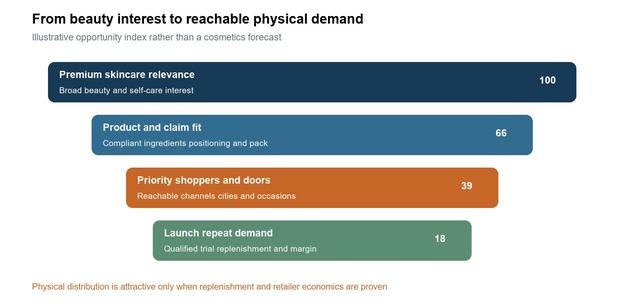
- Consumer goods Determine whether demand supports physical distribution after accounting for shelf access, import costs, distributor economics, pricing and fulfilment.
Frequently asked questions
Is this a market sizing study
Market sizing may be one part of the work. The assessment determines how much demand is accessible to the company, what it would take to serve that demand and whether the resulting economics support entry.
Can the assessment compare several countries
Yes. A broad comparison can identify the strongest candidates before a deeper assessment is completed. The comparison uses consistent definitions while preserving country-specific entry conditions that cannot be reduced to a common score.
How is a new product line assessed differently
The work places greater emphasis on customer overlap, brand fit, channel compatibility, cannibalisation and the capabilities required to design, supply, sell and support the new offer.
Does secondary research confirm customer willingness to buy
Secondary evidence can establish existing expenditure, adoption patterns, purchasing conditions and credible demand signals. When willingness to buy remains decisive and uncertain, the assessment identifies the customer research or pilot evidence required before entry.
Can August Research recommend an entry partner
The market entry assessment can define the partner role and identify potential organisations. A separate Partner or Vendor Evaluation can then test whether shortlisted organisations can perform and support the intended relationship.
What happens when the evidence does not support entry
The recommendation explains which condition failed, whether another segment or route remains viable, and what would need to change before the opportunity should be reconsidered.
Discuss a market entry decision August Research can determine whether a market is accessible to your organisation and define the evidence, route and conditions required before entry.
ASSESS A NEW MARKET | TEST A PRODUCT LINE