MARKET & BUSINESS INTELLIGENCE | PRIMARY RESEARCH
Brand Feedback Research
Find out what your brand means before deciding what it should say next.
THE SERVICE PROMISE August Research combines qualitative explanation with quantitative measurement to show which associations are present, how they vary across selected audiences and what the brand should protect, clarify or change.
RECOGNISED?
Who notices or recalls the brand
UNDERSTOOD?
What people think it stands for
TRUSTED?
Which signals create or weaken confidence
CHOSEN?
Whether the meaning supports consideration
Brand intention is only one side of the evidence
A positioning statement, identity system or campaign may be internally clear while creating a different impression outside the organisation. Brand Feedback Research examines that translation. Depending on the decision, it can discover meaning before measurement, explain an existing quantitative pattern or collect both evidence tracks in parallel.
Decisions this service can support
- Choose or refine a positioning direction.
- Evaluate a name, identity, message system or rebrand.
- Understand trust, differentiation and relevance across audiences.
- Assess how brand meaning transfers into a new market, category or service.
- Establish a defensible baseline before future tracking.
INDEPENDENT RESEARCH ADVANTAGE Respondents can criticise the brand without protecting a commercial relationship or adapting their language to the internal team’s expectations. Neutral facilitation also allows the same stimulus and questions to be used across audiences.
02 | DECISION AND AUDIENCE DESIGN
Start with the brand decision, not a standard questionnaire
The participant structure, exposure context and evidence mix are designed around what may change after the study.
When Brand Feedback Research is needed
POSITIONING The existing promise feels broad, dated or difficult to distinguish.
IDENTITY CHANGE A new name, visual system, tone or packaging system may alter meaning.
PORTFOLIO A master brand, sub brand or acquired brand needs a clearer role.
MARKET TRANSFER The brand is entering a geography, channel, category or audience.
TRUST A service failure, claim, ownership change or reputation issue may have weakened confidence.
TRACKING BASELINE The organisation needs an initial measure before monitoring change.
Whose interpretation should be included?
The audience is selected for its relationship to the brand decision. A broad demographic sample is not automatically useful.
CURRENT CUSTOMERS People with direct experience who can separate brand promise from delivery.
PROSPECTS AND CATEGORY BUYERS People who can show whether the brand is noticed, understood and considered before purchase.
FORMER CUSTOMERS AND REJECTORS People who reveal weakened trust, outdated meaning or reasons the brand was excluded.
INFLUENCERS AND MARKET INTERMEDIARIES Partners, advisers, distributors or professional recommenders when they shape brand interpretation.
Selection parameters
Awareness level, relationship stage, category involvement, recency, channel, geography, language, role in the decision and exposure to the relevant touchpoint can all shape selection. Only parameters that affect the decision become quotas or comparison groups.
Employees may be included when the client needs to compare internal brand intention with external interpretation, but internal opinion does not substitute for market evidence.
03 | QUALITATIVE DISCOVERY
Discover the brand language before measuring it
Open research reveals associations, contradictions and emotional or functional meanings that a predetermined rating scale may miss.
The qualitative track
Participants first encounter the brand, message or identity in a controlled but natural context. The discussion guide then moves from unprompted interpretation to structured probes, preserving the language people use before asking them to respond to the company’s own terms.
01 FIRST IMPRESSION Capture immediate words, images, feelings and expectations before explanation.
02 MEANING LADDER Trace each visible or verbal cue to its interpretation and expected consequence.
03 CONTRADICTION PROBE Explore where the promise conflicts with experience, category convention or evidence.
04 CONTEXT SHIFT Test whether meaning changes by touchpoint, audience, situation or comparison set.
05 PROOF REQUEST Identify what would make the positioning believable, distinctive or safe to repeat.
Method options selected by scope
METHOD | BEST USED WHEN | EVIDENCE CREATED |
|---|---|---|
Individual interviews | Decisions are personal, sensitive or commercially complex | Detailed meaning chains and proof expectations |
Small group discussions | Category language and social interpretation matter | Shared and contested associations |
Digital diaries or missions | Meaning develops across repeated touchpoints | Contextual reactions over time |
Stimulus comparison | Names, messages, identities or architectures are being considered | How each option changes interpretation |
The resulting meaning codebook becomes a set of hypotheses for measurement, not a population estimate.
04 | QUANTITATIVE MEASUREMENT
Measure the pattern without flattening it
Quantitative research can follow discovery, precede qualitative explanation or run alongside it. The sample is designed for the comparisons the client needs.
What can be measured
UNAIDED SIGNALS Spontaneous awareness, recall and first associations before lists are shown.
AIDED MEANING Familiarity, association strength, message comprehension and attribute ratings.
CONFIDENCE Trust, credibility and the evidence participants require before believing the promise.
CHOICE RELEVANCE Consideration, preference or recommendation where the study design supports it.
AUDIENCE DIFFERENCE Variation by relationship stage, segment, geography, channel or decision role.
OPEN EXPLANATION Selected open responses retained so numerical patterns keep their reasoning.
How the survey is carried out
INVITE
Use client approved contacts, independent recruitment, consumer or professional panels, communities, channel routes or a hybrid.
SCREEN
Confirm awareness, relationship, recency, category involvement and other eligibility conditions before the main survey.
CONTROL
Monitor only decision relevant quotas. Use reminders, targeted top ups or replacements when approved groups fall behind.
VALIDATE
Review duplicate signals, completion time, response patterns, contradictory answers and open response quality before analysis.
Sample and analysis discipline
- Sample size follows the target population, incidence, number of comparisons and precision required. It is not selected to create an impressive headline number.
- Weighting is used only when a defensible population frame and meaningful correction variables are available.
- Cross tabulation, significance testing, driver analysis or segmentation are applied only when the sample and question design support them.
- Uncertainty, low base sizes and subgroup limitations remain visible in the reporting.
INTERPRETATION BOUNDARY Incidence and population statements are made only when the sampling approach supports them. Otherwise, findings describe patterns and differences within the audiences reached by the study.
05 | BRAND MEANING CALIBRATION
Choose the route, then reconcile the evidence
August Research selects the sequence around what is already known and the decision the research must support.
Three evidence routes, one integrated conclusion
EXPLORATORY ROUTE
Qualitative discovery first, followed by quantitative measurement. Used when brand meaning or survey variables are not yet clear.
DIAGNOSTIC ROUTE
Quantitative measurement first, followed by qualitative explanation. Used when existing metrics or audience differences need diagnosis.
PARALLEL ROUTE
Qualitative and quantitative work run together, then integrate. Used when breadth and explanation are required within the same decision window.
The Brand Meaning Reconciliation
WEAK OR NARROW AUDIENCE EVIDENCE
STRONG OR WIDESPREAD AUDIENCE EVIDENCE
INTENDED MEANING
FRAGILE MEANING
Valued internally but not yet clearly received
ESTABLISHED MEANING
Recognised, understood and supported by evidence
UNINTENDED MEANING
LOW SIGNAL
Not central to the decision unless strategically important
MISREAD MEANING
A strong external interpretation that may require correction or adoption
What the client receives
Brand Meaning Map Associations linked to the cues, contexts and audiences that create them.
Audience Contrast View Meaning, trust and consideration differences across the agreed groups.
Positioning Tension Register Contradictions, fragile promises, unintended meanings and proof gaps.
Message and Identity Guidance What to protect, clarify, remove, substantiate or test next.
Tracking Baseline A reusable measure set and sample specification when future monitoring is required.
Evidence Pack Interview themes, selected verbatim language, survey tables, charts and an executive readout.
The final format can include a management presentation, detailed report, editable data tables, coded qualitative evidence and a decision workshop. Delivery is agreed for the study rather than imposed as a fixed package.
06 | WHY AUGUST RESEARCH
Independent evidence for brand decisions
Research design, fieldwork control, analysis and decision translation within one scope.
Why organisations use August Research
METHOD SELECTED BY DECISION Exploratory, diagnostic or parallel research routes produce one integrated conclusion.
INDEPENDENT PARTICIPANT ACCESS Client contacts can be combined with targeted recruitment, panels, communities and market partners.
EIGHT INDUSTRY GROUPS Coverage spans life sciences, chemicals and energy, mobility, high tech, food and personal care, engineering, packaging and medical devices.
MULTI MARKET DESIGN Core audiences, stimuli and measures remain comparable while language and context are adapted.
TRACEABLE INTERPRETATION Every conclusion retains its cue, participant context and evidence strength.
DECISION READY DELIVERY Outputs separate immediate brand actions from issues requiring further validation or review.
Engagement formats
FORMAT | TYPICAL SCOPE | INDICATIVE TIMING |
|---|---|---|
Focused Meaning Check | One decision, audience and stimulus set | Often 4 to 6 weeks |
Mixed Method Calibration | Exploratory, diagnostic or parallel route | Often 7 to 10 weeks |
Market or Audience Comparison | Comparable markets, segments or roles | Often 9 to 14 weeks |
Baseline and Pulse | Repeat measures with qualitative diagnosis when needed | Cadence agreed by scope |
Timelines are indicative and depend on audience incidence, recruitment response, questionnaire length, sample size, markets, languages, stimuli, approvals and fieldwork conditions.
Frequently combined with
Customer Interviews | Voice of Customer Research | Consumer Behaviour Analysis | Product Perception Studies | Customer Journey Mapping | User Experience Research
07 | ILLUSTRATIVE EXAMPLES
Five applications for Brand Feedback Research
Each example reflects a different brand decision, participant design, method sequence and evidence structure.
SETTING | BRAND DECISION | RESEARCH EMPHASIS |
|---|---|---|
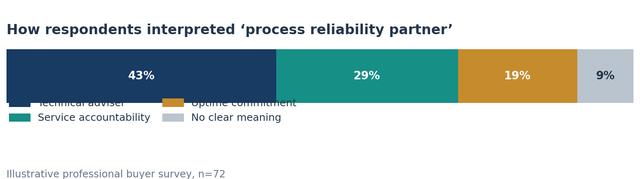
Industrial filtration | Rotterdam and Antwerp | Can the brand become a process reliability partner without losing engineering credibility? | Interviews followed by a professional buyer survey |
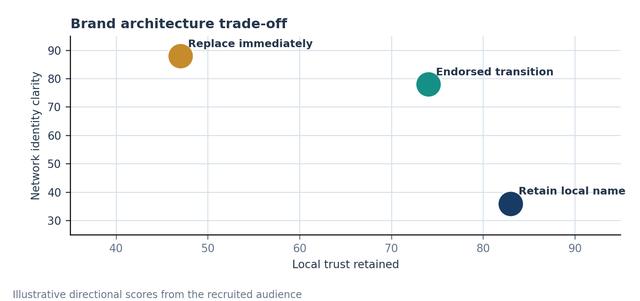
Diagnostic network | Chennai and Hyderabad | Should an acquired clinic name be retained, endorsed or replaced? | Audience survey followed by explanatory interviews |
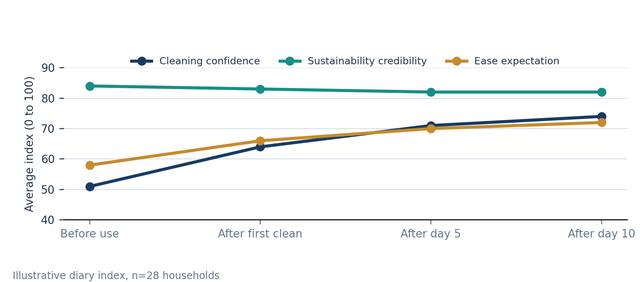
Refillable home care | Berlin and Hamburg | Is sustainability weakening expectations of cleaning performance? | Parallel home use diaries and audience survey |
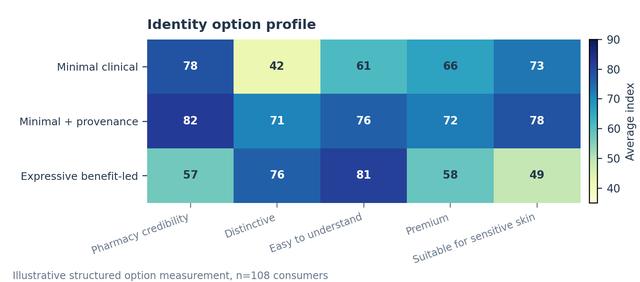
Pharmacy skincare | Palermo and Catania, Sicily | Does a minimalist identity improve credibility or feel generic? | Interviews followed by structured option measurement |
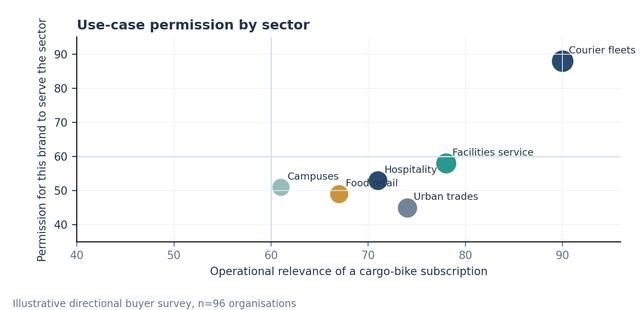
Cargo bike subscription | Lisbon and Porto | Can the brand expand beyond courier fleets without retaining a delivery only image? | Buyer survey followed by business interviews |
FAQ
How is this different from Product Perception Studies? Product studies assess one offer. Brand Feedback Research assesses meaning, trust and expectations attached to the wider brand.
Does every engagement require both qualitative and quantitative research? No. The evidence mix follows the decision. Mixed studies use an exploratory, diagnostic or parallel route.
Can current customers be included? Yes. Client contacts may be combined with independent recruitment under agreed consent and disclosure rules.
Can the research compare markets? Yes. Core measures remain comparable while recruitment, language and context are adapted.
Can this establish an ongoing brand tracker? Yes. Quantitative measures track change, while qualitative follow up explains why it occurred.
Scope boundaries Brand feedback explains perception within the study scope. It does not prove sales causation, advertising effectiveness, trademark availability, compliance, clinical performance or product claims.
Contact Us
DISCUSS YOUR BRAND DECISION
Tell us what may be changing, which audiences matter and where the brand is encountered. We will shape the participant design and evidence mix around that decision.