R&D, PRODUCT DEVELOPMENT & INNOVATION
Technical Expert Panels
Phase 1 | Website capability draft
Structured technical deliberation for decisions that cannot be resolved by one discipline alone.
Draft for review • August Research
Overview
Complex innovation decisions often appear to be technical questions, but their answer depends on several connected realities: whether a solution can perform, be manufactured, meet safety and regulatory expectations, integrate with existing systems, and create a credible path to adoption or scale. When these factors are considered separately, important trade-offs can remain hidden until late in development.
Technical Expert Panels give organizations a disciplined way to examine those trade-offs together. August Research convenes a purpose-built group of complementary specialists around a defined decision, not a broad topic, and guides them through a structured evaluation of the options, evidence, uncertainties and failure modes that matter most.
The objective is not forced consensus. It is a decision position that makes clear where the evidence is strong, where expert judgement is conditional, where views genuinely differ, and what must be proven before the client proceeds, pauses, redirects or stops.
Unlike individual SME Interviews, which capture experience across separate one-to-one conversations, a Technical Expert Panel is designed for controlled cross-examination. Participants assess the material independently first, then test claims and dependencies together under facilitation. The result is a traceable Technical Decision Record that leadership can act on.
Business Challenges We Help Address
Technical Expert Panels are particularly valuable when a decision is consequential, the evidence is incomplete, and no single expert can credibly resolve the issue alone.
- Selecting an R&D, product, process or platform route where performance, manufacturability, safety and cost point in different directions.
- Deciding whether an emerging technology is ready to enter prototype, pilot, qualification or commercial deployment.
- Testing whether an apparently promising technical claim survives challenge from downstream operations, regulatory or market realities.
- Resolving material disagreement among internal stakeholders, external advisers or technology partners before capital is committed.
- Defining validation priorities, evidence thresholds and stop conditions for a high-uncertainty innovation programme.
- Comparing technical pathways where the client needs a defensible rationale, rather than an unqualified ranking.
Best Suited For
R&D & Innovation Leaders
A structured route from technical uncertainty to a staged investment decision.
Product & Engineering Teams
An independent challenge to design choices, integration assumptions and qualification plans.
Operations & Manufacturing Leaders
Early visibility of scale-up, yield, supply-chain and operability constraints.
Technology Strategy & Corporate Development
A defensible assessment of strategic fit, evidence gaps and technical risk.
Investors & Due-Diligence Teams
A focused way to test technical claims before a transaction or funding milestone.
Cross-Functional Programme Teams
A neutral forum for exposing dependencies and assigning the next validation actions.
Our Approach
A strong panel does not begin with a room full of experts. It begins with a tightly framed decision and a neutral evidence base. We define the decision owner, viable options, non-negotiable constraints and the claims that need to withstand scrutiny. We then assemble the required perspectives across the relevant technical and operating system, including constructive dissent where it is needed.
Before the session, participants receive a concise evidence pack and assess the options independently. This protects early judgement from group influence and makes the reasons behind different views visible. During the facilitated session, the panel examines assumptions, trade-offs, interactions and failure pathways. Afterwards, August Research separates agreement from qualified agreement and unresolved contention, then translates the discussion into explicit decision gates and ownership.
Technical Decision Forum Workflow
Every engagement follows a structured eight-stage path from the client decision to an actionable record of what should happen next.
Stage | What we do | Why it matters |
|---|---|---|
01 Decision framing | Define the exact decision, decision owner, options, constraints and timing. | Prevents a broad discussion from replacing a real choice. |
02 Claim and dependency map | Identify the technical claims, linked assumptions and external conditions that must hold true. | Focuses scrutiny on the uncertainties most likely to alter the decision. |
03 Panel architecture | Select complementary specialists across the relevant value chain and include constructive challenge where needed. | Avoids a narrow technical view or an artificial consensus. |
04 Evidence pack | Prepare a concise, neutral pre-read that distinguishes established evidence, assumptions and open questions. | Gives all participants a common starting point without presenting assumptions as facts. |
05 Independent assessment | Gather private ratings, reasoning and confidence levels before group discussion. | Preserves individual judgement and reveals disagreement early. |
06 Facilitated technical challenge | Test trade-offs, dependencies, risks, counterarguments and plausible failure modes in a structured session. | Turns expert opinion into disciplined deliberation. |
07 Resolution and validation map | Classify agreement, conditional agreement and unresolved contention; identify the evidence required to resolve each issue. | Makes residual uncertainty explicit and manageable. |
08 Technical Decision Record | Set out the recommended decision path, validation gates, owners, timing and stop conditions. | Provides a traceable rationale for management action. |
VISUAL PLACEHOLDER: WEBSITE WORKFLOW: Present the eight stages as a vertical decision path. Use three visual bands: frame the decision, challenge the evidence, release the next action.
Project Outcomes & Outputs
The format is tailored to the decision, but every engagement is built to leave the client with a clear record of the reasoning, the uncertainty that remains, and the practical actions required to move forward.
Client-ready output | Purpose |
|---|---|
Technical Decision Record | States the decision position, rationale, evidence basis, material caveats and recommended next step. |
Claim and Dependency Map | Shows which technical claims depend on which conditions, interfaces or external validations. |
Agreement and Contention Register | Separates consensus from qualified agreement and documents the reasoning behind unresolved differences. |
Validation-Gate Roadmap | Sets evidence thresholds, owners, milestones and stop or redirect conditions before the next commitment. |
Risk and Failure-Mode Brief | Identifies the operational, technical, regulatory or commercial issues that could invalidate the proposed path. |
Executive Discussion Pack | Provides a concise management view for investment, programme or governance discussions. |
The August Research Panel Decision System
A Technical Expert Panel is not a larger interview programme or a generic roundtable. We build a controlled decision system around one consequential technical choice - bringing together the perspectives, evidence and challenge required to decide what should proceed, what needs validation and what should stop.
Decision-specific panel architecture
We design the participant mix around the decision and its dependencies - not a fixed standing roster.
Independent judgement before discussion
Private assessment before the session makes genuine differences visible before group influence can take hold.
Cross-disciplinary technical challenge
Technical, manufacturing, regulatory, operating and commercial implications are tested together, where the trade-offs actually sit.
Traceable decision closure
The Technical Decision Record turns deliberation into validation gates, owners and stop conditions - not minutes or a scorecard alone.
1,500+
Subject matter experts
40+
Countries represented
25+
Industry & technology domains
Supported by August Research's global expert network, with engagement capability in 20+ languages.
Our role is independent facilitation and evidence integration. Panel output does not substitute for the client’s governance, regulatory obligations or technical accountability; it strengthens the quality and traceability of the decision process.
Frequently Combined With
Technical Expert Panels are typically placed between early research and validation. The combinations below extend the panel's decision record into a practical evidence pathway.
Technology Scouting
Use before the panel when the viable technical routes are not yet clear. Scouting defines the option set that the panel will challenge and compare.
Patent Landscape Analysis
Use alongside the panel when IP position, white space, licensing exposure or freedom-to-operate implications could change the preferred technical route.
Product Testing & Validation
Use after the panel to execute the validation-gate roadmap, generate the required evidence, and confirm whether the decision should proceed, redirect or stop.
Frequently Asked Questions
How is a Technical Expert Panel different from SME Interviews?
SME Interviews collect individual experience across separate discussions. A Technical Expert Panel deliberately brings complementary experts into a structured evaluation process, so the client can see where judgements converge, diverge or depend on conditions.
How are panel members selected?
We design the panel around the decision and its dependencies, selecting participants for relevant expertise, operating perspective, independence and ability to challenge the evidence constructively.
How many experts participate?
The size depends on the decision and the range of disciplines required. We prioritize coverage of the decision system over a fixed participant count.
Can internal and external experts participate together?
Yes, where appropriate. The panel design and facilitation approach are adapted to protect independent input, manage confidentiality and keep discussion focused on the agreed decision.
What happens if the experts disagree?
Disagreement is recorded and analysed. We identify the assumption, evidence gap or contextual condition driving the difference, then define what would be needed to resolve it or manage it through a decision gate.
Let’s Discuss Your Project
If your next technical decision depends on several disciplines, competing assumptions or a meaningful capital commitment, August Research can design a Technical Expert Panel around the uncertainty that matters most.
VISUAL PLACEHOLDER: WEBSITE CONTACT CTA: Insert final contact details, enquiry link or button treatment.
Illustrative Engagements
These hypothetical applications sit at the bottom of the service page as independent, clickable panels. Each panel should open its own Phase 2 illustrative engagement, not expand into the core service description. They are not client case studies.
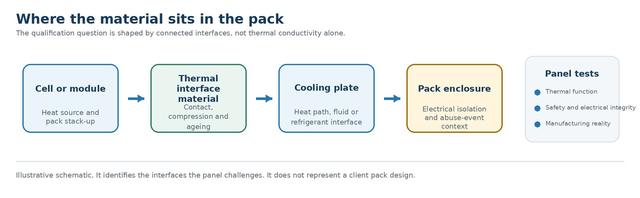
Qualification route for a high-voltage battery thermal-management material
Panel focus: Whether to advance the proposed material into vehicle-level validation, and which safety, manufacturing and supplier evidence must be cleared first.
WEBSITE LINK PLACEHOLDER: View illustrative engagement →
Technical readiness of a low-carbon cement additive for regional rollout
Panel focus: Whether the additive should move into field trials, which performance and standards risks remain, and how trial success should be defined.
WEBSITE LINK PLACEHOLDER: View illustrative engagement →
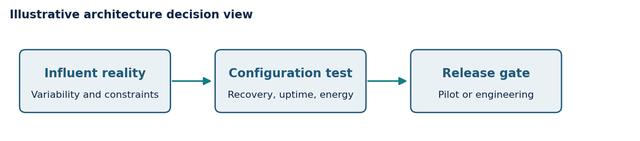
Architecture choice for an industrial wastewater-recovery system
Panel focus: Which configuration best balances recovery performance, uptime, energy demand, operator burden and permitting requirements.
WEBSITE LINK PLACEHOLDER: View illustrative engagement →
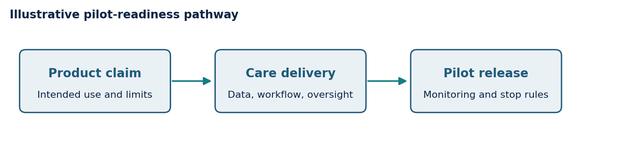
Go/no-go review for an AI-enabled diagnostic workflow
Panel focus: Whether the product claim, clinical workflow, data quality and regulatory path are sufficiently aligned for pilot deployment.
WEBSITE LINK PLACEHOLDER: View illustrative engagement →
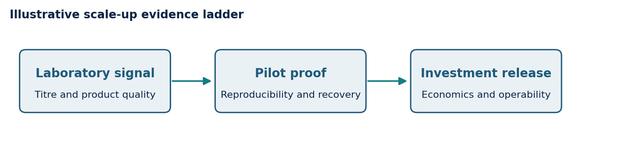
Scale-up decision for a precision-fermentation ingredient platform
Panel focus: Which scale-up route should be pursued, what must be demonstrated at pilot scale, and where process economics may fail to hold.
WEBSITE LINK PLACEHOLDER: View illustrative engagement →