PHASE 2 | HYPOTHETICAL ILLUSTRATIVE ENGAGEMENT
Modular Countertop
Air Purifier
Assembly-transfer readiness for a repairable consumer appliance.
THE ILLUSTRATIVE DECISION
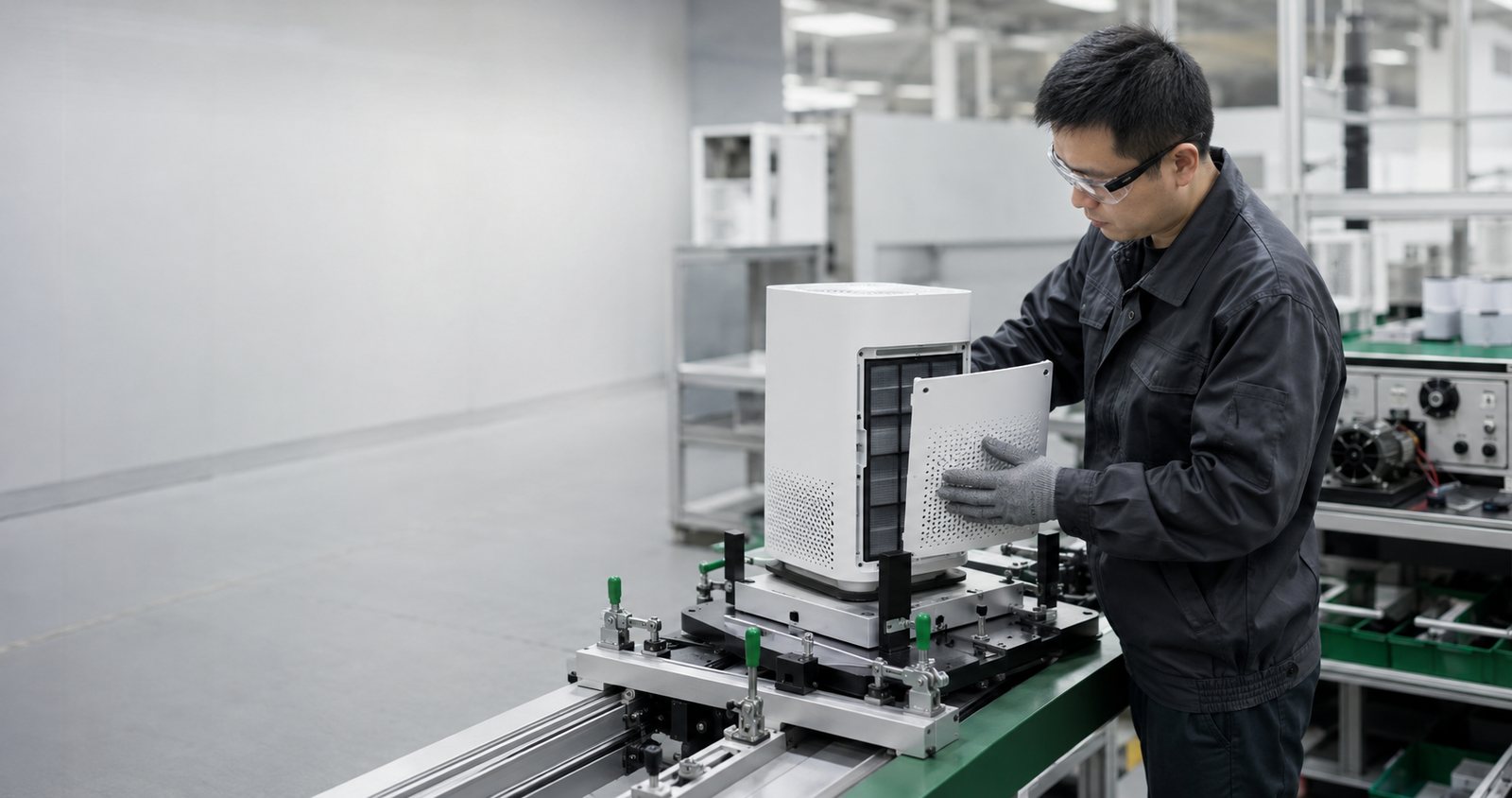
Can the selected air-purifier configuration transfer to an external assembly route while preserving stable motor installation, filter-door fit, end-of-line checks and replacement-part access?
Note: This is a hypothetical illustrative engagement, not a client outcome. The product, contributors, numbers, findings, methods, outputs and timing below are illustrative only.
Project Context
A consumer-appliance team has finalised the intended performance architecture for a modular countertop air purifier. It now needs an external assembly decision that protects both first-pass build quality and the practical access needed to replace a filter door or service a fan module later.
The Assembly-to-Service Loop
The visual output links four dependencies that are often reviewed separately. A weak link in one can undermine the whole transfer route.
Loop point | Transfer question | Illustrative evidence |
|---|---|---|
Build | Can the housing, motor module, wiring and fasteners be assembled in a repeatable sequence? | Assembly fixture review, operator input and draft work instructions. |
Check | Which end-of-line observations identify an incorrect fit, connection or basic functional issue? | Quality discussion, test-station capability and traceability proposal. |
Pack | Does the appliance and its removable parts move through packing without loosening interfaces? | Packaging-route review and component protection requirements. |
Restore | Can service access be retained without adding unmanageable line complexity? | Mechanical review, service-team input and spare-part assumptions. |
Evidence Collection
- Design, quality, operations and service contributors define the interfaces that cannot be compromised in transfer.
- External assembly-provider input covers fixtures, torque tools, wiring steps, end-of-line testing and packaging handling.
- Documentation review includes the preliminary BOM, mechanical drawings, assembly sequence, service concept and change-control needs.
- Findings are triangulated into conditions for a controlled first build, rather than treated as a universal durability or qualification result.
Illustrative Decision: Build with Conditions
Loop point | Illustrative conclusion | Condition before release |
|---|---|---|
Build | Supported | Finalise fixture location points and tool-access sequence. |
Check | Conditional | Agree a concise end-of-line functional check and record ownership. |
Pack | Supported | Confirm protection of filter door and loose accessory parts. |
Restore | Conditional | Lock approved access fasteners and service replacement path before design freeze. |
What the Client Would Receive
Output | Purpose |
|---|---|
Assembly-to-service loop | A concise visual of how line build, checks, packaging and restoration connect. |
Controlled-build condition sheet | Build requirements, evidence checkpoints, owners and escalation points. |
External assembly rationale | Why a route fits the appliance configuration and where it needs refinement. |
Decision briefing | Proceed, proceed with conditions, redesign interfaces or defer recommendation. |
Illustrative Delivery Method
Stage | Illustrative timing | Client-visible result |
|---|---|---|
Scope and contributor alignment | 1 week | Shared commitment, input list and evidence questions. |
Evidence gathering | 2-4 weeks | External-provider input, documentation review and open-issue map. |
Decision synthesis | 1-2 weeks | Conditions, owners and decision pack. |
TIMING NOTE
The 5 to 9 week range is illustrative. Primary research timing depends on provider response, fixture and test capability, design maturity, component availability, technical documentation and scope.
Evidence Boundary
This illustrative engagement supports an evidence-led manufacturing-transfer decision. It does not itself create a production qualification, certification, regulatory approval, supplier audit, validated process or guaranteed cost, yield or capacity. Formal responsibility remains with the relevant manufacturer and qualified parties.
What We Would Confirm Before Starting
- The product configuration, target assembly volume and markets in scope.
- Which performance, safety, quality and regulatory responsibilities remain with qualified parties.
- The external assembly, test, packaging and component providers that may be approached.
Let’s Discuss Your Project
START WITH THE COMMITMENT
Tell us what you are preparing to transfer, the external production decision ahead and the conditions that need to be true before a responsible commitment is made.