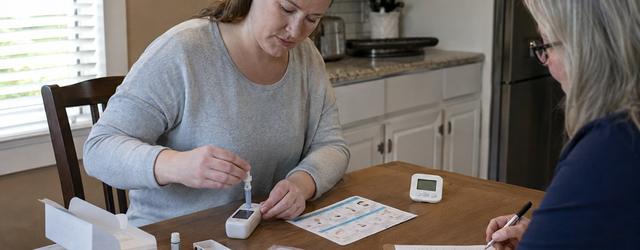
ILLUSTRATIVE ENGAGEMENT 04 / CONNECTED CONSUMER PRODUCT
Connected Water Monitor
Can households install, interpret and act on alerts while installers and support teams complete a secure, understandable handover?

WIDER-ROLLOUT DECISION Proceed with a limited rollout only after account transfer, update messaging and low-confidence alert actions are corrected.
A Connected Product Has More Than One Intended Use
A hypothetical provider has developed a compact under-sink monitor that connects to a household app and sends alerts for continuous flow, rapid flow, low temperature and device disconnection. The release candidate can detect and send events. The intended-use question is whether the household understands what each alert means, whether the installer leaves the account in the right hands and whether support can recover the product without creating new confusion.
Illustrative Product and Service Specification
- Hardware Battery-powered clamp sensor with a local status light and QR-based device identity.
- Connectivity Home Wi-Fi connection with cloud alerting and a documented offline state.
- Alert set Continuous flow, rapid flow, low temperature, battery low and device offline.
- Account model One household owner, up to three invited members and a time-limited installer setup role.
- Update route Automatic firmware updates with an in-app notice when an action or restart is required.
- Support route In-app checks, phone support and installer escalation for unresolved hardware or plumbing issues.
Note: These specifications, findings and the rollout recommendation are hypothetical and do not describe an actual connected product.
Participant Selection Follows the Product Lifecycle
The field includes 20 households across flats and houses, with variation in home ownership, plumbing confidence, digital confidence and shared household decision-making. Six professional participants are added because intended use begins before the first alert and continues after installation: four installers and two customer-support specialists.
20
households
4
installers
2
support specialists
5
alert types
Four Evidence Episodes
Episode | Who acts | What is tested |
|---|---|---|
Installation handover | Installer and household owner | Device placement, setup role, account ownership, status-light meaning and first-test alert. |
Everyday interpretation | Household members | Difference between information, monitor-now and act-now alerts. |
Recovery and update | Household owner and support | Offline recovery, battery replacement, update notice and support escalation. |
Home transfer | Outgoing and incoming owner | Removal of old access, transfer of device control and confirmation that monitoring continues. |
How Evidence Is Gathered and Triangulated
Researchers observe installation or use in the home, then issue scripted alerts through a controlled test environment. Participants complete a short mobile or paper form after each episode, rating clarity, urgency and confidence in the next action. Follow-up interviews explain the reasoning behind the response. App-event records, installer handover notes and support outcomes are compared with observed behaviour before the team classifies a finding.
SAFETY AND TECHNICAL BOUNDARY The study observes installation and response behaviour. Plumbing integrity, electrical safety, sensor accuracy, cybersecurity testing and regulatory conformity require appropriately qualified technical or regulatory assessment.
Illustrative Evidence Ribbon
The readout follows the product from installer to household to support and back to a new owner. This makes it possible to see where acceptance is lost between roles.
Lifecycle point | Illustrative evidence | Acceptance interpretation |
|---|---|---|
Installer leaves site | 18 of 20 owners hold the primary account. Two devices remain under installer credentials. | Handover rule not met for all households. |
Rapid-flow alert | 19 of 20 households identify the immediate check and escalation route. | Alert can proceed with one wording exception. |
Continuous-flow alert | 14 of 20 distinguish a possible leak from ordinary prolonged use. | Low-confidence action needs clearer context. |
Device offline | 15 of 20 recover independently; five contact support after repeating the same step. | Recovery route is conditionally acceptable. |
Account transfer | 12 of 20 remove old access and complete transfer without support. | Does not meet the release rule. |
Note: All participant counts and observations are illustrative. They demonstrate a possible evidence structure and are not real research outcomes.
An Upcoming Regulatory Concern Can Influence the Scope
The EU Cyber Resilience Act brings reporting obligations into application from 11 September 2026 and its main obligations from 11 December 2027 for products with digital elements within scope. Intended-use validation does not establish CRA compliance. It can, however, test whether users understand account ownership, security or update notices, recovery instructions and support responsibilities before those communications are fixed for rollout.
REGULATORY-USE LIMIT August Research can gather user evidence around security communication and product handover. Formal scope determination, conformity assessment, cybersecurity assurance, incident reporting and legal interpretation remain with qualified responsible parties.
What the Output Might Look Like
- Lifecycle acceptance map A stage-by-stage view of installation, account ownership, alert response, recovery, support and home transfer, with the acceptance status for each.
- Alert interpretation library Participant explanations for each alert, grouped into correct action, delayed action, unnecessary escalation and unsafe misunderstanding.
- Handover control sheet The installer actions, household confirmations and system records required before the setup task is considered complete.
- Support recovery tree The most common recovery paths, repeated loops, escalation triggers and the information support needs to resolve the issue.
- Security communication findings Evidence on whether account, update and access messages are noticed and understood, separated from formal cybersecurity assessment.
- Conditional rollout brief The household segments, alert types and support conditions that can proceed, plus the account-transfer tasks that must be corrected and retested.
Illustrative Delivery Window
Phase | Indicative activity | Timing |
|---|---|---|
Design | Acceptance protocol, scripted alerts, participant screening and installer handover rules | 1 week |
Recruit | Households, installers and support specialists | 1 to 2 weeks |
Field | In-home installation, alert episodes, forms and interviews | 2 to 3 weeks |
Triangulate | Behaviour, forms, interviews, app events and handover records | 1 week |
Close | Rollout decision, remediation priorities and focused retest plan | 1 week |
Note: A project of this type might take approximately 6 to 8 weeks. This is illustrative. Primary-research timing is subjective and depends on household and installer response times, geography, site access, product stability, scripted-alert capability, support availability and the materials supplied.
Let's Discuss Your Release Decision
If a connected household product is nearing rollout, August Research can test whether the complete installation, alert, recovery and ownership pathway works for the people expected to carry it.
Research Basis
Sources reviewed in framing: European Commission, Cyber Resilience Act policy page and July 2026 implementation guidance; European Commission, Summary of Regulation (EU) 2024/2847; NIST, Common Industry Specification for Usability Requirements. Accessed August 2026.
Note: This is a hypothetical illustrative engagement created to demonstrate Intended-Use Validation. It is not a client case study, and the numbers, findings, recommendation and timeline are not presented as actual outcomes.