
ILLUSTRATIVE ENGAGEMENT 01 / REGULATORY-LED
Home Diagnostic Reader
Can intended lay users complete the sample, read the result and take the correct next action under the labelled conditions?
RELEASE DECISION Remediate two critical tasks, then run a focused confirmation before the reader is treated as ready for wider home use.
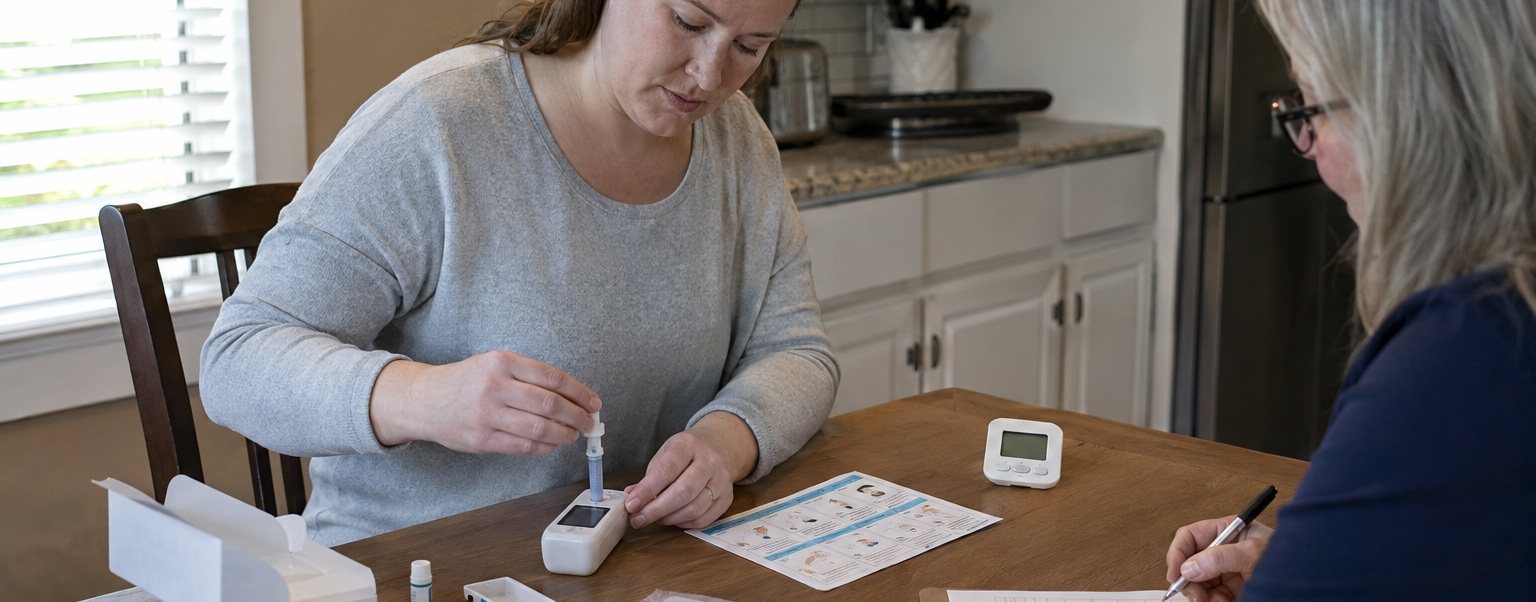
The Product at the Point of Decision
A hypothetical diagnostics developer has a near-final reader intended for adults to use at home without live professional supervision. The cartridge, reader, quick-start guide, packaging and support route are substantially fixed. The remaining question is not whether people like the concept. It is whether the complete labelled workflow can be used safely and correctly when no researcher steps in to rescue the task.
Release-candidate element | Illustrative specification |
|---|---|
Reader | Handheld optical reader with one power control, cartridge bay, result screen and audible completion cue. |
Sample step | Single-use collection swab transferred into a buffer tube, followed by four drops into the cartridge well. |
Timing | Reader displays a result after 15 minutes; the result should not be interpreted after the labelled window. |
Result states | Negative, positive and invalid, each linked to a different next action in the quick-start guide. |
Use setting | Unsupervised home use, ordinary household lighting, personal phone available, no assumed clinical training. |
Note: The specifications and release decision are hypothetical. They make the validation scenario concrete and do not describe a real product, clinical claim or regulatory conclusion.
Why the Regulatory Angle Changes the Study
FDA human-factors guidance issued in 2026 emphasises intended users, intended uses, use environments, critical tasks and the documentation of human-factors information in medical-device submissions. That does not make this illustrative engagement a formal regulatory validation. It does mean that an ordinary satisfaction study would be the wrong evidence model for the decision.
STUDY BOUNDARY August Research would structure and independently gather intended-use evidence. The manufacturer and its qualified regulatory, clinical and quality representatives remain responsible for risk classification, formal validation strategy, submission content and accountable sign-off.
Participants Selected for Use-Risk Exposure
The field is built around the people most likely to reveal a critical-use failure, not around a general consumer panel. The illustrative design recruits 18 adults who match the labelled user profile, with deliberate variation in prior self-testing experience, digital confidence, vision, dexterity and comfort following timed instructions.
18
intended lay users
6
lower digital confidence
3
result states tested
0
prohibited task rescues
Critical Tasks Fixed Before Fieldwork
- Prepare and collect Identify the correct components, complete collection and transfer the sample without contamination or an unplanned workaround.
- Dose and start Apply the labelled number of drops, insert the cartridge correctly and recognise that the test has started.
- Read and distinguish Interpret a negative, positive or invalid state within the labelled time window.
- Take the next action Explain what to do next, including when to repeat the test, seek advice or use the support route.
- Recover from an exception Respond appropriately to an under-filled cartridge, unreadable result or interrupted timer.
Project Delivery Method
A short protocol workshop fixes the user groups, critical tasks, assistance boundary and consequence of failure. Sessions are then conducted in a controlled simulated-home setting using the complete release candidate. Participants receive only the materials planned for real use. Each task is observed, followed by a short physical or online scorecard and a structured interview. Device state, task behaviour, participant explanation and researcher observation are triangulated before an issue is classified.
Illustrative Task-Level Evidence Ledger
The example below shows how the output could separate completion from understanding. A completed sequence does not pass if the participant reaches the wrong next action or depends on prohibited help.
Critical task | Pre-agreed rule | Illustrative observation | Decision effect |
|---|---|---|---|
Sample transfer | At least 16 of 18 complete without contamination or prohibited assistance. | 16 of 18 complete. Two touch the swab tip while checking the diagram. | Threshold met, but packaging sequence requires correction. |
Cartridge dosing | At least 16 of 18 apply four drops and recognise test start. | 14 of 18 dose correctly. Three add extra drops; one does not recognise the start cue. | Remediate and retest. |
Invalid result | At least 16 of 18 identify invalid and select the repeat route. | 13 of 18 identify invalid. Five treat it as negative or wait indefinitely. | Critical task does not meet the rule. |
Positive next action | At least 16 of 18 explain the labelled follow-up without researcher help. | 17 of 18 choose the correct action. One relies on the researcher. | Threshold met with one recorded exception. |
Note: All participant counts, thresholds and observations are illustrative. They are not real research findings and should not be interpreted as evidence for any actual product.
The Output Would Look Like a Decision Dossier
- Acceptance protocol The intended-user definition, use environment, critical tasks, result conditions, assistance boundary and rules agreed before sessions.
- Use-error and close-call ledger A participant-level record of errors, near misses, recovery, researcher intervention and the evidence supporting each classification.
- Task evidence map A direct link from each observed task to the relevant interface, labelling, packaging, training or support control.
- Remediation brief Prioritised changes to the dosing cue, invalid-result explanation and exception route, with an owner and closure requirement.
- Focused retest plan The two failed critical tasks, participant mix, materials and acceptance thresholds required before the release decision changes.
- Regulatory handover appendix A structured evidence index that qualified regulatory and quality teams can assess for relevance to their own documentation. It is not a submission or approval opinion.
Illustrative Delivery Plan
Week | Activity | Working output |
|---|---|---|
1 | Protocol workshop, use-risk review and release-candidate check | Locked tasks, criteria and assistance boundary |
2 | Recruitment screening and session dry run | Participant rationale and corrected field materials |
3 to 4 | Eighteen simulated-home sessions | Observed-task records, scorecards and interview notes |
5 | Evidence triangulation with manufacturer specialists | Use-error ledger and provisional remediation priorities |
6 | Decision readout and retest design | Decision dossier and focused confirmation plan |
Note: A focused project might take approximately 6 weeks. This timeline is illustrative. Primary-research timing is subjective and depends on participant and provider availability, response times, scope, materials, facility access and the readiness of the release candidate.
Let's Discuss Your Release Decision
If a near-final home-use product needs evidence that intended users can complete the critical tasks under the labelled conditions, August Research can define the acceptance boundary, recruit for use-risk exposure and build a traceable decision record.
Research Basis
Sources reviewed in framing: U.S. Food and Drug Administration, Applying Human Factors and Usability Engineering to Medical Devices, August 2026; FDA, Content of Human Factors Information in Medical Device Marketing Submissions, May 2026; FDA, Human Factors Considerations; NIST, Common Industry Specification for Usability Requirements. Accessed August 2026.
Note: This is a hypothetical illustrative engagement created to demonstrate Intended-Use Validation. It is not a client case study, and the numbers, findings, recommendation and timeline are not presented as actual outcomes.