RELIABILITY & DURABILITY ASSESSMENT
Reusable Transport Packaging
Illustrative durability assessment | wash, handling and stacking cycles
Sector
Packaging and return logistics
Duration
7 weeks
Decision
Release pathway
Decision to be made
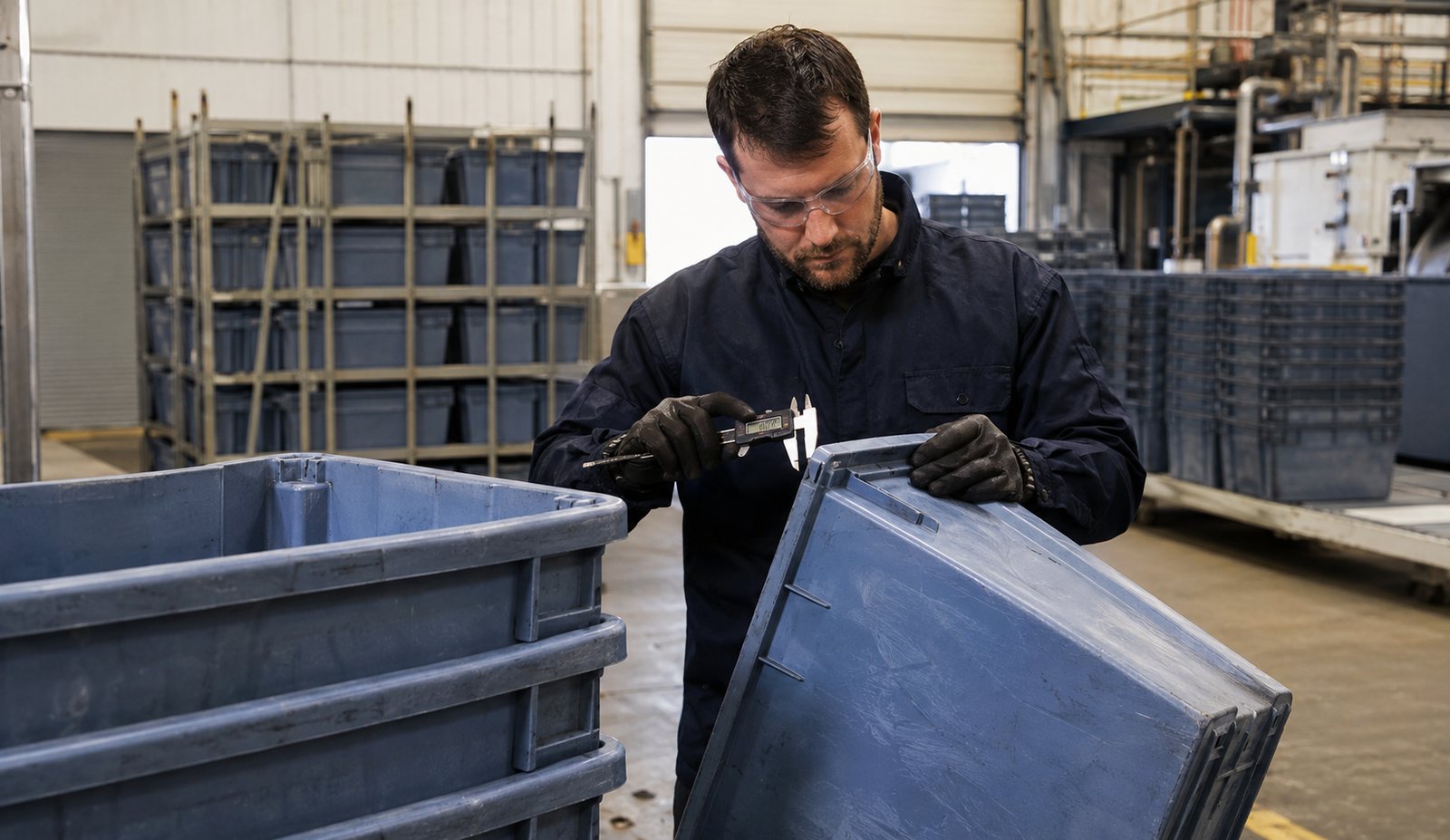
Decide whether a reusable polypropylene transit tote can advance to a controlled fleet pilot, needs a closure redesign, or requires a revised wash and handling specification.
Project Context
A hypothetical food and consumer-goods distributor is replacing single-use transport packaging with returnable 42 L totes. The operations team needs evidence that the tote retains stacking, closure and dimensional performance after repeated industrial washing, vehicle handling and warehouse use.
Evidence Scope
- 18 tote specimens across two moulding configurations
- 100 wash, return-handling and stacking cycles per specimen
- Baseline, 25-, 50-, 75- and 100-cycle inspections
- Closure force, nesting fit, sidewall deflection, crack grading and scanability checks
Lifecycle ledger
The evidence design follows a tote through the same sequence it would encounter in a return system. The purpose is not to claim a universal service life, but to establish whether wear emerges early enough to affect pilot readiness.
Checkpoint | Evidence captured | Illustrative decision signal |
|---|---|---|
0 cycles | Baseline dimensions, closure force, photographs | Reference condition |
25 cycles | Wash exposure and first handling review | Monitor surface whitening |
50 cycles | Stacking load and nesting-fit check | Compare moulding variants |
75 cycles | Corner, hinge and latch inspection | Escalate if crack propagation appears |
100 cycles | Full functional and dimensional review | Pilot, redesign or extend testing |
How the Work Would Be Delivered
August Research would define the evidence need, scout and assess suitable external laboratories or field settings, align the protocol and sample handling, coordinate testing checkpoints, and translate the evidence into a decision-ready pack. August Research does not own the laboratories or field facilities used for this work.
Stage | Illustrative delivery activity |
|---|---|
Week 1 | mission profile, sample plan and facility alignment |
Weeks 2–5 | wash, handling and stacking cycles with scheduled inspections |
Week 6 | failure review and cross-configuration comparison |
Week 7 | decision session and evidence handover |
Illustrative Outputs
- Cycle-by-cycle specimen ledger with condition photographs
- Comparison of closure force, nesting fit and sidewall deflection by configuration
- Provider coordination note for industrial wash and handling equipment
- Decision pack: pilot-ready, conditional pilot, redesign or further testing
Note:
This is a hypothetical illustrative engagement, not a client outcome. Sample counts, cycle counts, measurements, timing and possible outputs are conditional on the product, relevant standards, provider availability, specimen readiness, logistics and project scope. Accredited testing, regulatory interpretation and any formal conformity assessment remain the responsibility of appropriately qualified providers and responsible parties.
Research and Regulatory Context
The regulatory context is illustrative. It reflects the direction of Regulation (EU) 2025/40 on packaging and packaging waste, including future reuse obligations. Applicable requirements, definitions and dates must be confirmed for the product, market and business model.
Let’s Discuss Your Project
Tell us the product stage, expected service conditions, known failure concerns and the decision you need to make. We can shape an independent reliability evidence programme around the right facility, equipment and delivery route.
Illustrative timeline
This example is shown as 7 weeks. The actual timetable depends on external provider response times, equipment access, specimen availability, testing duration and any required approvals.