UX RESEARCH | ILLUSTRATIVE ENGAGEMENT
Does the handover application help the homeowner after the installer leaves?
Comparing installer completion with homeowner understanding across Greater Manchester and Cumbria, UK.
CLIENT SITUATION
A heat pump provider was preparing a digital commissioning and handover application for installers and homeowners.
DECISION REQUIRED
Decide which handover information should be redesigned before the application was introduced across different property and service conditions.
Why the interaction mattered
An installer could complete every required screen while the homeowner remained uncertain about normal operation, control changes or where to seek help. Satisfaction at the end of the visit would not show whether the handover still worked after the installer had left.
Hypothetical engagement frame
12 PAIRS
One installer and one homeowner per installation
2 GEOGRAPHIES
Greater Manchester and Cumbria
48 HOURS
Delayed homeowner recall and recovery check
5 WEEKS
Recruitment, handover, delay and readout
The questions the client needed answered
CAPTURE
Did the installer record and explain the intended information?
UNDERSTAND
Could the homeowner complete the relevant task without help?
RETAIN
What remained clear after 48 hours in the home?
Note: The location, participants, findings and recommendations are hypothetical and demonstrate how an engagement could be structured.
PARTICIPANT AND OUTREACH DESIGN
Recruit the handover pair, not two unrelated samples
The study follows information from the installer who records it to the homeowner who must use it later.
Twelve matched pairs
PAIR PARAMETER | INSTALLER | HOMEOWNER |
|---|---|---|
GREATER MANCHESTER | Six installers completing urban or suburban visits | Six households with different prior heating controls |
CUMBRIA | Six installers covering longer travel and dispersed properties | Six households with varied property and connectivity conditions |
Selection parameters
Direct responsibility for commissioning record and homeowner handover
Expected to use the controls and support information after the visit
Home type, control arrangement and internet availability relevant to the task
First heat pump users and people with prior smart heating control experience
Vision, hearing, dexterity, language or digital confidence considered where relevant
Both parties consent to separate sessions and delayed follow up
Outreach route
INSTALLERS
Approved installation partners and field teams
HOUSEHOLDS
Recent customers invited separately after permission
MATCH
Link each homeowner to the actual handover record
FOLLOW UP
Schedule a private session 48 hours later
Why independent research adds value
A homeowner may avoid admitting confusion while the installer is present. Separate follow up allows the homeowner to attempt the task without protecting the service relationship, while the installer can discuss time pressure and workarounds privately.
RESEARCH METHOD
Paired Handover Comprehension Test
The method follows the same information across four moments rather than treating installer completion and homeowner opinion as separate studies.
Four moments of evidence
1. RECORD
Installer completes the approved application flow
2. EXPLAIN
Homeowner receives the normal handover without research prompts
3. USE
Homeowner attempts selected tasks after the installer leaves
4. RECALL
Understanding and recovery are checked after 48 hours
Task set
HOMEOWNER TASK | EVIDENCE OBSERVED | RECOVERY TEST |
|---|---|---|
Explain current equipment state | What the homeowner believes is normal now | Find the relevant status explanation |
Make one control change | Whether the intended path and effect are understood | Undo or correct the change |
Describe expected behaviour | What would be treated as normal or concerning | Locate the next action |
Find support | Whether contact route and required information are available | Resume after leaving the screen |
Evidence link
APP FIELD
What was recorded
EXPLANATION
What was said
ACTION
What was done
DELAY
What remained
RECOVERY
What restored confidence
QUESTION DESIGN
Different questions for each side of the handover
The installer questions examine intended communication. Homeowner questions examine actual interpretation and delayed use.
Installer questions
Before you started the handover, which three things did you most need this homeowner to understand?
Establishes intended priorities without showing the homeowner response.
Which parts of the application did you explain in your own words rather than use as presented?
Identifies where the interface relies on installer translation.
What told you that the homeowner understood the control change?
Tests the evidence used to judge comprehension.
What did you leave for the homeowner to work out later?
Locates deferred learning and hidden assumptions.
Homeowner questions after the task
When the installer left, what did you believe the system would do next without any action from you?
Tests the homeowner's mental model of normal operation.
You changed the control and saw this response. What did you think had happened?
Links interpretation to observed feedback.
Which part of the handover did you return to when you were unsure?
Identifies the recovery route actually used.
After 48 hours, what would make you contact the installer rather than continue in the application?
Finds the confidence and escalation threshold.
ILLUSTRATIVE FINDINGS
What survived the handover
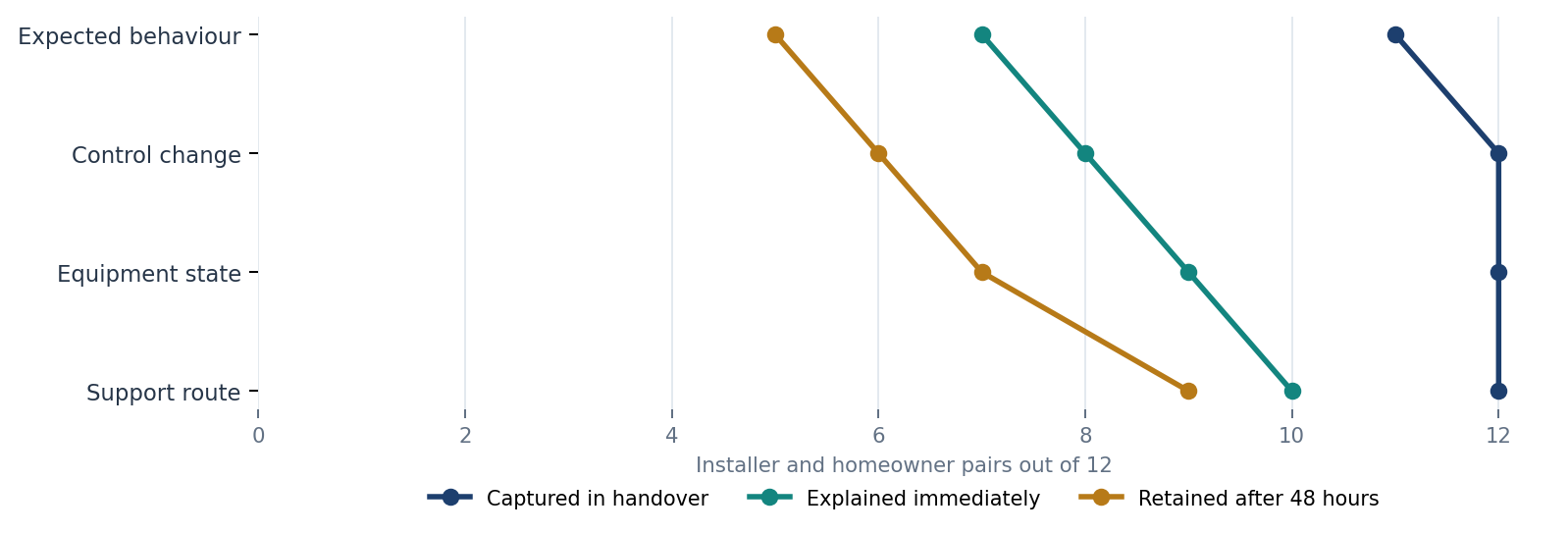
Hypothetical evidence from 12 installer and homeowner pairs compares recorded information, immediate explanation and delayed understanding.
Information retention after 48 hours
Handover gap pattern
GAP | WHAT HAPPENED | DESIGN IMPLICATION |
|---|---|---|
RECORDED BUT NOT EXPLAINED | Field completed without a homeowner cue | Separate installer completion from homeowner confirmation |
EXPLAINED BUT NOT FOUND | Homeowner remembered the message but not its location | Create a persistent handover summary |
FOUND BUT NOT ACTED ON | Feedback did not make the effect of a control change clear | Show state change and recovery together |
Illustrative decision
REDESIGN THE HANDOVER SUMMARY
Keep the commissioning workflow, but add a homeowner confirmation step, a persistent control summary and a visible route back to normal operation and support.
DECISION AND DELIVERY
What the client receives
The output separates installer completion from homeowner comprehension and gives the product team specific retest conditions.
Handover Survival Map
What was recorded, explained, used and retained for each pair
Installer Translation Register
Where installers replace, skip or expand the application language
Homeowner Recovery Path
What users do when a control response or status is unclear
Delayed Retest Protocol
Tasks and evidence to verify 48 hours after the revised handover
Delivery sequence
WEEK 1
Scope and matched recruitment
WEEK 2
Installer and handover observation
WEEK 3
Home task and delayed follow up
WEEK 4
Pair comparison and redesign
WEEK 5
Focused delayed retest
Timing is indicative and depends on installation schedules, homeowner response, property access, travel between Greater Manchester and Cumbria, consent and prototype readiness.
FAQ
Does this study validate commissioning quality or system performance?
No. It evaluates the handover interaction and homeowner use of the application. It does not replace technical commissioning, building assessment, electrical, safety, regulatory or performance verification.
Contact Us
Discuss your UX research question
Tell us the installer task, homeowner task, interface stage, property conditions, markets and decision you need to make. August Research will design the matched outreach, delayed test and decision outputs around the handover that matters.