R&D & INNOVATION / SECONDARY RESEARCH / PHASE 2 / MEDICAL DEVICES + DIAGNOSTICS
Direct-from-blood molecular diagnostics for bloodstream infection
A literature-led view of why direct whole-blood detection remains difficult, and which evidence would make a platform relevant.
DECISION-SPECIFIC REVIEW
PUBLISHED EVIDENCE
WEBSITE EXAMPLE
The challenge
A hypothetical diagnostics R&D team is exploring direct-from-blood molecular testing for suspected bloodstream infection. Its development question is tightly bounded: can a system preserve clinically useful pathogen and antimicrobial-resistance information while reducing the dependency on culture, within a workflow that an intended laboratory environment can operate? This requires more than a list of molecular technologies. It requires an evidence chain from patient sample to an actionable result.
Why this needs a careful evidence review now
Bloodstream infection is a high-consequence diagnostic setting, yet pathogen concentration can be low and whole blood introduces human DNA, inhibitors and complex sample-preparation demands. Positive molecular signal also needs clinical interpretation: contamination, residual nucleic acid and a limited target menu can all influence actionability. WHO’s 2025 bacterial IVD landscape notes the continued gap in multiplex platforms suitable for intermediate referral laboratories to identify bloodstream infection directly from whole blood without culture. That gap makes disciplined comparison of analytic, clinical and workflow evidence especially important.
REVIEW QUESTION Which direct-from-blood molecular approaches have evidence for a clinically usable, culture-independent workflow, and where do performance claims stop short of validation in the intended setting?
Published solution pathways to examine
Pathway | What published work actually supports |
|---|---|
Whole-blood direct detection | WHO identifies a continuing need for platforms that can identify bloodstream infection directly from whole blood without culture. |
Automated nucleic-acid workflows | Published and pipeline systems are assessed for specimen preparation, extraction, amplification and detection steps that can reduce laboratory complexity. |
Pathogen plus AMR information | WHO’s 2025 landscape maps bacterial-priority-pathogen and antimicrobial-resistance IVDs, highlighting the importance of target coverage and result interpretation. |
Clinical-utility evidence | Studies reporting analytical performance must be separated from clinical-comparator, turnaround-time and antibiotic-decision evidence. |
Published-source basis: World Health Organization, Landscape analysis of in vitro diagnostics for bacterial priority pathogens (2025), ISBN 978-92-4-010982-7; WHO diagnostics pipeline update (2025).
Website visual suggestion: sample-to-decision evidence chain
BLOOD DRAW
SAMPLE PREP
MOLECULAR DETECTION
CLINICAL COMPARATOR
ACTIONABLE REPORT
Use a five-stage chain with evidence tags beneath each stage: analytical LoD, inhibition control, clinical cohort, comparator quality and treatment-impact evidence. It helps a visitor see why a rapid assay is not automatically a validated care decision.
Direct-from-blood molecular diagnostics for bloodstream infection | Research protocol
How the review would be executed
The method is deliberately designed to make every conclusion traceable to the study conditions that produced it. It does not convert heterogeneous literature into a single score.
1. Define the intended-use boundary Set the population, blood volume, target organisms and resistance markers, reference standard, intended laboratory tier, acceptable hands-on time and reporting requirement. Exclude culture-only or non-blood evidence unless used solely as enabling context.
2. Build the evidence search Combine terms for bloodstream infection, whole blood, direct detection, molecular diagnostics, sample preparation, pathogen panel and AMR. Search guideline, public-health, peer-reviewed and manufacturer-source records separately.
3. Extract the full workflow Capture blood volume, pre-analytical handling, lysis or enrichment, extraction chemistry, target panel, limit of detection, invalid rate, time to result, comparator, clinical cohort and discordance-resolution method.
4. Grade clinical relevance Distinguish contrived-spike samples from prospective clinical samples; analytic sensitivity from positive/negative agreement; and result availability from documented antimicrobial-stewardship impact.
5. Form a design decision Identify which technical constraint most limits the intended use, then define whether the next action is assay design, specimen-processing development, clinical study design or a different intended-use claim.
Technical fields captured from each source
Evidence field | Evidence field |
|---|---|
Population and intended setting | Whole-blood volume and pre-analytics |
Enrichment / extraction approach | Panel and resistance-target scope |
Analytical LoD and interference testing | Comparator and discordance resolution |
Turnaround and hands-on time | Clinical-actionability / stewardship endpoint |
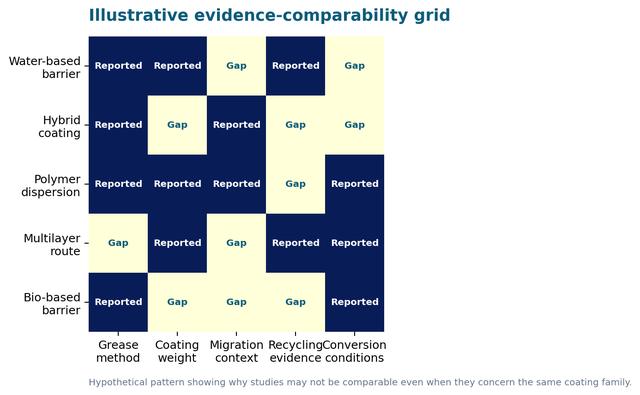
INTERPRETATION CONTROL Evidence is synthesised only where studies are technically comparable. Differences in model, operating conditions, assay, endpoint or reference standard remain visible in the final evidence record. | |
What the synthesis would and would not conclude
- It would identify the published pathways that are most relevant to the defined technical question and show the strength of the supporting evidence.
- It would preserve uncertainty, contradictory findings and transferability limits rather than presenting a generic “best technology”.
- It would not create a regulatory claim, compliance conclusion, product guarantee or client outcome from secondary evidence alone.
Direct-from-blood molecular diagnostics for bloodstream infection | Decision translation
What the output could look like
The final output is built for an R&D, engineering or product-development discussion. It links evidence to the next decision rather than ending with a bibliography.
- A source-linked workflow evidence map from sample draw to reportable result.
- A comparison matrix separating analytical, clinical, operational and stewardship evidence.
- A product-development brief showing the evidence threshold for the proposed intended use and the principal validation gaps.
Decision framing
RECOMMENDED USE OF THE EVIDENCE Use the review to decide whether the evidence supports a targeted internal experiment, a feasibility programme, a partner discussion, a narrower research question or a decision not to progress. The appropriate next step depends on the stated target conditions and evidence threshold.
Website presentation
This example can appear as a floating placecard on the service page. On click, it opens as a short technical story: the industry challenge, the actual evidence pathways, the review protocol, the visual evidence model and the decision-oriented delivery package.
Let’s discuss your project
August Research can structure a literature review around the technical conditions that matter to your next R&D decision, retaining the evidence limits that should shape what happens next.
NOTE This is a hypothetical engagement concept created for website illustration. The client situation, scope, records reviewed, delivery format, timing and resulting decisions are hypothetical. Published solution pathways and external context cited above are factual source material, but are not presented as a client outcome, performance guarantee or compliance conclusion.