
R&D & INNOVATION / SECONDARY RESEARCH / PHASE 2 / CHEMICALS + FMCG
PFAS-free barrier coatings for food-contact paper
A technical evidence review for assessing which published coating results are comparable enough to guide an R&D decision.
DECISION
Prioritise coating routes
TECHNICAL SCOPE
Paper and board barriers
OUTPUT
Evidence comparability matrix
TIMELINE
Illustrative 4-6 weeks
The challenge
A packaging-materials team is considering PFAS-free grease-resistant coatings for quick-service food wraps and paperboard formats. Published studies report many promising alternatives, but the evidence is difficult to use directly. Results can vary with fibre furnish, coating weight, cure or dry conditions, test liquid, contact time, temperature, barrier metric and whether the study considers migration, repulping or conversion.
The review question is deliberately narrow: which non-fluorinated coating families have published evidence that is comparable to the target paper grade, food-contact exposure and converting conditions, and where is a laboratory or converter validation still required?
PUBLIC CONTEXT
PFAS have been used in oil-resistant paper and cardboard food-contact materials. EU food-contact rules require materials to be safe and not transfer constituents in a way that could endanger health or adversely affect food. This context frames the evidence question only. The engagement does not provide compliance, migration or legal advice.
Review protocol
Compare PFAS-free barrier evidence for specified paper and board formats, use conditions and grease-resistance requirements.
Peer-reviewed studies and credible technical reports that state coating family, substrate, barrier method and at least one operating or performance parameter.
Claims without a defined substrate or test method; studies not distinguishable from fluorinated treatment; results unrelated to the intended food-contact or converting context.
Coating chemistry, basis weight, coat weight, cure or dry profile, test method, test medium, endpoint, migration context, recycling evidence and study limitation.
Group only evidence with comparable conditions, identify where a coating family is supported, conditional or not yet comparable, then define the next evidence need.
Evidence fields that change the conclusion
- Substrate identity and fibre composition, including whether the paper is coated, sized or multilayered.
- Barrier method, test liquid, temperature, time, pressure and endpoint definition.
- Coating add-on, solids, drying or cure conditions, and the line or laboratory setting.
- Food-contact relevance, extractables or migration context, and whether the evidence is directly measured or inferred.
- Repulping, recyclability, compostability or conversion evidence, kept separate from barrier performance.
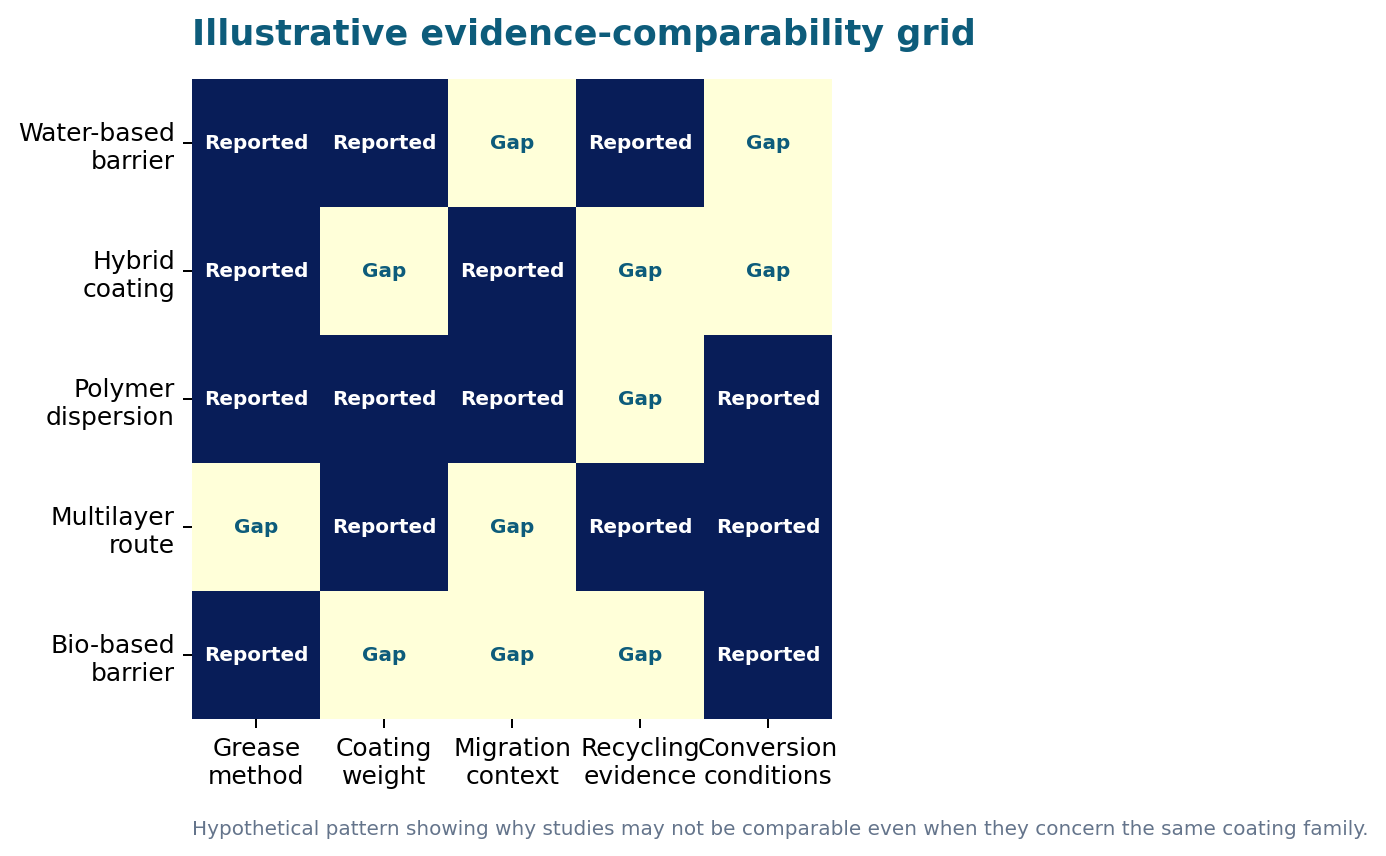
Illustrative evidence comparison
The output does not award a universal best coating. It makes visible which technical fields have actually been reported for each family, so that a team does not compare unlike studies as if they were equivalent.
Published solution pathways identified for review
The client brief is hypothetical, but the following technical routes and reported results are drawn from published studies. They are not treated as directly comparable because the substrate, coating weight, test method and end-use conditions differ.
Chitosan + genipin + microfibrillated cellulose
A 2025 study reported kit rating 12/12 at 4 g/m² on food-wrapping paper, with hot-oil testing and improvements in tensile, burst and water-vapour performance. Next question: Does the result transfer to the target paper grade, food-contact exposure and converting process?
Chitosan + pectin + carnauba wax
A 2025 ACS study reported a water-based bio-derived kraft-paper coating with improved oxygen, water-vapour, water and grease resistance after thermal annealing. Next question: Can the wax-phase and barrier response be reproduced at the required coat weight and line conditions?
CNF/CMC with chitosan interlayer
A 2023 molded-pulp study used a roughly 200 μm CNF/CMC coating with chitosan between layers and reported improved TAPPI T559 grease resistance, moisture performance and food-storage results. Next question: Is the coating build and processing burden feasible for a lighter paper-wrap format?
Functionalised PLA/PBAT waterborne coating
A 2025 ACS Omega study reported oil and water repellency, gas and moisture barrier, sealing and certified repulpability and recyclability for functionalised polyester-coated paper. Next question: Does this route fit the required end-of-life and material-strategy constraints?
Published-source basis: Shi et al., International Journal of Biological Macromolecules (2025), DOI 10.1016/j.ijbiomac.2025.143660; ACS Applied Materials & Interfaces (2025), DOI 10.1021/acsami.5c09638; ACS Applied Polymer Materials (2023), DOI 10.1021/acsapm.3c00979; ACS Omega (2025), DOI 10.1021/acsomega.4c11134.
What the evidence synthesis might conclude
ADVANCE TO VALIDATION
A published route reports a close substrate match and sufficient coating, process and barrier context to justify target-format validation.
CONDITIONALLY RELEVANT
A real study reports promising barrier results, but the missing migration, recycling, conversion or end-use context limits transferability.
DO NOT INFER YET
Published evidence is too incomplete or too dissimilar to support a meaningful technical comparison for the client’s format.
Illustrative delivery package
- A structured evidence database with screened records, exclusion reasons, source links and extracted technical parameters.
- A study-comparability workbook linking coating family, paper substrate, test method, process conditions, performance endpoint, food-contact context and evidence limitations.
- A decision presentation summarising comparable evidence, contradictions and the validation questions required before selecting a route.
- A short list of potential test methods, converter questions or external validation needs for the next project phase.
WEBSITE PRESENTATION SUGGESTION
Use a filterable comparability matrix. A visitor selects a coating family or paper format and sees which evidence fields are reported, missing or not comparable. Each cell should open a short definition so the page never implies that a missing field equals poor technology performance.
Let's discuss your project
August Research can organise a literature review around the formats, barrier requirements and evidence thresholds that matter before your team commits to the next coating-development step.
Note: This is a hypothetical engagement concept for website illustration, not a client project or a finding about any coating, supplier or compliance outcome. All values, record counts and timelines are illustrative.
Note: The timeline is illustrative. Actual timing depends on the final inclusion criteria, language coverage, source accessibility and depth of technical extraction required.