R&D & INNOVATION / SECONDARY RESEARCH / PHASE 2 / MINING + MATERIALS
Tailings dewatering additives under variable mineralogy
A literature review designed to prevent a published reagent result from being transferred blindly across ore bodies and water circuits.
DECISION-SPECIFIC REVIEW
PUBLISHED EVIDENCE
WEBSITE EXAMPLE
The challenge
A hypothetical process-technology team is reviewing additives for dewatering a tailings stream with variable mineralogy and changing process-water chemistry. The team needs to decide whether published flocculant results are sufficiently comparable to justify laboratory screening, rather than asking which additive has the highest reported number. This matters because apparent performance is strongly shaped by feed solids, clay and fine-particle composition, residual organics, dissolved ions, pH, shear history and the downstream filtration configuration.
Why this needs a careful evidence review now
Dewatering affects water recovery, tailings-storage volume, transport and long-term containment decisions. A reagent route that works on one tailings stream can underperform where sodium silicate, bitumen, ionic strength or clay characteristics are different. Published studies illustrate the point: oil-sands work has examined polymer combinations and chitosan-derived flocculants under specific feed conditions, while a sodium-silicate-tailings study reported an industrial calcium-chloride plus APAM route. The useful lesson is conditionality, not an off-the-shelf formulation recommendation.
REVIEW QUESTION Which published additive pathways are technically comparable to the target tailings stream, and which feed or process variables must be controlled before a bench or pilot programme is justified?
Published solution pathways to examine
Pathway | What published work actually supports |
|---|---|
Dual-polymer treatment | An ACS Energy & Fuels study on mature fine tailings evaluated two-stage polymer treatment with pressure-plate filtration, with filterability influenced by residual bitumen and dose. |
Chitosan-derived flocculants | An ACS study compared chitosan-derived materials with a commercial cationic polyacrylamide in oil-sands tailings, including capillary suction time and turbidity outcomes. |
Calcium chloride plus APAM | A study of high-sodium-silicate tailings reported a calcium-chloride/APAM route and industrial underflow observations under its stated operating conditions. |
Process-condition matching | Across the sources, reagent chemistry must be read alongside mineralogy, water chemistry, solids loading, pH, sequence and filtration method. |
Published-source basis: ACS Energy & Fuels (2017), DOI 10.1021/acs.energyfuels.7b00938; ACS Energy & Fuels (2018), DOI 10.1021/acs.energyfuels.7b03634; Sun et al. (2020), DOI 10.1155/2020/1918278.
Website visual suggestion: ore-to-water decision map
FEED MINERALOGY
WATER CHEMISTRY
REAGENT + DOSE
SOLIDS SEPARATION
WATER / CAKE OUTCOME
Present as a decision path, not a ranking chart. Each node can surface the variables that change transferability, such as clay fraction, sodium silicate, polymer sequence, CST, turbidity and cake solids.
Tailings dewatering additives under variable mineralogy | Research protocol
How the review would be executed
The method is deliberately designed to make every conclusion traceable to the study conditions that produced it. It does not convert heterogeneous literature into a single score.
1. Set the transferability profile Define the target ore/mineralogy, clay fraction, particle-size distribution, water chemistry, residual bitumen or organics, solids concentration, pH window and downstream equipment.
2. Search by mechanism and conditions Use tailings, dewatering, flocculation and filtration terms with mineralogical and water-chemistry qualifiers. Include academic studies, operating-practice papers and public technical reports; log exclusion reasons.
3. Extract operating context Record reagent identity and charge, dose and addition order, conditioning/shear, feed solids, pH, dissolved species, settling protocol, CST, turbidity, cake solids, filtration resistance and water-recovery outcome.
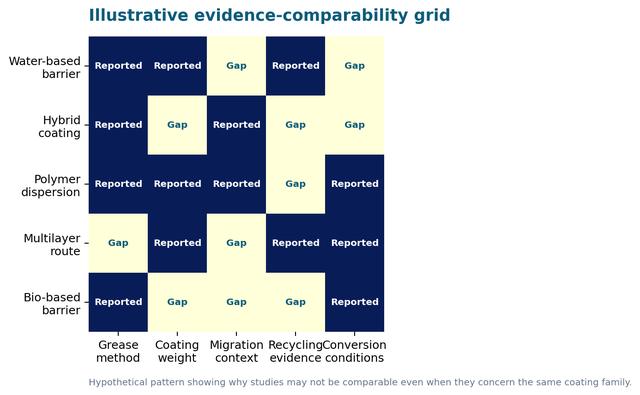
4. Build comparability bands Classify studies as directly comparable, conditionally comparable or contextual only. Do not pool performance values where test methods, feed composition or endpoints are materially different.
5. Convert evidence into a test plan Use the evidence map to select a small number of chemistry-and-condition combinations for laboratory verification, including the feed variables most likely to reverse performance.
Technical fields captured from each source
Evidence field | Evidence field |
|---|---|
Ore and clay mineralogy | Particle size and feed solids |
Residual bitumen / organics | Water chemistry and ionic strength |
pH, shear and ageing history | Reagent chemistry, dose and sequence |
Settling, CST and turbidity metrics | Filtration method, cake solids and water recovery |
INTERPRETATION CONTROL Evidence is synthesised only where studies are technically comparable. Differences in model, operating conditions, assay, endpoint or reference standard remain visible in the final evidence record. | |
What the synthesis would and would not conclude
- It would identify the published pathways that are most relevant to the defined technical question and show the strength of the supporting evidence.
- It would preserve uncertainty, contradictory findings and transferability limits rather than presenting a generic “best technology”.
- It would not create a regulatory claim, compliance conclusion, product guarantee or client outcome from secondary evidence alone.
Tailings dewatering additives under variable mineralogy | Decision translation
What the output could look like
The final output is built for an R&D, engineering or product-development discussion. It links evidence to the next decision rather than ending with a bibliography.
- A source-traceable dewatering evidence register with full operating conditions.
- A transferability map showing which studies match the target stream and why.
- A laboratory-screening brief that defines the variables, endpoints and condition windows to verify next.
Decision framing
RECOMMENDED USE OF THE EVIDENCE Use the review to decide whether the evidence supports a targeted internal experiment, a feasibility programme, a partner discussion, a narrower research question or a decision not to progress. The appropriate next step depends on the stated target conditions and evidence threshold.
Website presentation
This example can appear as a floating placecard on the service page. On click, it opens as a short technical story: the industry challenge, the actual evidence pathways, the review protocol, the visual evidence model and the decision-oriented delivery package.
Let’s discuss your project
August Research can structure a literature review around the technical conditions that matter to your next R&D decision, retaining the evidence limits that should shape what happens next.
NOTE This is a hypothetical engagement concept created for website illustration. The client situation, scope, records reviewed, delivery format, timing and resulting decisions are hypothetical. Published solution pathways and external context cited above are factual source material, but are not presented as a client outcome, performance guarantee or compliance conclusion.