COMPANY PROFILING | PACKAGING MACHINERY
Can This Family-Owned Packaging Machinery Company
Sustain Service Through Leadership Succession?
A continuity-focused company profile for a customer considering a five-year service framework.
1 company
ENTITY FOCUS
31 countries
INSTALLED BASE
2019 to 2026
EVIDENCE WINDOW
4 weeks
DECISION HORIZON
The business situation
A multinational food producer relied on a family-owned packaging-equipment manufacturer in Northern Italy. Before renewing a five-year service framework, the customer needed to understand whether product knowledge, service authority and export support were embedded in the organisation or remained dependent on the founder and a small number of long-tenured specialists.
DECISION QUESTION Can the manufacturer continue supporting an international installed base if leadership and technical authority begin to transfer to the next generation?
Why revenue and product history were insufficient
Ownership is not succession: Family involvement did not show how operational authority would transfer.
Installed base creates obligations: A machine sale can create years of parts, software and field-service dependency.
Private-company evidence is fragmented: Continuity had to be inferred from filings, leadership history, hiring, channels and service infrastructure.
RESEARCH DESIGN
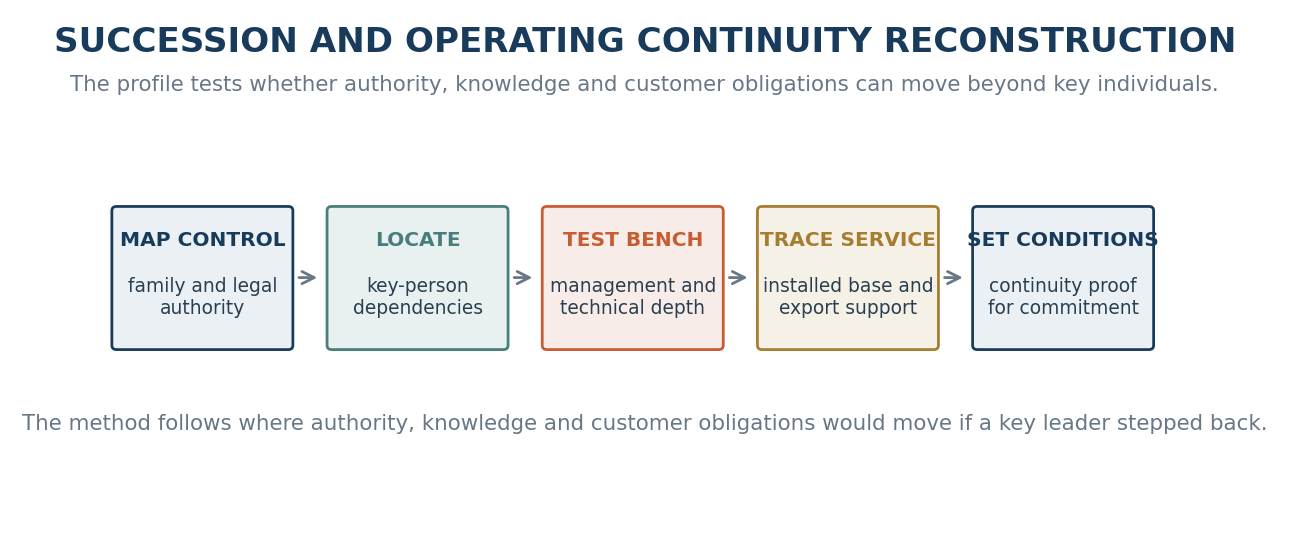
The profile followed authority and knowledge, not age alone
Succession and Operating Continuity Reconstruction connected family control with management depth, technical concentration, service coverage and customer obligations. A gap was recorded only when authority or knowledge appeared concentrated and no credible transfer mechanism was visible.
Profile boundary
BOUNDARY | INCLUDED |
|---|---|
Entity | Italian operating company, holding relationship and disclosed service affiliates |
Operating model | Machine design, assembly, field service, spare parts, software support and export channels |
Geography | Northern Italian operating base and material distributor or service locations abroad |
Time | Financial, leadership and operating signals from 2019 through August 2026 |
Evidence architecture
EVIDENCE FIELD | WHAT IT ESTABLISHED | LIMIT RETAINED |
|---|---|---|
Registry and accounts | Legal control, directors, financial continuity and operating scale | Private ownership detail could remain incomplete |
People and governance | Family roles, leadership bench, tenure and hiring direction | Titles did not prove delegated authority |
Installed base | Product history, countries served, distributors and service obligations | Marketing claims required corroboration |
Service capacity | Technicians, training, parts support and regional response structure | Availability was not inferred from headcount alone |
CONTINUITY EVIDENCE
Commercial continuity was stronger than governance continuity
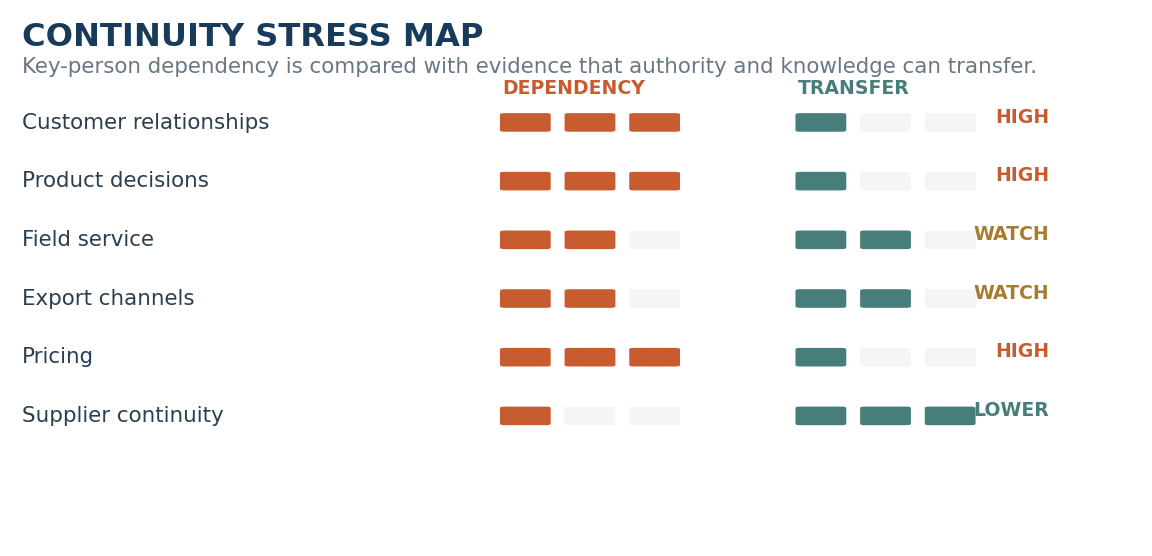
The company showed a durable export and service model, but strategic customer relationships, pricing exceptions and product decisions remained concentrated around the founder and two senior specialists. Evidence of a formal succession timetable was limited.
PROFILE FIELD | RECONSTRUCTED FINDING | CONFIDENCE |
|---|---|---|
Operating scale | Seventy-four observed employees, with production and engineering concentrated at one Northern Italian site | Supported |
Installed base | Approximately 2,400 machines across 31 countries, with eighteen active distributor or service relationships | Supported |
Service bench | Thirteen field-service technicians and four senior specialists with more than twenty years of tenure | Supported |
Succession | Next-generation family members held director roles, but delegated authority and timing were not disclosed | Unresolved |
Customer continuity | Service processes were visible; commercial exceptions still appeared founder-led | Conditional |
INTERPRETATION The company could support ongoing operations, but a long-term customer commitment should not depend on assumed succession readiness.
DECISION OUTCOME
Renew with continuity conditions
The profile supported renewal because the installed-base and service evidence was credible. The recommended agreement would convert unresolved succession issues into practical operating protections rather than treating them as a reason to exit the relationship.
CONDITION | EVIDENCE OR PROTECTION REQUIRED | PURPOSE |
|---|---|---|
Named deputies | Documented owners for product, service and key-account decisions | Reduce single-person dependency |
Knowledge transfer | Current manuals, escalation paths and cross-trained technical coverage | Protect service continuity |
Parts resilience | Critical-parts list, stocking policy and supplier contingency | Limit installed-base disruption |
Change trigger | Notification and review rights for material leadership or control changes | Create an early response point |
What the client would receive
- Ownership, leadership and family-control map
- Management-bench and key-person dependency assessment
- Installed-base, export-channel and service-capacity reconstruction
- Continuity stress map by business function
- Contract condition brief for procurement, operations and legal teams
Indicative delivery
A focused private-company profile would typically require three to five weeks. Timing depends on registry access, availability of local-language filings and the transparency of distributor and service relationships.
STUDY BOUNDARY This work supports commercial continuity planning from available evidence. It does not replace legal, financial, insurance or technical due diligence.
NOTE The company, figures, evidence and conclusions in this example are hypothetical and are not presented as real client outcomes.
Contact Us
TEST CONTINUITY BEFORE A LONG-TERM COMMITMENT Tell us which privately held company and operating dependency matter to your decision. August Research will reconstruct control, capacity and continuity around the obligations you need protected.