COMPANY PROFILING | ADVANCED MATERIALS
Is This South Korean Materials Company
Truly Repositioning Toward Semiconductor Applications?
A trajectory-focused company profile separating strategic language from funded and operating commitment.
27 signals
EVIDENCE SET
5 years
TIME WINDOW
South Korea
OPERATING CENTRE
6 weeks
DECISION HORIZON
The business situation
A global specialty-materials company was reviewing a listed South Korean competitor that increasingly described semiconductors as a growth priority. The competitor had announced projects, partnerships, products and hiring across several materials categories, but its reporting did not disclose semiconductor revenue as a separate segment.
DECISION QUESTION Is semiconductor exposure becoming an operating business with committed assets and commercial capability, or is it still primarily a strategic narrative?
Why announcement counting was unreliable
Signals carry different weight: A product mention, research partnership and operating plant do not represent equal commitment.
Attribution matters: Projects may sit in a subsidiary, joint venture or adjacent segment rather than the listed parent.
Revenue can remain hidden: A real repositioning may be visible in capital, people and assets before segment reporting changes.
RESEARCH DESIGN
The profile reconstructed a trajectory, not a collection of announcements
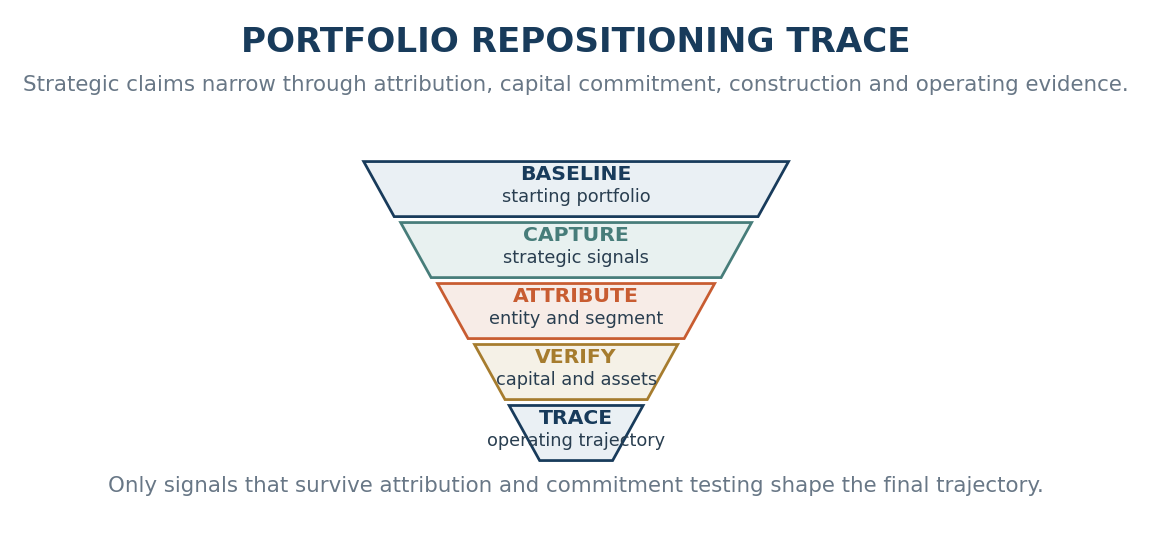
Portfolio Repositioning Trace established the company’s starting portfolio, captured semiconductor-linked signals and then narrowed them through entity attribution and commitment testing. Only funded, under-construction or operating activity shaped the final trajectory.
Profile boundary
BOUNDARY | INCLUDED |
|---|---|
Entities | Listed parent and subsidiaries materially connected with semiconductor materials |
Applications | Photoresist inputs, advanced packaging materials, wet chemicals and related electronic materials |
Geography | South Korean facilities and material overseas sales, qualification or investment locations |
Time | Strategic and operating signals from January 2021 through August 2026 |
Evidence architecture
EVIDENCE FIELD | WHAT WAS TESTED | CONTROL |
|---|---|---|
Regulatory filings | Reported segments, capex, subsidiaries, transactions and risk disclosures | Semiconductor attribution required explicit support |
Facilities and capital | Project values, locations, permits, construction and operating dates | Announced and deployed capital separated |
Products and IP | Product launches, patents, applications and customer-qualification signals | Research activity did not equal sales |
People and partnerships | Specialist hiring, leadership mandates and ecosystem relationships | Recruitment intent separated from built capability |
RECONSTRUCTED TRAJECTORY
The repositioning was operational, but the revenue mix remained unresolved
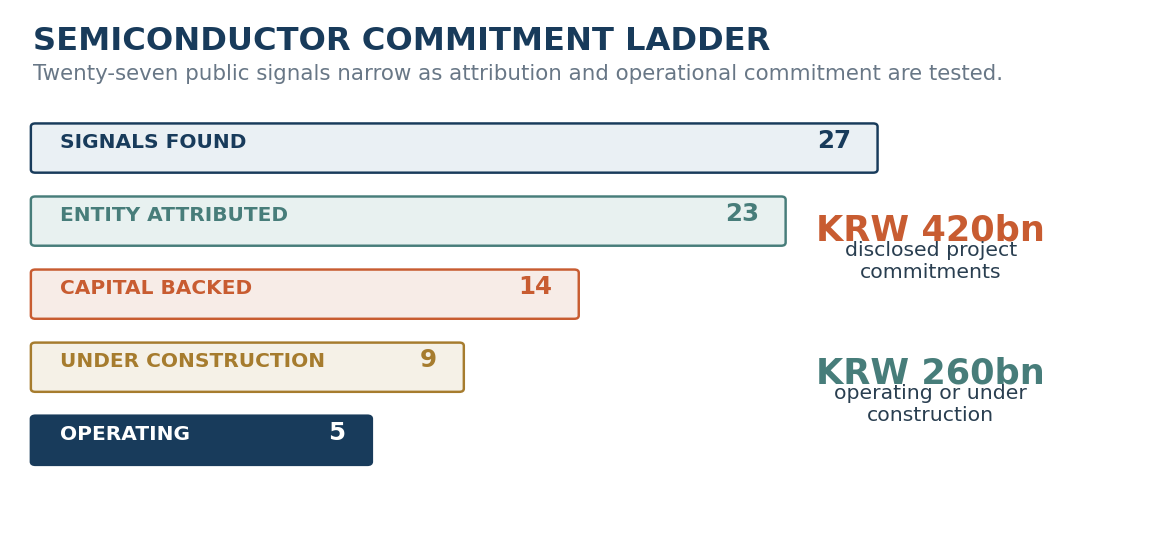
Twenty-seven semiconductor-linked signals were identified. Twenty-three could be attributed to the relevant entity or segment, fourteen had disclosed capital support, nine had reached construction and five were operating. The evidence showed genuine commitment without proving how much current revenue came from semiconductors.
SIGNAL FAMILY | RECONSTRUCTED FINDING | INTERPRETATION |
|---|---|---|
Capital | KRW 420 billion in disclosed project commitments; KRW 260 billion attributable to operating or under-construction assets | Commitment extended beyond narrative |
Facilities | Four South Korean sites carried material semiconductor-linked activity | The operating base was concentrated |
People | Specialist hiring moved from laboratory roles toward process, quality and account functions | Commercialisation capability was forming |
Reporting | Semiconductor revenue remained embedded within broader materials segments | Market exposure could not be sized confidently |
INTERPRETATION The company was building a real semiconductor-materials platform, but public evidence did not support treating the broader portfolio as already transformed.
DECISION OUTCOME
Respond to the operating trajectory, not the corporate narrative
The profile supported targeted competitive action in the applications where operating assets, specialist teams and qualification signals converged. It did not support a broad assumption that the competitor had already shifted its total revenue base toward semiconductors.
RESPONSE | WHERE TO ACT | WHY |
|---|---|---|
Defend | Applications with operating capacity and active qualification evidence | Competitive capability was already forming |
Differentiate | Segments where the competitor had capital but limited operating proof | Execution remained uncertain |
Monitor | Announced overseas projects and research-led product claims | Evidence had not crossed the commitment threshold |
What the client would receive
- Resolved parent, subsidiary and segment profile
- Five-year semiconductor signal register
- Capital, facility and commitment ladder
- Application and operating-capability map
- Competitive response brief with defend, differentiate and monitor priorities
Indicative delivery
A listed-company trajectory profile would typically require four to six weeks. Timing depends on subsidiary complexity, language coverage and the level of facility, patent and customer-qualification evidence required.
STUDY BOUNDARY This work supports strategic and competitive decision making from available evidence. It does not replace financial, legal, technical or investment due diligence.
NOTE The company, figures, evidence and conclusions in this example are hypothetical and are not presented as real client outcomes.
Contact Us
TRACE THE COMPANY BEHIND THE STRATEGY Tell us which company and strategic shift you need to assess. August Research will reconstruct the entities, commitments and operating signals into a decision-ready company trajectory.