COMPANY PROFILING | MOBILITY AND ENERGY
Where Is This Indonesian Conglomerate
Really Exposed to Electric Two-Wheelers?
A group-level company profile separating controlled operations from enabled exposure and strategic options.
8 entities
GROUP BOUNDARY
3 markets
GEOGRAPHY
2022 to 2026
EVIDENCE WINDOW
5 weeks
DECISION HORIZON
The business situation
A global component supplier needed to understand a diversified Indonesian conglomerate before setting its account strategy for electric two-wheelers. Public announcements connected the group with batteries, mobility, financing, charging and distribution, but they did not reveal which activities were controlled, merely enabled through another subsidiary, or retained as future options.
DECISION QUESTION Should the conglomerate be treated as an integrated electric two-wheeler manufacturer, an ecosystem orchestrator, or a collection of loosely connected investments?
Why the parent company story was not enough
Control differs from association: A press release may name the group even when execution sits with a minority venture or partner.
The value chain is distributed: Vehicles, batteries, finance, charging and service can sit in separate entities with different incentives.
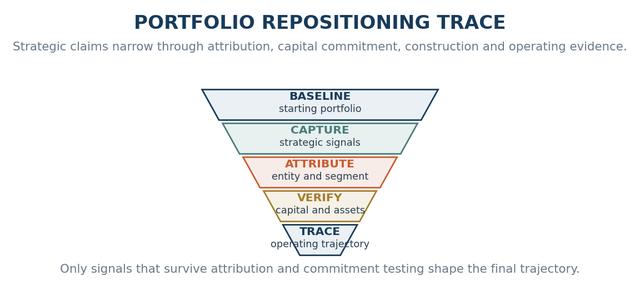
Commitment has stages: Announced investment, funded construction and operating capacity were classified separately.
RESEARCH DESIGN
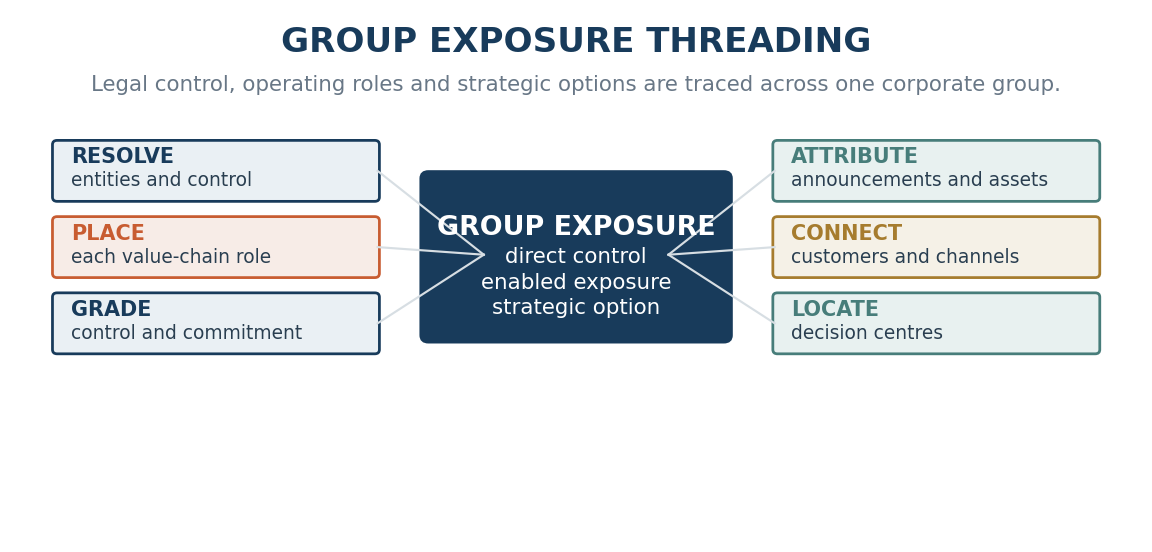
The profile followed exposure through the corporate group
Group Exposure Threading began with the legal entity tree and then moved each corporate signal to the subsidiary, joint venture or partner responsible for delivery. Exposure was graded only after ownership, assets, commercial activity and decision authority were connected.
Profile boundary
BOUNDARY | INCLUDED |
|---|---|
Entities | Indonesian parent, five operating subsidiaries and two material joint ventures |
Value chain | Battery packs, vehicle assembly, sales, financing, charging, digital services and aftersales |
Geography | Indonesia as the operating centre, with material links to Vietnam and Thailand |
Time | Corporate signals from January 2022 through August 2026 |
Evidence architecture
EVIDENCE FIELD | WHAT WAS TESTED | CONTROL |
|---|---|---|
Corporate filings | Ownership, directors, subsidiaries and reported segments | Legal identity before brand association |
Capital and facilities | Disclosed commitments, construction, equipment and operating assets | Announcements separated from execution |
Partnerships | Joint ventures, battery alliances, technology partners and commercial roles | Partner activity not attributed to the group |
Channels and people | Dealer coverage, financing reach, hiring and leadership responsibility | Observed capacity separated from theoretical reach |
RECONSTRUCTED EXPOSURE
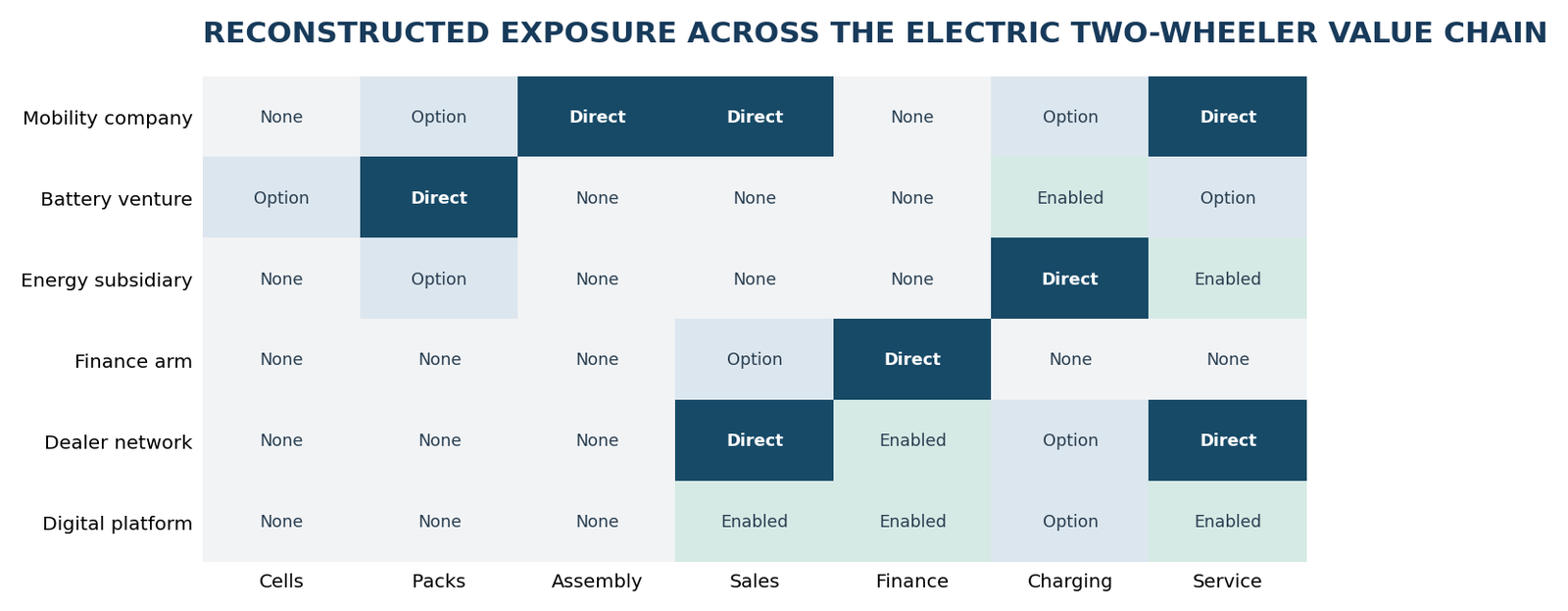
The group was broad, but not vertically integrated
The reconstructed profile found meaningful control in distribution, financing and aftersales. Battery-pack and charging exposure was enabled through affiliated ventures. Cell production remained an option rather than an evidenced operating capability.
PROFILE SIGNAL | RECONSTRUCTED FINDING | DECISION EFFECT |
|---|---|---|
Corporate boundary | Eight material entities: three majority-controlled, two joint ventures and three minority or strategic exposures | Account ownership had to follow the legal tree |
Capital commitment | IDR 4.2 trillion announced; IDR 1.6 trillion attributable to operating or under-construction projects | Headline investment overstated current capacity |
Route to market | A network of 420 sales and service outlets; 68 showed EV-specific capability | Strong conversion platform, uneven readiness |
Decision centre | Mobility and energy activities reported through different executive chains | One group-level relationship would be insufficient |
INTERPRETATION The conglomerate was best treated as an ecosystem orchestrator with strong commercial leverage, not as a single integrated manufacturer.
DECISION OUTCOME
Build a multi-entity account plan
The profile supported engagement, but through separate decision paths. Distribution and finance offered the nearest-term commercial route. Battery and charging relationships required venture-level qualification, while cell manufacturing should remain a monitored option rather than a sales assumption.
PRIORITY | RECOMMENDED RESPONSE | REASON |
|---|---|---|
Now | Engage the mobility company, finance arm and EV-ready dealer operations | These entities controlled the clearest customer access |
Develop | Qualify battery and charging ventures independently | Capability depended on joint ownership and partner execution |
Monitor | Track cell announcements against permits, assets and hiring | No operating control was evidenced |
What the client would receive
- Resolved corporate tree and ownership-confidence register
- Entity-by-entity electric mobility exposure map
- Capital and facility commitment chronology
- Decision-centre and account-routing map
- Priority brief distinguishing current, developing and option-only exposure
Indicative delivery
A group profile of this depth would typically require four to six weeks, depending on the number of affiliated entities, language coverage and the transparency of joint-venture reporting.
STUDY BOUNDARY The profile reconstructs corporate exposure from available evidence. It does not replace legal, tax, financial or investment due diligence.
NOTE The company, figures, evidence and conclusions in this example are hypothetical and are not presented as real client outcomes.
Contact Us
UNDERSTAND THE GROUP BEHIND THE HEADLINE Tell us which corporate group and strategic decision you need to examine. August Research will define the entity boundary, trace the operating evidence and show where control actually sits.