EXECUTIVE INTERVIEWS | EXAMPLE ENGAGEMENT
Aligning Retail Leaders Around a Reusable Transport Packaging Loop
How a grocery retailer could test whether suppliers, logistics partners and internal leaders would support a pooled reusable crate programme.
CLIENT SITUATION
Cross company reuse model under review
SECTOR
Retail supply networks
DECISION
Launch a closed loop or pause
Business background
A hypothetical grocery retailer was considering reusable crates for selected chilled and ambient categories. The environmental case appeared promising, but the operating model would shift work and cost across suppliers, distribution centres, stores, carriers and the pool operator.
Leadership needed to know whether the network would cooperate, which party should own each step, and whether asset loss, cleaning, data capture and reverse logistics could be governed without damaging supplier relationships.
The decision to support
CORE QUESTION
Should the retailer establish a pooled reusable crate programme, and which shared rules would make one supply loop commercially workable?
Why neutral research mattered
Unequal negotiating power
Suppliers could discuss workload and cost concerns without negotiating directly with the retailer.
Benefits and burdens sat in different places
The study could show who gained, who paid and where incentives needed redesign.
One loop required several owners
A neutral view could connect decisions across packaging, logistics, procurement and stores.
This is a hypothetical client scenario. Participant counts, findings and recommended actions demonstrate how the engagement could be delivered.
NETWORK CONSTITUENCY
The sample followed the crate, not the hierarchy
Executives were selected from every organisation that could keep the asset moving or allow the loop to break.
Executive constituency | Count | Decision contribution |
|---|---|---|
Retail procurement and sustainability | 4 | Supplier terms, targets and category selection |
Distribution and store operations | 4 | Handling, space, returns and exception management |
Supplier commercial and operations leaders | 6 | Filling changes, cost, stock and participation |
Logistics and pool operators | 4 | Collection, tracking, cleaning and asset control |
Finance and packaging leaders | 3 | Economics, specifications and loss treatment |
Example scope: 21 interviews across the United Kingdom, France and the Netherlands, covering retailer, supplier and logistics perspectives. Interview length: 40 to 50 minutes.
Each interview tested one complete asset cycle
HANDOVER
Where does custody change and how is it recorded?
EXCEPTION
What happens when crates are late, damaged or unavailable?
ECONOMICS
Who carries stock, handling and loss cost?
INCENTIVE
What would make participation preferable to single use packaging?
How executives were selected
- Authority over packaging specifications, supplier terms, network operations, asset pooling or programme funding.
- Direct experience with at least one handover in the proposed crate cycle.
- Balanced representation of large and mid sized suppliers so that scale effects were not mistaken for universal acceptance.
NETWORK EVIDENCE
No single organisation could make the loop work alone
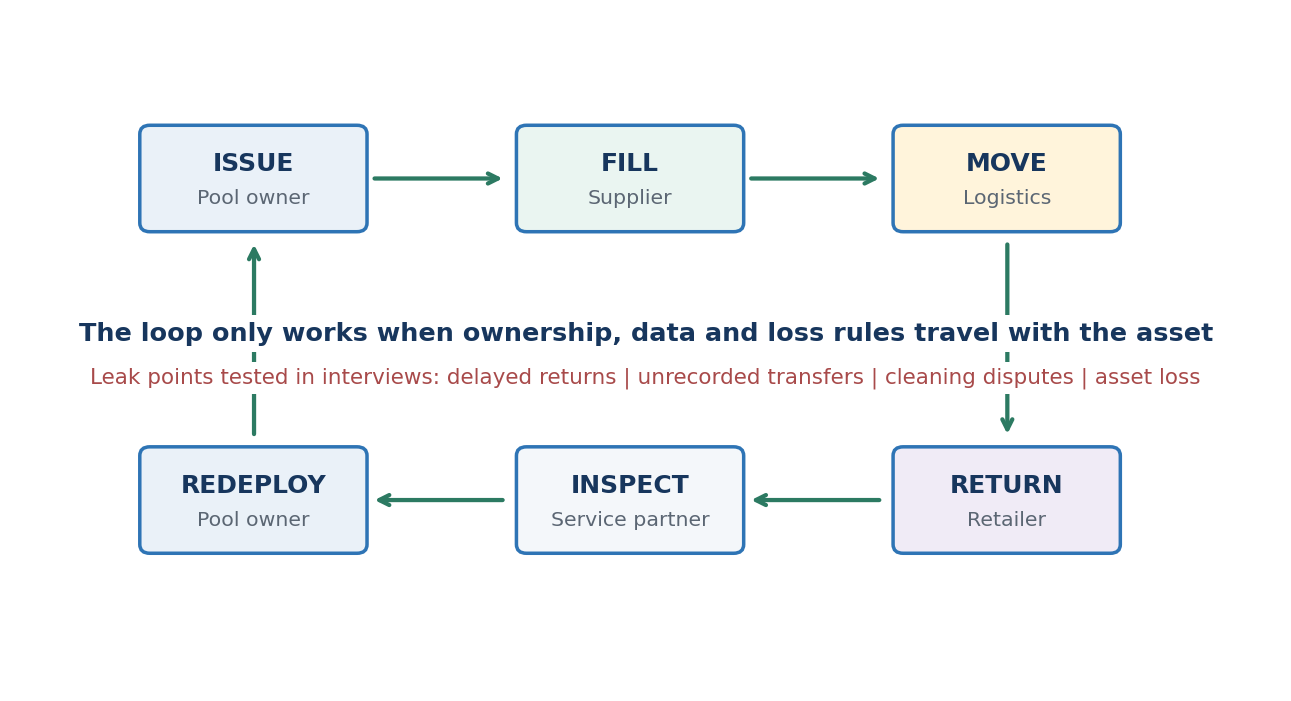
Support increased when the proposal was discussed as a shared operating system rather than a packaging substitution.
The operating loop tested in interviews
Where alignment was strongest
CLOSED ROUTES
Predictable supplier to depot routes made return planning easier.
COMMON SPECIFICATION
A limited crate range reduced sorting and storage complexity.
VISIBLE CUSTODY
Transfer scans made losses discussable rather than disputed.
The unresolved network question
Would every participant still support reuse after its own handling cost and accountability became visible?
COMMERCIAL ALIGNMENT
The programme needed a burden sharing agreement
The interviews translated general support for reuse into explicit responsibilities and incentives.
Benefit and burden by participant
Participant | Primary benefit | Primary burden | Condition for support |
|---|---|---|---|
Retailer | Less packaging waste and stronger control | Pool funding and supplier coordination | Network level cost view |
Supplier | Standard crate and fewer one way packs | Line change, crate stock and handling | Compensation and availability |
Logistics | Planned reverse movement | Sorting, scan compliance and exceptions | Volume density and clear SLA |
Stores | Less disposal and cleaner handling | Backroom space and return discipline | Simple process and collection |
Closed loop entry rules
Begin where collection can use existing return transport and predictable depot flows.
Choose products with stable volumes, manageable hygiene needs and limited crate formats.
Record each handover and define treatment of pooled, missing and damaged assets.
Rebalance charges when loss, dwell time or handling burden moves outside agreed limits.
LAUNCH DESIGN
Start with one recoverable loop
The engagement would support a closed loop trial on selected routes, with shared custody rules and a transparent method for allocating cost.
A practical starting position
SELECT
Choose one category and depot network with stable flows.
AGREE
Define custody, cleaning, loss and availability rules with participants.
MEASURE
Track turns, dwell time, losses, handling effort and service impact.
EXPAND
Add routes only after the first loop remains balanced for all parties.
What the client would receive
- Network executive constituency map
- Asset cycle interview framework
- Benefit and burden comparison
- Custody and exception register
- Closed loop entry criteria
- Leadership alignment briefing
Example delivery plan
WEEK 1
Loop definition and participant map
WEEK 2
Recruitment and cycle stimulus
WEEKS 3 TO 5
Network interviews
WEEK 6
Burden and incentive synthesis
WEEK 7
Alignment workshop and launch brief
Timing is indicative and depends on participant availability, market coverage, disclosure requirements and response time.
Important boundaries
- The engagement provides qualitative, directional evidence rather than a network adoption rate.
- Operational, hygiene, environmental and financial performance would require separate validation.
- Participants would not be asked for confidential, proprietary or material non public information.
Contact Us
Planning a cross company reuse programme?
Tell us the supply loop, decision makers and markets in scope. August Research will help test alignment independently.