EXECUTIVE INTERVIEWS | EXAMPLE ENGAGEMENT
Testing Executive Readiness for Pay per Pallet Automation
How an industrial automation manufacturer could test whether food producers would accept an outcome based palletising contract, and identify the conditions required for a credible pilot.
CLIENT SITUATION
New service model under consideration
SECTOR
End of line industrial automation
DECISION
Pilot, redesign or stop
Business background
A hypothetical automation manufacturer had built a strong equipment sales and maintenance business around robotic palletising cells. Management was considering a new offer in which the manufacturer would retain ownership of the cell and charge the customer for successfully completed pallets, with maintenance, monitoring and performance support included.
The commercial team could explain the benefits, but it did not know whether customer leaders would view the model as genuine risk transfer or as a more complex way to finance equipment.
The decision to support
CORE QUESTION
Should the manufacturer pilot a pay per pallet contract, and which commercial and operating conditions must be designed before launch?
Why independent interviews were needed
More candid buyer reactions
An external interviewer could explore contract concerns without making customers feel they were negotiating with the supplier.
Neutral comparison
The same decision questions could be tested across operations, engineering, finance and procurement.
Challenge to internal assumptions
The study could separate customer value from benefits the manufacturer wanted the market to value.
This is a hypothetical client scenario. Participant counts, findings and recommended actions are shown to demonstrate how the service could be delivered.
RESEARCH DESIGN
Who needed to be heard
The sample was built around authority over the decision, not seniority alone.
Executive constituency | Count | Decision contribution |
|---|---|---|
Operations leaders | 5 | Continuity, throughput, labour and network fit |
Plant and engineering leaders | 4 | Integration, changeover, fallback and recovery |
Procurement and finance leaders | 4 | Price logic, commitments, liability and exit |
EHS, digital and OT leaders | 3 | Safety, remote access, data and accountability |
Integration and service partners | 2 | Local response, spares and intervention capacity |
Example scope: 18 interviews across the United Kingdom, Germany, Poland and the Netherlands. Interview length: 40 to 50 minutes. Findings would be anonymised unless attribution was agreed.
Three commercial models tested
EQUIPMENT PURCHASE
Customer owns the cell and buys maintenance separately.
FIXED SUBSCRIPTION
Supplier retains ownership for a fixed monthly service fee.
PAY PER PALLET
Customer pays for completed pallets against agreed performance rules.
How each conversation was structured
1 Current decision
How automation is funded, approved and evaluated today
2 Model reaction
Immediate response to purchase, subscription and outcome pricing
3 Risk boundary
Who should own failure, variability, site conditions and change
4 Counterfactual
What evidence or contract change would alter the position
5 Adoption threshold
The minimum conditions required to support a pilot
DECISION EVIDENCE
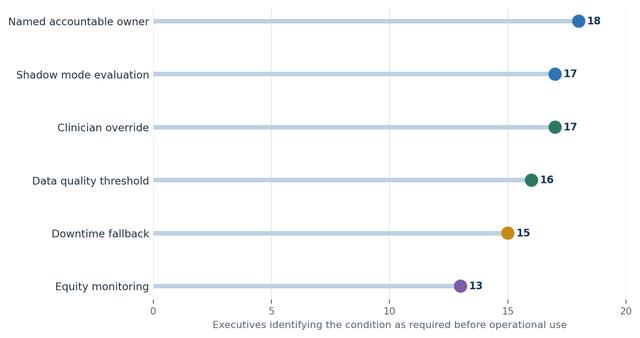
The offer was not rejected. It was conditional.
Executives were more interested in the model when it reduced operational uncertainty. Capex avoidance alone was not enough.
Conditions that would make the contract credible
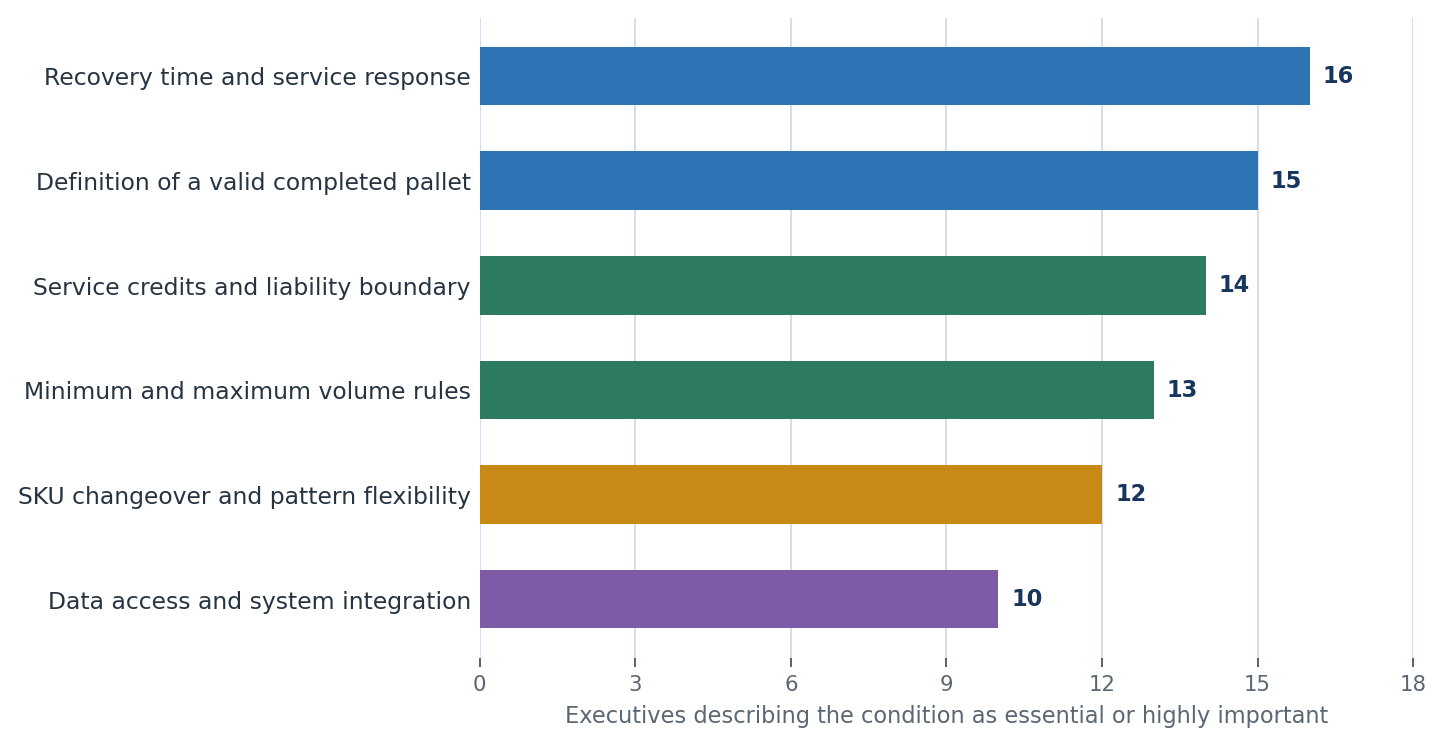
What sat behind the numbers
Define the outcome before setting the price
A completed pallet needed rules for pattern accuracy, load stability, label orientation, rework and rejection.
Risk transfer had to be observable
Operations leaders wanted recovery commitments and service credits tied to events the supplier could control.
Variable pricing still needed boundaries
Finance leaders wanted a clear volume floor, price ceiling and treatment for long periods of low utilisation.
Flexibility was part of uptime
Plant leaders viewed SKU changes, new carton sizes and pallet pattern updates as part of usable availability.
The underlying executive concern
Will this contract make production risk easier to manage, or simply make responsibility harder to prove?
CONTRACT DESIGN
The responsibility boundary mattered as much as price
The interviews helped distinguish events the provider could own from conditions that required shared rules or remained under customer control.
Proposed responsibility boundary
Operating event | Provider | Shared | Customer |
|---|---|---|---|
Robot availability and mechanical failure | ● | ||
Preventive maintenance and planned parts | ● | ||
New SKU and pallet pattern qualification | ● | ||
Line blockage caused by upstream equipment | ● | ||
Remote access and production data rules | ● | ||
Production schedule and material availability | ● | ||
Unapproved site or safety zone changes | ● |
This boundary would be refined through technical and legal review. The executive study identifies the commercial expectations that must be resolved before those reviews begin.
How different roles interpreted the same offer
OPERATIONS
Useful if response and recovery are guaranteed, with a practical fallback during prolonged failure.
FINANCE
Attractive if the volume floor, unit price, contract term and exit cost are visible before approval.
PROCUREMENT
Credible only when outcome definitions, exclusions, audit rights and service credits are precise.
ENGINEERING
Acceptable if the plant retains control over changeovers, safety and integration with upstream equipment.
DECISION AND DELIVERY
A focused pilot, not a broad launch
The research would support a conditional decision to proceed with a limited pilot after redesigning the offer around measurable outcomes and explicit responsibilities.
Decision made possible
PILOT
Select two stable, high volume lines where pallet definitions and production data are reliable.
REDESIGN
Offer a fixed base fee plus variable outcome charge instead of a fully variable starting model.
HOLD
Do not target low volume, high changeover sites until reconfiguration economics are proven.
What the client would receive
- Executive constituency and recruitment map
- Role specific interview guides and model stimulus
- Anonymised evidence summaries with source context
- Contract acceptance thresholds and contradiction log
- Responsibility boundary and unresolved clause register
- Pilot recommendation and executive decision briefing
Example delivery plan
WEEK 1
Decision frame and recruitment screen
WEEK 2
Evidence primer and interview guide
WEEKS 3 TO 4
Executive interviews and live coding
WEEK 5
Cross role synthesis and threshold mapping
WEEK 6
Decision workshop and final outputs
Timing is indicative and depends on participant availability, market coverage, disclosure requirements and response time.
Important boundaries
- Executive Interviews provide qualitative, directional insight. They do not estimate market demand or statistical adoption rates.
- The study does not replace technical validation, contract drafting, cybersecurity review, safety assessment or financial due diligence.
- Participants would not be asked to share confidential, proprietary or material non public information.
- Any pilot recommendation would remain subject to the client's engineering, legal, financial and operational review.
Contact Us
Testing a new commercial model with senior decision makers?
Tell us the decision, target executive roles and markets in scope. August Research will help design a focused, independent interview programme.