EXECUTIVE INTERVIEWS | EXAMPLE ENGAGEMENT
Testing Governance Readiness for AI Assisted Operating Room Scheduling
How a hospital group could determine whether an AI scheduling tool was ready for controlled evaluation, and define who must approve, monitor and override it.
CLIENT SITUATION
AI scheduling proposition under review
SECTOR
Hospital operations
DECISION
Evaluate, defer or redesign
Business background
A hypothetical hospital group was considering an AI assisted tool to improve elective operating room scheduling across several sites. The system could combine predicted case duration, staff availability, beds, equipment and emergency capacity when proposing schedules.
The digital team saw an efficiency opportunity, but clinical and operational leaders had different views on accountability, override rights, fairness and the evidence required before the tool could influence a live schedule.
The decision to support
CORE QUESTION
Should the group begin a controlled evaluation of AI assisted scheduling, and which governance conditions must be agreed before operational use?
Why an independent interviewer was useful
Separate adoption from sponsorship
Leaders could discuss concerns without appearing to oppose the hospital's digital programme.
Compare different accountabilities
Clinical, operational, data and finance leaders could be tested against one decision frame.
Challenge vendor led framing
The study could examine workflow, responsibility and patient impact, not only efficiency claims.
This is a hypothetical client scenario. Participant counts, findings and recommended actions demonstrate how the engagement could be delivered.
GOVERNANCE CONSTITUENCY
Authority mattered more than enthusiasm
Executives were selected according to the decisions they could approve, block, govern or implement.
Executive constituency | Count | Decision contribution |
|---|---|---|
Hospital operations executives | 4 | Capacity, access, performance and site coordination |
Surgical and anaesthesia leaders | 5 | Clinical acceptability, exceptions and override |
Nursing and theatre leaders | 3 | Daily workflow, staffing and escalation |
Digital, data and privacy leaders | 4 | Integration, monitoring, security and data use |
Finance, procurement and risk leaders | 4 | Investment case, contracting and accountability |
Example scope: 20 interviews across a multi site hospital group and selected peer institutions. Interview length: 45 to 55 minutes. Findings would be anonymised unless attribution was agreed.
Four governance questions used in every interview
WHO DECIDES
Which body approves evaluation, operational use and expansion?
WHO OVERRIDES
Which roles can reject a recommendation and on what grounds?
WHO MONITORS
Which indicators reveal drift, bias or workflow harm?
WHO ANSWERS
Who owns the response when the recommendation is wrong?
How executives were selected
- Direct responsibility for operating room capacity, clinical governance, technology approval or implementation.
- Experience with scheduling trade offs, exception handling or digital change in perioperative services.
- Coverage across approving, using, monitoring and challenging roles, with conflict and availability checks.
GOVERNANCE THRESHOLDS
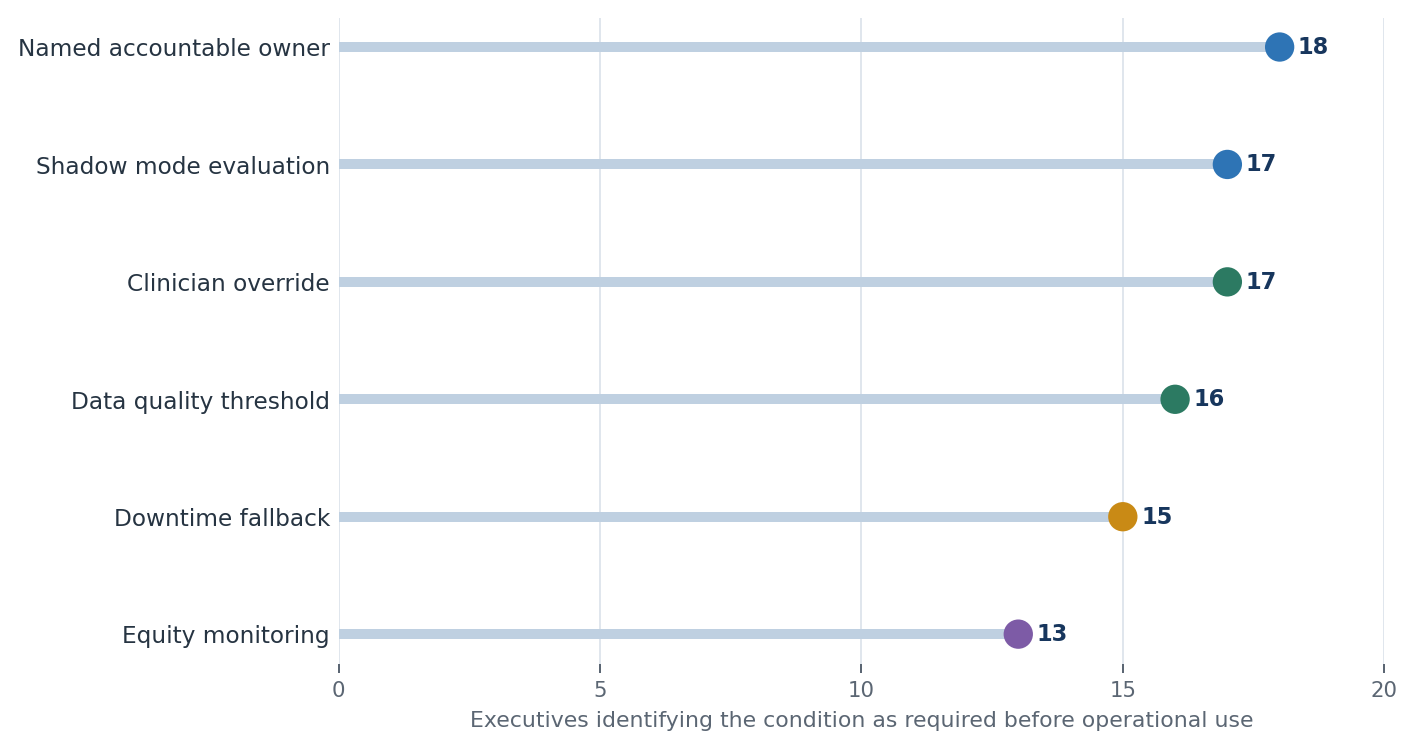
Efficiency was attractive. Unclear accountability was not.
Executives did not require a perfect algorithm. They required a controlled operating model that kept clinical authority visible.
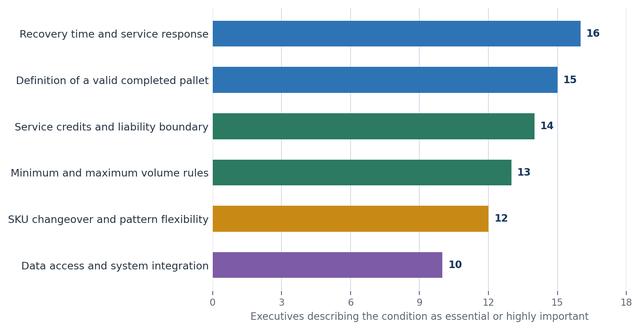
Conditions required before operational use
What the interviews clarified
A recommendation is not an instruction
The tool could propose schedules, but accountable leaders needed visible override and escalation rules.
Evaluation needed patient and workflow measures
Utilisation alone could hide cancellations, overtime, staff burden or inequitable access.
Data quality was an operating control
Missing duration, staffing or bed data had to trigger fallback rather than silent optimisation.
The question beneath the technology
Can the hospital improve schedule quality without making clinical accountability harder to see?
EVALUATION DESIGN
Begin in shadow mode before changing a live schedule
The interviews pointed to an evaluation in which the tool generated recommendations alongside the current process, without controlling the published schedule.
A four stage governance clearance path
Agree intended use, exclusions, success measures and named accountable owner.
Run historical and prospective shadow schedules, recording divergence and exceptions.
Review failures, subgroup effects, operational burden and clinician override patterns.
Approve a narrow operational use only if thresholds and fallback controls are met.
Evaluation scorecard
Dimension | Evidence reviewed | Decision use |
|---|---|---|
Schedule quality | Utilisation, delay, cancellation and overtime | Does the tool improve the whole pathway? |
Clinical control | Overrides, exceptions and disputed recommendations | Are accountable roles still in control? |
Data resilience | Missing fields, drift and fallback events | Can the process fail safely? |
Equity | Variation by specialty, urgency and patient group | Are burdens distributed acceptably? |
DECISION AND DELIVERY
A governed evaluation, not immediate automation
The engagement would support a decision to test the tool in shadow mode while governance, monitoring and override responsibilities were made explicit.
Decision made possible
EVALUATE
Use two specialties with sufficient data and different scheduling pressures.
GOVERN
Create one approval route, named owner and exception process before testing.
DEFER
Do not permit live schedule control until fallback and monitoring thresholds are met.
What the client would receive
- Executive governance map
- Role specific interview guides
- Adoption threshold register
- Shadow mode evaluation design
- Exception and override framework
- Leadership decision briefing
Example delivery plan
WEEK 1
Decision frame and governance map
WEEK 2
Recruitment and interview design
WEEKS 3 TO 4
Executive interviews and coding
WEEK 5
Threshold and evaluation design
WEEK 6
Governance workshop and briefing
Timing is indicative and depends on participant availability, market coverage, disclosure requirements and response time.
Important boundaries
- Executive Interviews provide qualitative, directional insight rather than adoption rates.
- The engagement does not validate algorithm performance or replace clinical, legal, privacy or safety review.
- Participants would not be asked for confidential, proprietary or material non public information.
Contact Us
Assessing an AI enabled hospital workflow?
Tell us the decision, governance roles and hospital context. August Research will help design an independent executive interview programme.