EXECUTIVE INTERVIEWS | EXAMPLE ENGAGEMENT
Defining the Executive Mandate for a Mining Remote Operations Centre
How a mid tier mining company could decide which operational decisions should move to a remote centre, remain at site or be shared.
CLIENT SITUATION
Remote operating model under review
SECTOR
Mining operations
DECISION
Centralise, share or retain
Business background
A hypothetical mining company operated several geographically dispersed sites and was considering a remote operations centre to improve coordination, visibility and specialist support.
The technology case was understandable. The harder question was organisational: which decisions the centre should own, whether sites would accept its authority, and how safety, production and maintenance accountabilities should work during normal and disrupted operations.
The decision to support
CORE QUESTION
Which operational decisions should move to a remote operations centre, and what mandate would allow the centre and mine sites to work without duplicated authority?
Why an external interview programme helped
Site leaders could speak candidly
A neutral moderator could explore loss of autonomy without turning the interview into an organisation debate.
Centre and site logic could be compared
The same operating events were tested with executives who saw different risks and benefits.
Technology bias was reduced
The decision was framed around work, authority and response, not the control room alone.
This is a hypothetical client scenario. Participant counts, findings and recommended actions demonstrate how the engagement could be delivered.
OPERATING AUTHORITY
Selection followed decision rights across the mine
Participants needed authority over production, safety, maintenance, technology or workforce change, plus direct exposure to site operations.
Executive constituency | Count | Decision contribution |
|---|---|---|
Corporate operations executives | 4 | Portfolio performance and operating model |
General managers and site leaders | 6 | Local accountability, execution and acceptance |
Mining, processing and maintenance leaders | 5 | Control tasks, reliability and escalation |
Safety and technical services leaders | 3 | Critical controls and specialist support |
Digital, workforce and finance leaders | 4 | Data, capability, change and investment |
Example scope: 22 interviews across corporate leadership and four mine sites in Australia and Southern Africa. Interview length: 45 to 60 minutes.
Every activity was tested against four operating questions
VISIBILITY
Does the centre see the situation early and accurately?
AUTHORITY
Can it direct action or only advise the site?
RESPONSE
Who acts when conditions depart from plan?
ACCOUNTABILITY
Who remains answerable for the outcome?
How executives were selected
- Formal authority over production, safety, maintenance, digital operations or workforce design.
- Recent experience with disrupted operations, cross site coordination or central technical support.
- Representation from both stronger and less mature sites to prevent one site's readiness from defining the network.
OPERATING READINESS
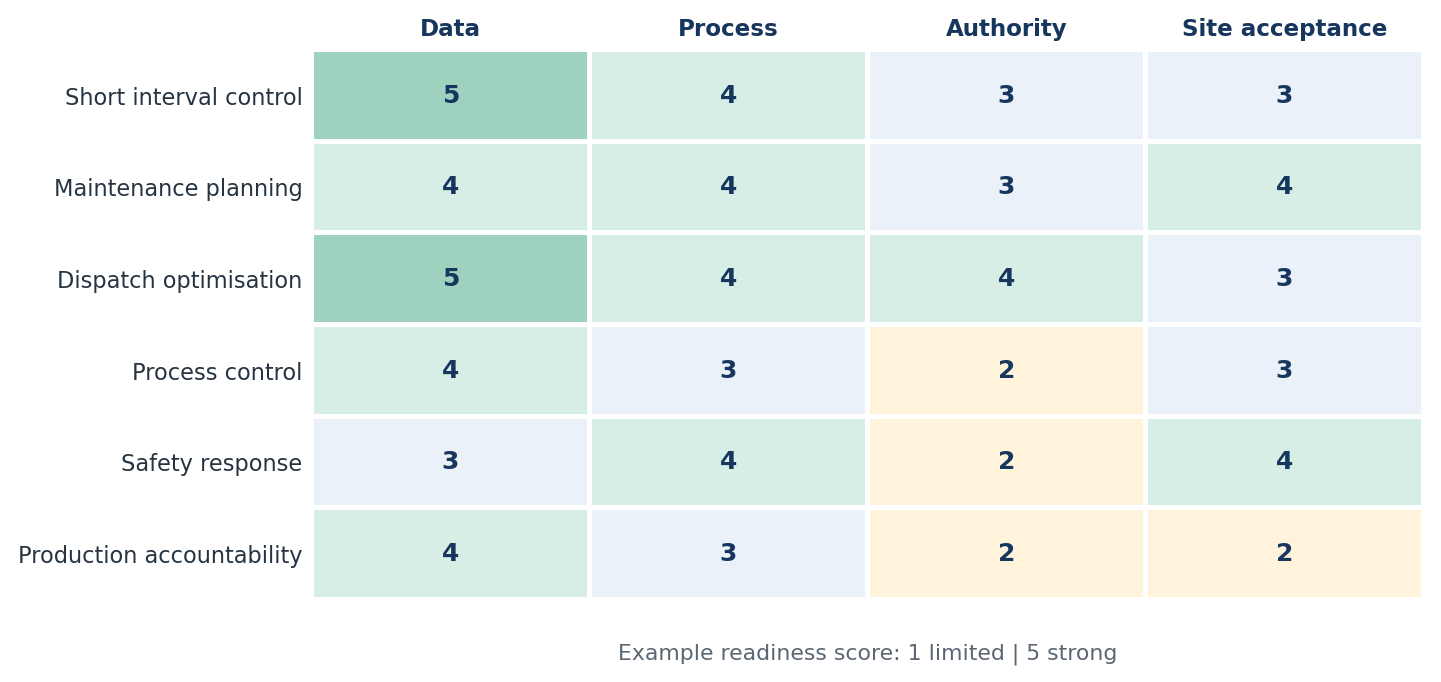
Data readiness was ahead of authority readiness
Several activities could be observed remotely, but executives were less certain about who could direct action and remain accountable.
Readiness by activity
What the pattern suggested
Observe first
Activities with reliable data but unclear authority could begin as advisory support.
Move bounded decisions
Routine optimisation could transfer only when escalation and fallback were explicit.
Keep critical control visible
Safety and production accountability needed named site and centre owners at all times.
The executive tension
How can the company gain cross site coordination without creating a second command structure?
CONTROL MIGRATION
Move decisions in stages, not whole functions
The interviews supported a task by task migration path based on data, repeatability, authority and site acceptance.
Four levels of centre authority
Level | Centre role | Operating rule |
|---|---|---|
1 SEE | Common monitoring | Centre identifies variance; site retains all action authority. |
2 ADVISE | Specialist recommendation | Site acts or records why a recommendation was declined. |
3 COORDINATE | Cross site optimisation | Centre directs bounded scheduling and resource choices. |
4 CONTROL | Defined remote command | Centre controls specified tasks with tested local fallback. |
Escalation design
Operating condition | Default authority | Escalation trigger |
|---|---|---|
Stable operation | Centre within agreed task boundary | Performance leaves approved range |
Data loss or conflict | Site resumes local control | Centre and site views cannot be reconciled |
Safety critical event | Named site incident authority | Immediate critical control response |
OPERATING MODEL DECISION
Build an advisory centre with a clear migration path
The engagement would support an initial mandate focused on visibility and coordination, with selected decisions moving only after readiness and fallback tests.
Mandate by maturity
NOW
Central monitoring, specialist support and cross site coordination.
NEXT
Bounded planning decisions after authority and escalation trials.
LATER
Remote control only where data, capability, trust and fallback are proven.
What the client would receive
- Executive authority map
- Activity readiness heatmap
- Site and centre friction register
- Control migration pathway
- Escalation and fallback framework
- Executive operating model briefing
Example delivery plan
WEEK 1
Operating decision frame
WEEK 2
Site and corporate recruitment
WEEKS 3 TO 4
Executive interviews
WEEK 5
Authority and readiness synthesis
WEEK 6
Mandate workshop and briefing
Timing is indicative and depends on participant availability, market coverage, disclosure requirements and response time.
Important boundaries
- The engagement provides qualitative executive evidence, not a technical ROC design.
- It does not replace safety, control system, workforce, cyber or financial assessment.
- Participants would not be asked for confidential, proprietary or material non public information.
Contact Us
Reframing a remote operations decision?
Tell us the mine network, decisions and executive roles in scope. August Research will help reconstruct the operating mandate.