PROTOTYPE FEEDBACK STUDIES | WORKSITE-FLOW ILLUSTRATION
Can a multi-bay battery dock reduce a worksite interruption?
A hypothetical study for a power-tool team deciding whether a bench prototype merits a trade launch trial.
DECISION
Move to a controlled worksite trial, or revise charging priority, status language and handover flow before release.
Prototype specification
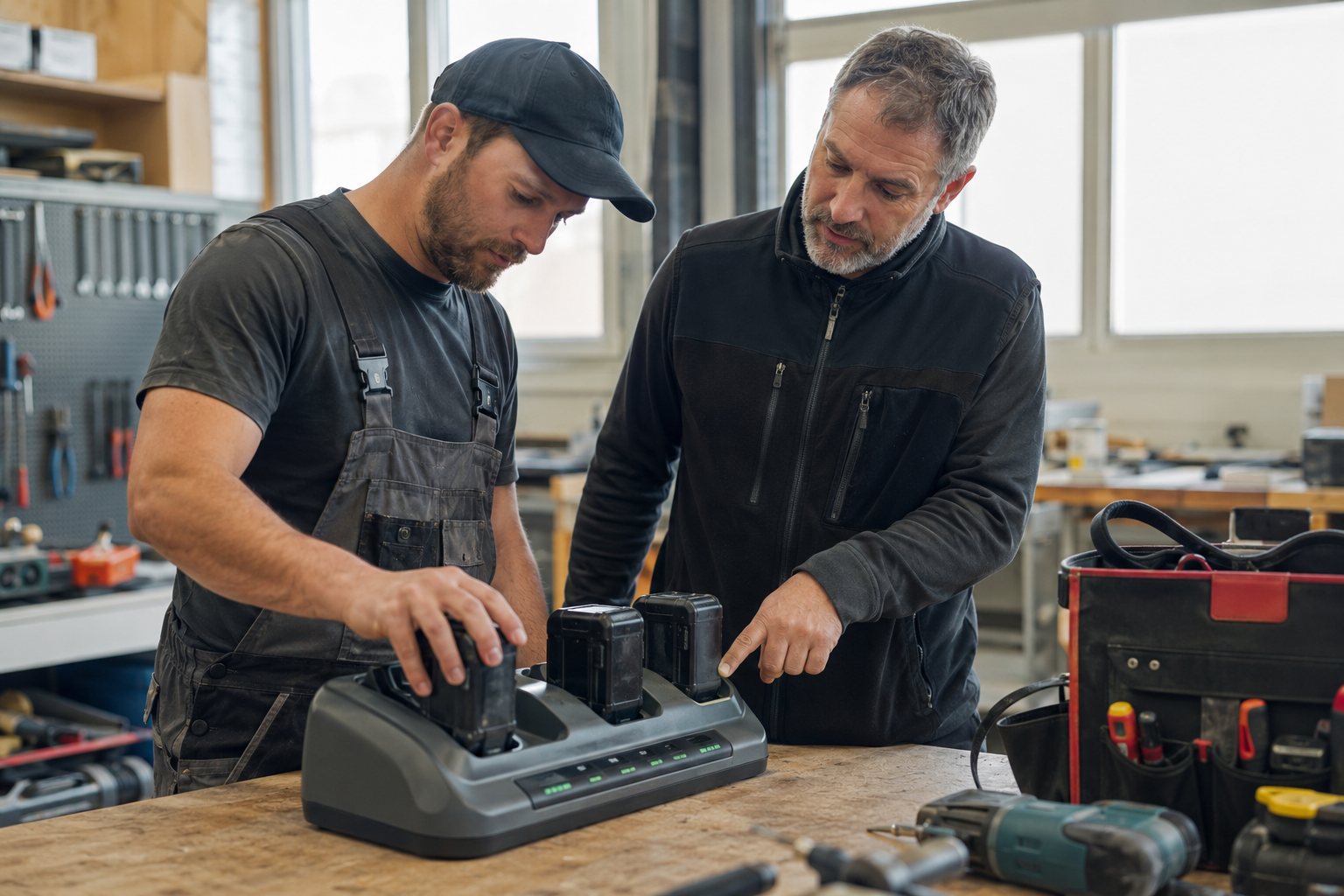
A four-bay dock for one 18 V nominal battery platform, with two simultaneous 6 A charging channels, a 45 W USB-C service port and individual bay indicators. The team is exploring a target recharge time of about 70 minutes for a 5 Ah pack. The prototype makes no final ruggedness, compatibility, warranty or charging-performance claim.
Feedback field
8 electricians, carpenters or general tradespeople; 4 site supervisors; 4 tool-distributor or trade-counter roles; and 3 repair or service technicians who can identify avoidable failure and return pathways.
Worksite interruption ledger
The central question is not “is the dock useful?” It is whether people can make the right charging decision in the few seconds available between tasks.
A depleted pack meets a 15-minute priority job. Which pack is selected, and why?
User reads bay status, charge order and the meaning of a non-ready pack.
A second person needs to understand the current queue without explanation.
The team decides whether the dock prevented downtime or simply moved it.
How the feedback is gathered
Moderated scenario exercises use a timed work sequence, depleted-pack mix and role handover. Facilitators observe first-glance interpretation, charging-priority choices and workarounds. Short trade-counter and service conversations test how the same signals translate beyond the bench.
Feedback Capture and Triangulation
After each timed scenario, participants complete a compact digital or paper scorecard on status clarity, queue confidence and likely workarounds. Short interviews add the operational reason behind the score. The readout triangulates scorecards, observed choices and supervisor, distributor and service perspectives before identifying a change priority.
Numerical lens
Each scenario tracks time-to-correct-bay selection, number of status re-checks and whether a participant can describe the priority rule without prompting. These are illustrative research measures, not promised product-performance outcomes.
Decision-ready output
- Worksite flow brief identifying the moments in which a status signal must be understood instantly.
- Status-language standard for bay indicators, priority states and exception states.
- Charge-priority rules: what the product should decide automatically and what users should control.
- Trade launch trial plan, including practical instrumentation and service observations for the next prototype.
Illustrative Timing
TIMING
3 to 5 weeks from agreed prototype, safety boundary and recruitment brief. Illustrative project assumptions only.
Primary-research timelines are indicative and depend on participant/provider availability, response times, scope complexity and availability of inputs/materials.
Reference Point
This illustration supports product-feedback decisions. Electrical safety, charging compliance, durability and final performance verification require appropriate engineering and test activity outside this study.
Let’s Discuss Your Project
We can shape the prototype, participant mix and decision threshold around the product question that needs resolving next.
Note: This is a hypothetical illustrative engagement. It does not describe a client project or represent client outcomes.