R&D & INNOVATION / SECONDARY RESEARCH
Construction-Product Passport Readiness for Façade Systems
Regulatory & Standards Intelligence | Construction products, product data and circularity
DECISION QUESTION What product, performance, environmental and supply-chain information should a façade-system manufacturer structure now for the new EU Construction Products Regulation and its future digital product passport?
The situation
A European manufacturer sells insulated façade panels, fixings, sealants and accessory kits across several Member States. Its product data is split among declarations, ERP records, product sheets, EPD files, supplier certificates and plant-level quality records. The business must modernise its data architecture without treating fields from a future delegated act as final requirements.
Why the decision is difficult
- A passport is not simply a new PDF. Product identity, variant logic, declared performance, instructions, environmental information and access rights must remain linked as records change.
- The new CPR, Regulation (EU) 2024/3110, coexists with a transition from the earlier CPR framework. Applicability depends on harmonised technical specifications, product families and future implementation acts.
- Incorrectly merging panel, adhesive or fixing variants can create a traceability problem; over-splitting every SKU can create an unmanageable passport estate.
WORKING PREMISE The objective is a controlled readiness architecture: identify stable data obligations, expose lineage gaps and design update rules, while keeping future DPP fields explicitly conditional.
REGULATORY CONTEXT AND DECISION BOUNDARY
The regulatory direction is clear, but implementation is staged
Regulation (EU) 2024/3110 establishes the new framework for construction products and provides for a construction digital product passport system to be created through delegated acts. The passport is expected to carry key compliance and product information, including declarations, safety information and instructions. The precise operational data model must therefore be monitored rather than invented.
Legal framework: Regulation (EU) 2024/3110
Implementation context: European Commission Construction Products Regulation page
The Commission’s first CPR Working Plan 2026–2029 connects implementation with product-family priorities, standardisation and DPP preparation. The EU Digital Product Passport registry went live in July 2026, but construction-product obligations remain tied to the CPR implementation route and future delegated acts. Readiness should therefore separate reusable data foundations from fields that still require legal confirmation.
Current work programme: First CPR Working Plan 2026–2029
Digital infrastructure update: European Commission DPP registry announcement
What the study does not assume
- It does not assume that one passport automatically covers every thickness, facing, adhesive, plant or performance class.
- It does not convert proposed or expected fields into a legal requirement before the relevant act or technical specification is adopted.
- It does not replace notified-body work, product testing, environmental verification or legal interpretation.
DECISION BOUNDARY The work tells the manufacturer what information can be normalised now, where evidence provenance is weak, and which future regulatory events should trigger a data-model change.
HOW THE RESEARCH IS EXECUTED
A product-family and data-lineage method
1. PORTFOLIO DECOMPOSITION Map panel, fixing, membrane, sealant and accessory families by intended use, harmonised route, manufacturing site, declared characteristics and commercial variant.
2. REGULATORY TRANSITION MAP Trace the old and new CPR routes, relevant harmonised technical specifications or EADs, Commission working-plan priorities, delegated acts and standardisation activity.
3. INFORMATION-OBJECT INVENTORY Identify declarations, CE records, installation instructions, safety information, EPD/LCA records, supplier certificates, test reports and master-data fields.
4. VARIANT AND IDENTIFIER LOGIC Test whether changes in thickness, facing, core, coating, adhesive, production site or performance class require a separate identity, relationship or controlled update.
5. FIELD-LEVEL PROVENANCE For each candidate field, record the source, owner, verification status, geography, language, update frequency and affected product family.
6. ACCESS AND DISCLOSURE DESIGN Separate public, customer, installer, authority and restricted supply-chain information. Flag confidentiality and personal-data concerns.
7. READINESS GRADING Score availability, consistency, machine readability, verification and change control. Unknown future obligations remain conditional rather than lowering every score.
8. TRIGGER PLAN Assign monitoring events for delegated acts, harmonised specifications, Commission guidance, standards and product-data changes.
TECHNICAL SCOPE AND RESEARCH PARAMETERS
Hypothetical portfolio boundary
Portfolio element | Planning scope | Research question |
|---|---|---|
Insulated panels | 3 families, 24 variants, 2 plants | Which characteristics and site dependencies control identity and declaration links? |
Sealants and adhesives | 2 chemistries, 11 variants, 4 suppliers | Which formulation, hazard, performance and supplier changes require record updates? |
Fixings and accessories | 18 components across 5 kits | How should component records relate to a marketed system without losing traceability? |
Geographic coverage | 8 EU markets and 6 languages | Which instructions, declarations and market-facing records require language control? |
Candidate fields | 96 fields from 41 source documents | Which fields are stable, duplicated, unverified, missing or dependent on future acts? |
Fields examined
Data domain | Examples |
|---|---|
Identity and responsibility | Product, variant, batch or serial logic, economic operator, plant, version and status. |
Performance and conformity | Intended use, declared characteristics, assessment route, declaration link and supporting technical record. |
Safety and use | Installation, maintenance, safe-use, disassembly and end-of-life instructions. |
Environmental information | Declared environmental indicators, EPD/LCA provenance, recycled content and evidence boundary. |
Governance | Field owner, verification authority, confidentiality, language, revision date and update trigger. |
RESEARCH BOUNDARY The output is a readiness and information-governance plan. It is not a digital-passport software implementation, product certification, EPD verification or declaration of conformity. | |
EXAMPLE OUTPUT
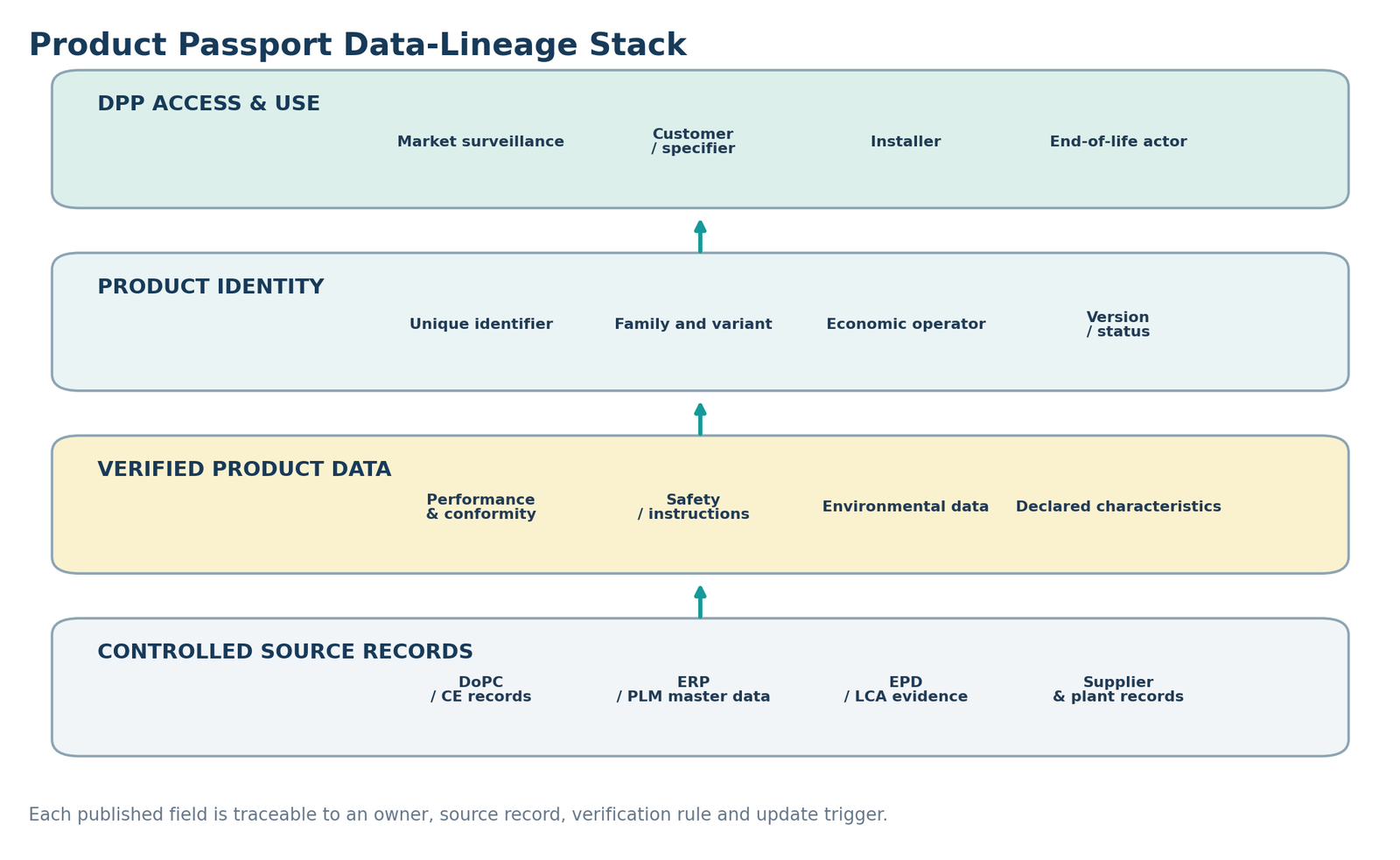
The Product Passport Data-Lineage Stack
The output follows information upward from controlled source records to verified product data, product identity and authorised use. It makes a missing lineage visible: a field cannot be treated as passport-ready merely because it exists in a brochure or spreadsheet.
How the stack supports a decision
- A declared fire-performance value is linked to its product family, test or assessment record, declaration version and plant or variant boundary.
- An environmental indicator is not published without its study boundary, verification status, unit and update rule.
- A supplier formulation change triggers review of the affected sealant records rather than a blanket update to every façade-system passport.
WEBSITE PRESENTATION SUGGESTION Use a four-layer interactive stack. Selecting a data object should reveal its source, owner, verification status, affected products and next regulatory trigger. A side filter can switch between panels, chemicals, fixings and system kits.
FINDINGS, DELIVERY AND DECISION OUTPUTS
Example findings and recommended actions
Finding | Hypothetical indication | Recommended action |
|---|---|---|
Reusable data foundation | 63 of 96 candidate fields have an identified owner and controlled source. | Normalise these fields first and retain links to the underlying record. |
Variant logic is incomplete | Nine marketed kits combine components with different update cycles. | Create parent-child relationships and explicit substitution rules. |
Environmental lineage varies | Four EPD records use different boundaries or revision dates. | Preserve methodology metadata and prevent unsupported comparisons. |
Future fields remain conditional | Twenty-one fields depend on future acts or specifications. | Maintain a monitored placeholder with trigger, owner and legal status. |
What the client receives
- A CPR transition and applicability register by product family and market.
- A field-level passport data dictionary with source, owner, status, access class and update rule.
- A product-family and variant relationship model, readiness scorecard and gap-remediation backlog.
- A regulatory and standards watchlist tied to explicit change triggers.
Indicative project delivery
A focused engagement could take approximately six to eight weeks. Week 1 defines the portfolio; weeks 2 and 3 reconstruct the regulatory and standards route; weeks 3 to 5 map product families, records and fields; and weeks 6 to 8 complete the lineage stack, governance model and management workshop. Delivery may include a Word report, Excel data dictionary and PowerPoint decision brief.
TIMELINE NOTE: This is a hypothetical planning range. Actual timing depends on portfolio complexity, document availability, language coverage, data ownership and the response time of internal and external record holders.
Let’s discuss your project
If product information is distributed across engineering, quality, sustainability and commercial systems, August Research can turn the upcoming CPR requirements into a prioritised data-readiness programme.
Note:
This is a hypothetical engagement. The regulatory framework and implementation status are based on official information available on 25 August 2026. The company, portfolio, counts, findings and timeline are examples. A live project would be refreshed against the latest delegated acts, harmonised specifications and Commission guidance. The work supports planning and does not constitute legal advice, certification or a conformity determination.