R&D & INNOVATION / SECONDARY RESEARCH
Euro 7 Readiness for a Battery-Electric Commercial Van
Regulatory & Standards Intelligence | Commercial vehicles, braking systems and tyres
DECISION QUESTION Should an N1 battery-electric delivery-van programme lock its brake specification, begin emissions evidence work and reserve tyre alternatives now, or wait for later Euro 7 and C2 tyre-abrasion milestones?
The situation
A vehicle manufacturer is preparing a battery-electric delivery van for an EU launch in the second half of 2027. The platform uses blended regenerative and friction braking, two brake-corner packages, two wheel sizes and several C2 tyre options. Procurement wants to nominate suppliers, engineering wants to freeze the braking package, and homologation needs a defensible evidence plan.
The timing has become more urgent. Euro 7 applies to new N1 vehicle types from 29 November 2026 and to new N1 vehicles from 29 November 2027. In July 2026, the European Commission published Implementing Regulation (EU) 2026/1762, setting the procedures, test methodologies and administrative requirements for M1 and N1 brake-particle emissions. The brake pathway is therefore moving from general obligation to executable type-approval work, while the C2 tyre-abrasion pathway remains less mature.
Why this is a real engineering decision
- Regenerative braking reduces routine friction-brake use, but friction braking remains necessary during low-speed stops, stability-control events, emergency braking, limited battery acceptance and other operating conditions.
- A pad, disc, caliper, wheel, tyre or control-calibration change may affect several approval families, supplier contracts and validation activities rather than one isolated component.
- The vehicle launch clock, brake test route and C2 tyre-abrasion clock do not mature at the same time. Waiting for complete certainty could compress sourcing and validation lead time.
WORKING PREMISE The research does not predict laboratory results. It establishes what is legally fixed, what is technically executable, what remains under development and which engineering choices should be committed, protected or monitored.
REGULATORY FACTS SHAPING THE DECISION
The brake route is now defined for M1 and N1 vehicles
Regulation (EU) 2024/1257 introduced Euro 7 limits for non-exhaust emissions, including brake particles and tyre abrasion. For a pure-electric M1 or N1 vehicle other than N1 Class III, the adopted brake PM10 limit is 3 mg/km per vehicle. N1 Class III vehicles have a different limit, so the vehicle classification and reference-mass boundary must be confirmed before the requirement is assigned.
Legal framework and limits: Regulation (EU) 2024/1257
Commission Implementing Regulation (EU) 2026/1762 now provides the M1 and N1 brake-emissions type-approval procedures and uses UN Regulation No 179 as the technical route. It addresses approval documentation, brake-system families, conformity of production and optional in-service conformity activities. This materially changes the decision: the team can now build a method-aligned evidence plan instead of waiting for a generic future standard.
Current brake implementation route: Commission Implementing Regulation (EU) 2026/1762
Underlying laboratory methodology: UN GTR No. 24 on laboratory measurement of brake emissions
The C2 tyre route has a fixed commercial date but developing technical content
Euro 7 applies its tyre-abrasion requirements to new C2 tyre types from 1 April 2030 and to new C2 tyres placed on the market from 1 April 2032. However, the international work programme has developed first around C1 tyres, while C2 and C3 methods and limits continue through later technical work. The research must therefore separate the statutory date from the maturity of the method and limit-setting process.
Current international tyre-abrasion development: UNECE work on tyre-abrasion measurement and limits
CRITICAL DISTINCTION A future application date does not justify ignoring the issue, and an active standards programme does not justify presenting an unsettled C2 threshold as final. The output assigns separate actions to the brake and tyre workstreams.
HOW THE RESEARCH IS EXECUTED
A requirement-to-engineering commitment method
The work begins with the product decision, not a generic summary of Euro 7. Each legal provision or standards milestone is traced through vehicle classification, brake-system family, control strategy, supplier evidence, approval documentation and programme timing. The method is designed to answer what can be frozen now and what needs a protected option.
1. VEHICLE AND TYRE CLASSIFICATION Confirm N1 class, reference mass, powertrain, tyre class, wheel and brake variants, approval route and launch dates. Classification assumptions are recorded before any threshold is assigned.
2. LEGAL-CLOCK RECONSTRUCTION Separate dates for new vehicle types, all new vehicles, brake-system approval, C2 new tyre types and C2 market placement. Proposed or review-dependent provisions are labelled separately.
3. BRAKE-METHOD DECOMPOSITION Extract the family definitions, test sequence, instrumentation, friction-brake share treatment, calculation logic, documentation and conformity controls in the current EU and UN texts.
4. PRODUCT ARCHITECTURE LINKAGE Connect pads, discs, calipers, axle loads, wheel size, regenerative-braking strategy, stability control and vehicle variants to the approval and evidence questions they may change.
5. SUPPLIER EVIDENCE INTERROGATION Compare supplier declarations, material descriptions, bench or vehicle data, tyre-abrasion information and change-control terms against the required decision fields.
6. EVIDENCE-GAP GRADING Classify each issue as fixed requirement, executable method, supplier-dependent evidence, developing standard or unresolved interpretation. A missing record is not treated as a failed test.
7. ENGINEERING COMMITMENT ANALYSIS Score regulatory certainty and engineering consequence separately. Lock mature high-consequence decisions, prepare options for uncertain high-consequence decisions and monitor low-consequence items.
8. TRIGGER-BASED WATCH Define the publication, amendment, supplier-data or programme event that would move each decision. The monitoring list has owners and dates rather than a broad news alert.
TECHNICAL PROJECT BOUNDARY
A scoped N1 commercial-vehicle programme
The hypothetical boundary below makes the research operational. The counts are planning assumptions, not claims about a completed client project. In a live engagement they would be replaced by the vehicle programme, supplier and approval records.
Programme element | Hypothetical scope | Decision relevance |
|---|---|---|
Vehicle platform | 1 N1 Class II BEV with 3 wheelbase and payload variants | Confirms the applicable vehicle category, launch clock and variant coverage. |
Brake architecture | 2 front brake-corner packages, 1 rear package and 3 control calibrations | Tests whether component or calibration changes create separate evidence or approval implications. |
Operating states | 12 load and battery-condition cases prioritised for friction-share review | Identifies where friction braking may increase despite a regenerative architecture. |
Tyre portfolio | 4 C2 tyre families across 2 wheel sizes and 3 suppliers | Creates a supplier evidence and substitution plan ahead of the C2 abrasion pathway. |
Launch footprint | 6 EU markets with one planned type-approval route | Aligns commercial timing with the new-type and all-new-vehicle dates. |
Evidence inventory | 38 regulatory, technical, supplier and programme records | Provides a controlled source set with status, date, owner and next trigger. |
Technical parameters extracted from the research
Parameter group | Fields carried into the analysis |
|---|---|
Brake system | Pad and disc combination, axle allocation, effective radius, brake family, friction material, cooling arrangement and change history. |
Vehicle controls | Regenerative-braking availability, blended-braking logic, low-speed transition, battery acceptance limits, ABS and stability-control intervention. |
Test and evidence | Applicable cycle, measurement route, PM10 result structure, friction share, family extension logic, conformity records and approval documentation. |
Tyres | C2 classification, dimension, load and speed indices, tread formulation, mass-loss evidence, supplier method, production site and planned change controls. |
Programme | Design freeze, supplier nomination, prototype build, test-slot reservation, approval submission, start of production and market launch. |
RESEARCH BOUNDARY Secondary research can define the applicable evidence route and reveal where test or supplier data is missing. It does not replace brake-emissions testing, tyre-abrasion testing, type approval or the engineering judgement of the vehicle manufacturer and its appointed technical service.
EXAMPLE OUTPUT
The Engineering Commitment Map
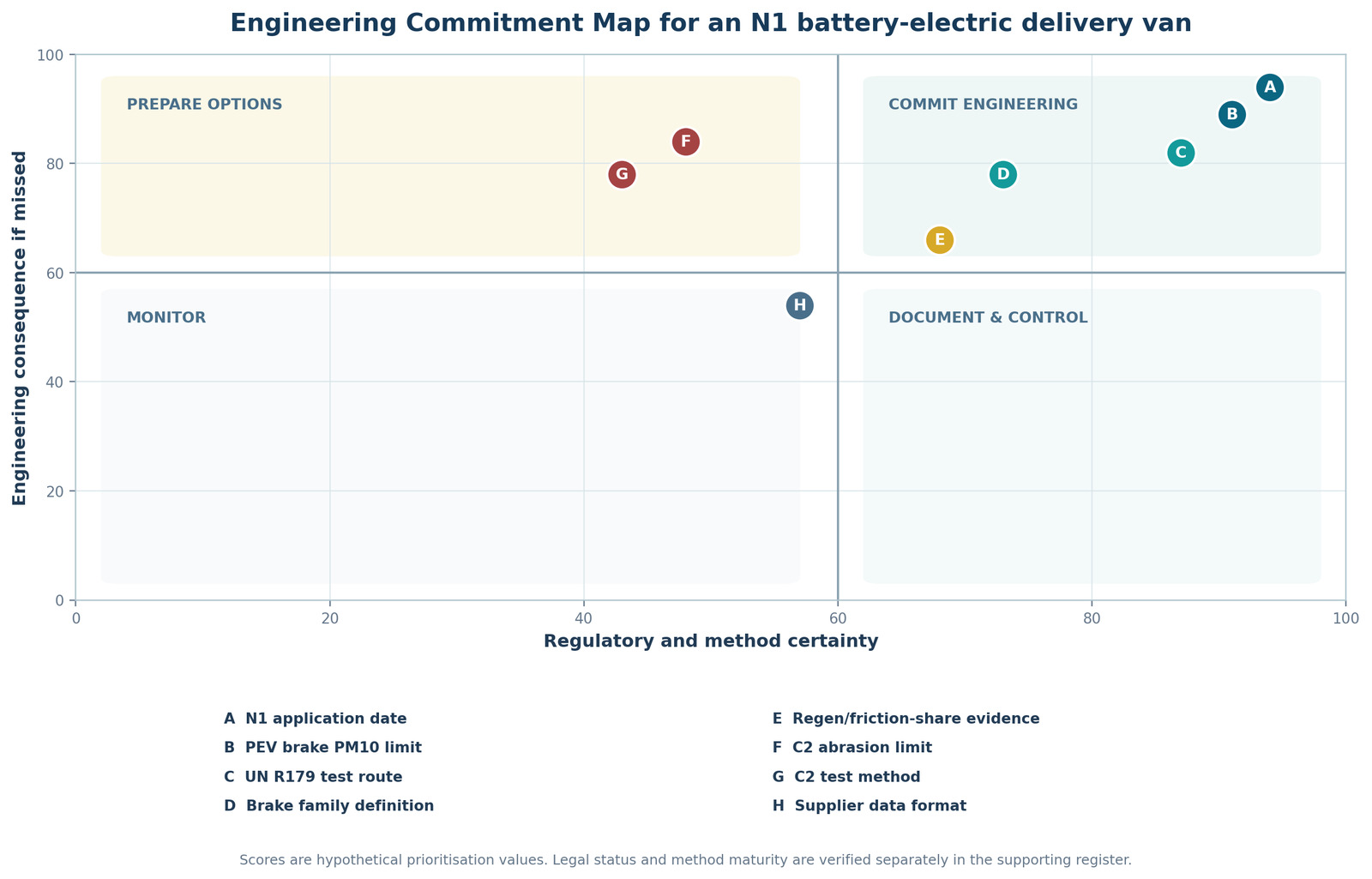
The output plots each requirement or dependency against two different questions: how certain is the current regulatory or method position, and how costly would it be to discover the issue late? This avoids reducing readiness to one percentage and prevents an uncertain but high-consequence tyre issue from disappearing behind a mature brake requirement.
What the map indicates
- The N1 application date, PEV brake limit and M1/N1 test route sit in the commit-engineering zone. They are mature enough to drive the evidence plan and brake-system decision now.
- Brake-family definition and regenerative/friction-share evidence require early programme ownership because late changes could expand testing or documentation even where the nominal hardware is unchanged.
- C2 abrasion method and limit questions sit in prepare-options. Their technical content is less settled, but supplier nomination and tyre substitution lead times make passive monitoring insufficient.
- Supplier data format remains a controlled documentation issue. The action is to standardise the request and change-notification fields rather than claim that a final C2 compliance conclusion is already possible.
WEBSITE PRESENTATION SUGGESTION Present the map as an interactive quadrant. Selecting a point should open its current status, official source, affected component, hypothetical programme consequence and next trigger. Filters can switch between Brake, Tyre, Supplier and Programme views. On mobile, show the four action zones as stacked cards with the highest-consequence item first.
FINDINGS, DELIVERY AND DECISION OUTPUTS
Example findings and recommended actions
Finding | Hypothetical evidence | Recommended action |
|---|---|---|
Brake evidence can begin now | The N1 class, PEV limit and EU test route are identifiable. | Confirm brake families and reserve a method-aligned pre-test and approval programme. |
Calibration affects evidence | Three blended-braking calibrations change friction-brake use. | Create a friction-share matrix and control calibration changes through the approval plan. |
Supplier record is incomplete | Pad wear data is not mapped to the nominated vehicle brake family. | Request variant, method, result, production-site and change-control fields. |
C2 tyres need options | Comparable C2 abrasion evidence is inconsistent while the method develops. | Retain two acceptable tyre routes and set evidence-refresh gates before final nomination. |
What the client receives
- A dated brake and C2 tyre obligation register separating adopted requirements, executable methods, developing work and open questions.
- A vehicle, brake and tyre applicability map covering variants, families, calibrations, suppliers and programme gates.
- A method-decomposition workbook and Engineering Commitment Map with source, rationale, owner, trigger and recommended action.
- A supplier evidence request and monitoring protocol for brake amendments, C2 methods and abrasion limits.
Indicative project delivery
A focused engagement could run for approximately five to six weeks. Week 1 defines the vehicle boundary; weeks 2 and 3 reconstruct the legal and technical route; weeks 3 and 4 map product and supplier evidence; and week 5 develops the commitment map, action plan and management readout. Delivery may include a PowerPoint decision brief, Excel registers and a Word report.
TIMELINE NOTE: The timing is a hypothetical planning range. Actual delivery depends on portfolio breadth, access to vehicle and supplier records, language coverage, standards availability, and the response time of internal and external evidence holders.
Let’s discuss your programme
If an upcoming regulation is approaching faster than its supporting technical pathway, August Research can structure the evidence, engineering dependencies and monitoring triggers around the decisions your programme must make now.
Note:
This is a hypothetical engagement. The legal dates, brake-emissions framework and standards status are based on official information available on 25 August 2026. The company, platform, counts, findings, scores, actions and timeline are examples. A live project would be refreshed against the latest legal text, UNECE documents and client evidence. The work supports decision-making and does not constitute legal advice, type approval, certification or a conformity determination.