R&D & INNOVATION / SECONDARY RESEARCH
EU Joint Clinical Assessment Readiness for an Oncology ATMP
Regulatory & Standards Intelligence | Advanced therapies, evidence strategy and EU HTA
DECISION QUESTION Can the planned evidence package for an allogeneic CAR-T therapy answer plausible EU assessment scopes across populations, comparators and outcomes without confusing joint clinical assessment with national reimbursement decisions?
The situation
A biotechnology company is preparing an allogeneic CAR-T therapy for adults with relapsed or refractory large B-cell lymphoma. The pivotal programme includes a single-arm cohort, supportive comparative analyses and extended safety follow-up. Clinical development, regulatory and market-access teams need a shared view of likely evidence pressure before the dossier is fixed.
Why the decision is difficult
- Cancer medicines and advanced therapy medicinal products have been subject to EU joint clinical assessment since 12 January 2025.
- Assessment scopes can contain multiple PICOs reflecting different Member State populations, clinical pathways, comparators and outcomes.
- Single-arm evidence, evolving standards of care, treatment switching, immature survival and sparse quality-of-life data may create different gaps across different PICOs.
WORKING PREMISE The research translates the current EU HTA process and methodology into an evidence-coverage plan. It does not predict the final assessment scope or the national appraisal outcome.
CURRENT EU HTA CONTEXT
One EU clinical assessment, followed by national decisions
Regulation (EU) 2021/2282 applies from 12 January 2025. New active substances for cancer and advanced therapy medicinal products enter the joint clinical assessment pathway. The JCA evaluates relative clinical effects, while Member States retain their national appraisal, pricing and reimbursement responsibilities.
EU implementation overview: European Commission HTA implementation page
JCA scope and process: European Commission joint clinical assessments page
Commission Implementing Regulation (EU) 2024/1381 defines procedural rules for medicinal-product JCAs, including interactions, dossier submission and involvement of patients and clinical experts. Current EU methodology also addresses outcomes, subgroup and sensitivity analyses, and direct and indirect comparisons. These sources can be converted into planning questions, but they do not justify inventing a final PICO.
Procedural rules: Commission Implementing Regulation (EU) 2024/1381
Evidence-synthesis guidance: EU HTA quantitative evidence synthesis guideline
Planning distinction
- JCA readiness asks whether comparative clinical evidence can address the assessment scope. It does not set a price or replace country-specific economic and policy assessment.
- Likely PICOs are planning scenarios built from clinical pathways and current comparators. They are not presented as the final EU scope.
- A gap can be mitigated by analysis, external data, protocol change or transparent uncertainty management. Not every gap requires a new randomised trial.
DECISION BOUNDARY The study identifies which evidence choices remain changeable before dossier lock and which uncertainties require an explicit mitigation narrative.
HOW THE RESEARCH IS EXECUTED
A PICO-to-evidence stress test
1. INDICATION AND PATHWAY DEFINITION Fix the intended indication, line of therapy, eligibility, conditioning regimen, bridging treatment and expected place in the treatment pathway.
2. ASSESSMENT-SCOPE SCENARIOS Construct plausible population, intervention, comparator and outcome combinations from current clinical pathways and official scoping logic. Label them as planning scenarios.
3. COMPARATOR SURVEILLANCE Track guidelines, HTA decisions, labels, trials and adoption signals for autologous CAR-T, bispecific antibodies, salvage regimens and other relevant options.
4. OUTCOME MAPPING Map OS, PFS, response, duration, HRQoL, adverse events, hospitalisation and long-term safety by definition, follow-up, estimand and data maturity.
5. STUDY-DESIGN APPRAISAL Review randomisation, single-arm limitations, crossover, treatment switching, missing data, subgroup power and follow-up adequacy.
6. COMPARATIVE-METHOD REVIEW Assess direct comparison, matching-adjusted comparison, propensity methods, synthetic controls and network routes against overlap, exchangeability and bias assumptions.
7. COVERAGE GRADING Grade every PICO and evidence module as direct, indirect, weak or absent. Record the reason rather than collapsing the project into one readiness percentage.
8. MITIGATION AND TRIGGER PLAN Prioritise protocol changes, data cuts, analyses, external-data acquisition, consultation questions and competitor events that would change the plan.
TECHNICAL PROJECT BOUNDARY
Hypothetical evidence programme
Element | Planning scope | Assessment relevance |
|---|---|---|
Population | Adults with R/R LBCL after at least two prior lines | Creates eligibility, prior-treatment and subgroup boundaries. |
Intervention | Allogeneic CD19 CAR-T with lymphodepletion | Defines treatment, manufacturing and follow-up context. |
Comparator families | Autologous CAR-T, bispecific antibody and salvage systemic therapy | Tests whether one evidence route can support several current-care scenarios. |
Clinical evidence | 1 pivotal single-arm cohort, 2 supportive cohorts and 3 external-data candidates | Exposes dependence on comparability and indirect methods. |
Planning matrix | 6 PICO scenarios, 9 outcomes and 22 candidate analyses | Makes gaps visible before dossier lock. |
Technical parameters examined
Domain | Parameters |
|---|---|
Population | Line of therapy, refractory definition, prior CAR-T or bispecific exposure, age, frailty, risk group and geography. |
Comparators | Eligibility, treatment era, bridging therapy, access constraints, crossover and subsequent treatment. |
Outcomes | Definition, assessment schedule, censoring, follow-up, maturity, missingness, clinical relevance and multiplicity. |
Indirect evidence | Overlap, effect modifiers, prognostic factors, anchoring, residual confounding and sensitivity analyses. |
Evidence currency | Guideline changes, competitor readouts, authorisations, JCA publications and national pathway changes. |
RESEARCH BOUNDARY This is secondary evidence and policy intelligence. It does not replace statistical analysis-plan ownership, regulator or HTA-body consultation, clinical development decisions or a formal JCA submission. | |
EXAMPLE OUTPUT
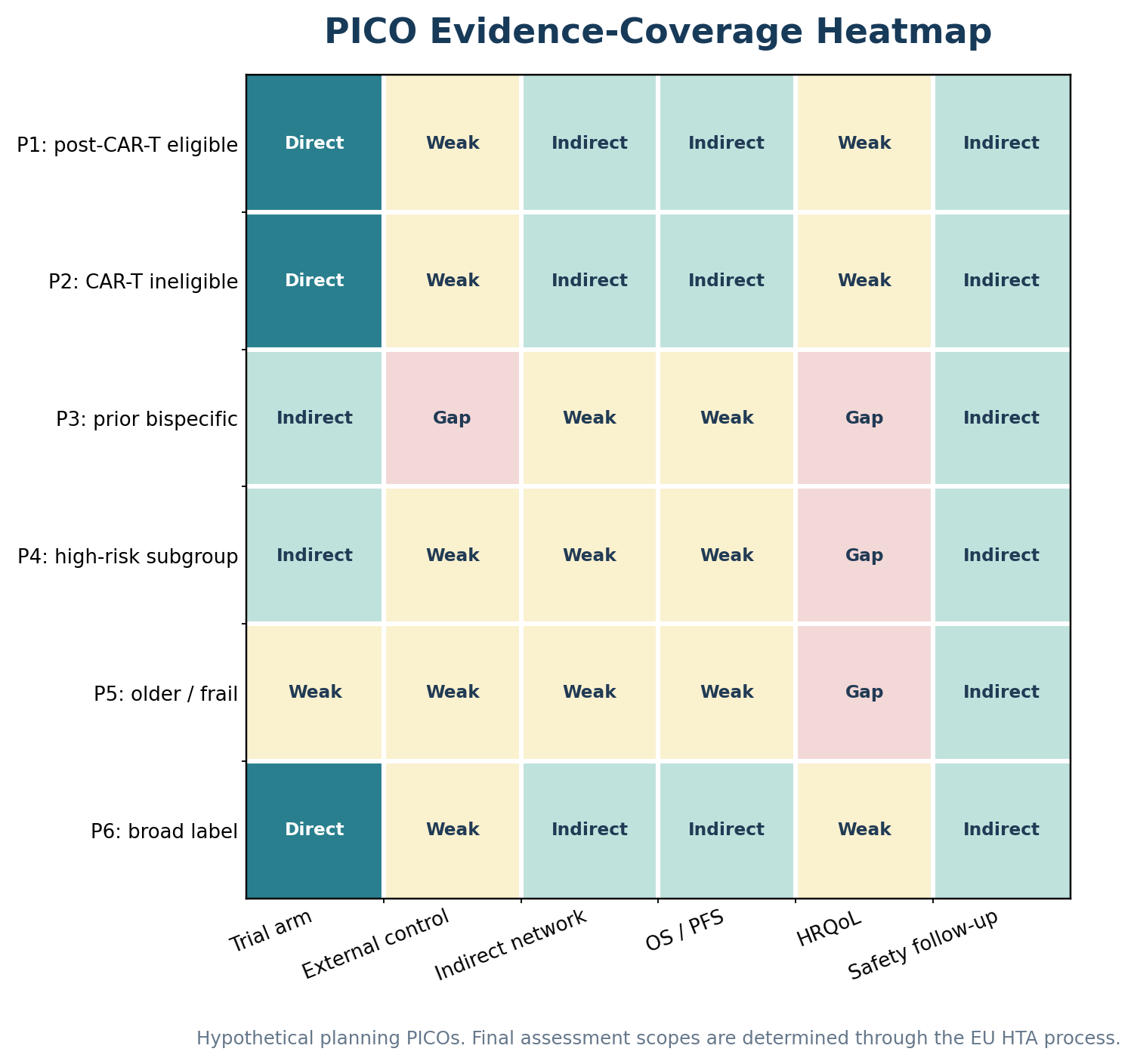
The PICO Evidence-Coverage Heatmap
The heatmap prevents a strong overall trial narrative from hiding a weak comparator- or subgroup-specific question. Each cell links to the study, analysis, assumption, uncertainty and mitigation action behind its status.
What the heatmap indicates
- The pivotal cohort directly describes the treated population but does not create a direct comparative estimate.
- External controls may help for selected populations, but treatment-era, eligibility and outcome-definition differences require explicit diagnostics and sensitivity analysis.
- HRQoL is a recurrent weak point because instrument completion, baseline availability and follow-up may not match survival data maturity.
- Prior bispecific exposure and older or frail populations need a separate evidence plan rather than an unsupported extrapolation from the broad cohort.
WEBSITE PRESENTATION SUGGESTION Display the heatmap as a filterable matrix. Selecting a cell should open the PICO assumption, available evidence, methodological risk, mitigation action and next data or policy trigger. Tabs can switch between populations, comparators, outcomes and analyses.
FINDINGS, DELIVERY AND DECISION OUTPUTS
Example findings and recommended actions
Finding | Hypothetical indication | Recommended action |
|---|---|---|
Comparative evidence is uneven | Three of six planning PICOs rely mainly on external or indirect evidence. | Pre-specify feasibility diagnostics and retain more than one comparator route. |
HRQoL needs intervention | Five scenarios have weak patient-reported outcome coverage. | Protect instrument completion and define missing-data sensitivity analyses. |
Treatment pathway is moving | Bispecific use may alter prior-treatment mix and comparator relevance. | Set a pathway-surveillance trigger and refresh PICOs before dossier lock. |
Subgroups need discipline | Older, frail and high-risk groups have limited effective sample size. | Separate descriptive, inferential and exploratory subgroup claims. |
What the client receives
- A dated EU HTA process and methodology register tailored to the programme.
- A planning PICO library with rationale, comparator sources, outcomes and uncertainty flags.
- A study-to-PICO evidence map, heatmap and mitigation backlog.
- A competitor, guideline and JCA watchlist with evidence-plan triggers.
Indicative project delivery
A focused engagement could run for approximately seven to nine weeks. Week 1 confirms the development and decision boundary; weeks 2 and 3 build the policy, pathway and comparator map; weeks 3 to 6 develop the PICO scenarios and evidence inventory; and weeks 7 to 9 complete the coverage analysis, mitigation workshop and executive readout. Delivery may include a Word report, Excel evidence matrix and PowerPoint decision brief.
TIMELINE NOTE: This is a hypothetical planning range. Actual timing depends on indication complexity, access to protocols and data summaries, the number of comparator markets, evidence maturity and the response time of clinical, regulatory and access stakeholders.
Let’s discuss your project
If a development programme has a compelling clinical story but an uncertain comparative route, August Research can show exactly where the EU HTA evidence pressure is likely to concentrate and which choices remain actionable.
Note:
This is a hypothetical engagement. The EU HTA process and methodology are based on official information available on 25 August 2026. The company, therapy, PICOs, counts, findings and timeline are examples. Final assessment scopes are determined through the applicable EU process, and national authorities retain their own appraisal and reimbursement responsibilities. The work is research support and does not constitute regulatory, statistical, legal or reimbursement advice.