R&D & INNOVATION / SECONDARY RESEARCH
FRMCS Migration Intelligence for a Cross-Border Rail Fleet
Regulatory & Standards Intelligence | Rail communications, rolling stock and ERTMS
DECISION QUESTION How should a freight operator prepare a mixed locomotive fleet for FRMCS while preserving GSM-R interoperability, controlling retrofit risk and avoiding premature specification lock-in?
The situation
A rail freight operator manages 120 locomotives across five European corridors and nine countries. The fleet contains several GSM-R cab-radio and ETCS baselines, different antenna arrangements and varied remaining asset lives. Procurement needs an investment sequence while engineering and authorisation teams need to understand which interfaces can be prepared before the complete FRMCS implementation package is stable.
Why the decision is difficult
- FRMCS is the 5G-based successor to GSM-R, but network and vehicle migration will not occur everywhere at the same time.
- Cross-border operation makes national deployment timing, roaming, coexistence and route access as important as the onboard radio itself.
- A retrofit may affect telecom architecture, ETCS data transport, cab voice, antennas, cybersecurity, vehicle configuration and authorisation evidence.
WORKING PREMISE The research separates stable architectural preparation from specification-dependent procurement. It creates a corridor and fleet decision model rather than guessing one Europe-wide replacement date.
CURRENT FRMCS CONTEXT
FRMCS is part of the European railway radio framework
The European Commission describes Railway Mobile Radio as comprising GSM-R and FRMCS. FRMCS is based on 5G and is intended to succeed GSM-R, supporting the digitalisation of rail. The CCS TSI established by Commission Implementing Regulation (EU) 2023/1695 provides the interoperability framework, while technical specifications and validation continue to evolve.
European system overview: European Commission ERTMS explanation
CCS interoperability framework: Commission Implementing Regulation (EU) 2023/1695
UIC develops FRMCS specifications for railway use. ERA has emphasised that mandatory requirements intended for the first deployable specification set require test and validation before inclusion. In 2026, work on FRMCS V3 and large-scale introduction testing remained active. For an operator, that makes version control and validation status procurement-critical facts.
Specification programme: UIC FRMCS programme
Validation position: ERA opinion on FRMCS specifications
Current test programme: UIC FRMCS introduction test announcement
Planning distinction
- Technology direction is not the same as a confirmed route-by-route migration date.
- An architecture-ready locomotive is not automatically authorised or operationally accepted on every corridor.
- GSM-R coexistence can be a migration requirement, not a sign that FRMCS planning should be delayed.
DECISION BOUNDARY The study determines which fleet, interface and procurement decisions can be made now and which require a standards, test, national-plan or authorisation trigger.
HOW THE RESEARCH IS EXECUTED
A fleet, corridor and specification-baseline method
1. FLEET BASELINE Map locomotive class, age, remaining life, GSM-R radio, ETCS baseline, antenna, power, space, software and prior modifications.
2. CORRIDOR DEPENDENCY MAP Record countries, infrastructure managers, border transitions, GSM-R features, ETCS levels, national implementation information and expected FRMCS milestones.
3. SPECIFICATION REGISTER Version-control CCS TSI references, ERA opinions, UIC functional and system requirements, TOBA specifications, 3GPP dependencies and test results.
4. SERVICE DECOMPOSITION Separate cab voice, emergency and group calls, ETCS data, operational applications, identity, QoS and cybersecurity needs.
5. INTERFACE ANALYSIS Trace applications through onboard services, TOBA or gateway functions, radio modules, antennas and trackside networks. Identify vendor-locked and replaceable elements.
6. COEXISTENCE SCENARIOS Compare GSM-R only, pre-cabling, dual-radio, modular gateway and later FRMCS-only states by route access, disruption, obsolescence and cost exposure.
7. CHANGE AND AUTHORISATION SCREEN Identify configuration changes, safety or interoperability relevance, evidence needs and country-specific acceptance dependencies for each retrofit archetype.
8. TRIGGERED ROADMAP Tie procurement, pilot, fleet retrofit and retirement decisions to specification release, validated functionality, network availability and asset-life events.
TECHNICAL PROJECT BOUNDARY
Hypothetical fleet and route scope
Element | Planning scope | Decision relevance |
|---|---|---|
Fleet | 120 locomotives in 4 hardware archetypes | Determines repeatable retrofit packages and retirement exceptions. |
Operations | 5 corridors across 9 countries | Exposes border, roaming, route-access and timing dependencies. |
Existing radio | 3 GSM-R cab-radio families and 2 antenna arrangements | Tests replacement, coexistence and pre-installation options. |
Train control | 2 ETCS onboard baselines plus national Class B interfaces | Separates radio bearer changes from train-control modification risk. |
Planning horizon | 2027 procurement through mid-2030s asset decisions | Links pilots and retrofits to remaining life and network triggers. |
Parameters carried into the assessment
Domain | Parameters |
|---|---|
Applications | ETCS data, cab voice, emergency call, group call, operational data and future applications. |
Architecture | TOBA functions, gateways, radio modules, antennas, cab equipment, interfaces, power, cooling and space. |
Network | 5G standalone and mission-critical dependencies, GSM-R coverage, roaming, QoS, spectrum and national rollout. |
Assurance | Specification version, test evidence, cybersecurity, configuration control, interoperability and authorisation route. |
Programme | Vehicle downtime, depot capability, spares, supplier support, asset life, pilot availability and corridor criticality. |
RESEARCH BOUNDARY Secondary research can align official requirements, specifications, test status, national plans and fleet data. It does not certify interoperability, perform radio testing, grant vehicle authorisation or replace infrastructure-manager acceptance. | |
EXAMPLE OUTPUT
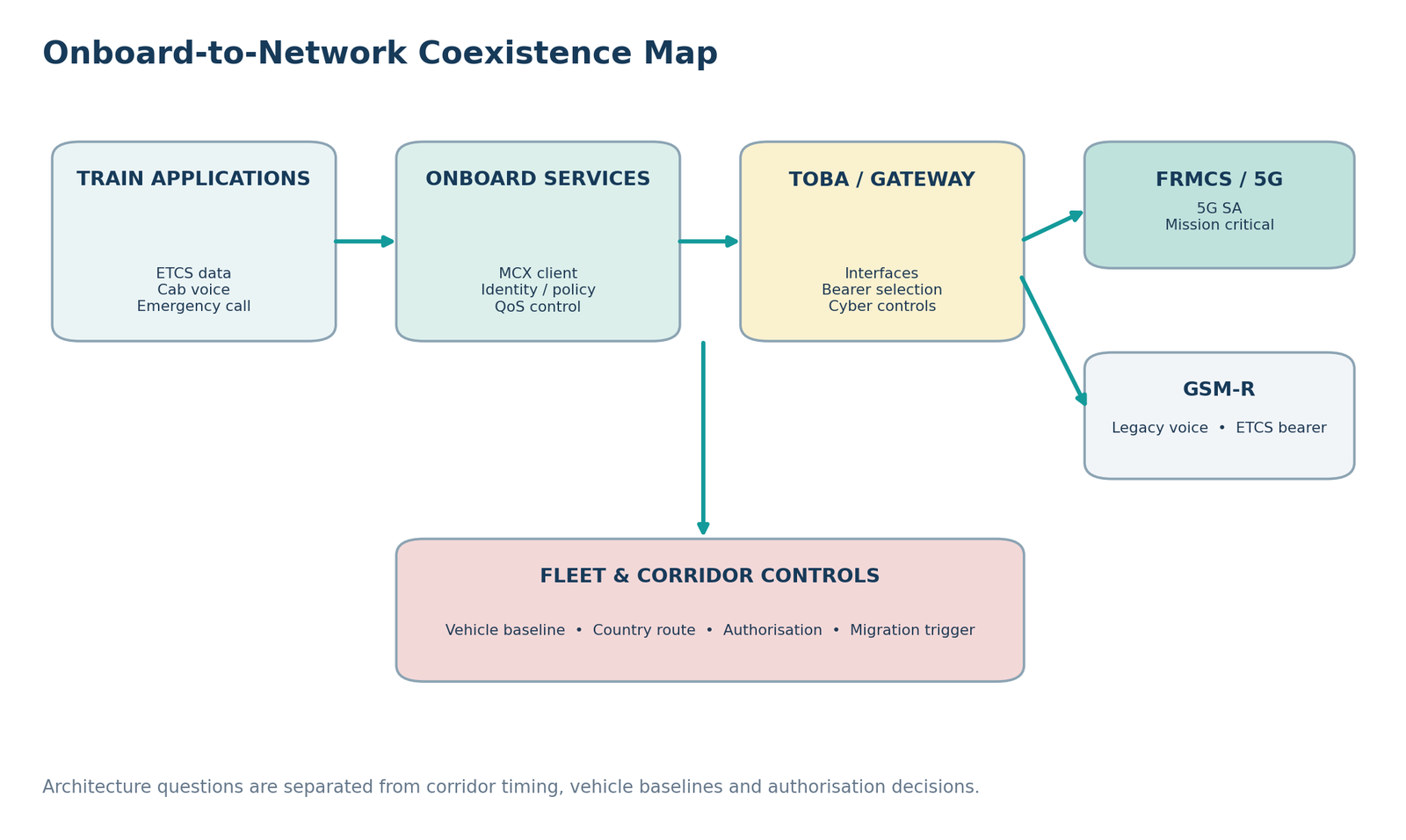
The Onboard-to-Network Coexistence Map
The map separates train applications from onboard service functions, transport architecture and the available radio bearer. Fleet and corridor controls sit underneath the architecture because the same technical package may have different value or timing on different vehicles and routes.
How the map supports procurement
- Applications and interfaces that are stable can be modularised before the final radio and network commitment.
- Dual-bearer or gateway options are evaluated against route continuity, not treated as a universal answer for every locomotive.
- A short-life locomotive can remain on a controlled GSM-R path while a long-life class receives pre-cabling or a modular architecture.
- Every architecture choice links to a specification baseline, validated function, corridor trigger and authorisation question.
WEBSITE PRESENTATION SUGGESTION Use an interactive system map with switches for GSM-R, coexistence and FRMCS states. Selecting a block should reveal its interfaces, applicable specification version, fleet archetypes, corridor dependencies and unresolved trigger. A route filter can show which countries drive each decision.
FINDINGS, DELIVERY AND DECISION OUTPUTS
Example findings and recommended actions
Finding | Hypothetical indication | Recommended action |
|---|---|---|
Fleet should not follow one retrofit date | The 120 vehicles separate into four hardware and asset-life archetypes. | Create class-specific packages and retirement exceptions. |
Interfaces can be prepared early | Two archetypes can accept cabling, power and mounting provisions during scheduled overhaul. | Add controlled pre-installation requirements without locking the final radio. |
Cross-border timing drives coexistence | Three corridors are likely to require mixed network operation during transition. | Retain GSM-R capability until route triggers and acceptance evidence are confirmed. |
Specification control is a procurement issue | Mandatory V3 functions and validation status are still moving. | Use versioned requirements and acceptance gates in supplier documents. |
What the client receives
- A fleet baseline and retrofit-archetype register.
- A corridor dependency map covering radio, ETCS, national plans and border transitions.
- A version-controlled FRMCS, CCS TSI, UIC and validation-status register.
- A coexistence architecture, procurement gate plan and trigger-based migration roadmap.
Indicative project delivery
A focused engagement could take approximately seven to ten weeks. Weeks 1 and 2 establish the fleet and corridor baseline; weeks 2 to 5 build the regulatory, specification and network register; weeks 4 to 7 develop architecture and coexistence scenarios; and weeks 8 to 10 complete the roadmap, procurement clauses and management workshop. Delivery may include a Word report, Excel fleet and source registers, and a PowerPoint decision brief.
TIMELINE NOTE: This is a hypothetical planning range. Actual timing depends on fleet diversity, access to configuration records, country and language coverage, publication of national plans, supplier responses and the maturity of current test evidence.
Let’s discuss your project
If a fleet must remain interoperable while railway communications move between generations, August Research can connect standards status, onboard architecture and corridor timing to a practical investment sequence.
Note:
This is a hypothetical engagement. The FRMCS direction, CCS TSI framework and specification status are based on official information available on 25 August 2026. The operator, fleet, corridors, counts, findings and timeline are examples. A live project would be refreshed against current EU, ERA, UIC, national and infrastructure-manager information. The work supports planning and does not constitute engineering certification, legal advice, interoperability approval or vehicle authorisation.