ENGAGEMENT EXAMPLE 02 / BIOTECH + PHARMA / MANUFACTURING TRANSITION
Continuous bioprocessing for monoclonal antibodies
Testing whether an intensified upstream and semi-continuous downstream platform is credible for an existing molecule, rather than treating continuous manufacturing as one maturity category.
PROJECT SCOPE
6 process layers
EVIDENCE SET
214 records*
ORGANISATIONS
18 profiles*
INDICATIVE TIMELINE
6 weeks*
The challenge
A biologics manufacturer expected demand for an established IgG monoclonal antibody to exceed the practical capacity of its fed-batch network. The technical team needed to compare a conventional capacity expansion with a smaller-footprint platform combining intensified seed expansion, perfusion production, continuous capture chromatography and selected semi-continuous polishing steps. The decision affected facility fit, buffer and resin consumption, control strategy, deviation handling and the evidence package needed for a manufacturing change.
The problem was not whether continuous bioprocessing is generally mature. It was whether published and disclosed evidence is transferable to the client’s molecule, cell line, product-quality profile and manufacturing boundary. Reported improvements in volumetric productivity or resin utilisation cannot be compared without run duration, viable-cell-density range, perfusion rate, retention-device performance, residence-time distribution, load density, cycle count and cleaning or replacement assumptions. Downstream continuity also depends on surge capacity, viral-inactivation strategy, column switching, failure recovery and material traceability.
The regulatory context is active. ICH Q13 applies continuous-manufacturing principles to therapeutic proteins and conversions from batch operation, while the FDA’s Advanced Manufacturing Technologies Designation Program encourages earlier engagement for qualifying manufacturing technologies. For an existing biologic, comparability remains central: the research must identify what is documented, what is product-specific and what would require analytical, process-development and regulatory work.
PUBLIC CONTEXT USED TO GROUND THE RESEARCH SCENARIO
The scenario is grounded in ICH Q13, ICH Q5E and the FDA Advanced Manufacturing Technologies Designation Program. These sources frame the evidence questions and do not imply that a proposed platform would receive a designation, approval or favourable comparability determination.
Technical scope and decision boundaries
PROCESS LAYERS INCLUDED
- N-1 intensification and production perfusion using ATF or TFF cell retention
- Harvest clarification and continuous or periodic clarification options
- Protein A capture using periodic counter-current or multi-column configurations
- Viral inactivation, polishing chromatography, concentration and diafiltration
- PAT, process models, material diversion, surge capacity and failure recovery
COMPARABLE EVIDENCE FIELDS
- Molecule class, host cell, scale, run duration, viable cell density and cell-specific productivity
- Perfusion rate, retention performance, bioburden strategy and harvest quality
- Residence time, load density, cycle count, step yield, resin and buffer use
- Glycosylation, aggregates, charge variants, host-cell protein and residual DNA
- Evidence setting, geography, source independence and disclosed control strategy
DECISION CONSTRAINTS
- Existing facility utilities, single-use limits, buffer preparation and storage footprint
- Campaign length, contamination exposure, maintenance and intervention frequency
- Data integrity, sensor calibration, state-of-control definition and batch genealogy
- Scale-down model relevance and compatibility with the current analytical package
RESEARCH BOUNDARIES
- Evidence focus from 2018 to 2026, with earlier foundational records retained selectively
- United States and European regulatory context with global technical evidence
- No process design, validation protocol, regulatory submission strategy or comparability conclusion
- No announced commercial use treated as GMP evidence without an attributable operating basis
How the research would be executed
Define the conversion decision
Fix the molecule class, existing process, intended scale, demand gap, facility constraints and which unit operations can remain batch. This prevents evidence for unrelated continuous concepts from entering the comparison.
Build a process and terminology taxonomy
Separate perfusion, intensified fed-batch, truly continuous, periodic and hybrid operation. Map upstream, harvest, capture, viral safety, polishing, formulation, analytics and digital-control layers.
Search by unit operation and failure mode
Use literature, patents, conference records, regulatory materials, supplier documents and disclosed manufacturing cases. Add searches for filter fouling, cell-retention failure, column switching, viral-inactivation residence time, sensor drift and material diversion.
Qualify transferability
Code molecule, host, scale, duration, operating window, product-quality attributes and evidence setting. Separate laboratory demonstrations, pilot runs, GMP-relevant disclosures and unsupported commercial claims.
Map integration and comparability dependencies
Connect each unit operation to surge capacity, buffer demand, sterile boundary, process models, failure recovery and the attributes likely to support a before-and-after comparability assessment.
Build a staged pathway
Assign each process layer to retain, monitor, model, pilot or defer. State the evidence strength, key assumption and next primary-research or process-development question for every recommendation.
Evidence architecture and example output
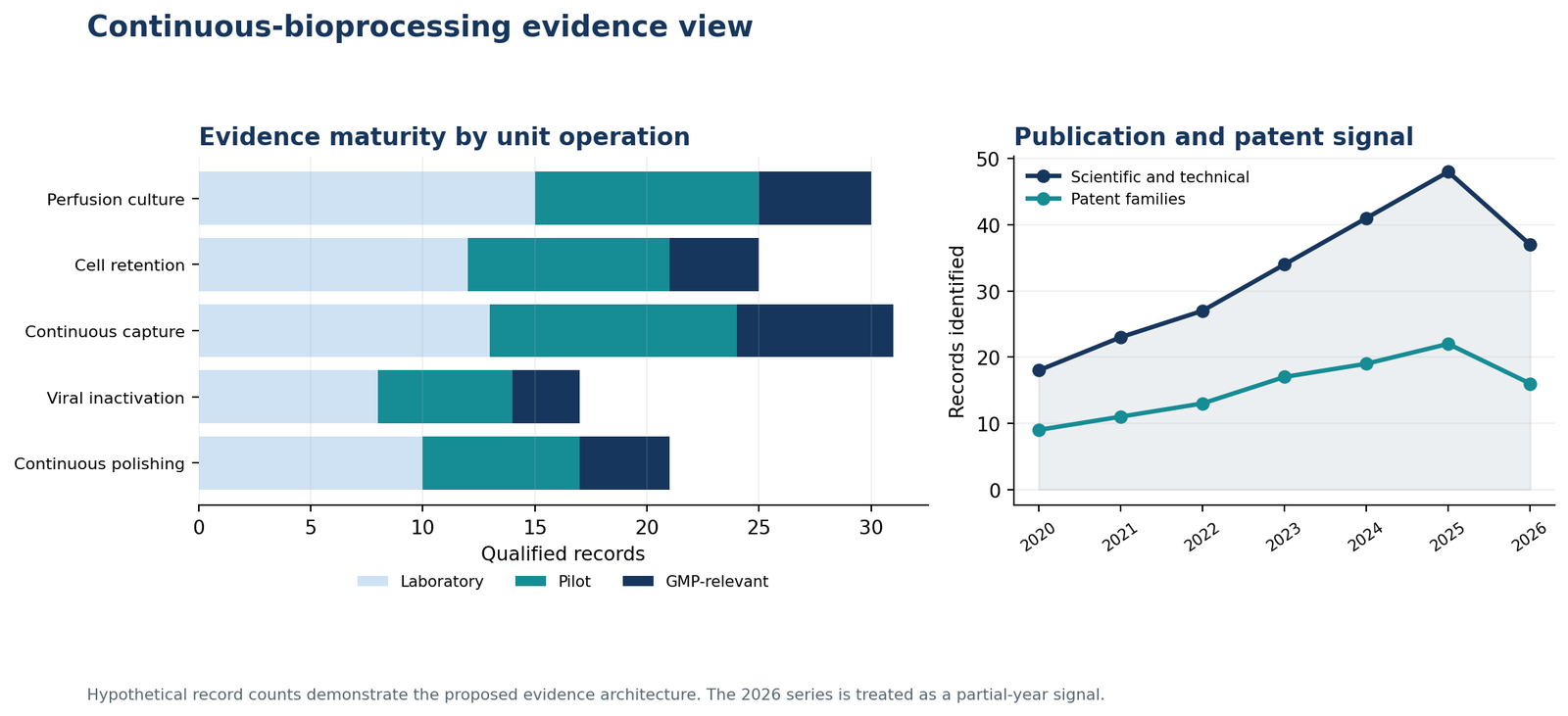
A possible synthesis could show that upstream perfusion has a broad technical evidence base but that transferability narrows sharply when the target cell line, run length and product-quality attributes are applied. Continuous capture chromatography may have enough comparable pilot and GMP-relevant evidence to justify modelling and supplier diligence. Viral inactivation could remain a deliberate batch or semi-continuous hold because residence-time control, segregation and deviation recovery create a different risk profile. Continuous polishing might be prioritised only where load variability and sensor capability are adequately characterised.
How the example output should be read
The output would be a process-chain decision rather than a maturity score for continuous manufacturing. Each unit operation would show its evidence level, integration dependency, unresolved quality question and next action. Bibliographic growth would signal activity, not implementation readiness.
Deliverables and indicative schedule
DELIVERY PACKAGE
- Excel evidence base with approximately 214 screened records, source links, coding fields and exclusions
- Unit-operation evidence map distinguishing laboratory, pilot, GMP-relevant and unsupported claims
- Approximately 18 profiles covering equipment, analytics, software, integration and development partners
- PowerPoint pathway with retain, model, pilot and defer decisions plus primary-validation questions
SIX-WEEK WORKPLAN
- Week 1: decision boundary, process taxonomy and search protocol
- Weeks 2 and 3: discovery, screening and unit-operation coding
- Week 4: transferability, integration and comparability mapping
- Week 5: partner profiling and evidence-gap review
- Week 6: synthesis, quality checks and decision presentation
Note: The six-week schedule is a planning assumption. Actual timing depends on taxonomy breadth, source access, product and process specificity, language coverage, evidence quality and the depth of organisation profiling required.
WEBSITE PRESENTATION SUGGESTION
Present this page as a process-chain explorer. Visitors move from seed expansion to final formulation and see the evidence maturity, control dependency and next validation question change at each step. The bibliographic trend should appear only as supporting context. Clicking a unit operation should open the underlying evidence fields and reasons why records were qualified or excluded.
Let's discuss your project
If your team is assessing continuous or intensified bioprocessing for a specific molecule, capacity constraint or facility transition, August Research can structure the landscape around the evidence needed for that exact conversion decision.
Note: This illustrative engagement is a hypothetical website example, not a client project or actual finding. All counts, profiles, scores, findings, timelines and deliverables would change with the scope and available evidence. Secondary research does not replace regulatory, engineering, laboratory or operational validation.