ENGAGEMENT EXAMPLE 01 / FMCG + CHEMICALS / REGULATORY-LED
Energy-curable coatings for packaging and electronics
Determining which curing routes remain technically and strategically relevant as packaging design, chemical restrictions and recycling expectations evolve.
PROJECT SCOPE
4 route families
EVIDENCE SET
186 records*
ORGANISATIONS
21 profiles*
INDICATIVE TIMELINE
5 weeks*
The challenge
A packaging-materials team needed to decide whether to extend an installed mercury-UV coating platform, prioritise an LED-UV formulation programme, assess low-voltage electron-beam curing or retain a water-based thermal route for selected applications. The decision affected flexible food packaging, folding cartons, pressure-sensitive labels and functional coatings on heat-sensitive electronic films. It could not be reduced to cure speed or supplier claims.
The technical difficulty was comparability. Reported results often use different resin systems, photoinitiators, pigment loads, coating weights, substrates, irradiation wavelengths, dose definitions, oxygen conditions and test methods. A route that performs well on an unpigmented PET film at laboratory speed may not transfer to an opaque coating on PE or PP at a commercial web speed. Migration results may also be reported under different food simulants, contact times, temperatures and analytical limits, while recycling claims may refer to different collection streams, de-inking protocols or recyclate-quality endpoints.
The regulatory horizon added a second constraint. Regulation (EU) 2025/40 links packaging placed on the EU market to design-for-recycling performance grades from 2030, while food-contact materials must control transfer of constituents under foreseeable conditions of use. The research therefore had to test which coating-and-cure combinations have credible evidence for the intended substrate, line architecture, food-contact status and recycling stream, and where primary testing would still be necessary.
PUBLIC CONTEXT USED TO GROUND THE ILLUSTRATION
The scenario is grounded in Regulation (EU) 2025/40, EU food-contact-material requirements and current design-for-recycling guidance for plastic packaging. These sources shape the research questions; they are not used to declare that a coating system is compliant or recyclable.
Technical scope and research boundaries
APPLICATIONS AND SUBSTRATES
- Flexible PE, PP and PET packaging films, including food-contact and non-food-contact use cases
- Folding cartons and pressure-sensitive labels
- Protective or functional coatings on selected heat-sensitive films used in printed electronics
- Barrier, print-protection, abrasion-resistance and surface-functional coating requirements
TECHNOLOGY ROUTES
- Mercury-UV systems as the installed-base benchmark
- LED-UV systems, including wavelength and photoinitiator compatibility
- Low-voltage electron beam, including inerting and shielding requirements
- Water-based thermal curing as the incumbent comparison route
TECHNICAL VARIABLES CODED
- Oligomer or resin family, monomer or reactive diluent, photoinitiator class, pigment and additives
- Coating weight, irradiation wavelength, irradiance or dose, web speed, oxygen control and cure depth
- Adhesion, rub and chemical resistance, odour, set-off, residual species and reported migration conditions
- Barrier results only where test method, film structure and conditioning are sufficiently comparable
LINE AND INTEGRATION CONSTRAINTS
- Web width and speed, heat load, dose uniformity and substrate dimensional stability
- Nitrogen demand, shielding, extraction, cooling and safety controls
- Retrofit space, downtime, maintenance, lamp or emitter life and operator requirements
- Available capex, energy and consumables data, retained with the supplier assumptions behind them
EVIDENCE FRAME
- Evidence published mainly from 2020 to 2026, with earlier foundational records retained selectively
- EU regulatory and packaging focus, supported by global technical and supplier evidence
- Scientific literature, patents, technical data sheets, equipment specifications, converter trials, official rules and recycling protocols
- Separate fields for source independence, test context, geography, date, contradiction and confidence
EXPLICIT EXCLUSIONS
- No laboratory confirmation, migration testing, recyclability certification or production-line trial
- No legal compliance conclusion or freedom-to-operate opinion
- No supplier performance claim treated as proven without comparable supporting evidence
- No market sizing unless it is separately added to the scope
What the research needed to establish
TECHNOLOGY QUESTIONS
- Which curing mechanisms fit each substrate and coating function?
- Where do line speed, heat sensitivity and curing depth change the preferred route?
- Which performance claims survive normalisation to comparable materials, operating conditions and test methods?
- What equipment, shielding, inerting or retrofit requirements affect adoption?
DECISION QUESTIONS
- Which routes merit further formulation work?
- Which applications should be prioritised or deferred?
- What migration, de-inking, sorting and recyclate-quality evidence may become more important by 2030?
- Which suppliers, converters or testing partners warrant follow-up?
How the research would be executed
Translate the decision into searchable claims
Break the brief into route-to-application questions such as LED-UV surface cure on pigmented PE coatings, electron-beam dose and penetration at the target coating weight, and the effect of ink or coating systems on a defined recycling stream.
Build the taxonomy and query architecture
Combine curing route, chemistry, substrate, coating function, equipment term, performance measure and end-use term. Run separate search strings for technical performance, food contact, recyclability, patents, equipment and commercial activity so one evidence type does not dominate the landscape.
Screen and code at record level
Retain records only when they contribute a defined data field. Capture formulation, substrate, coating weight, wavelength or dose, web speed, oxygen condition, test method, result, evidence setting, geography and publication date. Log exclusion reasons and duplicate claims.
Normalise before comparison
Group evidence into comparable test windows rather than averaging unlike results. Preserve original units and assumptions, convert only where the basis is defensible, and flag results that rely on an undisclosed formulation or incomplete operating conditions.
Map switching and integration logic
Assess where LED-UV, electron beam or thermal curing could replace or complement an installed mercury-UV line. Link formulation changes to lamp or emitter configuration, inerting, shielding, heat load, web handling, utilities, capex and qualification effort.
Triangulate the ecosystem and gaps
Cross-check scientific and patent evidence against supplier documents, equipment specifications, converter trials, official requirements and recycling protocols. Profile relevant suppliers and partners, then state which questions remain desk-research conclusions and which require interviews, migration tests, recycling trials or line trials.
Evidence architecture
EVIDENCE CAPTURED
- Chemistry and curing mechanism
- Substrate and coating function
- Wavelength or dose, web speed and coating weight
- Residual species, migration conditions and analytical limits
- De-inking, sorting, process yield and recyclate-quality evidence
- Equipment and retrofit requirements
RESEARCH CONTROLS
- Source independence
- Application comparability
- Regulatory relevance
- Claim-to-test traceability
- Evidence date and geography
- Confidence and gap labels
What the output could show
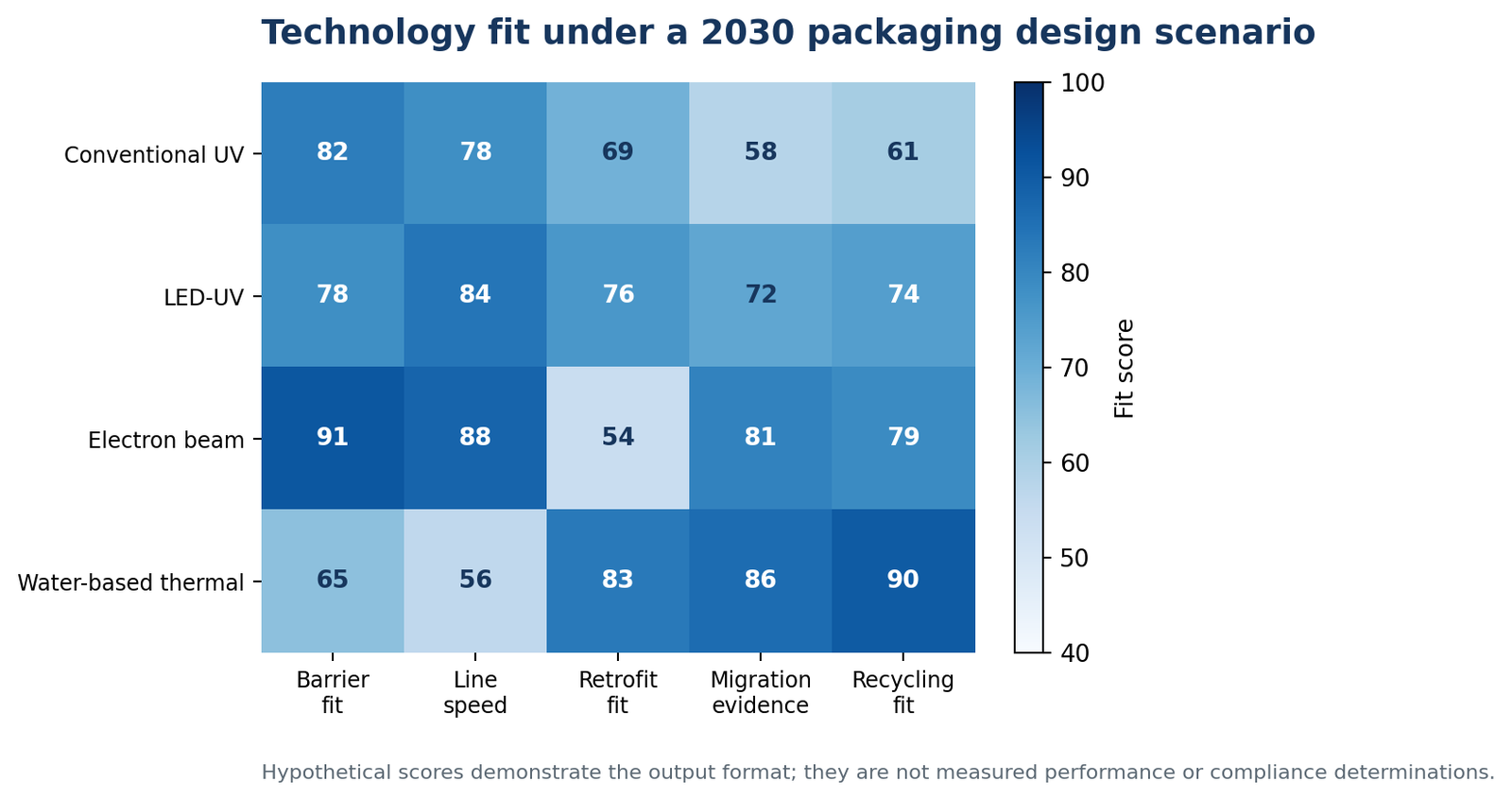
A worked synthesis could separate the portfolio into application-specific pathways. Electron beam may warrant deeper diligence for high-throughput coating systems where cure depth and the removal of a photoinitiator dependency are valuable, but only after the client tests shielding, inerting, web-handling, dose-uniformity and capital assumptions. LED-UV may be a stronger retrofit candidate for heat-sensitive films or targeted lines, provided the formulation absorbs at the installed wavelength and the evidence demonstrates adequate surface and through-cure at the required pigment load, coating weight and speed. Mercury UV may remain defensible for qualified applications where installed assets and formulation history outweigh transition benefits. Water-based thermal curing may remain the control option where drying capacity, substrate heat exposure and line footprint are acceptable.
The final comparison would not name a universal winner. It would show which route-to-application combinations are supported by comparable evidence, which depend on unresolved assumptions, and which should be deferred. For example, a promising LED-UV route could be marked “conditional” if migration evidence does not match the intended food, contact time and temperature. An electron-beam route could be technically attractive but placed behind a capital gate until equipment footprint, shielding and line-integration assumptions are confirmed.
How the example output should be read
The matrix is not intended to certify a route or predict compliance. It demonstrates how evidence from different source families could be translated into a comparable decision view. Each score would be supported by a transparent definition, an evidence-strength label and a record of the assumptions used. A low score would indicate a weaker fit under the stated scenario, not that the technology is inherently ineffective.
Deliverables and indicative schedule
DELIVERY PACKAGE
- Excel evidence base with approximately 186 screened records, coded fields, exclusions and source links
- PowerPoint decision narrative with route comparison, application fit, switching logic and evidence gaps
- Approximately 6 to 8 priority route-and-application combinations, each with its status, evidence strength and validation question
- Approximately 21 source-backed profiles spanning chemistry, equipment, formulation, converting and testing
FIVE-WEEK WORKPLAN
- Week 1: confirm decision criteria, taxonomy, search logic and source plan
- Weeks 2 and 3: discover, screen, deduplicate and code evidence
- Week 4: build switching logic, profile the ecosystem and review contradictions
- Week 5: synthesise findings, complete quality review and prepare the database and presentation
Note: The five-week schedule is a planning assumption. Actual timing for secondary research depends on taxonomy breadth, source accessibility, language and geographic coverage, evidence quality, and the depth of technology and organisation profiling required.
WEBSITE PRESENTATION SUGGESTION
Present this example as an interactive application-to-technology switchboard. Visitors first select a substrate and coating function, then choose food-contact status, line-speed range and regulatory horizon. The page reveals the relevant curing routes, integration gates, evidence strength and unresolved validation questions. Keep every numerical score visibly labelled as hypothetical example data and allow its definition and source logic to open in a side drawer. The service-page placard should show only the industry tag, title and one-line decision preview before opening this complete page.
Let's discuss your project
If your team is reconsidering a coating platform because of changing packaging, chemical or recycling requirements, August Research can structure the technology landscape around the applications, evidence and transition decisions that matter most.
Note: This illustrative engagement is not a client project or an actual research finding. The record counts, organisation profiles, scores, findings, timeline and deliverables are hypothetical examples and would change with the final scope and available evidence. Secondary research cannot establish legal compliance, recyclability certification or production performance without the appropriate primary validation.