BRAND FEEDBACK RESEARCH | ENGAGEMENT EXAMPLE
Can a cargo-bike subscription brand expand beyond courier fleets?
A business-buyer brand permission study in Lisbon and Porto
THE BUSINESS DECISION A cargo-bike subscription provider was strongly associated with delivery fleets. It wanted to reach hospitality, facilities, retail, trades and campus operators without losing the operational credibility built in courier use.
96 ORGANISATIONS
Directional buyer survey
18 INTERVIEWS
Adopters, considerers and rejectors
6 USE-CASE SECTORS
Delivery and non-delivery contexts
8 WEEKS
Example delivery window
The brand problem was not category demand
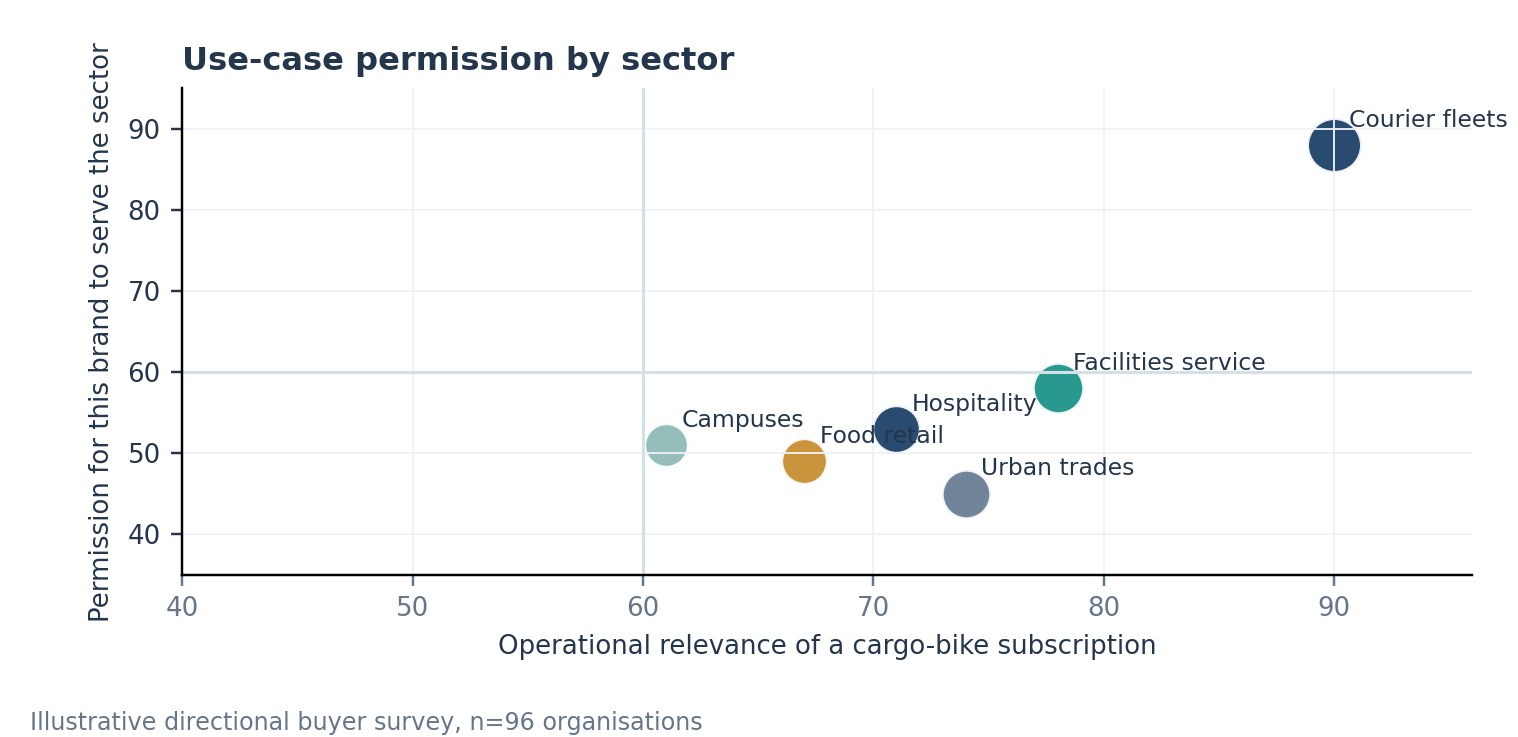
A sector could have a practical mobility need and still reject this particular brand because it appeared built only for couriers. The study therefore separated operational relevance from permission for the brand to serve the use case.
Why Lisbon and Porto mattered
The two locations created different business routes, terrain, parking and service expectations to explore. Core questions remained comparable, while interviews used each organisation’s actual operating area rather than abstract city stereotypes.
Decisions to resolve
Which sectors grant permission | which courier cues should remain | which proof widens relevance | how the subscription should be described | where local service evidence matters
Note: The organisation, participant counts and findings in this example are hypothetical and are not presented as real client outcomes or market estimates.
02 | OUTREACH AND METHOD
Use-Case Permission Mapping
A buyer survey mapped relevance and brand permission. Follow-up interviews reconstructed the operating evidence required to close the gap.
Buyer survey outreach
The 10-minute survey recruited 96 organisations, 48 per city, through business directories, professional networks and verified B2B recruitment partners. Respondents were owners, operations leads or fleet and facilities decision makers with responsibility for local movement of people, tools, supplies or goods.
Sector structure
Facilities and field service
Movement of tools, parts and technicians
Hospitality
Guest services, supplies and local property operations
Food retail and catering
Store replenishment and short local movements
Urban trades
Equipment and material transport between jobs
Campuses and property
Internal logistics across distributed sites
Courier fleets
Reference category and credibility anchor
How the research was carried out
01 CATEGORY BASELINE Capture unaided brand associations and current sector fit before describing expansion.
02 USE-CASE SCREEN Measure operational relevance, perceived brand fit and proof requirements across six sectors.
03 PERMISSION SEGMENTS Identify adopters, considerers and rejectors within high-relevance use cases.
04 BUSINESS INTERVIEWS Reconstruct routes, loads, service risks, internal approval and message interpretation with 18 organisations.
05 EXPANSION ARCHITECTURE Define the master proposition, sector adaptations and evidence boundaries.
SCREENING AND CONTROL Respondents needed a verified organisation, operating location and decision role. Invitations did not reveal the preferred repositioning. Survey-to-interview selection preserved sector, city and permission pattern.
03 | QUESTIONS AND FINDINGS
Find the gap between practical fit and brand permission
Interviews began with the organisation’s actual movement problem before revealing the broader subscription proposition.
Sample business interview questions
OPERATING CONTEXT Thinking about a typical working week, which local movements create the most delay, vehicle mismatch or coordination effort?
CURRENT CATEGORY Before seeing the broader proposition, which organisations do you believe this cargo-bike brand is designed for, and what creates that impression?
USE-CASE FIT Where could a subscription solve part of your movement problem, and where would it be unsuitable?
BRAND PERMISSION What would the brand need to show before it felt credible for your sector rather than borrowed from courier delivery?
BUYING THRESHOLD Which service, safety, maintenance or commercial condition would determine whether the idea progressed internally?
Expansion logic
KEEP
Operational reliability, service response and real urban-use credibility from courier fleets.
WIDEN
The category language from delivery vehicle to urban business mobility.
PROVE
Payload fit, route suitability, maintenance coverage and business-specific service examples.
Note: Scores, sector positions and conclusions on this page are hypothetical and demonstrate the analysis structure only.
04 | DECISION AND DELIVERY
Reframe the brand as urban business mobility
Courier credibility became evidence of demanding use, not the boundary of who the service was for.
RECOMMENDED DIRECTION Retain the operational discipline associated with courier fleets, but lead with an urban business mobility subscription. Build sector pages around real movement tasks and state where the bike, service model or route conditions do not fit.
Proposition structure
MASTER BRAND
Urban business mobility with vehicle, service and subscription in one offer.
SECTOR VERSION
The specific movement problem, load context and internal buyer supported.
LOCAL PROOF
Route suitability, service coverage, maintenance access and comparable examples.
Engagement outputs
Category Permission Map Operational relevance and permission for the brand by sector.
Courier Cue Audit Existing associations to protect, broaden or remove.
Sector Proof Thresholds Evidence required by adopters, considerers and rejectors.
Expansion Message Architecture Master proposition, sector adaptations and boundaries.
Local Activation Priorities Where Lisbon and Porto evidence requires different emphasis.
Boundaries and timing This research evaluates buyer perception and brand permission. It does not validate vehicle safety, route feasibility, total cost, environmental impact or legal compliance. Example timing is approximately eight weeks.
Contact Us
DISCUSS YOUR BRAND DECISION
Tell us which category boundary is limiting growth, which business audiences matter and what operating evidence is available. We will shape the buyer research around that expansion decision.