BRAND FEEDBACK RESEARCH | ENGAGEMENT EXAMPLE
Is a refillable cleaning brand’s sustainability promise weakening performance expectations?
A promise-in-use study with households in Berlin and Hamburg
THE BUSINESS DECISION A home-care brand wanted to strengthen its refill and environmental messaging. Before revising packaging and digital communication, it needed to know whether sustainability cues made the product feel responsible but less capable of delivering a thorough clean.
28 HOUSEHOLDS
Ten-day diary programme
220 SURVEY RESPONDENTS
Category buyers across two cities
PARALLEL DESIGN
Observed meaning and audience breadth
8 WEEKS
Example delivery window
Why timing mattered
The study was designed ahead of the 27 September 2026 application of new EU consumer rules affecting environmental claims and sustainability labels. Research tested what consumers understood and believed. It did not determine legal compliance.
The brand tension
Responsible Refill, material and waste-reduction cues should remain visible and credible.
Capable The brand must still signal cleaning strength, hygiene and dependable results.
Easy The refill process should feel manageable rather than like extra work transferred to the household.
Substantiated Environmental wording should be specific enough for separate legal and evidence review.
Note: The organisation, participant counts and findings in this example are hypothetical and are not presented as real client outcomes or population estimates.
02 | FIELDWORK AND METHOD
Promise-in-Use Alignment
Home-use diaries and an audience survey ran at the same time, then converged around the points where the brand promise strengthened or weakened.
Household diary outreach
Independent recruiters enrolled 28 households, 14 per city, for a ten-day programme. Participants cleaned at least three times per week and represented a mix of refill experience, household size and dwelling type. The study supplied the same branded stimulus and tasks; participants used it in their normal home context.
What participants recorded
BEFORE USE
Expected strength, safety, effort and sustainability from the brand and pack.
FIRST CLEAN
Short form, photo and voice note after a standard kitchen or bathroom task.
REPEATED USE
Moments that reinforced or contradicted the brand promise across ten days.
FINAL REFLECTION
What the brand now meant and which message felt earned after use.
Parallel survey outreach
The 9-minute survey recruited 220 adults who had bought household cleaning products in the previous three months, split equally between Berlin and Hamburg. Quotas reflected decision-relevant variation in refill experience and household responsibility, not a claim of city representativeness.
How the evidence was integrated
DIARY EVIDENCE Showed how meaning changed when the brand entered an actual cleaning routine.
SURVEY EVIDENCE Measured how widespread the initial performance concern and claim interpretations appeared.
CONVERGENCE Separated a pre-use communication problem from an experience problem and identified the proof needed for each.
OUTREACH CONTROLS Invitations used neutral language, consent covered diary media, and participants could omit private household details. Survey quality checks covered duplicates, completion behaviour and open-response quality.
03 | QUESTIONS AND EVIDENCE
Ask before, during and after the brand is used
The sequence separated what the packaging promised from what the household experience allowed the brand to claim credibly.
Sample diary prompts
BEFORE OPENING Without using the product, what does this pack make you expect about cleaning strength, safety and environmental impact?
AFTER THE TASK What happened during this clean that strengthened or weakened those expectations? Please capture the cue that influenced you.
REFILL MOMENT What did the refill step make the brand feel like: easier, more responsible, more complicated or something else? Explain the moment.
DAY TEN Which statement could this brand now make credibly, and which statement would still require more proof?
Sample survey questions
After an unaided first impression, respondents rated expected cleaning performance, refill effort and environmental credibility. They then selected what specific evidence each environmental statement would require and compared a performance-led message with a sustainability-led message.
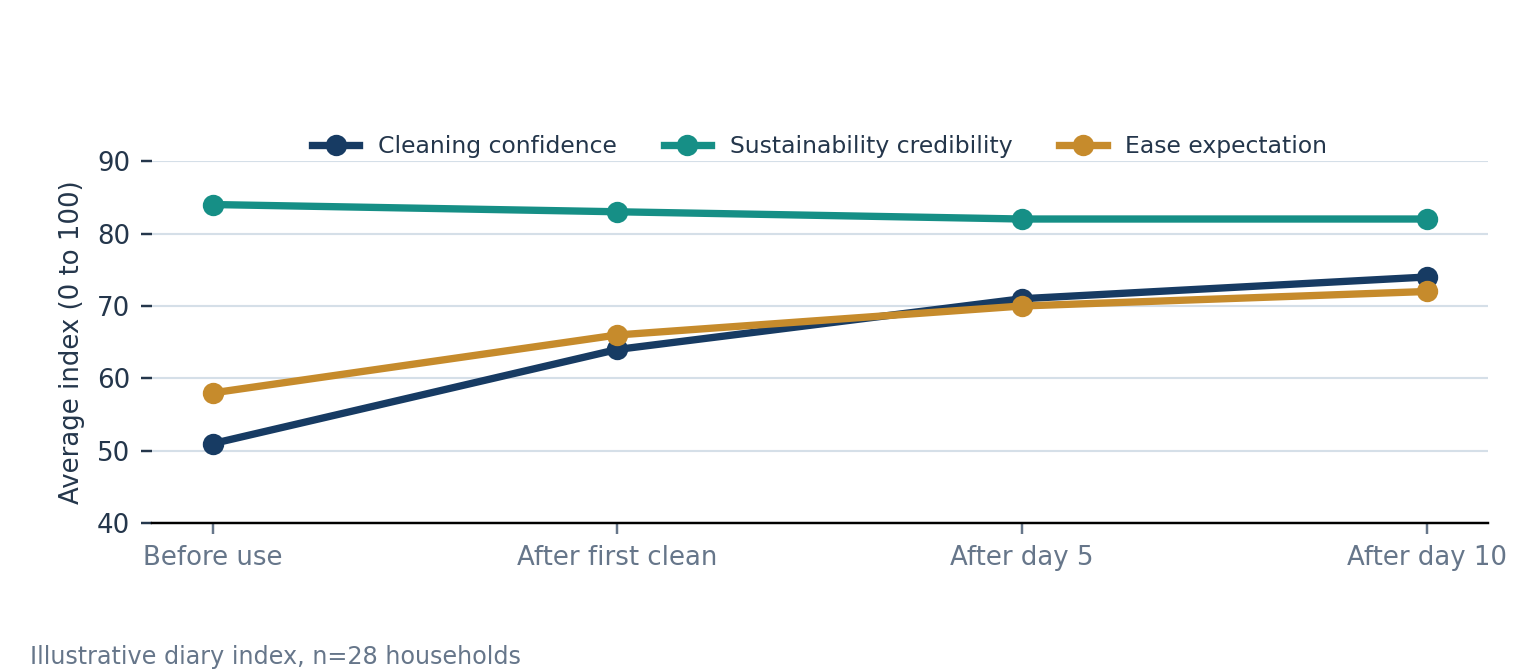
Meaning convergence
BEFORE USE
Refill cues created responsibility but made some participants expect gentler performance.
DURING USE
Dosing, scent and visible cleaning cues determined whether capability caught up with the promise.
AFTER USE
The strongest meaning combined dependable cleaning with a specific, evidenced reduction claim.
Note: Indices and conclusions on this page are hypothetical and demonstrate how parallel evidence could be reconciled.
04 | DECISION AND DELIVERY
Lead with cleaning confidence, then prove the refill benefit
The brand did not need to choose between performance and sustainability. It needed to make their relationship explicit.
RECOMMENDED DIRECTION Use a performance-first promise supported by clear refill instructions and a specific environmental statement prepared for separate substantiation and legal review. Avoid broad green language that asks the pack to carry more meaning than the evidence supports.
Message architecture
CORE PROMISE Dependable cleaning performance designed for repeat refill use.
FUNCTIONAL PROOF Dosing, application and expected result explained in the task context.
ENVIRONMENTAL PROOF A defined claim, relevant comparison and evidence boundary.
EXPERIENCE SUPPORT Refill guidance that reduces effort and prevents misuse.
Engagement outputs
Promise Shift Timeline
How brand meaning changes across household use.
Claim Interpretation Map
What environmental language participants believe it communicates.
Performance Confidence Drivers
Cues and moments that strengthen capability expectations.
Message and Evidence Rules
Wording to protect, clarify, substantiate or remove.
Boundaries and timing The study assesses consumer interpretation and use-context meaning. It does not establish cleaning efficacy, environmental impact or legal compliance. Example timing is approximately eight weeks.
Contact Us
DISCUSS YOUR BRAND DECISION
Tell us which promise is changing, where it appears and which consumer contexts matter. We will combine field evidence and audience measurement around that decision.