BRAND FEEDBACK RESEARCH | ENGAGEMENT EXAMPLE
Should an acquired diagnostic clinic name be retained, endorsed or replaced?
A diagnostic brand architecture study in Chennai and Hyderabad
THE BUSINESS DECISION A growing diagnostic network had acquired a locally recognised clinic brand. Management needed to decide whether to retain the local name, introduce an endorsement or move directly to the network identity without weakening patient trust or confusing referring professionals.
240 SURVEY RESPONDENTS
Recent users and category decision makers
24 INTERVIEWS
Patients, referrers and clinic-facing roles
2 CITIES
Chennai and Hyderabad
9 WEEKS
Example delivery window
Why this required external research
Patients and referring professionals may soften criticism when speaking directly to a clinic. Independent outreach protected candour and allowed the three brand architectures to be shown with the same explanation, sequence and visual treatment.
The decision criteria
- Retain trust and familiarity attached to the acquired clinic.
- Make network ownership and service consistency understandable.
- Avoid implying clinical superiority or continuity that the brand architecture cannot prove.
- Create a transition that can work across signage, reports, booking channels and referrals.
Note: The organisation, participant counts and findings in this example are hypothetical and are not presented as real client outcomes or market estimates.
02 | PARTICIPANTS, OUTREACH AND METHOD
Name Equity Transfer Diagnostic
A survey located the trust and clarity trade-offs. Interviews then explained why particular audiences accepted or resisted each option.
Survey design and outreach
The 8 to 10 minute survey recruited 240 adults, split equally by city. Eligible respondents had arranged, paid for or influenced a diagnostic test within the previous 12 months. Recruitment combined verified consumer panels and independent local recruiters. No medical records or health-condition details were requested.
Explanatory interview selection
PARTICIPANT | SELECTION LOGIC | COUNT |
|---|---|---|
Recent patients and family decision makers | Selected from strong retain, endorse and replace preferences | 12 |
Referring physicians and clinic coordinators | Recent interaction with diagnostic referrals and report pathways | 8 |
Front-desk and booking intermediaries | Direct experience explaining the acquired and network identities | 4 |
How the research was carried out
01 UNAIDED BASELINE Measure name recall, existing associations and source of familiarity before showing options.
02 CONTROLLED OPTIONS Show retained, endorsed and replaced architectures in randomised order across realistic touchpoints.
03 DIAGNOSTIC SEGMENTS Identify trust preservers, network seekers and architecture rejectors from response patterns.
04 EXPLANATORY INTERVIEWS Explore the experiences, fears and proof expectations behind each pattern.
05 TRANSITION RULES Define where each name appears, when endorsement starts and what must be explained.
OUTREACH SAFEGUARDS Neutral invitations described a study about choosing diagnostic providers. Screeners confirmed recent decision involvement, city and channel. Duplicate signals, speed, patterned answers and low-quality open responses were reviewed before analysis.
03 | QUESTIONS AND FINDINGS
Move from preference to transition logic
The interview guide did not ask which logo people liked. It reconstructed what each name implied about care, accountability and continuity.
Sample questions
DECISION CONTEXT Thinking about the last diagnostic test you arranged, which signals helped you decide that the provider was dependable?
OPTION MEANING When the local name appears with the network endorsement, what do you assume has changed and what do you assume has stayed the same?
TRUST TRANSFER What would the network need to demonstrate before the new name could carry the same confidence as the existing clinic?
REFERRAL RISK At which point could a name change make a patient or referrer hesitate, and what explanation would reduce that hesitation?
TOUCHPOINT Should the naming approach be identical on signage, reports, digital booking and referral communication? Why or why not?
What the evidence suggested
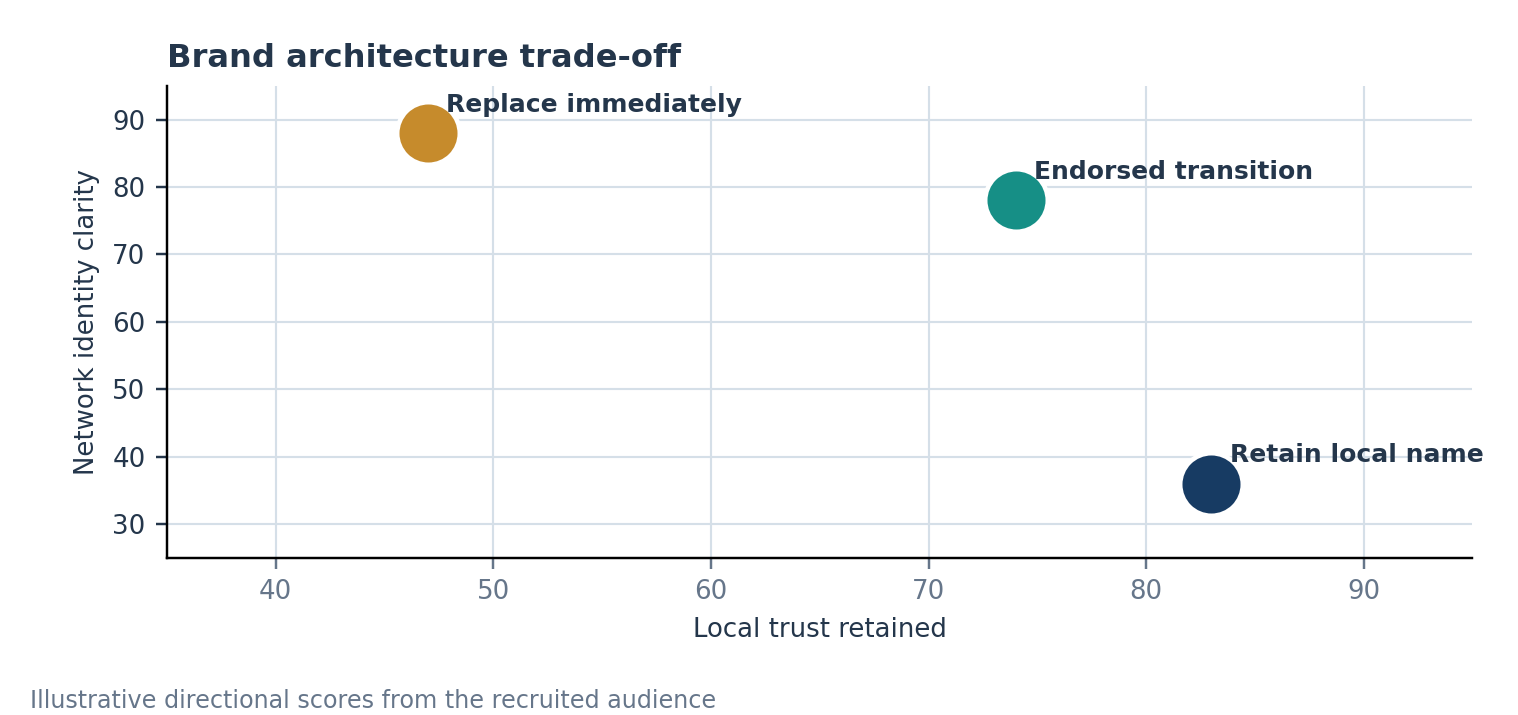
Local equity remained useful The acquired name retained familiarity, particularly among recent users and referrers.
Immediate replacement created avoidable loss The network identity was clear but lacked the local history required to carry trust immediately.
Endorsement needed an explanation Participants interpreted endorsement differently unless ownership, clinical continuity and report access were stated plainly.
Note: Scores and conclusions on this page are hypothetical and demonstrate the analysis structure only.
04 | DECISION AND DELIVERY
Use an endorsed transition with touchpoint rules
The recommendation protected useful local equity while building a visible path toward the network identity.
RECOMMENDED DIRECTION Use ‘Local Clinic, part of Network Brand’ during a defined transition period. Keep the local name most visible where familiarity drives confidence, while increasing network prominence on booking, report access and service-standard communication.
Transition architecture
TOUCHPOINT | EARLY TRANSITION | LATER TRANSITION |
|---|---|---|
Clinic signage | Local name leads; network endorsement visible | Balanced prominence after familiarity review |
Reports and portal | Network system explained with local continuity | Network identity leads; local reference retained where useful |
Referral communication | Direct explanation of ownership and operating continuity | Network standards and access become primary |
Engagement outputs
Name Equity Baseline Trust, familiarity and meaning attached to each identity.
Architecture Trade-off Audience response to retained, endorsed and replaced options.
Transition Rules Name prominence and explanation by touchpoint and stage.
Risk Register Conditions that could create confusion, distrust or unsupported implications.
Boundaries and timing This is perception research, not clinical, legal, privacy or trademark advice. Example timing is approximately nine weeks and depends on recruitment, option approval and fieldwork response.
Contact Us
DISCUSS YOUR BRAND DECISION
Tell us which brand architecture decision is pending, who encounters the names and where the transition will appear. We will design the evidence route around that decision.