BRAND FEEDBACK RESEARCH | ILLUSTRATIVE ENGAGEMENT
Can an industrial filtration brand credibly become a process reliability partner?
A mixed-method positioning study across Rotterdam and Antwerp
THE BUSINESS DECISION A European filtration supplier was recognised for component quality and application knowledge. Before changing its positioning, it needed to understand whether plant buyers would accept a broader process reliability promise, what responsibilities that promise would imply and which proof would make it credible.
2 INDUSTRIAL CLUSTERS
Rotterdam and Antwerp
18 INTERVIEWS
Exploratory qualitative phase
72 RESPONDENTS
Directional professional survey
8 WEEKS
Illustrative delivery window
Why the geography mattered
Both locations contain dense process-industry ecosystems, yet supplier relationships, service expectations and operating contexts can differ. The design therefore treated location as a comparison parameter while keeping the core stimuli and questions consistent. Geography was used to test transferability, not to create a claim about either market as a whole.
What the study needed to resolve
- Which parts of the existing engineering reputation could transfer into the broader positioning?
- What did buyers believe a process reliability partner should actually do?
- Where would the promise create expectations the supplier was not yet equipped to meet?
- Which evidence and service conditions were required by technical, operational and procurement audiences?
All organisations, participant counts and findings in this illustration are hypothetical. They demonstrate a possible research design and are not presented as market evidence.
02 | PARTICIPANTS AND OUTREACH
Recruit people who can judge the promise
Selection was based on recent involvement in filtration specification, operation, service or purchase, not job title alone.
Exploratory interviews
DECISION ROLE | WHY INCLUDED | ILLUSTRATIVE ALLOCATION |
|---|---|---|
Maintenance and reliability | Judge failure response, maintenance burden and technical support | 6 participants |
Operations and process | Judge production consequences and responsibility boundaries | 4 participants |
Procurement and category management | Judge commercial scope, evidence and supplier accountability | 4 participants |
Distributor and service partners | Judge delivery capability, escalation and channel boundaries | 4 participants |
Nine interviews were assigned to each location. Interviews were 45 to 60 minutes and available in Dutch or English according to participant preference.
Directional professional survey
The 10 to 12 minute survey included 72 verified professionals, split equally between the Rotterdam and Antwerp study areas. Role targets ensured sufficient technical, operational and procurement evidence for directional comparison. The sample was not designed to estimate population incidence.
What the outreach looked like
IDENTIFY
Target relevant sites and professionals through verified business directories, professional networks, specialist recruiters and approved panel sources.
INVITE
Use a neutral invitation describing a study about filtration supplier expectations. Keep account managers outside the response process.
SCREEN
Confirm location, facility context, recent decision involvement and relevant filtration responsibility. Exclude competitors and conflicts.
CONTROL
Monitor role and geography targets, cap reminders, review response quality and replace only within the same approved participant group.
RELATIONSHIP SAFEGUARD Client-approved contacts could be included only where consent and disclosure rules allowed it. Invitations and responses remained separate from commercial teams so participants could challenge the proposed positioning freely.
03 | RESEARCH METHOD
Reliability Claim Calibration
Qualitative discovery defined what the promise meant. The survey then measured how widely those interpretations and proof requirements appeared within the recruited audience.
The exploratory route
01 CURRENT MEANING
Capture unprompted expectations from the existing brand.
02 CLAIM REVEAL
Introduce the proposed positioning without explanation.
03 OBLIGATION TRACE
Link each interpretation to expected actions and evidence.
04 MEASUREMENT
Test meaning, credibility and proof thresholds in the survey.
05 RECONCILIATION
Separate transferable, conditional and unsupported meanings.
06 POSITIONING
Translate evidence into claim, proof and service boundaries.
Sample interview questions
RECENT EXPERIENCE Thinking about the last time a filtration issue affected maintenance planning or throughput, what role did the supplier play before, during and after the issue?
CURRENT BRAND Before seeing any new statement, what expectations does this supplier’s current identity create for you?
CLAIM REVEAL The proposed statement is ‘a process reliability partner’. In your own words, what would a supplier need to do for that statement to be deserved?
RESPONSIBILITY BOUNDARY Which responsibilities should remain with your site team even if a filtration supplier uses this positioning?
PROOF THRESHOLD What evidence would move the statement from plausible to credible, and what would make it feel like marketing language?
How questions became measures
Interview language was converted into a concise survey that preserved an unaided first response. Respondents then classified the responsibility implied by the claim, rated credibility, selected required evidence and identified conditions that would make the promise unacceptable. The survey did not ask respondents to agree with the supplier’s preferred interpretation.
04 | ILLUSTRATIVE FINDINGS
Engineering credibility transferred, accountability did not
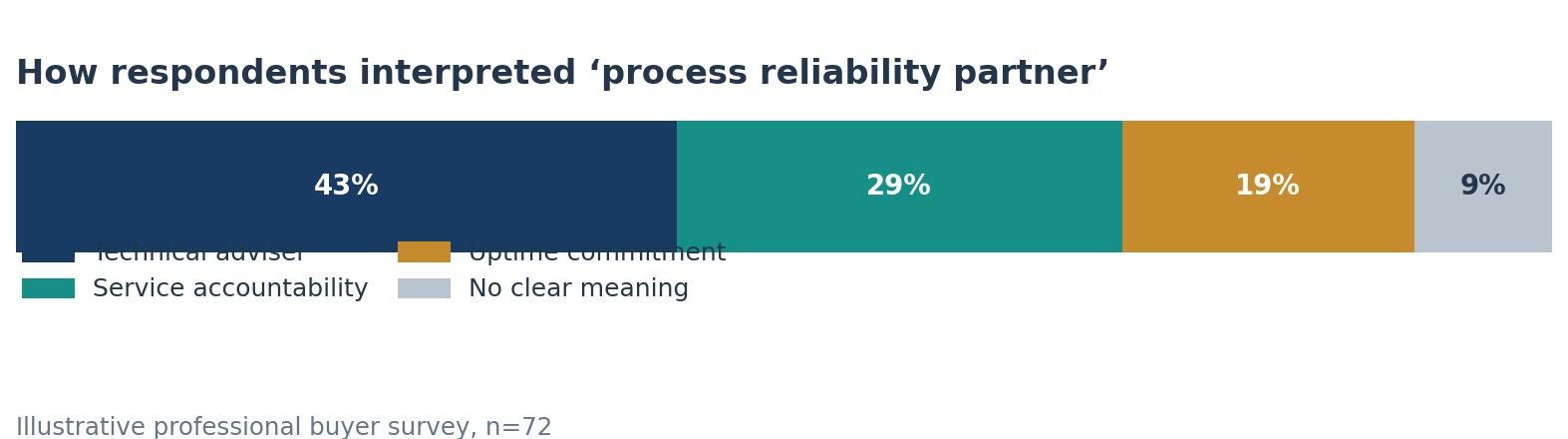
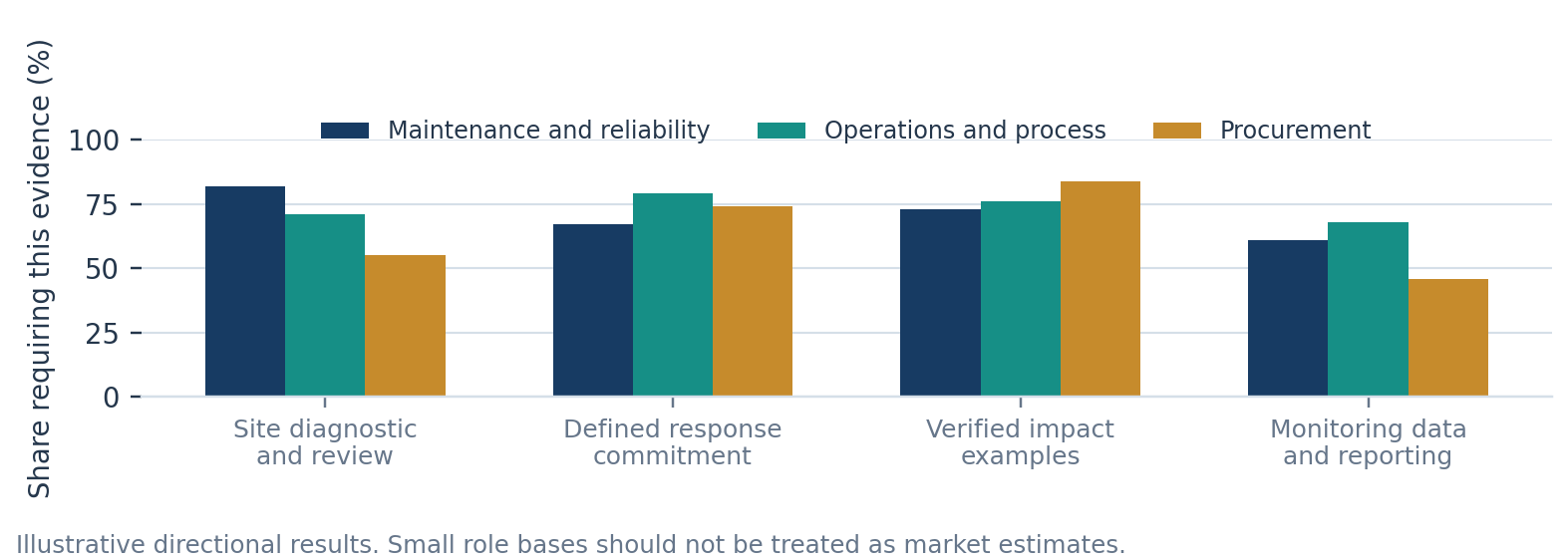
The broader promise created different expectations across roles. That made evidence and service boundaries part of the brand decision.
Brand Meaning Reconciliation
TRANSFERABLE NOW
Filtration competence, application knowledge and product quality.
CREDIBLE WITH CONDITIONS
Diagnostic support, service responsiveness and root-cause contribution when scope and evidence are defined.
UNSUPPORTED WITHOUT CAPABILITY
Uptime guarantees, continuous monitoring or shared operational accountability without an operating model to deliver them.
With 36 survey respondents per location, small differences would guide activation hypotheses, not broad claims about Rotterdam or Antwerp.
05 | DECISION AND DELIVERY
Use a staged reliability proposition
The broader direction was supportable only when the wording matched the capabilities available to each account.
RECOMMENDED POSITIONING Lead with ‘filtration expertise that supports process reliability’ across the wider market. Reserve ‘process reliability partner’ for offers with a defined diagnostic review, response commitment, reporting approach and evidence from comparable operations.
What changed after the research
DECISION AREA | BEFORE RESEARCH | AFTER RESEARCH |
|---|---|---|
Core message | One broad partner claim | A support claim for the market and a stronger claim for qualified service accounts |
Proof | Product credentials and application expertise | Role-specific evidence covering diagnostics, response, impact and reporting |
Service boundary | Implied rather than stated | Responsibilities, exclusions and escalation routes made explicit |
Engagement outputs
Brand Meaning Reconciliation
Current associations, transferable credibility and overreach.
Claim Obligation Map
Expected actions and responsibilities by audience.
Audience Proof Thresholds
Evidence priorities by role and study location.
Positioning Architecture
Core wording, adaptations, substantiation and boundaries.
Evidence Pack
Interview themes, survey tables, charts and management readout.
Activation Guidance
Immediate message changes and capability-dependent claims.
Boundaries and timing The study evaluates perception within the recruited audience. It does not validate performance, downtime, savings, safety, compliance or contractual claims. Illustrative delivery is approximately eight weeks, subject to recruitment and fieldwork conditions.
Contact Us
DISCUSS YOUR BRAND DECISION
Tell us what may be changing, which audiences matter and where the brand is encountered. We will shape the participant design and evidence mix around that decision.