CONSUMER BEHAVIOUR ANALYSIS | ILLUSTRATION 04
How cleaning workarounds change air fryer use
A mixed evidence study examining how residue, liners, basket care and delayed cleaning influence the next cooking decision.
SETTING
Owned appliance in the home
BEHAVIOUR
Cook, clean, postpone or adapt
EVIDENCE
Public signals and kitchen diaries
DECISION
Guidance and accessory priorities
Background
An appliance brand found that many owners praised air-fryer convenience but developed their own cleaning routines. Some used paper or reusable liners, delayed washing the basket, avoided foods likely to create residue or reduced use after a difficult cleaning event.
The client needed to understand which workarounds made ownership easier, which created cooking trade-offs and which repeated problems were strong enough to change future use.
The behavioural loop
1 CHOOSE
Food, quantity and cooking goal
2 PREPARE
Liner, oil, placement and batch
3 COOK
Result, residue and interruption
4 CLEAN
Wipe, wash, soak or postpone
5 RETURN
Repeat, adapt or avoid next use
Why outside research is useful
Owners may describe a cleaning workaround as successful because it saves effort, while the same workaround changes airflow, browning or capacity. Independent evidence can connect the workaround to both the immediate cooking result and the next-use decision.
Illustrative study
All figures and findings are hypothetical. The scale is based on an 18-month public-source window and a two-week household diary with two short kitchen walkthroughs per participant.
EVIDENCE FOUNDATION
Use public signals to locate the workaround, then observe the loop
The secondary scan identifies recurring language and accessory choices. Primary fieldwork tests how those choices perform in real kitchens.
Feasible evidence frame
PUBLIC RECORDS
DEEP CODING
HOUSEHOLDS
PRIMARY EVENTS
2,100 reviews, Q&A and comments screened
330 records with cleaning or liner behaviour
20 weekly air-fryer users
158 documented cooking and cleaning loops
Final volumes would be confirmed after checking public-source yield, ownership incidence, appliance variation and diary burden.
Participant variation
OWNERSHIP MATURITY
Recent owners, established owners and households returning after lower use
USE FREQUENCY
Daily or near-daily, several times weekly and occasional use
BASKET FORMAT
Single or dual drawer and selected size bands
WORKAROUND
No liner, paper liner, reusable liner or foil and ad hoc method
FOOD CONTEXT
Frozen foods, vegetables, protein, reheating and higher-residue meals
CLEANING ACCESS
Dishwasher use, sink space and household responsibility
Primary outreach
Participants are recruited through verified appliance ownership and recent-use screening. They complete a setup walkthrough, a two-week event diary and a closing kitchen walkthrough using their own basket, liner and cleaning tools.
SCOPE-SPECIFIC METHODOLOGY
Use-Clean-Return Loop
Each cooking event remains connected to the preparation method, cleaning action and time taken to use the appliance again.
Capture sequence
SETUP WALKTHROUGH
Basket condition, usual tools, liner stock and storage
COOK EVENT
Food, quantity, liner, temperature, result and residue
CLEAN EVENT
Timing, effort, method, soaking and unresolved residue
NEXT-USE PULSE
Whether cleaning affected the next cooking choice
PHOTO EVIDENCE
Before, after and post-clean basket images when consented
CLOSING REPLAY
Review repeated loops and contradictory events
Questions framed around the kitchen evidence
You used a paper liner for this meal but not for the previous one. What did you expect it to prevent, and what cooking trade-off were you willing to accept?
The basket was left to soak overnight after this event. What made immediate cleaning feel unrealistic, and how did that affect the next planned use?
The photos show residue in the same corner after three meals. How has that changed the foods, batch size or temperature you now choose?
Another household member cleans the appliance differently. Which method determines whether it is ready when you next want to use it?
Questions begin with a documented use or cleaning event. Participants are not asked to defend or reproduce the manufacturer's preferred routine.
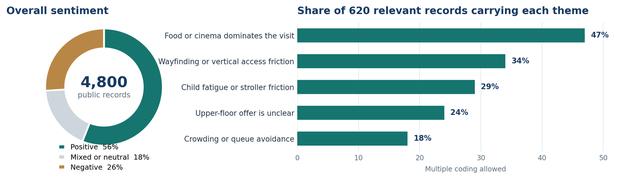
ILLUSTRATIVE FINDINGS | PUBLIC SIGNALS
Positive ownership can coexist with persistent cleaning friction
Overall sentiment alone would hide the specific workarounds that shape day-to-day use.
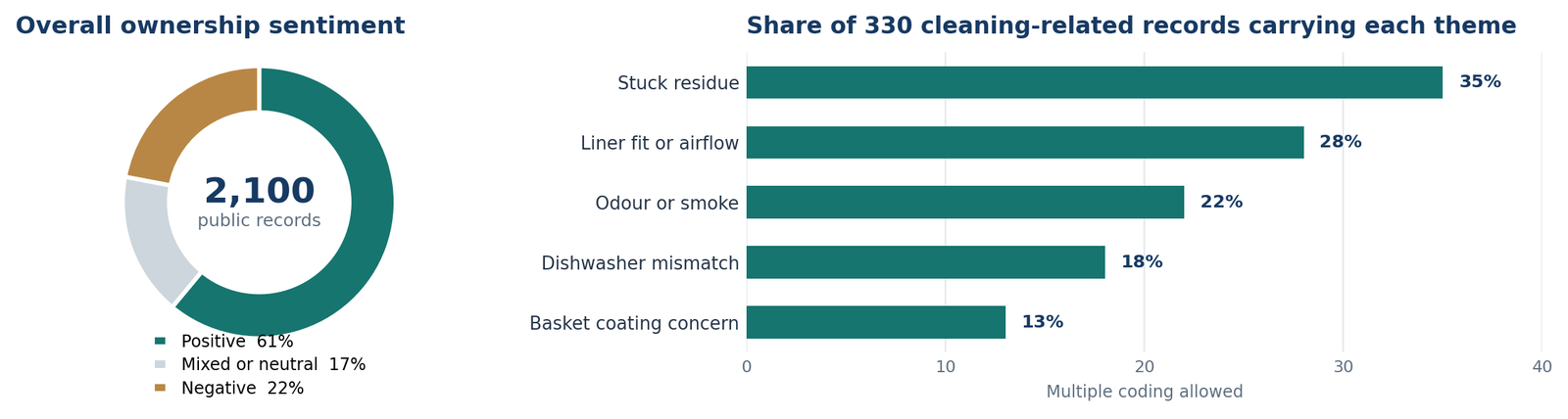
What the public scan changes
Owners can recommend the appliance while still changing use because of cleaning effort.
A liner may reduce cleanup but change airflow, capacity or browning.
Residue that returns in the same basket area can create avoidance beyond one meal.
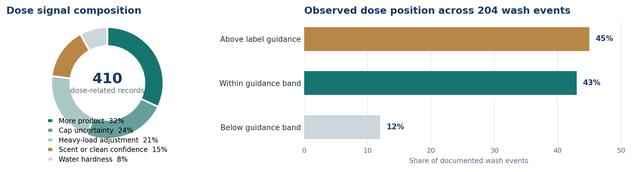
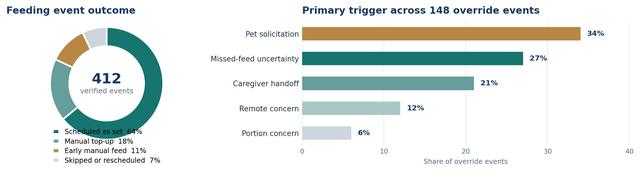
ILLUSTRATIVE FINDINGS | HOUSEHOLD LOOPS
The easiest cleanup is not always the best cooking outcome
The primary evidence connects cleaning effort, cooking trade-offs and the delay before the appliance returns to use.
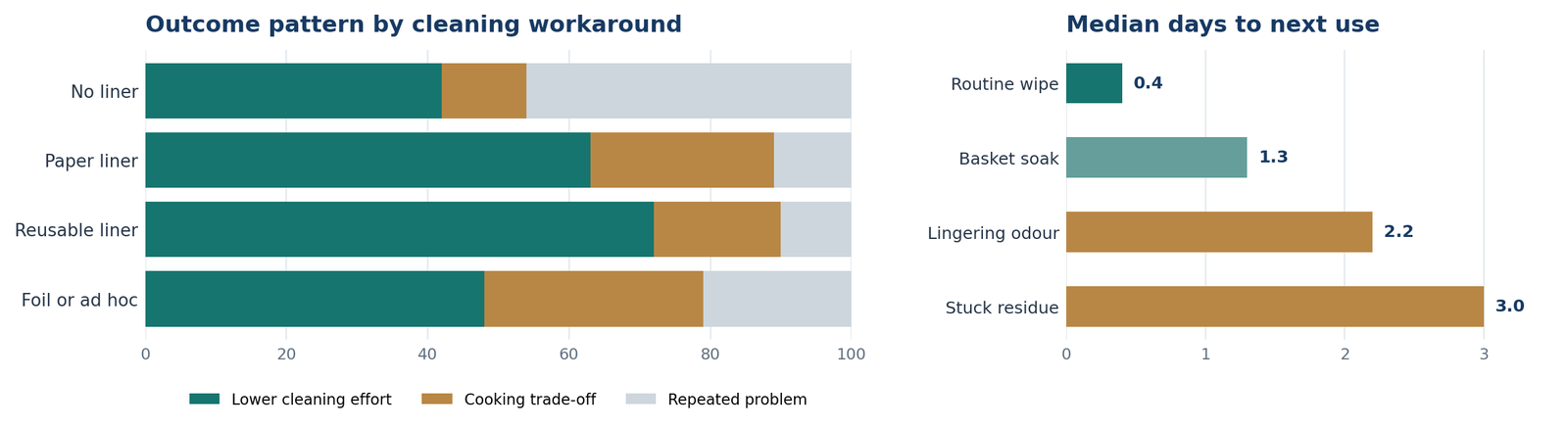
Decision conclusion
The evidence would support a layered guidance system rather than a universal liner recommendation. The client could distinguish low-residue meals suited to quick wiping, higher-residue occasions requiring a planned soak and liner situations where airflow or capacity trade-offs need to be stated clearly.
Priority opportunities
FOOD-BASED GUIDANCE
Cleaning method linked to meal type
LINER FIT
Clear compatible use and airflow boundary
RESIDUE ACCESS
Basket areas that repeatedly resist cleaning
RETURN TO USE
Make readiness for the next meal visible
DELIVERY AND DECISION USE
A behaviour brief for product, content and accessory teams
The output separates what owners like from the workarounds that change use.
Client outputs
PUBLIC SIGNAL DATABASE
Coded reviews and comments with platform, appliance and behaviour context
USE-CLEAN-RETURN DATASET
Event-level file linking food, workaround, cleaning action and next use
WORKAROUND OUTCOME MAP
Benefits and trade-offs for liner and cleaning approaches
GUIDANCE ARCHITECTURE
Food, liner and cleaning situations requiring different instructions
PRODUCT OPPORTUNITY BRIEF
Basket access, coating, accessory and interface implications
DECISION WORKSHOP
PowerPoint readout for product, marketing, safety and service teams
Indicative delivery path
WEEK 1
Feasibility, source frame and recruitment
WEEKS 2 TO 3
Public scan and household diary
WEEK 4
Closing walkthroughs and loop analysis
WEEK 5
Guidance and product workshop
Contact Us
Discuss your consumer behaviour question
Tell us the behaviour, consumer group, setting, markets, available evidence and business decision. August Research will design the public-signal scan, kitchen diary, walkthroughs and use-clean-return view around the conditions that matter.