CONSUMER BEHAVIOUR ANALYSIS | ILLUSTRATION 01
Why weekend families bypass upper-floor specialty stores
A mixed-method study combining a feasible public review and comment scan with in-mall fieldwork to identify where family routes break and which changes are worth testing.
SETTING
Regional multi-level shopping mall
BEHAVIOUR
Upper-floor route and store entry
EVIDENCE
Public signals plus observed visits
DECISION
Where to pilot an intervention
Background
A regional shopping mall generated strong weekend family footfall around dining, entertainment and essential retail. Upper-floor specialty tenants, however, reported limited exposure and low store entry even when visitors remained in the centre for several hours.
The operator needed to understand whether the problem came from vertical access, weak awareness, group coordination, child-related friction, unclear store relevance or a lack of connection between upper-floor tenants and the family's main destination.
The decision to support
WHERE THE ROUTE BREAKS
Identify the moments when families choose not to move upward or not to cross a store threshold
WHICH CONTEXTS MATTER
Separate planned visits, mixed missions and browsing across catchment distance and family composition
WHAT TO TEST FIRST
Prioritise a small set of changes that connect upper-floor stores to real family routes
Why an independent study adds value
Tenant feedback often reflects the view from individual storefronts, while mall teams see aggregate footfall and sales. Independent fieldwork can follow the complete family route, ask questions without defending an existing layout decision and compare what visitors say with what they actually do.
Illustrative study
All sample sizes, charts, percentages, findings and recommendations in this document are hypothetical. They demonstrate how the engagement could be designed and are not presented as actual client outcomes.
EVIDENCE AND OUTREACH DESIGN
Observe the route, not only the opinion
Public signals locate recurring concerns. Fieldwork then tests when those concerns affect a real visit and how the behaviour changes across visit contexts.
Evidence architecture
PUBLIC SIGNAL SCAN
ACCOMPANIED VISITS
ENTRY AND EXIT INTERCEPTS
Approximately 4,800 public records screened across a selected 36-month source window
36 consented weekend family visits observed from entry to exit
180 verified visitors across entrances, dayparts and visit missions
This illustrative scale assumes adequate public-source volume, two fieldwork weekends and access to four entrances. Final volumes would be confirmed after an initial source-yield and recruitment-incidence check.
Outreach and participant controls
0 to 15, 16 to 30 and 31 to 45 minute travel bands remain visible in recruitment and analysis.
Adult-only, younger-child, older-child and mixed-age groups are screened separately where incidence permits.
Dining or entertainment-led, planned purchase, mixed mission and open browsing visits are balanced across the study.
Fieldwork covers Saturday and Sunday across opening, midday, afternoon and evening blocks at four entrances.
What outreach looks like
1 SITE PLAN
Agree permissions, entrances, observation zones and privacy boundaries
2 RECRUIT
Use pre-recruited families plus on-site screened visitors
3 CONSENT
Explain observation, optional probes and evidence capture before participation
4 TRACE
Record route, pauses, group negotiation and store thresholds
5 RECONSTRUCT
Compare entry intention, observed behaviour and exit explanation
Privacy boundary
The design does not require facial recognition or covert recording. Route evidence is captured against agreed zones and choice points, and personally identifiable information is excluded from the behavioural dataset unless explicitly required and consented.
SCOPE-SPECIFIC METHODOLOGY
Intent-to-Route Trace
A decision method that connects what families planned, what they encountered, how the group negotiated the route and what finally happened.
Six-part research design
1 SIGNAL MAP
Code public records by action, setting, family context, friction and outcome
2 ENTRY SNAPSHOT
Capture visit purpose, planned destinations, time budget and group constraints
3 ROUTE TRACE
Observe vertical movement, pauses, backtracking and threshold decisions
4 MOMENT PROBE
Ask short neutral questions only after a meaningful route choice
5 EXIT REBUILD
Compare intended, observed and remembered journeys before the group leaves
6 DECISION INDEX
Combine incidence, decision impact, addressability and evidence confidence
Sample questions with behavioural context
You mentioned that lunch and a children's activity were the main reasons for today's visit. Which other destinations did the group expect to consider, and on which floors did you think they were located?
The group paused near the escalator and checked the directory before continuing on this floor. What information was missing when you decided whether going upstairs was worthwhile?
One person suggested moving upstairs while the rest continued toward the dining area. How was the final route decided, and whose preference carried the most weight?
You passed several specialty storefronts after reaching the upper floor but did not enter. What made each store feel relevant, uncertain or easy to postpone?
At entry, the group expected to browse beyond the planned destinations. What changed during the visit, and at which point did that wider browsing stop being realistic?
Questions are adapted to the observed event. Interviewers do not assume that moving upstairs or entering a store was the correct choice.
ILLUSTRATIVE FINDINGS | PUBLIC SIGNALS
Large-scale review analysis identifies where to look
The public scan is directional. It reveals repeated behaviour signals and language patterns, while the fieldwork tests whether those patterns affect the route in the selected mall.
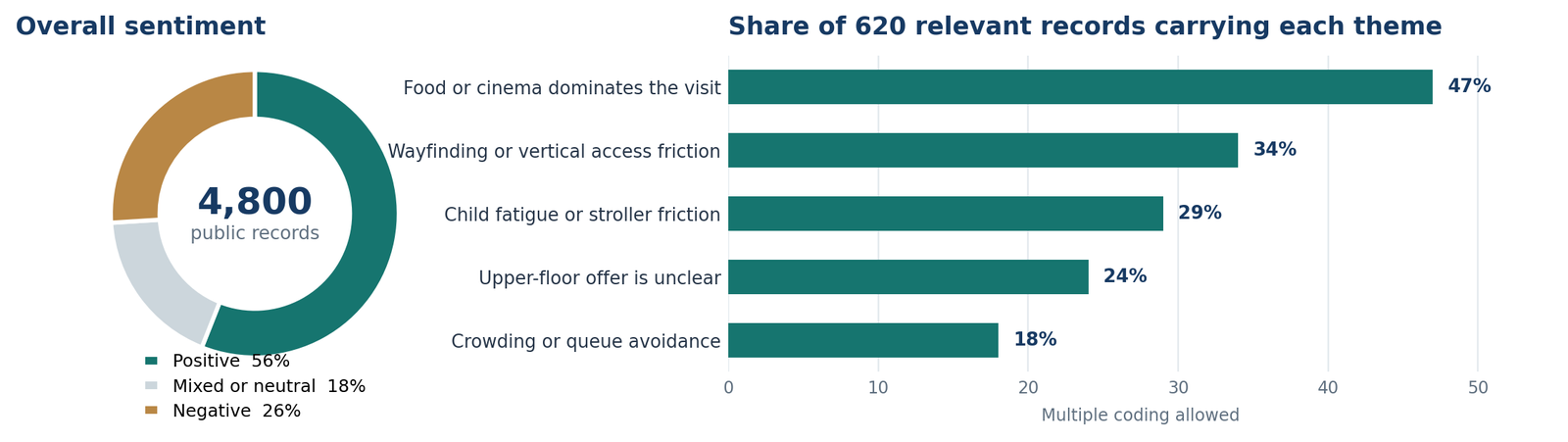
How the 4,800 records are handled
KEEP CONTEXT VISIBLE
SEPARATE RELEVANCE
DO NOT CLAIM PREVALENCE
Platform, date, location, family reference and visit occasion remain attached to each coded record
620 records containing route, floor, family or navigation signals receive deeper behavioural coding
Public records are not treated as a representative survey of every mall visitor
What this changes in the field plan
The review scan suggests that the study should not test signage alone. It should observe how family destinations, vertical movement, fatigue, stroller handling and crowding combine at the same choice point. These signals shape the observation zones and the wording of moment-level probes.
Working hypothesis
Upper-floor avoidance may be less about dissatisfaction with the mall and more about whether the floor offers a clear purpose that fits the family's remaining time and energy.
ILLUSTRATIVE FINDINGS | IN-MALL BEHAVIOUR
The main loss occurs before the store threshold
Observed routes and exit reconstructions show how a family visit moves from general mall entry to a much smaller set of specialty-store opportunities.
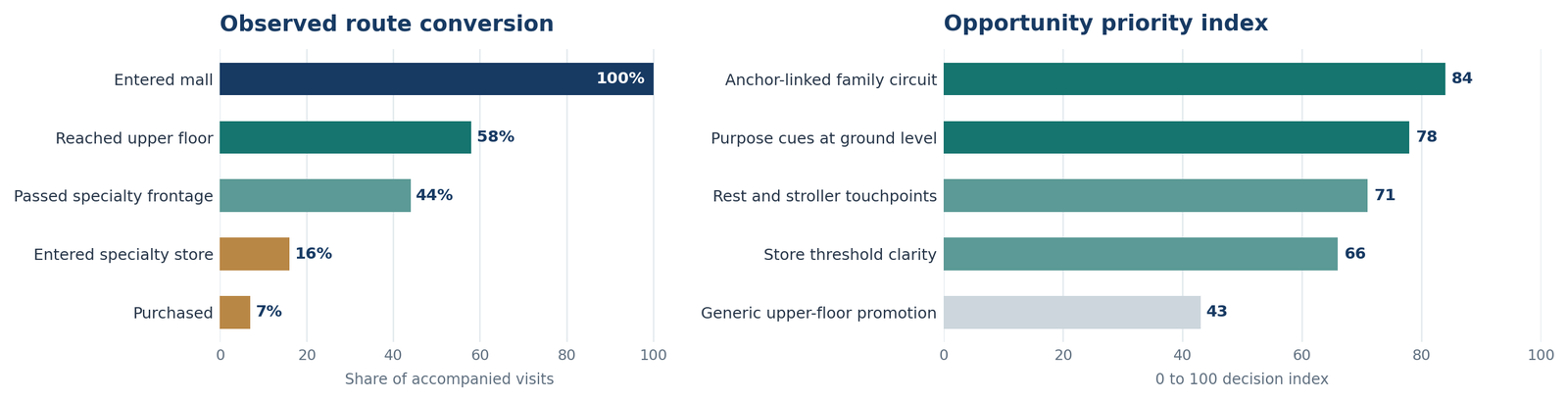
Interpretation
Most families could identify an escalator or lift, but many did not see a reason to add the upper floor to an already full visit.
A single interested shopper rarely redirected the family unless the proposed stop supported the shared mission or required little extra effort.
Reaching the upper floor did not guarantee store entry. Families needed to understand quickly why a specialty store mattered now rather than on a later visit.
Decision conclusion
The evidence would support a focused pilot rather than a mall-wide awareness campaign. The recommended test would create an anchor-linked family circuit between a high-intent destination, the nearest vertical access point and a selected cluster of upper-floor tenants. Ground-floor purpose cues, a family rest point and clearer store thresholds would be tested as one route intervention.
DELIVERY AND DECISION USE
From behaviour evidence to a measurable pilot
The engagement ends with a specific decision package for mall operations, leasing, marketing and participating tenants.
What the client receives
BEHAVIOUR EVIDENCE DATABASE
Excel file containing coded public signals, route events, visit context and evidence tags
FLOOR MOVEMENT VIEW
Zone-level movement, pause, backtrack and store-threshold map for the observed sample
OPPORTUNITY PRIORITY INDEX
Ranked intervention options with incidence, impact, addressability and confidence components
PILOT DESIGN
Test zones, participating tenants, visitor conditions, success measures and comparison logic
DECISION BRIEFING
PowerPoint briefing connecting the behaviour pattern to leasing, operations and marketing decisions
FIELD APPENDIX
Recruitment screen, consent route, observation guide and context-led interview questions
Pilot measures
UPPER-FLOOR REACH
Share of eligible family routes reaching the pilot zone
THRESHOLD ENTRY
Share passing the frontage who enter a participating store
GROUP ABANDONMENT
Routes reversed or shortened after a group constraint emerges
ROUTE COMPLETION
Share completing the linked circuit without missing the main destination
Indicative delivery path
WEEK 1
Scope, permissions and public-data frame
WEEKS 2 TO 3
Signal coding, recruitment and site preparation
WEEKS 4 TO 5
Weekend fieldwork and evidence alignment
WEEK 6
Decision workshop and pilot brief
Timeline is illustrative and depends on site permissions, participant incidence, fieldwork access and the number of comparison zones.
Contact Us
Discuss your consumer behaviour question
Tell us the behaviour, consumer group, physical or digital setting, markets, available evidence and business decision. August Research will design the public-signal scan, participant route, fieldwork and decision view around the conditions that matter.