CONSUMER BEHAVIOUR ANALYSIS | ILLUSTRATION 05
When commuters switch, pause or remove noise-cancelling headphones
A commute-triggered study mapping how safety, announcements, conversation, discomfort and task changes affect listening mode.
SETTING
Door-to-door commute
BEHAVIOUR
Mode switch or removal
PRIMARY ROUTE
Triggered pulses and route diary
DECISION
Context controls and profiles
Background
A headphone brand offered cancellation, transparency and manual pause controls. Commuters used all three, but the product team did not know which environments caused switching, when users removed the device instead of changing mode, or where automatic context profiles would be helpful rather than intrusive.
The study needed to observe the complete commute because the same user could seek isolation on a train, awareness at an interchange and conversation at arrival within one journey.
Decision boundaries
DO NOT MAXIMISE CANCELLATION
The goal is appropriate control for each environment
KEEP SAFETY CONTEXT
Road crossings and platform events remain separate from general walking
RESPECT USER CONTROL
Automation concepts retain a clear manual override
Illustrative study
All figures and findings are hypothetical. The proposed scale reflects six commute days per participant and limits accompanied observation to a small, consented subsample.
PARTICIPANT AND OUTREACH DESIGN
Build the sample around route environments
Travel mode, interchange complexity and commute duration determine which switching opportunities a participant actually encounters.
Feasible field frame
PARTICIPANTS
DIARY WINDOW
COMPLETE LEGS
OBSERVATIONS
28 verified regular commuters
Six normal commute days
286 valid journey legs after exclusions
11 accompanied journey segments
Final journey volume depends on work pattern, commute frequency, participant burden and route access. The diary pauses on atypical travel days rather than forcing completion.
Outreach parameters
TRAVEL MODE
Rail or metro, bus, walking and mixed-mode routes
ROUTE COMPLEXITY
Direct journeys and routes with one or more interchanges
COMMUTE LENGTH
Short, medium and longer regular journeys
DEVICE FORMAT
Over-ear, on-ear and in-ear noise-cancelling devices
CONTROL EXPERIENCE
Manual switchers and users of automatic or adaptive modes
ENVIRONMENT
Selected quieter, moderate and high-intensity urban routes
Privacy and safety
Prompts are participant-initiated at predefined safe points. The design does not require continuous location tracking, and no question is delivered while the participant is crossing a road, boarding or managing another safety-critical task.
SCOPE-SPECIFIC METHODOLOGY
Mode Switch Moment Map
The method treats each environment transition as a possible mode decision and records the trigger close to the moment.
Journey capture
1 ROUTE SETUP
Define normal legs and safe pulse points
2 START STATE
Record initial mode and listening task
3 SWITCH PULSE
Log environment, trigger and new mode
4 ARRIVAL REPLAY
Review missed or ambiguous switches
5 ROUTE MAP
Compare mode patterns across environments
Questions with commute context
You changed from cancellation to transparency two minutes before the crossing. What changed in the environment, and what did you need to hear?
At the interchange you removed one earcup rather than using transparency. What made removal feel more reliable at that moment?
Cancellation remained on throughout the train segment. Which sounds were you trying to reduce, and which still needed to remain noticeable?
The diary shows removal after 34 minutes even though the environment stayed noisy. What changed physically or mentally?
If the device recognised this location next time, what could it change automatically and what should always remain under your control?
Prompts refer to a logged transition. They do not imply that cancellation, transparency or removal was the preferred response.
ILLUSTRATIVE FINDINGS
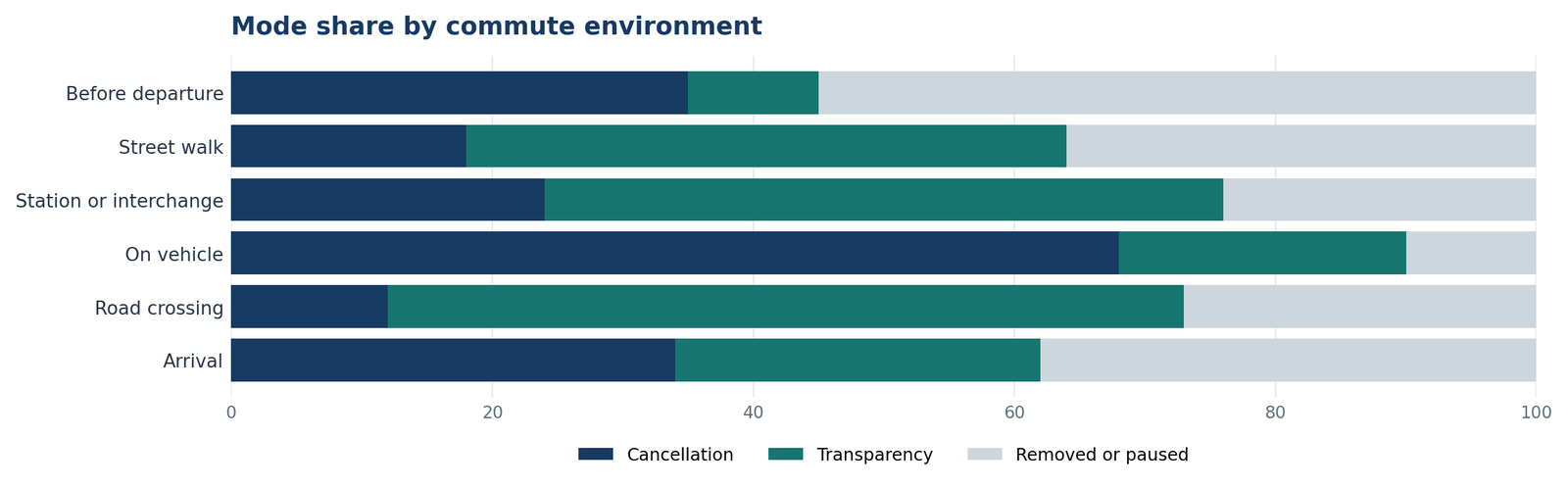
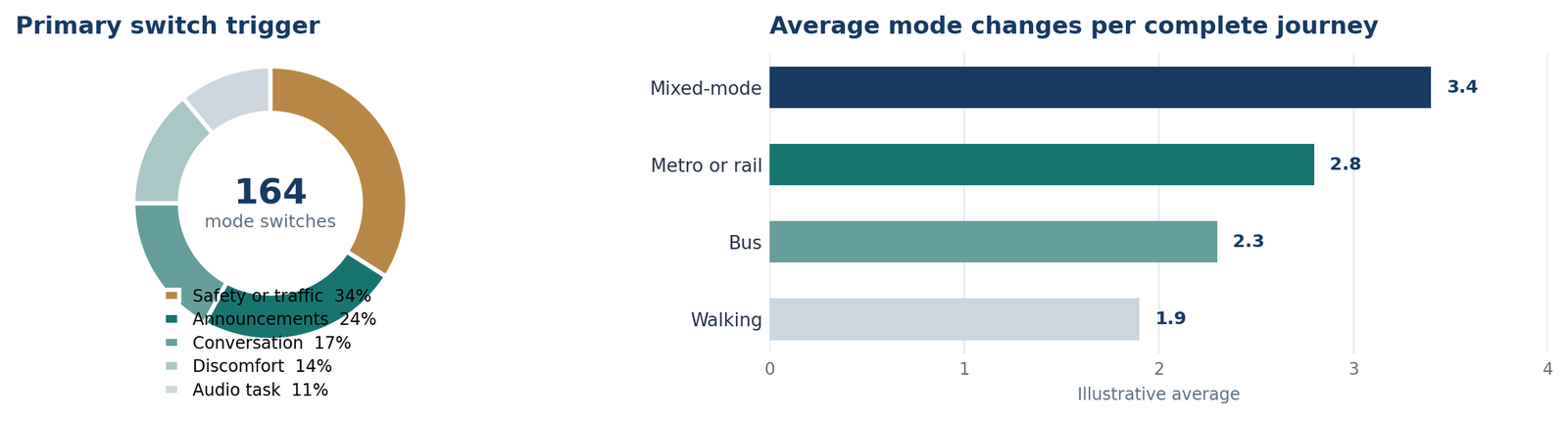
Mode choice follows the environment, not one fixed preference
Cancellation dominates stable vehicle travel, while transparency and removal rise where awareness, conversation or comfort becomes more important.
Decision conclusion
The evidence would support route-aware profiles only where the context is stable and predictable. Vehicle segments could support a remembered cancellation preference, while crossings, announcements and conversations require faster transparency access and a visible manual override.
PRODUCT DECISION PACKAGE
Design for switching confidence
The engagement translates commute evidence into control, interface and profile decisions.
Client outputs
JOURNEY-STATE DATABASE
Environment, listening task, starting mode, trigger and resulting action
ENVIRONMENT-BY-MODE MAP
Mode shares and switching conditions across route stages
CONTROL FRICTION VIEW
Where users remove the device because switching feels slow or uncertain
PROFILE OPPORTUNITY BRIEF
Contexts suitable for remembered, suggested or automatic settings
SAFETY BOUNDARIES
Situations where manual awareness control must remain prominent
DECISION WORKSHOP
PowerPoint readout for product, UX, audio and safety teams
Indicative delivery
WEEK 1
Route screen and pulse setup
WEEKS 2 TO 3
Commute diary and selected observations
WEEK 4
Switch map and profile logic
WEEK 5
Product and UX workshop
Contact Us
Discuss your consumer behaviour question
Tell us the behaviour, consumer group, setting, markets, available evidence and business decision. August Research will design the route screening, triggered diary, observation and mode-switch decision view around the conditions that matter.