CONSUMER BEHAVIOUR ANALYSIS | ILLUSTRATION 03
Why owners override a smart pet feeder
An in-home event study examining when scheduled feeding loses credibility and how pets, alerts and caregiver handoffs change the final action.
SETTING
Existing smart-feeder households
BEHAVIOUR
Manual override or schedule change
EVIDENCE
Feeder logs and event capture
DECISION
Trust and caregiver controls
The household problem
A smart pet feeder brand found that owners valued scheduled feeding but still added food manually, fed early or changed the schedule when the pet appeared hungry, an alert was unclear or another caregiver could not confirm what had happened.
The product team needed to separate necessary intervention from avoidable uncertainty. Removing manual control was not an option because owners still needed to respond to real changes in pet health, routine or care responsibility.
The event to reconstruct
SCHEDULE
What the feeder was expected to do
SIGNAL
What the owner, pet or app communicated
INTERPRETATION
What the caregiver believed had happened
ACTION
Top-up, early feed, skip or no change
Illustrative study
All figures and findings are hypothetical. The proposed scale reflects a two-week capture period in existing-user homes and does not assume new hardware installation.
HOUSEHOLD SYSTEM AND OUTREACH
Recruit the care arrangement, not only the owner
Override behaviour changes when feeding responsibility is shared, routines change or the household cannot verify whether food was dispensed.
Feasible study frame
16 HOUSEHOLDS
Existing feeder users verified during screening
14 DAYS
Event capture aligned with normal household routines
412 EVENTS
Verified scheduled feeding events after exclusions
34 REPLAYS
Selected override events explored in depth
Final event volume depends on feeder schedule, log access, pet routine and household completion. Recruitment would stop if the study burden disrupted normal feeding.
Household comparison groups
ONE CAREGIVER
One person owns the schedule and usually responds to alerts
ALIGNED CAREGIVERS
Two or more caregivers follow the same feeding rule
HANDOFF GAPS
Responsibility changes by day, shift or household availability
PET CONTEXT
Cat or dog, single or multiple pets, stable or changing routine
USE MATURITY
Recent adopter, established user or recent schedule change
ALERT CONTEXT
Normal operation, connectivity issue, low food or uncertain dispense
Data boundary
The study uses only consented feeder logs and participant-submitted evidence. It does not require continuous home video, audio monitoring or observation of private household activity outside feeding events.
SCOPE-SPECIFIC METHODOLOGY
Override Event Replay
The study waits for a meaningful feeding event, then reconstructs what each caregiver knew, believed and did.
Four evidence layers
DEVICE RECORD
Scheduled time, dispense status, alert and later manual action
OWNER CAPTURE
Short mobile note on what prompted concern and what action followed
CAREGIVER COMPARISON
Separate account from another caregiver when responsibility was shared
INCIDENT REPLAY
Interview selected events while the household can still reconstruct the sequence
Questions anchored to an override
At 18:12 the feeder dispensed as scheduled, and a manual top-up followed nine minutes later. What did the pet do that made the scheduled portion feel insufficient?
The app showed a completed feed but you checked the bowl before deciding. What information did the status confirm, and what remained uncertain?
Another caregiver believed the evening feed had not happened. What had each person seen, and where did the handoff break down?
If the same event happened tomorrow, what evidence would make you trust the schedule, intervene earlier or wait longer?
Questions distinguish pet-care judgement from interface uncertainty. A manual override is not automatically classified as an error.
ILLUSTRATIVE FINDINGS
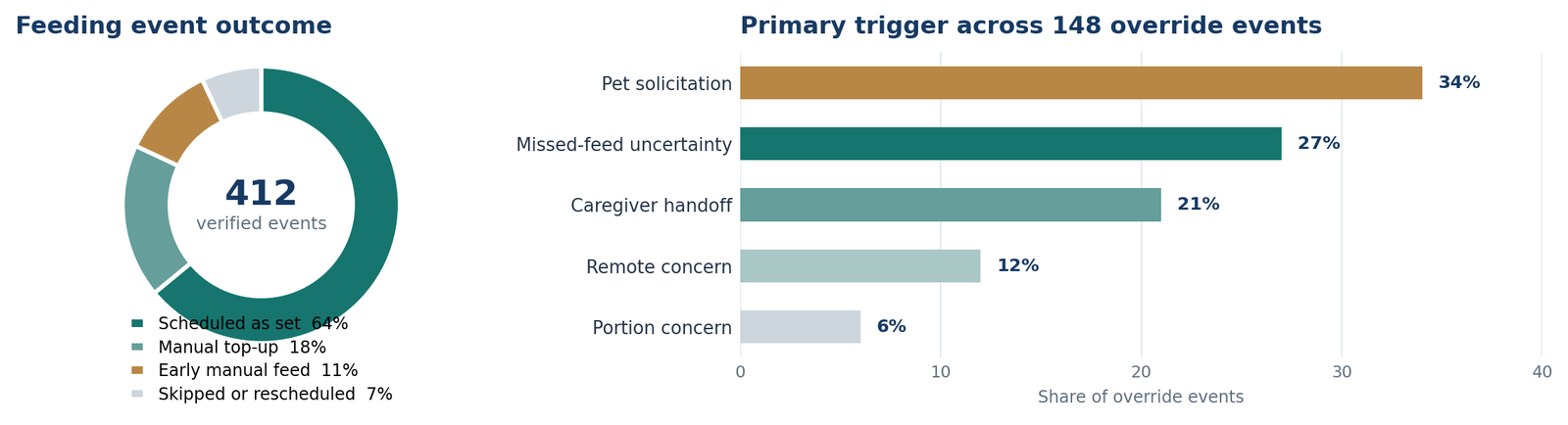
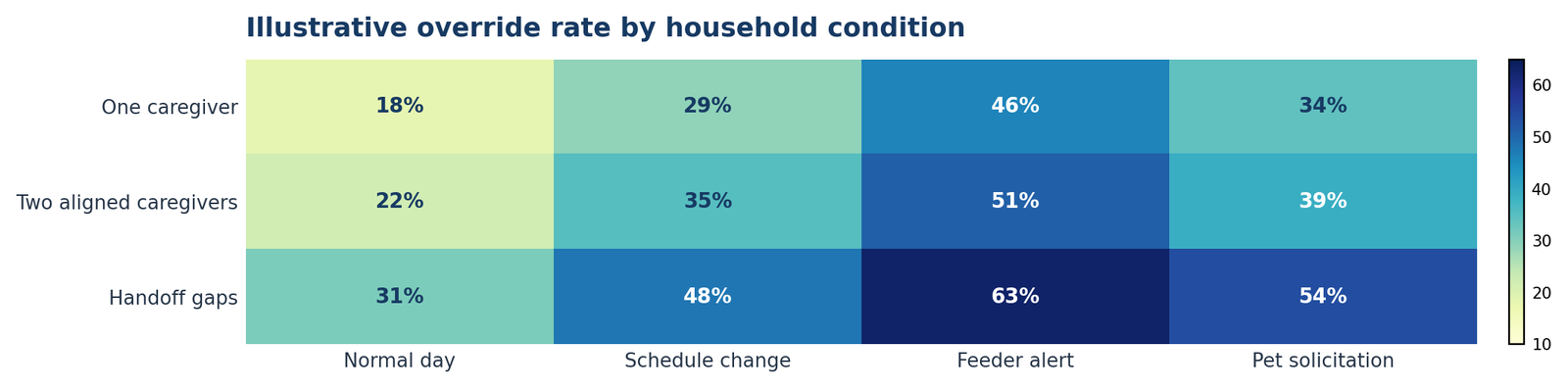
Overrides concentrate where confidence and responsibility overlap
Most scheduled events proceed unchanged, but alerts, pet solicitation and caregiver handoffs create different forms of intervention.
Decision conclusion
The evidence would support clearer dispense confirmation and shared-caregiver visibility rather than stronger automation alone. The highest-priority concept would show what was dispensed, which caregiver last intervened and whether a manual action changed the next scheduled feed.
PRODUCT DECISION PACKAGE
Design for accountable flexibility
The final output helps product, app and customer-support teams distinguish a trusted override from an avoidable one.
Client outputs
EVENT-LEVEL DATABASE
Feeder record, owner signal, caregiver interpretation and final action
TRUST AND OVERRIDE MAP
Conditions under which households wait, verify, top up or reschedule
CAREGIVER HANDOFF MODEL
Information required when feeding responsibility changes
CONCEPT TEST BRIEF
Status, confirmation and shared-care concepts to evaluate
SUPPORT LANGUAGE
Incident categories and questions for customer-support diagnosis
DECISION BRIEFING
PowerPoint readout connecting household evidence to product priorities
Indicative delivery
SETUP
Recruit, verify devices and test consented log capture
TWO-WEEK CAPTURE
Collect events and replay selected overrides
SYNTHESIS
Trust map, concept implications and product workshop
Contact Us
Discuss your consumer behaviour question
Tell us the behaviour, consumer group, setting, markets, available evidence and business decision. August Research will design the event capture, caregiver comparison and override decision view around the conditions that matter.